

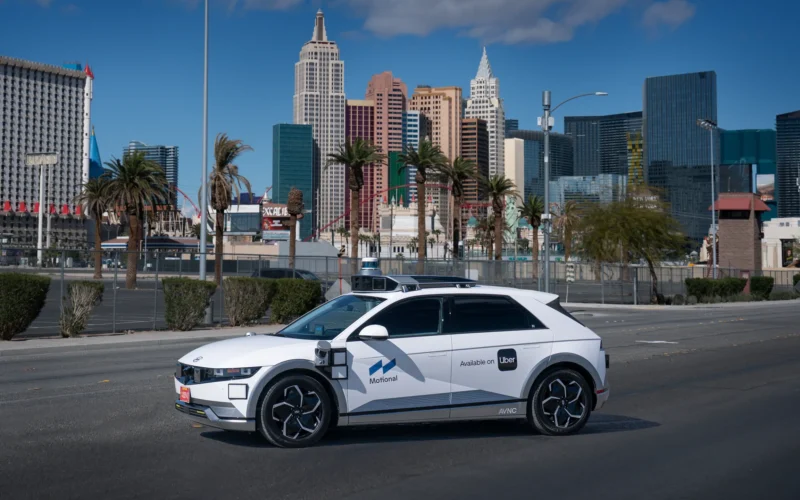
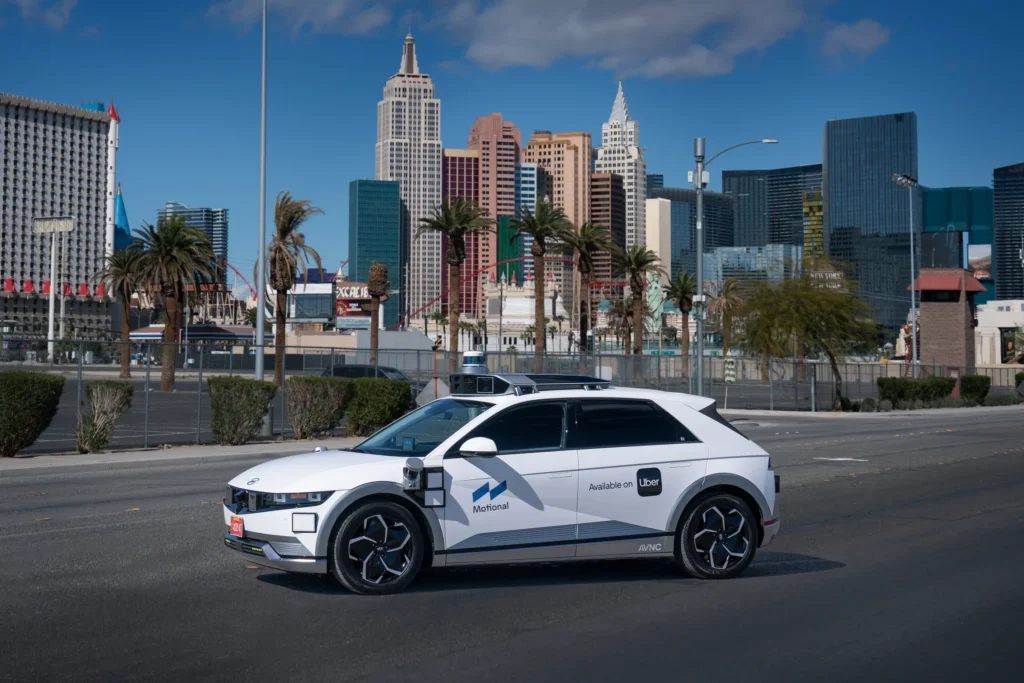
Uber Technologies, Inc. (NYSE: UBER) and Motional, the autonomous vehicle company majority-owned by Hyundai Motor Group, have launched a commercial robotaxi service in Las Vegas, making all-electric Motional IONIQ 5 vehicles available to riders through the Uber app at no additional cost. The service activates across designated zones along Las Vegas Boulevard, at hotel-casino rideshare zones including Resorts World Las Vegas and Encore at the Wynn Las Vegas, as well as Downtown Las Vegas and the Town Square shopping district near the airport. The launch represents a meaningful moment for both companies: Motional is executing its commercial reboot after a period of significant restructuring, while Uber advances its rapidly expanding strategy of positioning itself as the neutral aggregator platform for autonomous vehicle operators worldwide. For Uber Technologies, whose shares trade near $74 to $76 on the New York Stock Exchange, significantly below the 52-week high of $101.99 reached in September 2025, the accumulation of operational AV partnerships has become central to the investment thesis the company is presenting to a sceptical market.
Why did Uber and Motional choose Las Vegas to relaunch their robotaxi partnership after Motional’s major restructuring?
Las Vegas is not an accidental choice. The city combines a high density of ride-hailing demand, a well-mapped urban grid, favorable weather conditions, and a regulatory environment that has actively encouraged autonomous vehicle testing and deployment. For Motional, which has conducted over 130,000 autonomous rides through its pilot programs, returning to Las Vegas with a full commercial service marks the conclusion of a difficult two-year reset. The company had previously operated a ride-hailing pilot with Uber in Las Vegas in late 2022 following an Uber Eats delivery pilot in Los Angeles, but operational and financial pressures forced a fundamental rethink of its technology architecture and business model.
The restructuring was substantial. Aptiv, which co-founded Motional as a joint venture with Hyundai Motor Group in 2020, exited the funding arrangement, leaving Hyundai to decide whether to sustain the venture or absorb the write-down. Hyundai committed approximately $1 billion in additional capital, Motional subsequently cut around 40 percent of its workforce, and the engineering team pivoted its autonomous driving stack toward a neural network-first approach that mirrors the direction taken by Waymo and other leaders in the sector. The decision to embrace AI-driven perception and decision-making at the core of the system, rather than rules-based architectures, reflects the broader industry consensus that has emerged over the past two years. Motional’s president has described the previous system as safe but insufficiently scalable and generalisable to achieve the unit economics required for commercial viability.
Against that backdrop, the Las Vegas launch carries real symbolic and operational weight. Motional needs to demonstrate that its rebuilt autonomous driving system performs reliably in a commercial environment, that its partnership with Uber remains productive, and that it can move credibly toward fully driverless operations. The IONIQ 5 robotaxi is one of the first SAE Level 4-capable autonomous vehicles to be certified under the United States Federal Motor Vehicle Safety Standards, which provides a meaningful regulatory baseline. Initially, each vehicle will operate with a safety monitor behind the wheel. Motional has indicated it expects to remove the safety operator and transition to fully driverless service by the end of 2025, though execution against that timeline will be watched closely.
How does the Motional Las Vegas launch fit within Uber’s broader autonomous vehicle platform strategy announced in early 2026?
The Motional launch is one move in what has become a rapidly accelerating set of announcements from Uber Technologies in the autonomous vehicle space. Just days before the Las Vegas service went live, Uber unveiled Uber Autonomous Solutions, a formal business division that codifies what the company describes as its “hard-won competencies” in on-demand mobility into a suite of services it now sells to AV technology partners. The offering encompasses demand generation, in-vehicle rider experience software, customer support operations, and fleet management capabilities. The strategic logic is explicit: Uber is positioning itself as the commercial infrastructure layer that AV technology companies need to reach scale, without Uber itself needing to develop the core autonomous driving stack.
The list of partners operating under this model has grown to nearly two dozen companies spanning robotaxis, autonomous trucking, sidewalk delivery robots, and drones. In Las Vegas alone, Amazon-owned Zoox has separately announced plans to offer rides through the Uber app later this year. Waymo, the Alphabet subsidiary that is widely regarded as the sector’s most advanced commercial operator, runs shared robotaxi services in Atlanta and Austin through the Uber platform. A Lucid-Nuro robotaxi developed exclusively for deployment on the Uber network is in on-road testing in the San Francisco Bay Area, with a commercial launch expected later in 2026 and plans to scale to 20,000 or more vehicles across dozens of markets over six years.
Uber and Wayve, backed by a memorandum of understanding signed alongside Nissan, are targeting a Tokyo pilot by late 2026. Volkswagen is planning a Los Angeles robotaxi service with Uber, though fully driverless operation there is not expected until 2027.
This aggregator model is a deliberate response to the competitive dynamic that has unnerved investors since Waymo began its aggressive expansion. Rather than viewing AV proliferation as an existential threat to its human-driver network, Uber Technologies is attempting to make itself indispensable to every major autonomous vehicle operator that lacks the consumer distribution, brand trust, and operational depth to reach the public directly. Uber Autonomous Solutions effectively externalises the capabilities that took years and billions of dollars to build, and turns them into a revenue stream from the very companies that might otherwise disrupt the legacy ride-hailing business.
What are the operational risks and competitive pressures Motional must navigate as it scales the Las Vegas service toward fully driverless operations?
Motional’s technology reboot reduced headcount and rewrote core architectural assumptions. That kind of transition carries inherent execution risk: neural network-first systems require enormous volumes of training data, careful validation across edge cases, and consistent real-world performance before a company can responsibly remove human safety operators. The Las Vegas operating geography, while relatively structured by Las Vegas Boulevard corridor standards, will still present challenging scenarios involving pedestrians, intoxicated individuals, non-standard road behaviour near casino entrances, and the kind of irregular traffic patterns that accompany major events at venues like the Las Vegas Convention Center. Motional’s assertion that it can reach fully driverless operations by the end of this year is an ambitious target that the company will need to substantiate through demonstrated system performance, not just executive communications.
The competitive backdrop is also demanding. Waymo is the benchmark against which every other AV operator is now measured, and it has accumulated several years of commercial driverless experience across San Francisco, Phoenix, and its expanding multi-city footprint. Tesla’s Full Self-Driving technology, which the company has transitioned to a subscription model, represents a different kind of competitive pressure at the consumer awareness level, even if the product remains at a materially lower autonomy level. Meanwhile, Chinese operators including Baidu’s Apollo Go are pursuing Western market partnerships aggressively, as are domestically-focused players including Pony.ai and WeRide, both of which have arrangements with Uber. The field has become crowded precisely at the moment when Motional is trying to re-establish its commercial credibility.
For Motional, the financial structure of the venture also warrants scrutiny. With Aptiv’s exit and Hyundai carrying the capital burden, the company is now a wholly-owned subsidiary of one of the world’s largest vehicle manufacturers. That provides balance sheet support and a natural vehicle supply chain advantage through the IONIQ 5 platform. But it also means Motional’s commercialisation timeline is ultimately subject to Hyundai Motor Group’s capital allocation priorities, strategic patience, and appetite for continued investment in a business that has consumed substantial resources before generating meaningful commercial revenue. The 10-year framework agreement with Uber Technologies, signed in 2022, provides a degree of commercial stability, but the terms of economics, volume commitments, and expansion sequencing remain confidential.
How are investors and analysts reading Uber Technologies’ autonomous vehicle accumulation strategy amid a stock that trades well below its 52-week peak?
Uber Technologies shares have had a difficult several months. From a 52-week high of $101.99 in September 2025, the stock has declined to the $74 to $76 range, reflecting a combination of macro headwinds, geopolitical uncertainty following the Iran conflict that has pushed oil prices and risk sentiment in unfavourable directions, and a broader investor debate about whether Uber’s platform model provides genuine protection against AV disruption or whether it is a transitional arrangement that erodes as AV operators gain sufficient scale to build direct consumer relationships. The 52-week low of $60.63, hit in April 2025, at least establishes a floor, and the stock has recovered meaningfully from that trough.
The analyst consensus remains constructive. A consensus of 34 analysts carries a strong buy rating on Uber Technologies shares, with an average 12-month price target of approximately $106, implying more than 40 percent upside from current levels. The bull case rests on the platform aggregator argument: that Uber Technologies captures a share of every autonomous mile driven by any of its two dozen-plus AV partners, while simultaneously retaining its human-driver network as a high-availability complement to autonomous fleets that cannot yet handle all ride categories, geographies, or demand scenarios. The bear case is that take rates from AV rides may compress over time as AV operators gain leverage, and that Waymo in particular may ultimately decide that direct consumer relationships are more strategically valuable than Uber’s distribution.
The Motional Las Vegas launch, and the broader Uber Autonomous Solutions announcement made earlier this month, represent Uber Technologies management’s most explicit attempt yet to change the terms of that debate. By formalising the commercialisation services Uber offers to AV partners, and by publicly listing the scale of its partner network and geographic expansion plans, Uber Technologies is arguing that the platform is not merely a transitional distribution channel but a durable commercial infrastructure that compounds in value as more AV operators reach deployment stage. Whether the market ultimately accepts that framing at a valuation consistent with analyst targets will depend on execution across a set of partnerships that range from early-stage memoranda of understanding in Tokyo to actively scaling commercial services in Atlanta, Austin, and now Las Vegas.
Key takeaways: What the Uber-Motional Las Vegas robotaxi launch means for investors, competitors, and the autonomous vehicle industry in 2026
- Uber Technologies and Motional have activated a commercial robotaxi service in Las Vegas, marking a significant step in Motional’s recovery after a deep restructuring that included 40 percent workforce reductions and a full architectural pivot to AI-first autonomous driving.
- The IONIQ 5 robotaxi is one of the first SAE Level 4-capable vehicles certified under US Federal Motor Vehicle Safety Standards. Initial operations include a safety monitor, with fully driverless service targeted by year-end 2026, subject to system validation.
- Uber Technologies’ aggregator model is accelerating: the company now has nearly two dozen AV partners spanning robotaxis, trucking, delivery robots, and drones, with Uber Autonomous Solutions formalising the commercial services it offers to help operators scale.
- Las Vegas is simultaneously hosting Motional (live), Waymo (via Uber), and soon Amazon-owned Zoox (also via Uber), making the city the most concentrated commercial AV market outside San Francisco and Phoenix.
- Uber Technologies shares trade near $74 to $76, roughly 27 percent below the September 2025 peak of $101.99, while 34 analysts maintain a strong buy consensus with an average 12-month price target near $106.
- Motional’s full commercial dependence on Hyundai Motor Group’s capital, following Aptiv’s exit, concentrates financial risk and links its expansion timeline to a single automotive parent’s strategic priorities.
- The competitive environment is demanding: Waymo, Tesla, Baidu Apollo Go, Pony.ai, WeRide, and multiple domestic US players are all scaling simultaneously, making Motional’s window for differentiation and commercial momentum relatively narrow.
- Uber Technologies’ long-term thesis rests on capturing a durable share of every AV mile across its partner network, but take rate compression and the potential for major AV operators to bypass third-party distribution remain credible risk vectors.
- The Lucid-Nuro-Uber robotaxi, targeting the San Francisco Bay Area later in 2026 with a fleet target of 20,000 vehicles, and the Wayve-Nissan-Uber Tokyo pilot, together suggest Uber’s AV platform is building toward meaningful scale rather than remaining a showcase of early partnerships.
- For Hyundai Motor Group, the success of Motional’s Las Vegas commercial service is a critical data point for its autonomous vehicle investment thesis and for the longer-term value of the Hyundai-IONIQ brand in a market where electric vehicle and AV credentials are increasingly intertwined.
Discover more from Business-News-Today.com
Subscribe to get the latest posts sent to your email.