



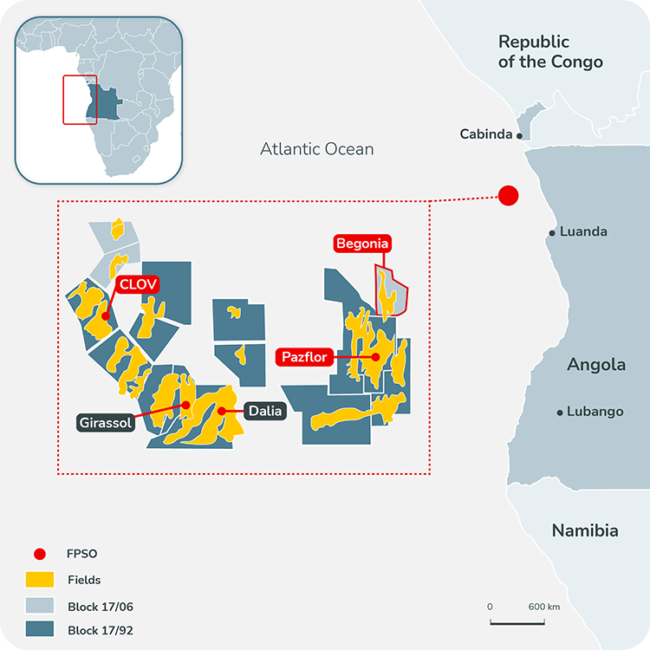
TotalEnergies SE (Ticker: TTE) has started production from its BEGONIA and CLOV Phase 3 offshore projects in Angola, delivering an additional 60,000 barrels per day (bpd) of oil. Both developments are subsea tie-backs to existing floating production, storage and offloading (FPSO) units, optimizing available capacity on the PAZFLOR and CLOV FPSOs to ensure low-cost, low-emission output. The French energy major described these projects as integral to its 2025 upstream strategy, which targets a production growth of over 3 percent while maintaining a disciplined capital structure.
The announcement comes at a crucial time for Angola, whose oil production has been declining for more than a decade. From a peak of nearly 2 million bpd in 2008, national output has hovered closer to 1.1 million bpd in recent years due to mature field declines. Angola’s regulator, the National Agency for Petroleum, Gas and Biofuels (ANPG), has been pushing for new developments and enhanced recovery initiatives, and TotalEnergies’ tie-back approach is seen as a model for extending the life of existing offshore blocks.

What are the full technical details of BEGONIA and CLOV phase 3 and how do they expand TotalEnergies’ Angola footprint?
The BEGONIA project, located approximately 150 kilometers offshore in Block 17/06, is Angola’s first inter-block development. It consists of five wells tied back to the PAZFLOR FPSO and is expected to produce 30,000 bpd. TotalEnergies operates the project with a 30 percent stake, alongside Sonangol E&P (30 percent), SSI (27.5 percent), ETU Energias (7.5 percent) and Falcon Oil (5 percent). By reusing PAZFLOR’s ullage capacity, BEGONIA avoids the cost of installing new offshore infrastructure and ensures faster first oil.
The CLOV Phase 3 project, situated around 140 kilometers offshore in Block 17, mirrors this efficiency. Four subsea wells tied to the CLOV FPSO add another 30,000 bpd. TotalEnergies holds a 38 percent stake and operates the development in partnership with Equinor ASA (22.16 percent), Exxon Mobil Corporation (19 percent), Azule Energy (15.84 percent) and Sonangol E&P (5 percent). Both projects are designed to maintain a low carbon intensity per barrel, aligning with TotalEnergies’ energy transition goals.
The projects also strengthen TotalEnergies’ existing footprint in Angola, where the French energy major operates several key blocks, including Blocks 17, 17/06, 32 and 20/11. Together, these fields account for a significant portion of Angola’s offshore production and remain a cornerstone of TotalEnergies’ African portfolio.
Why are institutional investors highlighting these low-cost tie-backs as critical to TotalEnergies’ upstream portfolio?
Institutional investors are viewing BEGONIA and CLOV Phase 3 as prime examples of capital efficiency in a sector facing growing pressure to balance profitability with environmental performance. By using existing FPSOs, TotalEnergies has significantly reduced capital expenditure, shortened project timelines and improved free cash flow generation per barrel. Analysts note that such projects improve return on capital employed (ROCE), a key metric closely monitored by shareholders.
There is also an ESG dimension. By deploying subsea tie-backs instead of greenfield developments, TotalEnergies is producing oil with a lower carbon intensity compared to frontier exploration projects. Institutional sentiment suggests this approach could help TotalEnergies retain access to sustainable financing channels and maintain investor confidence at a time when global energy majors are under increasing scrutiny from ESG-focused funds.
How do BEGONIA and CLOV phase 3 support Angola’s production stability and local content objectives?
Paulino Jerónimo, chairman of ANPG, described the projects as strategically important for maintaining Angola’s production above 1 million bpd. He noted that BEGONIA is the first project to connect two blocks, demonstrating innovative cooperation between concessionaires and reinforcing Angola’s local content goals. The integration of multiple Angolan service providers and workforce participation in BEGONIA sets a precedent for future projects.
The ANPG has emphasized that such developments are key to extending Angola’s resource life without relying solely on new frontier exploration. CLOV Phase 3 also illustrates how efficient collaboration between the regulator and international oil companies can unlock incremental barrels in mature fields, supporting national revenue stability at a time when Angola is diversifying its economy.
What operational and financial characteristics make these projects stand out among TotalEnergies’ global upstream assets?
TotalEnergies has stressed that BEGONIA and CLOV Phase 3 are among its lowest-cost offshore developments. The use of PAZFLOR and CLOV FPSOs not only lowers capital intensity but also cuts development timeframes, allowing faster cash flow generation. Early production start-ups like these are critical for maintaining the French energy giant’s strong dividend program, which is a key attraction for long-term investors.
Operationally, the projects demonstrate TotalEnergies’ capability to extend the economic life of mature fields by exploiting ullage capacity on existing infrastructure. This approach, combined with subsea technology improvements, enables the recovery of additional reserves at a cost per barrel well below the company’s average upstream development benchmarks.
What is the macroeconomic and competitive context for these developments in Angola’s oil sector?
Angola’s upstream sector has been reshaped over the past five years by regulatory reforms aimed at attracting new investment. Revised production-sharing agreements, streamlined approvals and increased incentives for enhanced recovery have created a more favorable environment for international oil companies. TotalEnergies has been one of the biggest beneficiaries, maintaining its position as the country’s leading international operator.
From a regional perspective, Angola is competing with Guyana, Namibia and Mozambique for international capital. Analysts believe that by demonstrating cost-efficient tie-back developments, Angola can maintain its competitiveness and continue to attract reinvestment, especially as global majors focus on quick-payback projects in politically stable jurisdictions.
What future developments are expected from TotalEnergies in Angola and how do these align with its global strategy?
TotalEnergies’ future Angola strategy includes ramping up development in Block 20/11’s Kaminho project, targeting 70,000 bpd by 2028, and continuing infill drilling in Block 32 into late 2025. These developments are expected to build on the tie-back model demonstrated at BEGONIA and CLOV Phase 3, ensuring incremental volumes with minimal carbon intensity.
On a global scale, TotalEnergies is positioning itself as a leader in low-cost oil production while expanding its liquefied natural gas (LNG) and renewable energy portfolios. Institutional analysts expect that Angola will remain a core contributor to TotalEnergies’ upstream cash flow, helping finance its broader energy transition initiatives. With strong cash generation from low-cost barrels, the French energy giant can continue to fund its renewables expansion without significantly increasing debt.
TotalEnergies’ success with BEGONIA and CLOV Phase 3 reinforces its reputation as a disciplined operator capable of balancing profitability, production growth and emissions targets. For Angola, these projects symbolize a step forward in sustaining national output and strengthening its position as one of Sub-Saharan Africa’s most important oil producers.
Discover more from Business-News-Today.com
Subscribe to get the latest posts sent to your email.