

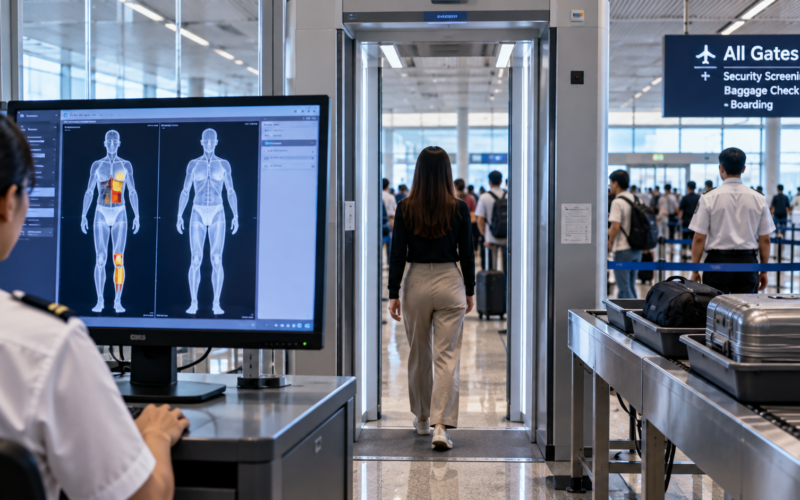
Thruvision Group plc (AIM: THRU) has emerged as one of the more striking examples of why older AIM announcements can become more interesting after investors have had time to digest them. On August 10, the security-screening technology company announced a contract expected to generate more than £3 million of revenue from deployments across major South-East Asian airports. The shares were quoted around 0.85p that day, up 36%, but subsequently reached a new 52-week high above 3p in early September before trading around 2.5p on September 10.
The scale of the contract explains why the announcement deserves more than a brief contract-win rewrite. Thruvision generated only £6 million of revenue in the year ended March 31, 2026, meaning the new Asian award alone is worth more than half the preceding year’s revenue. Delivery is expected during the second half of the financial year ending March 2027.
Why is Thruvision’s £3 million airport contract unusually material for a company of its size?
Thruvision’s partner will deploy multiple high-throughput screening systems across major South-East Asian airports, primarily for aviation-worker screening and insider-threat mitigation. The company described the award as its largest Asian deployment to date and its third Asian contract worth more than £1 million in a 14-month period.
Compared with FY26 revenue of £6 million, the more-than-£3 million order is exceptionally material. Investors often see small-cap companies announce contracts without enough financial detail to determine whether they meaningfully alter forecasts. In this case, the comparison is straightforward: one order represents more than 50% of the previous year’s sales base.
That does not mean all £3 million drops through to profit. Thruvision reported an adjusted gross margin of 33.9% in FY26 and remained loss-making, with an adjusted EBITDA loss of £2.5 million. Gross margins had also declined because of discounting on legacy equipment. The real financial test will therefore be the margin achieved on newer WalkTHRU deployments rather than contract value alone.

Has Thruvision’s subsequent order flow validated the initial share-price reaction?
The August 10 contract was followed by another commercially useful milestone on August 27 when Thruvision secured its first Canadian government customer. A municipal customer ordered an 8108 WalkTHRU solution through a Canadian value-added reseller for screening visitors to council chambers. The order also represented Thruvision’s first deployment in Canada’s entrance-security market rather than the retail-distribution applications that had dominated its existing Canadian presence.
The company simultaneously said it had recently received additional orders from retail-distribution customers in the United Kingdom, Europe and the United States, as well as from a new European government customer. Those smaller orders do not carry the same disclosed financial scale as the South-East Asian airport deployment, but they support the idea that demand is broadening across geographies and use cases.
Thruvision has also been developing a partner-led distribution strategy, which can be important for a small technology company because channel partners reduce the need to build large direct-sales and support teams in every country. The Asian airport contract and Canadian government win both emerged through regional partners, giving investors early evidence that this route-to-market model can produce contracts.
Why did THRU shares keep rising weeks after the original August contract?
Thruvision’s price history is arguably more informative now than it was on August 10. Shares were around 0.85p when the Asian contract was announced, reached approximately 1.3p during the following week and then continued climbing, eventually touching around 3.25p on September 9. By September 10 they were around 2.5p, still several times the pre-contract level.
That sustained rerating suggests investors were not merely reacting to the opening headline. The market appears to have repriced the probability that Thruvision can reach a larger and more repeatable revenue base after several years of losses and uneven order timing.
The caution is valuation volatility. At 2.5p, the company’s market capitalisation was only around £11.7 million, while the bid-offer spread remained relatively wide. Small shifts in sentiment or order timing can therefore produce large percentage moves. Investors should avoid extrapolating a multi-week rally as proof that the operating turnaround is complete.
Can Thruvision convert contract momentum into positive EBITDA and stronger cash generation?
FY26 showed progress but also explains why the equity remains speculative. Revenue increased 45% to £6 million, while the adjusted EBITDA loss narrowed from £3.8 million to £2.5 million. Cash at March 31 stood at £2 million and the group had no debt, following a £2.75 million equity financing completed in July 2025.
If the Asian contract delivers more than £3 million during the second half of FY27 as scheduled, it provides a meaningful contribution toward the revenue scale needed to absorb Thruvision’s operating-cost base. However, investors need evidence that new contracts come with healthier margins than the discounted legacy-system sales that hurt FY26 profitability.
The strongest signal would be a combination of rising revenue, improved gross margin and further large orders without another immediate requirement for equity financing. Thruvision’s share-price recovery shows investors increasingly believe that outcome is possible. The next financial results will determine whether the operating numbers justify a rerating that has already been substantial.
Discover more from Business-News-Today.com
Subscribe to get the latest posts sent to your email.