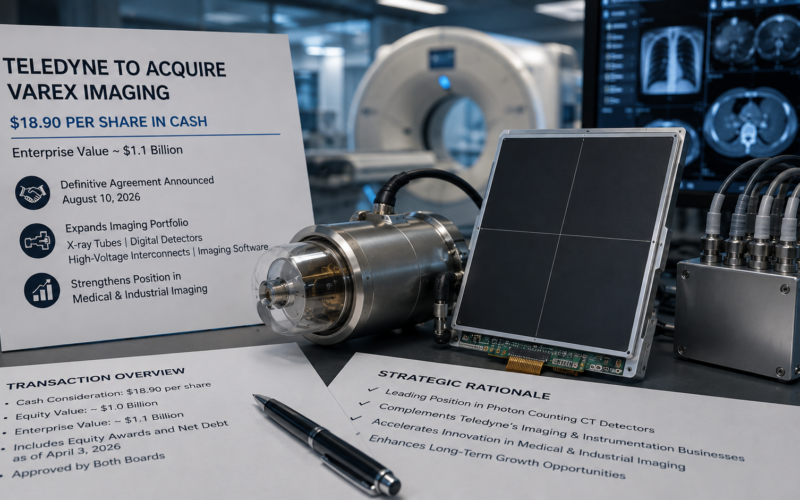
Teledyne Technologies Incorporated (NYSE: TDY) has entered into a definitive agreement to acquire Varex Imaging Corporation (NASDAQ: VREX) for $18.90 per share in cash, in a transaction valued at approximately $1.1 billion including Varex’s equity awards and net debt as of April 3, 2026. The deal was announced jointly by both companies on Monday, August 10, 2026, and was unanimously approved by each board of directors. The transaction adds X-ray tubes, digital detectors, high-voltage interconnects and imaging software to Teledyne’s existing digital imaging, instrumentation and vacuum electronics portfolio. The central tension for investors sits between the strategic logic of consolidating a critical component supplier that dominates independent photon counting computed tomography detectors, and a substantial premium being paid in cash at a moment when Teledyne is only just below the debt-reduction threshold it hit at the end of the second quarter of 2026.
How does the $1.1 billion Varex Imaging acquisition reshape Teledyne Technologies’ medical imaging portfolio and its long-term positioning
Teledyne’s medical imaging exposure has been built in staged acquisitions since 2011, and the Varex transaction is the largest single expansion of that leg since Teledyne e2v joined the group in 2017. Executive Chairman Robert Mehrabian described the deal in the joint release as complementary rather than overlapping, noting that both companies serve similar customers with related but distinct technologies. Teledyne’s existing digital imaging franchise, which contributed roughly 56 per cent of net sales in the most recently disclosed segment mix, is heavily weighted toward complementary metal-oxide semiconductor sensors, scientific cameras and infrared subsystems. Varex sits on the source side of the X-ray chain, supplying the X-ray tubes and photon counting detectors that Teledyne’s own components then help process and display. The combined footprint would place Teledyne in a much stronger position across the full X-ray value chain, from source generation to detection and image processing, without meaningful antitrust overlap in any single line.
For Teledyne, the acquisition also anchors a healthcare and industrial X-ray platform that is increasingly relevant to security screening, cargo inspection and non-destructive testing, all areas where Varex has grown faster than its medical business over the last two fiscal years. Third-quarter fiscal 2026 product sales, released by Varex the same day as the deal announcement, came in at approximately $217 million before a $17 million reimbursement adjustment related to previously paid International Emergency Economic Powers Act tariffs, with the company describing the underlying quarter as strong growth in Industrial and continued expansion in cargo and vehicle inspection systems. Teledyne’s most recent full-year 2026 guidance, raised in July, points to non-GAAP diluted earnings per share of $24.45 to $24.65, giving management the operating cushion to absorb integration costs while retaining its stated capital return philosophy.

Why does Varex Imaging’s photon counting detector position sit at the heart of the deal’s strategic value
Varex is unusual among X-ray component suppliers in already having a commercial photon counting detector platform. Photon counting computed tomography registers individual X-ray photons and sorts them by energy, rather than integrating total energy across a pixel over a measurement window. The practical results include finer pixel resolution, lower radiation dose, simultaneous multi-material discrimination and elimination of artifacts that limit conventional CT. Siemens Healthineers received United States Food and Drug Administration clearance for its NAEOTOM Alpha photon counting CT scanner on September 30, 2021, and every major imaging original equipment manufacturer has since been building or licensing its own equivalent. GE HealthCare, Philips and Canon Medical are all working on competing systems, and Varex has positioned itself as the leading independent supplier of the underlying detector technology that non-vertically integrated OEMs can adopt.
That positioning is precisely what makes the deal strategically important for Teledyne. By bringing Varex inside the group, Teledyne secures a share of the value that will accrue as photon counting shifts from a Siemens showcase into mainstream computed tomography over the second half of the decade. The commercial timeline for that shift is still uncertain, and the ramp will depend on OEM roadmaps, reimbursement decisions and hospital capital budgets. However, owning the sole commercially ready independent detector supplier gives Teledyne exposure to more than one OEM adoption path, rather than being tied to any single system vendor. It also potentially strengthens Teledyne’s negotiating position with existing digital imaging customers that overlap with Varex’s OEM base.
How does the $18.90 per share offer compare against Varex Imaging’s trading history and analyst consensus
The offer price of $18.90 per share represents a premium of approximately 52 per cent to Varex Imaging’s Friday closing price of $12.41 on August 7, 2026. It also sits above the stock’s prior 52-week trading range, which for much of the past year was bounded by a low near $9.09 and a high near $14.57. Varex shares opened at $18.40 on the day of the announcement and were trading around $18.42 by late morning in New York, up more than 48 per cent intraday. Volume by mid-session had already exceeded 9.5 million shares, well above the stock’s normal daily average, reflecting arbitrage flow and index-driven repricing rather than fundamental repricing.
Prior sell-side coverage of Varex was thin, with two to five analysts publishing regularly. Consensus price targets in the weeks before the transaction clustered around $17 to $18.80, with a high estimate near $22 and a low around $16, and a broadly buy-weighted rating profile from B. Riley Securities, Oppenheimer and CJS Securities. On that basis, the $18.90 cash offer sits above the average target and only modestly below the high, meaning existing shareholders receive a fully priced exit relative to the near-term analyst view, but do not receive an obvious excess above the most bullish scenarios. For long-term holders who had been anchored to a fundamental turnaround thesis around photon counting, cargo systems and Indian manufacturing capacity ramp, the cash consideration crystallises value ahead of the operational proof points. For more recent buyers who accumulated at prices below $10, the outcome is materially better than the standalone case implied.
What does the transaction mean for Teledyne Technologies’ balance sheet and its recent debt reduction path
Teledyne ended the second quarter of 2026 with cash and cash equivalents of $340.1 million against reported net debt of $1,686.9 million and a consolidated leverage ratio of 1.1 times. The company had repaid $450 million of debt during the quarter and generated free cash flow of $284.7 million, continuing the deleveraging profile that has characterised the years following the 2021 FLIR Systems acquisition. Funding a roughly $800 million equity purchase price on a mostly cash-financed basis, alongside the assumption of Varex’s own net debt, will step up gross leverage in the near term. On the numbers disclosed by both parties, the combined post-close net debt position would likely rise to a mid-twos leverage multiple before any deleveraging in 2027, subject to Teledyne’s ability to draw on its committed facilities and to any post-signing bridge or term financing that management chooses to arrange.
Teledyne has not yet disclosed the financing structure for the equity purchase price, and no bridge commitment has been named in the initial announcement. Given the strong recent free cash flow profile and the retained investment-grade credit standing, the deal is comfortably within the group’s borrowing capacity, but it does reset the timing on any further large-scale acquisition activity through 2027. The employee stock ownership plan-related shelf registration filed earlier in 2026 covered ordinary corporate purposes and does not point to equity issuance for this transaction, particularly since management has structured the offer as all-cash with no dilution to existing Teledyne holders.
How does the Varex Imaging deal fit alongside Teledyne’s earlier DALSA and e2v healthcare acquisitions
The Varex transaction extends a 15-year build in Teledyne’s imaging and healthcare exposure. The 2011 acquisition of DALSA brought CMOS sensor and machine vision technology, which subsequently anchored the group’s low-dose, high-resolution digital X-ray detector development. The 2017 acquisition of e2v added vacuum electronics, imaging sensors and radio frequency components with dual-use applications across defence, space and medical. Both deals fit a pattern of buying specialist components suppliers with sticky OEM customer relationships and rerating them under Teledyne’s operating discipline. Varex is a larger transaction than either DALSA or e2v in absolute terms, but the strategic logic is the same, namely acquiring critical component technology that either supplies existing Teledyne customers or is used within Teledyne’s own systems. What differentiates Varex from the earlier two is that it comes with a full standalone commercial franchise generating $845 million in fiscal 2025 revenue, rather than a bolt-on unit inside a larger group, and requires the more complex work of integrating a listed operating company alongside Teledyne’s existing segments.
Where does the deal leave Varex Imaging’s OEM customers including GE HealthCare, Siemens Healthineers, Philips and Canon Medical
Varex sells to nearly every major imaging OEM globally, and the customer base has historically depended on Varex’s independence from any single system vendor. Once inside Teledyne, that independence remains formally intact because Teledyne is not itself an imaging system OEM, but the perception of neutrality could shift depending on how Teledyne positions the combined business over time. Some customers may pursue dual-sourcing or accelerate captive detector development to reduce single-supplier reliance, particularly for the highest-margin photon counting systems. Others may welcome the greater scale and research and development investment that comes with being part of a larger corporate parent. Varex CEO Sunny Sanyal is quoted in the release as saying the transaction provides opportunities for customers and employees across medical and industrial markets, framing the change as constructive for the existing OEM base.
What are the main regulatory antitrust and closing-condition risks that could delay the Teledyne-Varex deal into 2027
The transaction is expected to close in early 2027, subject to customary closing conditions including required regulatory approvals and adoption by Varex stockholders at a special meeting. Because Teledyne and Varex operate on adjacent but distinct segments of the imaging value chain, the antitrust review is expected to focus on any overlaps in specific detector categories, ancillary imaging software or industrial and security applications rather than on horizontal concentration in medical CT. Reviews are likely to span the United States, the European Union, the United Kingdom and China, given both companies’ global footprints, and China review timing is a variable that has affected recent transatlantic medical technology transactions. Varex will file a proxy statement with the Securities and Exchange Commission for a special stockholder meeting, and the stockholder vote is a further gating item, although the size of the premium and the unanimous board recommendation should support approval. Evercore is acting as exclusive financial advisor to Varex, with Orrick, Herrington and Sutcliffe as legal counsel, while Latham and Watkins and McGuireWoods are acting as legal counsel to Teledyne.
What has improved for Teledyne Technologies shareholders, what remains unresolved, and what is the next measurable proof point
For Teledyne shareholders, the deal offers a defined path into the photon counting era of medical computed tomography and reinforces the group’s positioning in industrial and security X-ray applications, without diluting existing holdings. Management has effectively swapped some near-term deleveraging optionality for a stronger long-cycle growth asset with a differentiated technology moat. What remains unresolved is the pace at which photon counting adoption translates into detector volume for Varex, the exact financing structure Teledyne uses to fund the cash consideration, and any customer-behaviour effects at Varex’s OEM base once the transaction closes. The next measurable proof points are the release of the definitive proxy statement outlining the sale process and financing arrangements, the timing of major antitrust filings, and any updated integration outlook Teledyne provides alongside its next quarterly results.
Key takeaways for investors tracking the Teledyne Technologies acquisition of Varex Imaging
- Teledyne Technologies (NYSE: TDY) has agreed to acquire Varex Imaging Corporation (NASDAQ: VREX) for $18.90 per share in cash, in a transaction valued at approximately $1.1 billion.
- The offer represents a premium of approximately 52 per cent to Varex’s Friday closing price of $12.41 and sits above the previous 52-week trading range.
- Varex shares opened around $18.40 and were trading up more than 48 per cent intraday, with volume above 9.5 million shares by late morning.
- Varex Imaging is the leading independent supplier of photon counting computed tomography detectors, a technology cleared by the United States FDA for Siemens Healthineers’ NAEOTOM Alpha in September 2021 and now being pursued by every major imaging OEM.
- The deal extends Teledyne’s 15-year build-out of medical and industrial imaging exposure, following the 2011 DALSA and 2017 e2v acquisitions, and adds X-ray tubes and detectors that are complementary rather than overlapping with the group’s existing digital imaging portfolio.
- Teledyne ended the second quarter of 2026 with $340.1 million in cash, net debt of $1,686.9 million, and leverage of 1.1 times, meaning the equity consideration will lean primarily on new debt and reset the group’s near-term deleveraging trajectory.
- Robert Mehrabian, Executive Chairman of Teledyne, framed the businesses as complementary with minimal overlap, while Varex CEO Sunny Sanyal cited a substantial premium and expanded opportunities for customers and employees.
- Closing is expected in early 2027 subject to regulatory approvals across the United States, European Union, United Kingdom and China, and adoption of the merger agreement by Varex stockholders.
- Evercore is exclusive financial advisor to Varex with Orrick, Herrington and Sutcliffe as legal counsel, while Latham and Watkins and McGuireWoods are legal counsel to Teledyne.
- The next measurable proof points for investors are the definitive proxy statement, the disclosed financing structure for the cash consideration, the sequence of antitrust filings and any integration outlook update at Teledyne’s next quarterly results.
Discover more from Business-News-Today.com
Subscribe to get the latest posts sent to your email.