Tamboran Resources Corporation (NYSE: TBN, ASX: TBN) is approaching first gas sales from the Shenandoah South Pilot Project in Australia’s Beetaloo Basin after completing the basin’s largest hydraulic stimulation programme and moving its associated processing infrastructure toward commissioning. The Northern Territory project remains targeted for first gas during the third quarter of 2026, initially supplying around 40 terajoules per day to the Northern Territory Government under a contracted sales arrangement. Tamboran said construction of the Sturt Plateau Compression Facility was nearing completion within its A$141 million gross budget when it issued its latest detailed operational update, while Reuters reported on August 21 that Beetaloo production was expected to begin in September. The milestone would move Beetaloo from years of exploration and appraisal into actual gas sales, although the initial volumes remain far below the scale required to establish the basin as a major new source for eastern Australia or LNG exports.
How close is Tamboran Resources to first gas from Shenandoah South?
Tamboran completed stimulation, cleanout and completion work on the Shenandoah South 3H, 4H and 5H wells during a campaign conducted with Liberty Energy’s frac fleet. The programme placed 178 stimulation stages across approximately 30,000 feet of horizontal section in the Mid Velkerri B Shale, averaging 6.7 stages per day and setting a company-reported Beetaloo record of 12 stages in a single day. Tamboran also trialled locally produced “Beetaloo Red” sand across 10 stages in the SS-4H well, an experiment that could become commercially important if locally sourced proppant reduces dependence on imported material as drilling activity expands.
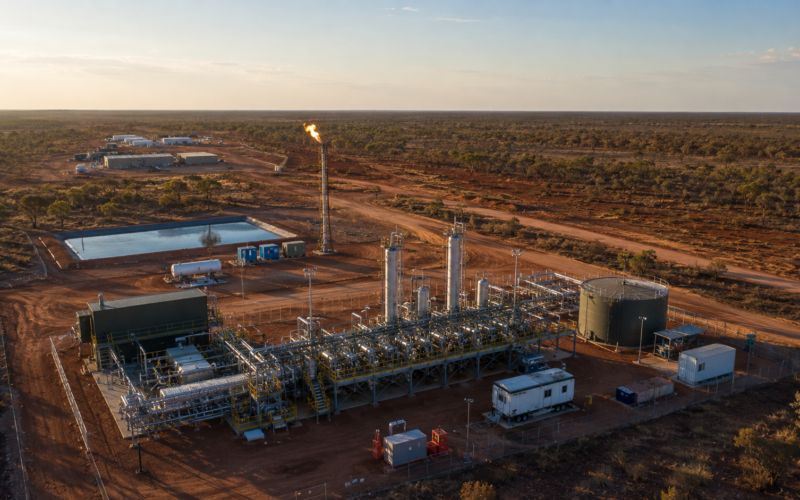
Those completed wells are intended to feed the Sturt Plateau Compression Facility, which Tamboran said was nearing completion with commissioning set to begin imminently. The company was also drilling the SS-7H, SS-8H and SS-9H wells, which are planned for stimulation during the second half of 2026 and can subsequently be connected to the processing facility as required. The progression from drilling to completions, processing and contracted sales means the project is no longer primarily an exploration story, although its initial output remains appraisal gas rather than evidence that a basin-wide commercial development has been established.

Why is the 40 TJ/d Beetaloo gas contract commercially important?
The Shenandoah South Pilot Project is designed to deliver around 40 TJ/d, approximately 39 million cubic feet per day, into the Northern Territory market. Tamboran previously secured Northern Territory approval to sell appraisal gas under the Beneficial Use of Gas framework, enabling gas produced during appraisal to enter the market rather than simply being flared. The gas sales agreement with the Northern Territory Government creates an anchor customer for the first production phase, while the infrastructure built for the pilot gives Tamboran an operating platform from which it can gather longer-duration production data.
The initial supply level is meaningful for the relatively small Northern Territory market but modest when compared with Tamboran’s longer-term ambitions. The company has repeatedly positioned Beetaloo as a potential source of gas for eastern Australia and eventually international LNG customers, objectives that would require substantially greater production, additional processing capacity and long-distance pipeline infrastructure. First sales therefore answer one question, whether Beetaloo shale can be drilled, stimulated, processed and commercially delivered, while leaving the much larger question of scalable development economics unresolved.
Has Tamboran reduced the cost risk around Beetaloo shale development?
The latest stimulation campaign provides several indicators that operating efficiency is improving. Tamboran reported pumping operations exceeding 20 hours per day, completion of 178 stages across three wells and the successful use of locally sourced sand in part of the programme. Experience from United States shale basins has shown that repeatability, lateral length, drilling speed, stimulation intensity and supply-chain localisation can materially affect well economics, making operational learning particularly important for an Australian shale play that does not yet have the mature service ecosystem found in the Permian or Marcellus basins.
The company nevertheless remains at an early stage. Tamboran itself continues to identify substantial additional capital requirements, infrastructure availability, drilling performance, gas prices, regulatory requirements and the absence of proved reserves among the risks to its business plan. Its Northern Pilot Area working interest was reported at 44.38% following acreage realignment and farm-out transactions, while the group holds approximately 2.8 million net prospective acres across the broader Beetaloo Basin position. The sheer acreage creates development optionality, but acreage and prospective resources do not automatically translate into commercially recoverable reserves.
Does first gas make an East Coast Beetaloo development more realistic?
The pilot gives Tamboran something it has not previously had: operating production history tied to real customers and infrastructure. Longer-term production data from the Shenandoah wells will help determine decline rates, recoveries, processing requirements and the number of wells required to sustain a materially larger development. Those metrics will ultimately influence whether the economics support a pipeline linking Beetaloo to Australia’s East Coast gas network, a project that would carry a substantially larger capital requirement than the current local-market pilot.
Australia’s eastern gas market creates an attractive strategic opportunity because existing southern supply sources are declining while demand for dispatchable gas remains important for industry and electricity generation. Beetaloo nevertheless faces competition from other supply developments, LNG-linked producers and potential policy interventions intended to preserve domestic availability. Moving 40 TJ/d into the Northern Territory proves access to a market; delivering multiples of that volume over hundreds or thousands of kilometres while maintaining competitive delivered costs is a different challenge.
What should investors watch after Tamboran’s Beetaloo first gas milestone?
The most informative post-start-up indicators will be production stability, decline rates, well uptime and whether the compression facility performs within its design envelope. Results from the additional SS-7H, SS-8H and SS-9H wells should also show whether the company can reproduce earlier well performance as activity broadens, while the local-sand programme could indicate whether completion costs have room to fall. Tamboran’s July operational update maintained the third-quarter first-gas target and A$141 million gross budget for the Sturt Plateau Compression Facility, so significant deviation from either would change the execution narrative.
First gas should therefore be viewed as the beginning of Beetaloo’s commercial test rather than its conclusion. Tamboran is close to establishing an operating gas business in the Northern Territory after years of drilling and appraisal, but the investment case increasingly depends on what those first producing wells reveal about repeatable economics. If Shenandoah South can sustain contracted production while drilling and completion costs continue to improve, the argument for a larger Beetaloo development strengthens materially; if costs or decline rates disappoint, the gap between a successful pilot and a major new Australian gas province will remain considerable.
Discover more from Business-News-Today.com
Subscribe to get the latest posts sent to your email.