



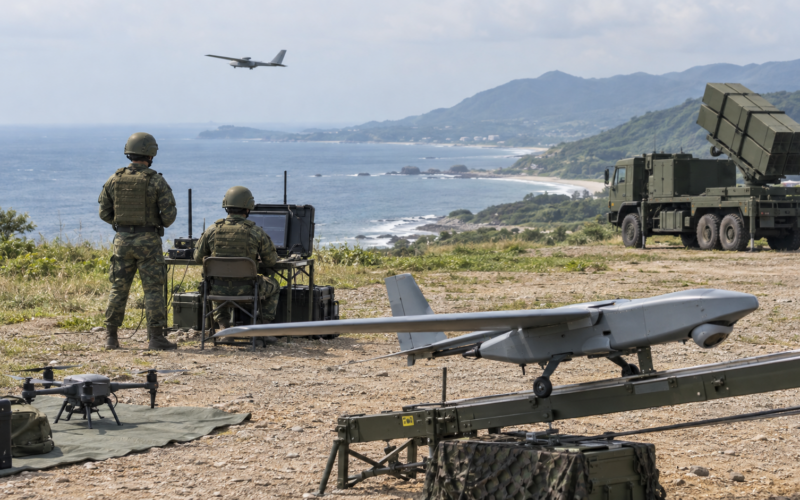
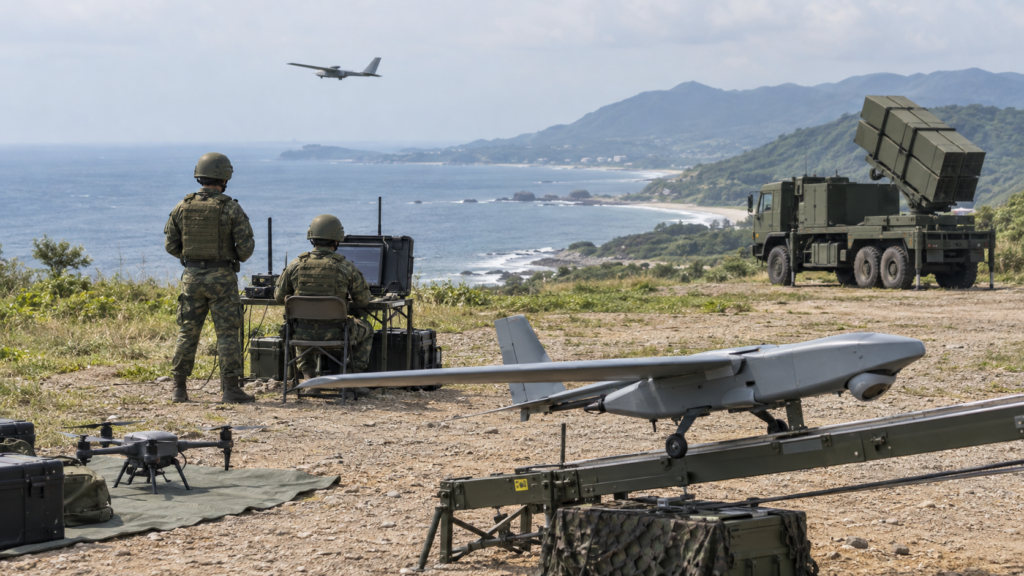
Taiwan’s armed forces have incorporated multiple types of attack drones into a joint combat exercise for the first time, combining unmanned systems with conventional missiles during live-fire drills observed by President Lai Ching-te in southern Pingtung County on September 18. Taiwan’s Presidential Office said the exercise demonstrated an effort to adapt military training to modern warfare by coordinating unmanned platforms with traditional weapon systems rather than operating drones as standalone equipment. Anti-air, anti-ship and anti-landing missiles were also launched during the drills.
The exercise comes less than a week before US President Donald Trump is scheduled to meet Chinese President Xi Jinping in Washington on September 24, when Taiwan is expected to be among the most sensitive issues under discussion. Beijing considers Taiwan part of China and has not renounced the use of force to bring the island under its control, while Taiwan’s elected government rejects Beijing’s sovereignty claim. The United States does not maintain formal diplomatic relations with Taiwan but is required under US law to provide the island with means for self-defence.
What did Taiwan test during the September 18 Pingtung military drills?
Taiwan’s Presidential Office said several attack-drone types were integrated into joint combat training for the first time. The government did not publicly identify every model used, but Lai said coordination between unmanned systems and conventional weapons represented adaptation to changing forms of warfare. Missile firings formed another major element of the exercise, including weapons intended for air defence, maritime targets and attempts to land hostile forces.
Taiwan is expected to continue exercises during the following week using equipment including US-made HIMARS rocket systems and Stinger missile simulators. This indicates that the September 18 event is part of a broader training cycle rather than an isolated demonstration timed solely around the Trump-Xi meeting. The political timing nevertheless gives the drills additional visibility because US arms support to Taiwan has become a major subject in Washington-Beijing negotiations.
Why are attack drones becoming so important to Taiwan’s defence strategy?
Wars in Ukraine and the Middle East have demonstrated that relatively inexpensive unmanned aircraft can locate targets, attack vehicles and infrastructure, relay battlefield information and force adversaries to expend expensive air-defence missiles. Taiwan faces a much larger Chinese military, making asymmetric capabilities particularly attractive because Taipei cannot realistically match Beijing platform for platform in conventional aircraft, warships or missiles.
Drones can complicate an amphibious attack by providing persistent surveillance over beaches, coastlines and approaching vessels while also attacking troop concentrations or logistics. Their value increases further when integrated with artillery and missile systems, because an unmanned platform can detect a target while another weapon delivers the strike. Lai’s emphasis on combined use therefore reflects a move toward networked combat rather than simply purchasing larger numbers of drones.
How does the September 24 Trump-Xi summit affect Taiwan’s security calculations?
Taiwanese officials and other US allies are closely watching whether Trump changes Washington’s language or policies toward the island in exchange for economic concessions from Beijing. Reuters reported concerns among regional governments after Trump called US arms sales to Taiwan a negotiating chip and postponed a planned package valued at around $14 billion following his previous meeting with Xi.
That does not establish that Trump intends to abandon Taiwan or accept Beijing’s preferred political position. The administration is simultaneously negotiating on trade, rare earths, agricultural purchases, fentanyl precursor chemicals, Iran and artificial intelligence, meaning Taiwan is one part of a much broader summit agenda. Taipei’s challenge is that even relatively small changes in US policy language can affect perceptions of deterrence across the Taiwan Strait.
Is Taiwan preparing for an imminent Chinese invasion?
Publicly available evidence does not establish that Taipei expects an invasion on a particular near-term date. Taiwan routinely conducts exercises because China maintains substantial military forces opposite the island and regularly operates aircraft and naval vessels around it. Strengthening readiness is therefore an ongoing defence policy rather than proof that war has been scheduled or judged inevitable.
Taiwan’s strategy increasingly focuses on making any attack difficult and costly through dispersed weapons, mobile missiles, drones, air defence and resilient communications. The objective is deterrence: convincing Beijing that military action would be uncertain, expensive and prolonged. Exercises such as the September 18 drill test whether separate capabilities can work together under operational conditions.
Why does Pingtung matter for Taiwan’s military exercises?
Pingtung County sits at Taiwan’s southern end and provides coastal training areas suitable for missile firings and joint-service exercises. Its geography allows Taiwan’s armed forces to train against scenarios involving maritime approaches, amphibious landings and attacks from the air while operating away from the densely populated Taipei metropolitan area.
Southern Taiwan also sits close to sea lanes connecting the Taiwan Strait, Bashi Channel and northern Philippines, making the region strategically important in a wider Indo-Pacific conflict. Military exercises there can therefore rehearse scenarios involving not only defence of beaches but also protection of maritime access around the island.
What are the key takeaways from Taiwan’s first joint attack-drone drill?
The new element is not that Taiwan has suddenly acquired drones, but that multiple attack-drone systems are now being formally integrated with conventional weapons during a joint combat exercise. That suggests Taiwan is moving from experimentation toward operational doctrine shaped by lessons from recent wars. President Lai presented the exercise as evidence that the military is modernising its approach to battlefield coordination.
The timing immediately before the Trump-Xi summit makes the exercise geopolitically significant without proving it was designed as a direct message to either leader. Taiwan wants stronger deterrence regardless of summit diplomacy, while Beijing continues to regard US military assistance as interference in what it considers a domestic issue. The next signals will come from Washington, particularly whether the delayed US arms package advances after Trump meets Xi.
What should be watched after the Trump-Xi summit?
Any language concerning Taiwan in joint statements, presidential remarks or subsequent US arms decisions will receive unusually close scrutiny. Beijing would welcome stronger US opposition to formal Taiwanese independence, while Taipei will look for continuity in Washington’s commitment to provide defensive capabilities without negotiating those interests away.
Taiwan’s own response will also matter. Continued investment in drones, mobile missiles and distributed defence would demonstrate that Taipei is trying to reduce dependence on political assurances by increasing the military cost of coercion itself. September 18 therefore marks a technical military milestone whose wider meaning will become clearer after the Washington summit.
Discover more from Business-News-Today.com
Subscribe to get the latest posts sent to your email.