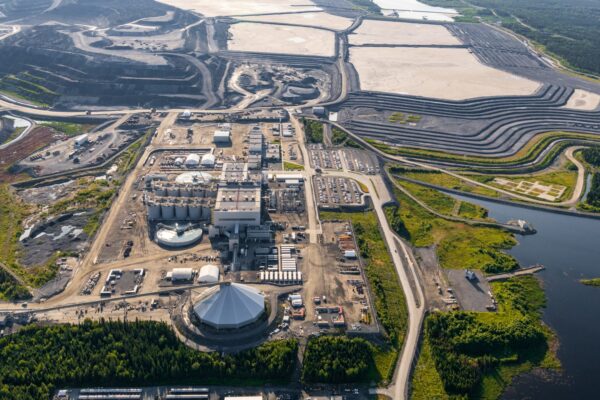




Strategic Minerals PLC (AIM: SML) has delivered the first assay results from the latest resource infill programme at its wholly owned Redmoor Tungsten-Tin-Copper Project in Cornwall, with drilling confirming several modelled high-grade zones and intersecting tungsten-equivalent grades above 6%. The results include 1.03 metres grading 5.90% tungsten trioxide plus 3.68% copper, equivalent to 6.54% WO₃ Eq, while another interval returned 1 metre at 6.00% tungsten trioxide, 0.22% tin and 1.54% copper.
Strategic Minerals also reported a 0.65-metre interval containing 6.79% copper within a wider 12.06-metre section grading 1.70% copper, together with a previously unmodelled style of copper-tin mineralisation in flatter aplitic bodies beneath the currently modelled Redmoor Sheeted Vein System. The company cautioned that this new lower mineralisation does not yet demonstrate economic potential and requires additional geological and metallurgical work.
Why do the September drilling results matter when Redmoor already has a large mineral resource?
The purpose of the current drilling programme is increasingly about confidence rather than simply headline tonnage. Redmoor’s March 2026 Mineral Resource Estimate increased the project to 17.4 million tonnes grading 0.65% tungsten trioxide equivalent, including 0.49% tungsten trioxide, 0.17% tin and 0.44% copper. The resource contains an estimated 85,800 tonnes of WO₃, 29,000 tonnes of tin and 76,300 tonnes of copper, alongside more than 3.2 million ounces of contained silver.
That resource was 49% larger than the previous 2019 estimate. Contained tungsten increased 31%, contained tin rose 55% and contained copper increased 30%, while the potential mine life based on the older 2020 scoping-study mining rate increased from around 12 years to approximately 29 years. The entire resource remains classified as Inferred, however, which makes infill drilling essential if Strategic Minerals wants to support higher-confidence resource categories and eventually feed robust prefeasibility and feasibility studies.
The September holes are therefore useful because they intersected the expected high-grade domains broadly where the geological model predicted them. That may sound less glamorous than discovering an entirely new orebody, but for mine planning it is arguably more useful. A development study requires confidence that the mineralised zones behave consistently enough for engineering assumptions, stoping design and production scheduling.
How unusual are Redmoor’s tungsten grades compared with other European development projects?
Strategic Minerals says its review of publicly reported CRIRSCO-compliant undeveloped European tungsten projects indicates Redmoor remains the highest-grade undeveloped tungsten resource in Europe. The company bases that statement on the average WO₃ grade of comparable reported Mineral Resources and acknowledges that cut-offs, resource categories, metallurgy and development stages differ between projects.
The headline Redmoor resource averages 0.49% tungsten trioxide, but the dedicated high-grade tungsten domain is considerably richer. The March resource estimate identified 7.3 million tonnes within tungsten high-grade domains grading 0.83% WO₃, 0.12% tin and 0.53% copper, with a calculated net smelter return of US$499 per tonne under the assumptions used in the model.
The September drilling adds further evidence of localised very high-grade zones. Intersections such as 1.03 metres at 5.90% WO₃ and 1.02 metres at 6.16% WO₃ are not representative of the average resource, but they demonstrate the grade variability and potential value concentration within the system.
That distinction is essential. Investors should not take individual 6% tungsten intervals and extrapolate them across Redmoor. The economic case depends on the average recoverable grade across mineable volumes, metallurgical recovery, development costs and mining dilution.
Could the new copper-tin mineralisation change the Redmoor development case?
Potentially, but it is far too early to assign significant value to it. The newly described aplitic bodies sit below the currently modelled Sheeted Vein System and produced an interval of 2.91 metres at 0.51% tin and 0.18% copper, including one metre at 1.10% tin and 0.37% copper.
The geological importance is that Redmoor may host additional mineralisation styles outside the model used in the current resource estimate. If follow-up drilling demonstrates continuity and sufficient grade, those bodies could eventually create new resource opportunities. However, Strategic Minerals explicitly said the new mineralisation does not currently demonstrate economic mineralisation and will need further geological and metallurgical investigation.
That caution should stay in the investor narrative. The immediate investment case remains the existing 17.4-million-tonne resource and the process of increasing confidence in it. The new zone is optionality rather than bankable value.
Why might SML shares not immediately rerate after apparently spectacular assay grades?
Strategic Minerals has already experienced an enormous rerating over the past year. Recent delayed London data put the shares around 5p, compared with a 52-week low of just 0.30p and a high of 7.25p. That means SML has risen by well over 1,000% from its lowest levels even before the September 14 assays.
That historical move changes the interpretation of good drilling results. The market is no longer valuing Strategic Minerals as though Redmoor has little worth. Investors have already priced in a substantial portion of the tungsten project’s improved strategic position, larger resource and development potential.
The next rerating therefore requires more than spectacular individual intercepts. Strategic Minerals needs continued resource confidence, metallurgy, engineering, capital-cost estimates, permitting clarity and eventually an economically credible prefeasibility study.
With three drilling rigs active and more assays expected, Redmoor has a visible news pipeline. September 14 strengthens the geological story, but the investment case is increasingly moving from exploration excitement toward the much harder task of demonstrating that Europe’s high-grade tungsten opportunity can become a financeable mine.
Discover more from Business-News-Today.com
Subscribe to get the latest posts sent to your email.