

Space Exploration Technologies Corp (SpaceX), set to list under the ticker SPCX in a record initial public offering next week, disclosed a multiyear agreement to rent artificial intelligence computing capacity to Google for roughly 920 million dollars per month, a deal worth as much as 30 billion dollars through mid-2029. According to a regulatory filing on Friday, Google will pay the monthly fee from October 2026 through June 2029 for access to approximately 110,000 Nvidia GPUs along with associated CPUs, memory, and infrastructure. It is the second enormous compute lease SpaceX has struck in a matter of weeks, following a similar but larger arrangement with the AI lab Anthropic in late May worth around 45 billion dollars. The capacity comes from the data centers SpaceX absorbed through its merger with Elon Musk’s AI venture xAI earlier this year, which it is now monetizing by renting to other AI players. Coming just before an IPO targeting a valuation around 1.77 trillion dollars, the deal materially boosts SpaceX’s revenue profile and underscores how scarce AI computing power has become, even for a company as well resourced as Google.
What are the terms of the $30 billion SpaceX-Google AI compute deal?
The structure is a large, time-bound cloud-services contract. Google has committed to paying SpaceX approximately 920 million dollars per month from October 2026 through June 2029, a span of roughly 32 months that adds up to more than 30 billion dollars at the full rate, with capacity ramping up through September at reduced fees. In exchange, Google gains access to about 110,000 Nvidia GPUs and the surrounding computing infrastructure.
The agreement includes meaningful protections for Google. If SpaceX fails to deliver the committed GPU capacity by September 30, 2026, Google has a one-month grace period after which it may terminate the agreement outright or accept the delivered capacity with a proportional reduction in fees. After December 31, 2026, either party may terminate with 90 days’ written notice, and Google retains full ownership of and intellectual property rights in its own data and models.
The purpose is to meet surging demand for Google’s enterprise AI. A Google Cloud spokesperson described the arrangement as bridge capacity to meet customer demand for Gemini Enterprise, its agentic AI platform for large businesses, which the company said has run even higher than expected. In other words, Google is renting external capacity to bridge a gap between the AI demand it is seeing and the infrastructure it can bring online itself in the near term.

Why is Google renting compute from SpaceX despite its own massive AI spending?
The deal is striking precisely because Google is among the largest builders of AI infrastructure in the world. Parent company Alphabet has committed to more than 180 billion dollars in capital expenditure this year, with plans to increase that significantly in 2027, and recently announced an 80 billion dollar equity sale partly to fund that buildout. That a company spending at this scale still needs to rent capacity speaks to the intensity of demand.
The explanation is timing and the limits of even rapid construction. Building data centers, securing power, and installing chips takes time, and when demand for a product like Gemini Enterprise accelerates faster than expected, even a hyperscaler can face a near-term shortfall. Renting ready capacity bridges that gap immediately, avoiding the delay of constructing new facilities while demand is hot.
The episode illustrates the broader compute shortage defining the AI era. The constraint on AI growth is increasingly the availability of chips, power, and data center space rather than demand, and that scarcity has turned spare computing capacity into a valuable, rentable commodity. When Google, with its vast resources, opts to lease 110,000 GPUs from an outside provider, it confirms that the bottleneck in AI is supply, a dynamic that benefits anyone holding excess capacity.
How has SpaceX become an unexpected AI cloud landlord through the xAI merger?
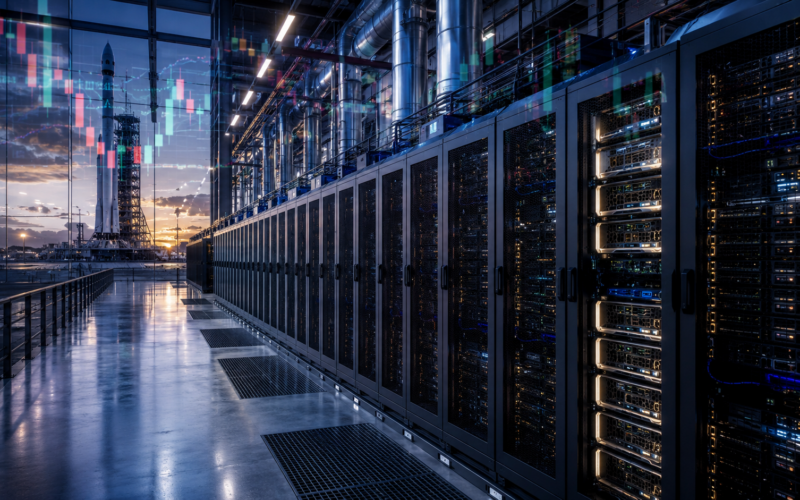
SpaceX’s emergence as a compute provider stems from its absorption of xAI. SpaceX merged with Musk’s artificial intelligence company xAI, along with the social platform X, in a transaction earlier in the year that valued the combined entity at around 1.25 trillion dollars. That deal brought xAI’s data centers, including the Colossus facility near Memphis originally built for training xAI’s own models, under the SpaceX umbrella.
The company is now monetizing that infrastructure. SpaceX has said the rental agreements allow it to generate revenue from compute capacity it is not using internally while retaining the option to reallocate that capacity for its own needs, such as xAI’s continued model development. This flexible approach lets SpaceX earn substantial income from idle capacity without permanently committing it away from its own AI ambitions.
The result is an unusual competitive dynamic. SpaceX, through xAI and its Grok chatbot, competes directly with both Google and Anthropic in AI, yet it is now leasing them the computing power they need. Musk has indicated the company may reserve a second data center for xAI’s own use, signaling that SpaceX intends to balance its role as a compute landlord against its ambitions as an AI developer, renting out today what it does not yet need itself.
What does the deal mean for SpaceX’s revenue ahead of its record IPO?
The timing, one week before the IPO, is no coincidence. SpaceX is preparing to raise a record sum at a valuation near 1.77 trillion dollars, and the AI compute agreements have become a central selling point to investors. The Google deal, worth up to 30 billion dollars, combined with the roughly 45 billion dollar Anthropic arrangement, represents around 75 billion dollars in contracted future revenue across the two contracts.
That contracted revenue addresses a key weakness in the SpaceX story. In the first quarter of 2026, the company generated nearly 4.7 billion dollars in revenue but posted a net loss of around 4.3 billion dollars, with its xAI operations consuming substantial capital. Large, multiyear compute contracts provide visible, recurring revenue that helps justify the lofty valuation and counters concerns about the company’s profitability ahead of the listing.
The deals reshape how investors can value the company. Beyond rockets, satellites, and Starlink, SpaceX is now demonstrably an AI infrastructure provider with billions in committed cloud revenue, broadening its appeal. With one analysis projecting SpaceX revenue could reach trillions of dollars over the long term, the compute agreements offer near-term, tangible evidence of the diversified revenue streams that underpin the most ambitious bull cases for the stock.
Why are AI rivals increasingly renting compute capacity from one another?
The deal exemplifies a new pattern of cooperation among competitors. SpaceX’s xAI competes with Google’s Gemini and Anthropic’s models, yet all three are now linked through compute, with SpaceX supplying the rivals it competes against. This blurring of the line between competitor and supplier is becoming common as the industry races to secure scarce resources.
The driver is the sheer scale of compute required. Training and serving advanced AI models demands enormous quantities of GPUs, and no single company can always build capacity fast enough to meet its own needs, so firms increasingly buy, rent, and trade capacity among themselves. Securing access to chips and data centers has become more important than competitive purity, leading rivals to transact.
This interdependence has strategic implications. It concentrates value in whoever controls the underlying infrastructure, chips from Nvidia, data centers, and power, and it means AI companies are simultaneously customers, competitors, and suppliers to one another. For investors, the lesson is that the economics of the AI boom increasingly favor the owners of compute capacity, a position SpaceX has opportunistically seized through its xAI assets even as it pursues its own AI goals.
What delivery, cancellation and concentration risks does the deal carry?
The first risk is execution and delivery. The agreement is contingent on SpaceX making the committed GPU capacity available by a deadline, and the contract explicitly allows Google to walk away or reduce payments if SpaceX falls short. Standing up and reliably operating large-scale AI data center capacity is operationally demanding, and any shortfall would jeopardize the revenue.
The second risk is the cancellation flexibility. Because either party can terminate with 90 days’ notice after the end of 2026, the full 30 billion dollars is not guaranteed, and the recurring revenue could prove less durable than the headline number suggests. The contracts are framed as monetizing capacity that SpaceX could reclaim for internal use, which cuts both ways, providing flexibility but also less certainty than a locked-in commitment.
The third consideration is concentration and the AI cycle. None of this is investment advice, and the agreements are a genuine validation of SpaceX’s infrastructure value and a meaningful boost to its pre-IPO revenue. But the company is becoming significantly exposed to the AI compute cycle and to a small number of large customers, and a slowdown in AI demand or a build-out of capacity by the hyperscalers themselves could reduce the need to rent. For now, the scarcity of compute makes SpaceX’s idle capacity highly valuable, and the Google deal is a powerful demonstration of that, but the durability of such arrangements depends on the AI boom continuing to outrun the industry’s ability to build its own infrastructure.
Key takeaways on the SpaceX-Google compute deal
- SpaceX disclosed a deal to rent Google roughly 110,000 Nvidia GPUs for about 920 million dollars per month, worth as much as 30 billion dollars through June 2029.
- It is SpaceX’s second major compute lease in weeks, following a roughly 45 billion dollar agreement with the AI lab Anthropic in late May.
- The capacity comes from data centers SpaceX gained through its merger with xAI, which it is now monetizing by renting to other AI players.
- Google described the deal as bridge capacity to meet higher-than-expected demand for its Gemini Enterprise agentic AI platform.
- Even though Alphabet is spending over 180 billion dollars on its own infrastructure, it still needs to rent capacity, underscoring the compute shortage.
- The agreement includes delivery deadlines and lets either party terminate with 90 days’ notice after 2026, so the full value is not guaranteed.
- Together the Google and Anthropic deals represent around 75 billion dollars in contracted revenue ahead of SpaceX’s record IPO.
- SpaceX competes with Google and Anthropic in AI through xAI yet supplies them compute, reflecting a new pattern of rival cooperation.
- The deals boost SpaceX’s revenue profile, which showed a large net loss in the first quarter, helping justify its roughly 1.77 trillion dollar IPO valuation.
- Key risks include delivery execution, cancellation flexibility, and growing exposure to a concentrated set of customers and the AI cycle.
Discover more from Business-News-Today.com
Subscribe to get the latest posts sent to your email.