




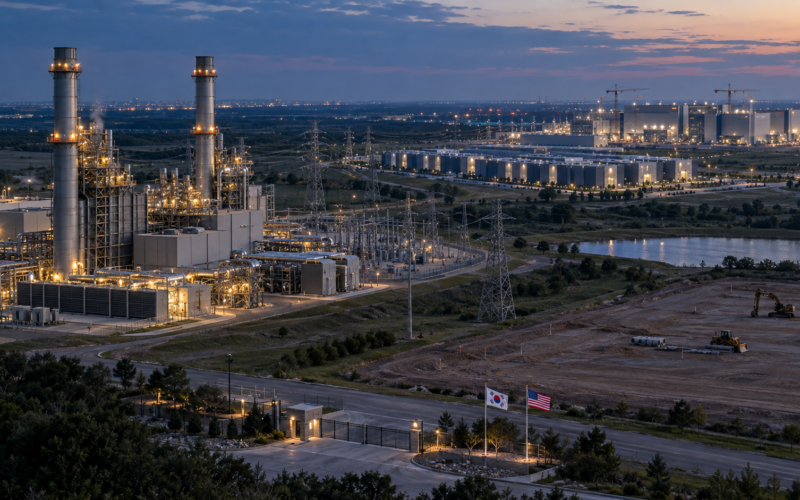
South Korea’s $350 billion strategic investment commitment to the United States is beginning to produce a potential project pipeline spanning artificial-intelligence power infrastructure, nuclear reactors, shipbuilding, liquefied natural gas and other industrial assets. Reuters reported that projects under discussion include a proposed $22.3 billion, 6.3-gigawatt combined-cycle gas power development in Encinal, Texas, designed partly to supply electricity to AI data centres and semiconductor manufacturing facilities. The individual projects have not been finally approved, and South Korea’s industry ministry has stressed that implementation details remain under negotiation.
The broader $350 billion framework is considerably more established. South Korea’s National Assembly passed legislation creating the legal structure for the investment programme in March, with $150 billion earmarked for bilateral shipbuilding cooperation and another $200 billion available for strategic U.S. investments considered commercially reasonable.
How could a 6.3 GW Texas plant support AI data centres and chip fabs?
Texas has become one of the central locations in the U.S. data-centre boom because of available land, rapidly growing electricity infrastructure and a business environment that has attracted technology and semiconductor investment.
The proposed Encinal development would be extraordinarily large for a gas-fired project. Reuters reported that plans under discussion contemplate approximately 6.3 GW of eventual capacity, with development potentially occurring in stages beginning with around 1.4 GW before expanding through additional combined-cycle facilities. The estimated investment discussed in South Korean media is approximately $22.3 billion.
A plant of that scale could supply electricity equivalent to several conventional utility generating stations. Its relevance to AI comes from the enormous continuous power requirement of hyperscale data centres, where processors operate around the clock and electricity availability increasingly determines where computing campuses can be built.
Semiconductor fabrication plants create another large industrial load because clean rooms, manufacturing equipment and supporting systems operate continuously. Combining both types of demand creates a potential customer base capable of supporting major new generation capacity.
The proposal nevertheless remains under discussion rather than final investment approval. Commercial viability, customers, fuel supply, environmental permits, financing and transmission connections would all need to be resolved before construction on the full 6.3 GW scale could proceed.
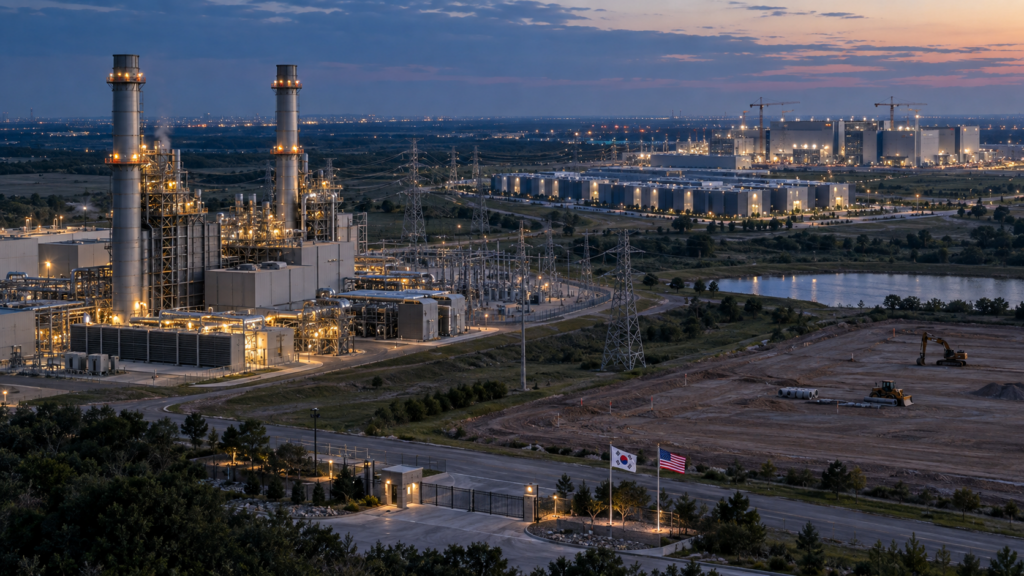
Why could South Korea finance as many as eight new US nuclear reactors?
Nuclear power represents another potential pillar of the strategic investment programme.
Reuters reported that discussions have included construction of as many as eight reactors in the United States, with six potentially using Westinghouse technology and two using South Korean designs. Estimates discussed in connection with the programme put individual reactor costs at roughly $15 billion, although actual nuclear-project economics can vary substantially depending on design, financing, construction schedule and location.
The proposal would deepen an already important nuclear relationship between the countries. South Korea possesses substantial expertise in reactor construction and supply chains, while Westinghouse’s AP1000 technology has become a core U.S. platform for possible new large-reactor deployment.
South Korean entities have also discussed acquiring an equity stake in Westinghouse. Reuters reported that Seoul is interested in approximately 15%, while discussions have involved a smaller potential stake of around 5% to 10%. No agreed investment has been publicly announced.
Any Korean-designed reactors built in the United States would represent a particularly important industrial milestone because they could demonstrate that South Korea’s nuclear-export capabilities can participate directly in America’s domestic generation expansion.
How does shipbuilding fit inside South Korea’s $350 billion US commitment?
Shipbuilding is the most clearly defined component of the investment framework.
South Korea has allocated $150 billion of the overall package to shipbuilding cooperation, reflecting Washington’s desire to rebuild U.S. maritime manufacturing capacity and Seoul’s position as one of the world’s leading shipbuilding powers.
The Korea-U.S. Strategic Investment Corporation, policy-finance institutions and HD Hyundai Heavy Industries, Samsung Heavy Industries and Hanwha Ocean signed a memorandum of understanding in June to implement the shipbuilding portion.
The two governments also established the Korea-U.S. Shipbuilding Partnership Initiative and subsequently opened a joint partnership centre in Washington to support investment, workforce development, shipyard modernization and technical cooperation.
That means shipbuilding has progressed further institutionally than many of the energy projects now being discussed. The remaining $200 billion strategic-investment pool is where competition among nuclear, power, LNG and other large industrial opportunities becomes particularly important.
Could Alaska LNG receive funding from the South Korean investment package?
Reuters reported that participation in the approximately $44 billion Alaska LNG project is among the possibilities being examined, although South Korea has approached the project cautiously.
The project seeks to transport natural gas from Alaska’s North Slope through an enormous pipeline system to a liquefaction facility capable of exporting LNG to Asian markets. South Korean companies could theoretically participate as investors, contractors, equipment suppliers or buyers.
For Seoul, however, every investment must satisfy the commercial-reasonableness standard embedded in the strategic programme. South Korean legislation requires projects to undergo assessment based on expected returns, financing conditions and wider economic considerations rather than serving purely diplomatic objectives.
That requirement explains why negotiations over individual projects have taken time. A $350 billion headline commitment does not mean the government can simply transfer the entire amount without examining repayment, foreign-exchange effects and project economics.
Why is South Korea insisting that US investments remain commercially rational?
The scale of the commitment creates domestic financial risk.
South Korea negotiated the investment package as part of a broader trade arrangement that reduced U.S. tariffs on Korean products to 15%. The programme therefore combines commercial investment with trade diplomacy, which can create tension when the projects preferred by Washington do not automatically produce attractive financial returns for Seoul.
South Korean law established a dedicated investment corporation and fund to evaluate and execute projects. Officials have repeatedly emphasized that final decisions will depend on commercial reasonableness, financial conditions and foreign-exchange considerations.
The government has also sought to limit the potential effect of large dollar outflows on the won. That is particularly important because committing hundreds of billions of dollars abroad over a compressed period could create currency pressure even if individual projects are economically attractive.
The resulting negotiation is therefore about pace and structure as much as total value.
What would make the Korea-US investment package transformative for energy markets?
The final project mix will determine its significance.
A combination of shipyards, eight nuclear reactors, a 6.3 GW Texas power project and LNG infrastructure would move the programme far beyond conventional foreign direct investment. It would become a coordinated industrial strategy spanning electricity, maritime manufacturing, energy security and AI infrastructure.
That could create large opportunities for Korean engineering, equipment and construction companies while giving the United States access to skills and capital in sectors where domestic capacity has become constrained.
The numbers circulating around individual projects remain proposals rather than commitments, making final memoranda, financing structures and investment approvals the key milestones.
What is already clear is the direction of travel. South Korea’s $350 billion package is increasingly being treated not simply as payment for lower tariffs but as a platform for integrating Korean industrial expertise into some of the largest infrastructure challenges facing the United States.
Discover more from Business-News-Today.com
Subscribe to get the latest posts sent to your email.

