

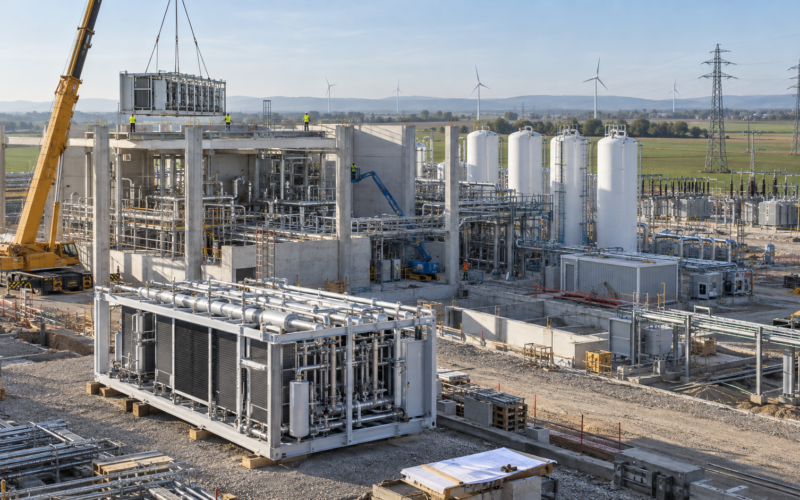
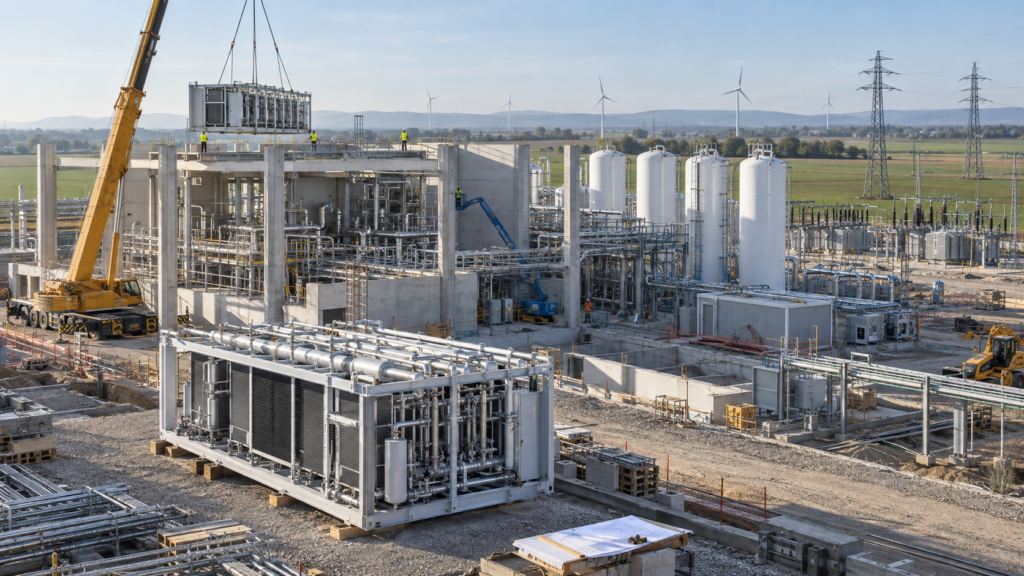
OMV Aktiengesellschaft (Vienna: OMV) will proceed with a €600 million green hydrogen project in Austria without Abu Dhabi Future Energy Company, better known as Masdar, after the state-owned renewable energy investor withdrew from a venture in which it had been expected to take a 49% stake. OMV said the departure would not affect the project timetable, financing plan or intended output, preserving a target to commission a 140-megawatt electrolyser by the end of 2027. The facility in Bruck an der Leitha is designed to produce as much as 23,000 tonnes of renewable hydrogen a year, which would make it Austria’s largest and place it among Europe’s five biggest operating projects of its kind. The withdrawal is a setback to the partnership structure, but not yet to the asset itself, according to the company’s account reported by Reuters.
Masdar’s exit reverses an agreement announced in November 2025, when the Emirati group was expected to contribute several hundred million euros and share ownership while OMV retained operational control. OMV attributed the decision to strategic changes in Abu Dhabi but did not provide further detail, and Masdar did not immediately comment. The episode highlights a central tension in Europe’s hydrogen market: projects can have industrial logic and public-policy support while still testing the capital discipline of large energy investors. OMV’s decision to continue alone suggests that the project is closely tied to its own refinery and decarbonisation strategy rather than dependent on a third-party financial sponsor.
Why can OMV continue the hydrogen project without Masdar’s capital?
The financing structure gives OMV room to absorb the partner’s departure. The European Investment Bank has committed a €450 million loan, equivalent to three quarters of the estimated project cost, while the Austrian government has indicated that public funding will also be available. That does not mean OMV faces no additional capital requirement, because loan conditions, eligible expenditure and grant timing can all affect the cash profile. It does mean that Masdar’s equity was not the only source of funding and that a large portion of the project had already moved into an institutional financing framework.
The EIB commitment also carries a signalling effect. A long-tenor lender backed by European Union member states performs technical, environmental and financial due diligence before committing capital. Its presence can lower the project’s financing cost and reassure suppliers that the development is more advanced than a conceptual hydrogen announcement. Public support, however, transfers part of the risk from OMV shareholders to policy institutions, making delivery discipline and transparent performance important. A subsidised project that starts late, runs below capacity or depends permanently on uneconomic power would weaken the case for similar investments.
OMV also has strategic reasons to preserve the schedule. Hydrogen is already used in refining and chemicals, usually produced from natural gas with associated carbon emissions. Replacing part of that conventional supply with renewable hydrogen can reduce direct emissions in an existing industrial system without waiting for a completely new end market. That makes the project different from developments that rely on uncertain future demand from transport, heating or export customers. OMV can anchor at least part of the output in its own operations, although the company has not published the expected utilisation rate, electricity contract or full offtake structure.
What changed between the original Masdar deal and the decision to proceed alone?
The original partnership was presented as a landmark direct investment from Abu Dhabi into Austria. Masdar was expected to hold 49%, while OMV would own 51% and operate the project. At the time, the commitment was described as a high three-digit-million-euro investment, and the venture strengthened a broader relationship between Austrian and Emirati energy interests. The UAE’s national oil company ADNOC already owns 24.9% of OMV, making it the Austrian group’s second-largest shareholder, and the two companies have since combined major chemicals assets under Borouge International.
That wider relationship makes the exit notable but not necessarily adversarial. Masdar’s decision was described as the result of strategic changes in Abu Dhabi rather than a disagreement over the Austrian plant’s technology or economics. Capital allocation within a state-backed energy group can shift as priorities, financing costs and geographic exposures change. OMV’s refusal to delay the project indicates that it views the asset as sufficiently important to continue without sharing control, even if that concentrates construction and operating risk.
The revised structure could eventually create flexibility. OMV might bring in another investor, retain the whole project or refinance once construction risk falls. A later partner would probably assess the project with more information on equipment delivery, power procurement and customer demand than Masdar had at the formation stage. OMV has not said that it is seeking a replacement, so any such outcome remains speculative. The current commitment is that the company itself will keep the development moving.
Why does a 140MW electrolyser matter for Austria’s industrial strategy?
At 140 megawatts, the plant is large enough to affect Austria’s hydrogen supply but still small relative to the long-term volumes envisaged in European decarbonisation plans. Producing 23,000 tonnes a year implies a substantial and relatively steady demand for renewable electricity, with actual efficiency and output depending on the electrolyser design and operating hours. The economics will be influenced by power prices, grid charges, guarantees of origin, equipment performance and the value attached to avoided emissions. A project can be technically successful and still struggle commercially if clean electricity is expensive or available only intermittently.
Location is therefore central. Bruck an der Leitha sits in Lower Austria, a region with access to renewable generation and industrial infrastructure. Connecting production to OMV’s existing demand can reduce the need to build an entirely new customer network, while proximity to pipelines or storage can improve flexibility. The company has not disclosed all logistics in the withdrawal announcement, but the project’s industrial integration is likely one reason it can survive a change in ownership structure.
Austria also gains a domestic demonstration of large-scale electrolysis. European hydrogen policy has often moved faster than final investment decisions because developers face uncertainty around regulation, subsidies and offtake. A project that reaches operation in 2027 would provide real cost and performance data at a time when governments are deciding which parts of the hydrogen value chain deserve continued support. It could also strengthen local engineering capability and supplier experience, even if the long-run economics require further improvement.
What are the main execution risks now that OMV is the sole project sponsor?
Construction timing is the first risk. Large electrolysers require specialised stacks, power electronics, compression, water treatment, grid connections and safety systems, all of which must be integrated with the receiving industrial site. Supply-chain delays or changes in equipment cost can erode a budget even when headline financing is secure. OMV’s end-2027 target leaves limited tolerance for redesign if Masdar’s departure changes procurement or governance arrangements. The company’s statement that the project remains unaffected will be tested by milestone delivery rather than by the announcement itself.
Electricity economics form the second risk. Renewable hydrogen is only as competitive and low-carbon as the power that produces it. OMV will need a credible electricity procurement strategy that meets regulatory definitions while keeping utilisation high enough to spread fixed costs. If the electrolyser runs only during the cheapest hours, annual output may fall below nameplate expectations. If it runs through expensive periods, hydrogen costs can rise sharply. The optimum will depend on contract design, grid conditions and the value OMV receives for emissions reductions in refining or other uses.
Demand and policy are the third risk. An internal customer can provide a base load, but public support often assumes that renewable hydrogen will expand beyond a single corporate balance sheet. Certification rules, carbon prices and sector mandates will influence whether third parties pay enough to support future capacity. A shift in European policy or slower industrial adoption could limit expansion even if this plant performs well. OMV must therefore show that the first project can operate competitively within its own system before investors will credit it with a broader hydrogen platform.
How does Masdar’s exit affect OMV’s relationship with Abu Dhabi?
The withdrawal removes one planned joint venture but leaves much larger corporate ties intact. ADNOC’s 24.9% ownership of OMV aligns the two groups at shareholder level, while their chemicals combination under Borouge International creates a major jointly controlled business. Those relationships involve assets and strategic commitments far larger than the Austrian electrolyser. There is no disclosed evidence that Masdar’s decision changes ADNOC’s stake or the chemicals partnership.
Even so, investors will watch whether the exit reflects a narrower Emirati appetite for European renewable projects or simply a project-specific capital reallocation. Masdar has built a global portfolio across wind, solar and emerging clean-energy technologies, and a decision to withdraw after announcing a large minority investment can influence counterparties’ perception of commitment. OMV’s calm response appears designed to contain that concern by emphasising that financing and construction remain intact.
For Austria, the episode is a reminder that foreign strategic capital can be valuable without being permanent. Domestic policy institutions and OMV now carry more responsibility for delivery. If the plant starts on time and produces at the expected rate, the withdrawal may become a footnote. If cost or schedule problems emerge, the loss of a partner will be viewed as an early warning that the project’s risk was greater than the initial announcement suggested.
What does the decision mean for OMV investors and market sentiment?
The project is material enough to attract scrutiny but not large enough by itself to redefine OMV’s valuation. A €600 million development is meaningful within the company’s capital programme, yet the €450 million EIB commitment and prospective public funding reduce the direct equity burden. Investors are therefore likely to focus on whether OMV must replace Masdar’s expected contribution from its own balance sheet, whether the return threshold changes and whether management preserves discipline across its simultaneous energy and chemicals commitments.
The announcement did not include a revision to group guidance, the project budget or the 2027 start date. That supports a neutral-to-cautiously-positive reading: management has protected a strategic asset and avoided a visible delay, but it has also accepted greater concentration of execution risk. The absence of disclosed commercial offtake terms limits confidence in the eventual return. Share sentiment should respond more to evidence on capital funding, power costs and commissioning progress than to the symbolic fact that the project is continuing.
OMV can improve that sentiment by publishing a clear ownership plan, construction milestones, expected subsidy contribution and the destination of the hydrogen. Investors will also want to understand how the plant contributes to refinery emissions targets and whether those benefits are reflected in avoided carbon costs or product premiums. Until then, the project remains a strategically coherent investment with significant public backing and unresolved commercial variables.
What would make the Austrian hydrogen plant a repeatable European model?
The strongest model would combine an existing industrial customer, low-cost renewable power, bankable policy support and equipment that performs at high availability. OMV has several of those elements, especially a potential internal demand anchor and institutional financing. The missing proof is operating data. Commissioning on time, reaching targeted output and demonstrating a measurable emissions reduction would give other refiners and industrial groups a benchmark for projects that do not rely entirely on speculative external demand.
Cost transparency would matter as much as scale. Europe has announced many gigawatts of electrolysis, but developers often disclose capacity without a delivered hydrogen price or realistic utilisation assumption. OMV can distinguish the Bruck an der Leitha project by showing how power procurement, financing and industrial integration translate into unit economics. That would help policymakers judge whether the project represents a bridge to competitive production or a permanently subsidised exception.
Masdar’s departure makes the test sharper. OMV no longer has a renewable-energy partner sharing ownership, but it also has more control over execution and integration. Success would show that a large incumbent can carry a hydrogen project through a capital-structure shock because the asset serves a real operating need. Failure would reinforce concern that even heavily supported projects remain vulnerable when strategic investors reassess priorities.
Discover more from Business-News-Today.com
Subscribe to get the latest posts sent to your email.