


Siemens Energy AG (ETR: ENR) faces a fresh test of its wind-power turnaround after Siemens Gamesa warned that European turbine manufacturing capacity could be reduced if governments fail to accelerate offshore wind expansion. Reuters reported that Siemens Gamesa chief executive officer Vinod Philip said Europe’s current offshore wind pipeline may not be strong enough to support existing industrial capacity beyond the later part of the decade. The warning matters because Siemens Gamesa is operating inside a Siemens Energy AG group that is benefiting from strong demand for gas turbines and grid equipment, while its wind division is still working to prove that losses can be sustainably reduced. Siemens Energy AG shares recently traded near €153.58, well above their 52-week low but still below the €191.66 high reached during the stock’s power-equipment rally. The strategic question is whether Europe can turn offshore wind targets into bankable projects quickly enough to protect its turbine supply chain, or whether manufacturers will begin shrinking before the continent’s clean-power ambitions are fully delivered.
Why is Siemens Gamesa warning about European offshore wind capacity cutbacks now?
Siemens Gamesa’s warning is rooted in a simple industrial problem: factories need orders, not just targets. European governments have set ambitious offshore wind goals, but turbine manufacturers need visible project approvals, grid connections, auctions and final investment decisions to justify maintaining production capacity. Reuters reported that Siemens Gamesa warned of possible capacity cuts if Europe fails to move fast enough, even though its existing plants are currently operating at high utilisation.
The timing matters because the industry is entering a dangerous gap between current manufacturing activity and future demand certainty. If projects expected for the late 2020s are delayed, manufacturers may face a shortage of orders from around 2028. That could force companies to reduce shifts, slow investments or cut capacity just as governments say they want to expand domestic clean-energy manufacturing.
For Siemens Energy AG, the warning also lands during a delicate wind turnaround. Siemens Gamesa has been one of the group’s most closely watched problem areas after years of quality issues and losses in the wind business. The parent company is now stronger because gas services and grid technologies are performing well, but the credibility of the full Siemens Energy AG recovery still depends partly on proving that Siemens Gamesa can stabilise rather than remain a recurring source of investor anxiety.
How does Europe’s offshore wind target gap threaten turbine manufacturers?
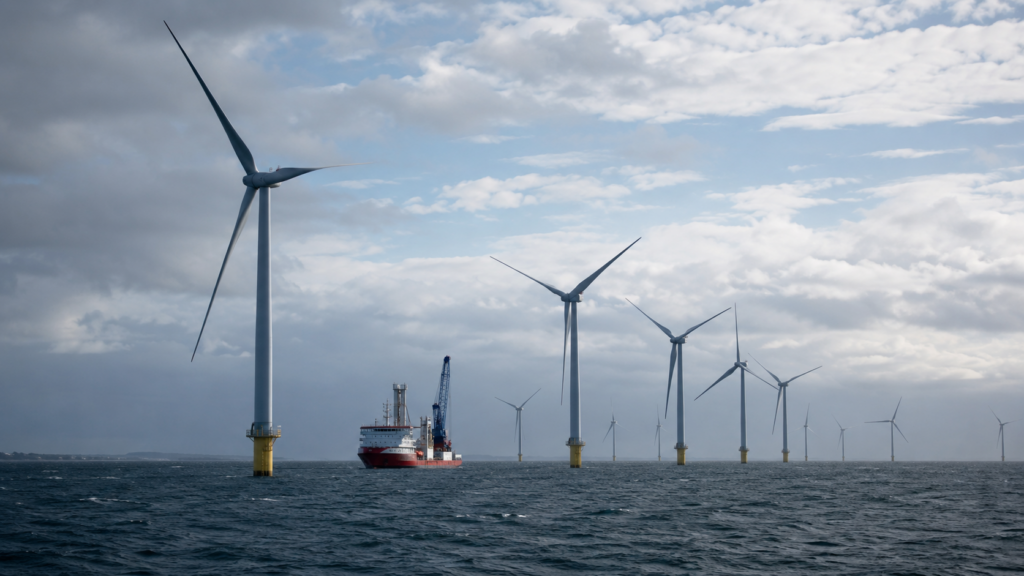
Europe’s offshore wind problem is not a lack of ambition. It is the gap between ambition and execution. Reuters reported that Siemens Gamesa sees the European Union as being around 40 gigawatts short of its 120-gigawatt offshore wind target for 2030. That gap is large enough to affect not only power-sector emissions targets, but also the economics of turbine factories, blade plants, nacelle assembly, installation vessels and service networks.
Germany is especially important. Reuters reported that Siemens Gamesa highlighted 16 gigawatts of German offshore projects that may be at risk because of regulatory and project uncertainty. If a major offshore wind market such as Germany falls behind, the impact spreads across the European supply chain. Turbine manufacturers cannot keep specialised capacity ready indefinitely if customers do not reach investment decisions.
This creates a circular risk. Governments want local manufacturing capacity to support energy security and industrial policy. Manufacturers want stable project pipelines before committing capital and labour. Developers want predictable auctions, grid connections and permitting. If any one part slows down, the entire chain becomes weaker. Europe’s offshore wind sector is therefore not facing a technology problem alone. It is facing a coordination problem with billion-euro consequences.
Why does the Siemens Gamesa warning matter for Siemens Energy AG’s investment case?
The warning matters because Siemens Energy AG’s stock market recovery has been built largely on confidence in gas turbines, grid demand and improving execution, while Siemens Gamesa remains the key uncertainty inside the group. Siemens Energy AG reported Q2 FY2026 orders of €17.7 billion, a book-to-bill ratio of 1.72 and a record order backlog of €154 billion. That is a strong group backdrop, but it also sharpens the contrast between booming grid and gas markets and the more fragile offshore wind cycle.
Investors have rewarded Siemens Energy AG for exposure to power-demand growth, especially from grid investment, electrification, data centres and energy security. The company has become one of Europe’s most important listed power-equipment stories. However, Siemens Gamesa still affects the valuation because wind losses, quality provisions or capacity adjustments can dilute the benefit of strength elsewhere.
The stock context reflects that tension. Siemens Energy AG shares remain up strongly from their 52-week low, but recent market data show weakness over the latest five-day and one-month periods. That suggests investors are not abandoning the story, but they are becoming more selective after a powerful rally. When a stock has already priced in a turnaround, warnings from the least stable division carry extra weight. The market does not need perfection, but it does need evidence that wind will not keep eating the group’s homework.
What does this mean for Europe’s clean-power industrial strategy?
Siemens Gamesa’s warning should concern policymakers because offshore wind is no longer just a climate target. It is also an industrial strategy issue. Europe wants more domestic clean-energy manufacturing, more energy independence and less reliance on imported equipment. Those goals require companies such as Siemens Gamesa to keep investing in people, plants, technology and supply chains.
The risk is that policy delays could weaken the very industrial base Europe wants to defend. If manufacturers scale back capacity because projects are delayed, Europe may become more dependent on imported equipment later. That would undermine the strategic logic behind building local clean-energy manufacturing capability in the first place.
There is also a competitiveness issue. Chinese wind manufacturers have become more prominent globally, while European manufacturers have faced margin pressure, supply-chain inflation and project delays. If Europe wants domestic champions to remain viable, it must make offshore wind deployment easier, not just more aspirational. Targets are useful. Grid permits, auction visibility and bankable contracts are better.
Why are offshore wind economics still difficult despite long-term demand?
Offshore wind remains strategically attractive because Europe needs large volumes of clean electricity for industry, hydrogen, electrification and energy security. However, the economics have become harder. Higher interest rates, supply-chain inflation, larger turbine costs, installation bottlenecks and grid delays have made some projects less attractive than developers originally expected.
That matters for turbine makers because weak project economics can delay orders. Developers cannot commit to turbines unless the entire project works financially. A government auction may create a headline capacity target, but if power prices, grid costs or financing assumptions do not support returns, projects stall. That directly affects manufacturers.
For Siemens Gamesa, the challenge is sharper because the company must rebuild profitability while also protecting technology leadership. It needs enough volume to absorb fixed costs, enough pricing discipline to avoid margin damage and enough policy clarity to plan capacity. Offshore wind has the demand story. What it needs now is the commercial plumbing that turns demand into orders.
How could Siemens Energy AG balance strong gas and grid momentum with wind uncertainty?
Siemens Energy AG is in an unusual position. Its gas and grid businesses are benefiting from powerful structural trends, including data-centre power demand, grid modernisation, energy security investment and the continued need for dispatchable electricity. That has helped lift group orders and investor confidence. Siemens Gamesa, however, sits in a more volatile part of the power transition.
The company can manage this tension in several ways. It can keep focusing on operational discipline inside Siemens Gamesa, reduce exposure to weak-margin projects, preserve service revenue, and push governments for clearer offshore wind frameworks. It can also rely on group strength in gas and grid to absorb some of the wind turnaround pain.
The danger is that investors begin to value Siemens Energy AG as two stories instead of one. One story is a high-demand power infrastructure company supplying grids, gas turbines and energy systems. The other is a wind manufacturer still exposed to policy delays, project economics and capacity risk. If Siemens Gamesa cannot show steady progress, the market may keep applying a discount even while other divisions perform well.
What are the risks for European developers if turbine capacity is reduced?
If Siemens Gamesa or other manufacturers cut European capacity, offshore wind developers could face higher equipment costs, longer delivery times and less flexibility in procurement. That would create another obstacle for projects already dealing with permitting, financing and grid constraints. In a sector where timing and supply-chain reliability matter, lost manufacturing capacity can become a future bottleneck.
There is also a strategic risk for governments. If domestic manufacturers shrink, Europe may find itself trying to accelerate offshore wind deployment later with fewer local production options. That could increase dependence on imported components and expose projects to trade tensions, logistics delays or political pressure.
The impact would not be immediate in every market, but it could become visible later in the decade. Offshore wind supply chains take years to build and are not easy to restart once skilled workers, suppliers and specialised facilities are lost. Capacity cuts may save costs in the short term, but they can weaken the industry’s ability to scale when demand finally arrives.
What should investors watch next in Siemens Energy AG and Siemens Gamesa?
Investors should first watch whether Siemens Gamesa continues narrowing losses and moves closer to breakeven. Siemens Energy AG has already shown improvement in the wind unit, but market confidence depends on sustained progress rather than one strong quarter. The key issue is not whether Siemens Gamesa can survive inside the group. It is whether it can become investable on its own economics.
Second, investors should watch European offshore wind auctions and German project approvals. If Germany and other major markets provide clearer auction schedules, faster grid connections and stronger contract frameworks, the order outlook could improve. If delays continue, the capacity warning becomes more serious.
Third, investors should watch whether Siemens Energy AG continues to benefit from gas and grid strength strongly enough to offset wind volatility. The group’s record order backlog gives it strategic resilience, but the share price has already moved significantly over the past year. That means the next phase of investor sentiment will depend less on turnaround hopes and more on proof that every major division can contribute without creating new surprises.
What happens next if Europe fails to close the offshore wind execution gap?
If Europe fails to close the execution gap, turbine manufacturers may begin protecting margins by reducing capacity, limiting investments or prioritising markets with better project visibility. That would be rational from a corporate perspective, but damaging from an energy-policy perspective. It would mean Europe’s offshore wind ambitions are being slowed not by a lack of technology, but by weak implementation.
For Siemens Energy AG, that scenario would keep Siemens Gamesa under pressure and may delay a cleaner re-rating of the group. Strong gas and grid demand could still support earnings, but the wind division would remain a strategic overhang. Investors may continue valuing Siemens Energy AG as a power-infrastructure winner with a wind-related discount.
If governments respond quickly, the outcome could be very different. Clearer auctions, faster permitting, grid investment and bankable pricing frameworks could stabilise the offshore wind pipeline and protect manufacturing capacity. Siemens Gamesa would then have a stronger path to turning today’s warning into a policy catalyst rather than a capacity-cutting plan. Europe has the demand. Now it needs to make the projects real.
Key takeaways on Siemens Gamesa’s offshore wind warning and Siemens Energy AG stock
- Siemens Gamesa has warned that European turbine manufacturing capacity could face cutbacks if governments fail to accelerate offshore wind expansion and convert targets into bankable projects.
- Reuters reported that Europe remains around 40 gigawatts short of its 120-gigawatt 2030 offshore wind target, creating a serious execution gap for the power sector.
- Germany is a major risk point, with Reuters reporting that 16 gigawatts of planned offshore wind projects could be vulnerable to regulatory and project delays.
- Siemens Energy AG remains a strong broader power-equipment story, with Q2 FY2026 orders of €17.7 billion and an order backlog of €154 billion.
- Siemens Gamesa remains the key uncertainty inside Siemens Energy AG because the wind business is still proving that it can stabilise after years of losses and execution problems.
- Siemens Energy AG shares remain far above their 52-week low, but recent five-day and one-month weakness shows investors are cautious after a powerful rally.
- Europe’s offshore wind challenge is increasingly about permits, grid access, auctions and financing rather than turbine technology alone.
- If manufacturers cut capacity, developers could later face higher costs, longer delivery times and weaker European clean-energy supply-chain resilience.
- The warning puts pressure on policymakers to align industrial strategy with project delivery, because factories cannot survive on targets without orders.
- The executive read is clear: Siemens Gamesa’s warning is not just about one company, it is a stress test for Europe’s offshore wind policy credibility.
Discover more from Business-News-Today.com
Subscribe to get the latest posts sent to your email.