




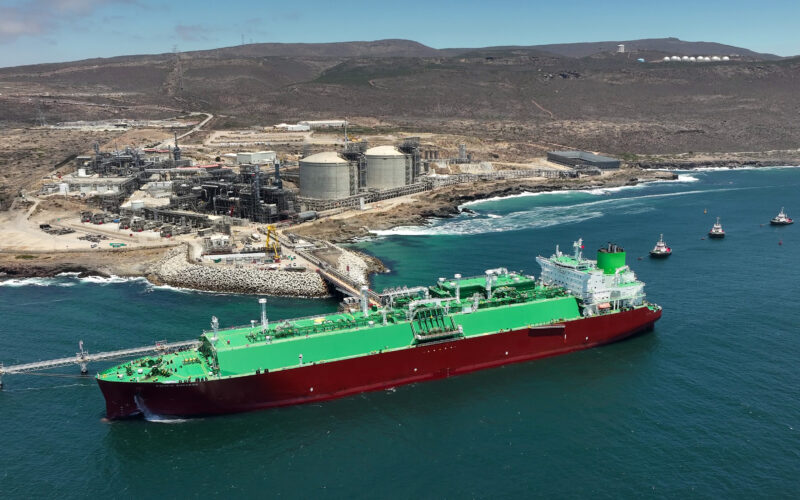
Sempra (NYSE: SRE), through Sempra Infrastructure, has shipped the first liquefied natural gas cargo from ECA LNG Phase 1 in Ensenada, Mexico, marking a confirmed commissioning milestone for one of North America’s most strategically placed LNG export projects. TotalEnergies SE (NYSE: TTE, Euronext Paris: TTE), which owns 16.6% of the project, shipped the first cargo to Asia as the project moves toward full commercial operations. The single-train facility has nameplate capacity of 3.25 million tonnes per annum and is backed by long-term sale and purchase agreements with TotalEnergies SE and Mitsui & Co., Ltd. Sempra shares were trading around $95.33 on July 9, about 5.7% below their 52-week high of $101.04, while TotalEnergies SE’s U.S.-listed shares were around $78.87, keeping both listed parents under investor focus as LNG demand, shipping routes and project execution converge.
Why does Sempra Infrastructure’s first ECA LNG cargo matter for Mexico’s Pacific Coast energy strategy?
The first cargo from ECA LNG Phase 1 matters because it turns Mexico’s Pacific Coast LNG export proposition from a long-planned infrastructure thesis into an operating reality. The cargo does not mean the project has fully entered commercial operations, and that distinction is important. It does, however, confirm that the facility has advanced beyond first LNG production into physical export activity, which is a materially stronger project signal than construction progress alone.
For Mexico, the milestone is strategically significant because ECA LNG Phase 1 gives the country a role in North American LNG exports that is different from the U.S. Gulf Coast model. The facility is designed to use U.S. natural gas and export LNG from Baja California, offering a Pacific-facing route to Asian and Pacific Basin buyers. That geography creates a commercial angle that Gulf Coast projects cannot replicate without longer voyages through the Panama Canal or around more congested shipping corridors.
For Sempra Infrastructure, the first cargo strengthens the credibility of its dual-coast LNG platform. Sempra Infrastructure is not relying only on Gulf Coast scale through projects such as Port Arthur LNG and Cameron LNG. ECA LNG Phase 1 gives the company a smaller but strategically differentiated Pacific export position, which could become more valuable if Asian buyers continue to prioritise supply diversity, shorter routes and destination flexibility.
How does the ECA LNG Phase 1 project change the shipping economics for LNG buyers in Asia?
ECA LNG Phase 1’s central commercial advantage is location. LNG exported from Mexico’s Pacific Coast can move to Asia without the same shipping route complexity faced by cargoes loaded on the U.S. Gulf Coast. For buyers in Japan, South Korea, China and other Pacific Basin markets, shorter routing can reduce voyage time, shipping cost and logistical uncertainty, particularly when canal congestion, geopolitical risk or freight-market volatility affects global LNG movements.
This does not automatically make ECA LNG Phase 1 cheaper in every market condition. LNG pricing depends on feed gas costs, liquefaction fees, shipping rates, destination economics and portfolio optimisation. However, location can become a powerful advantage when buyers are comparing flexible North American LNG options. A Pacific Coast cargo can fit more naturally into Asian delivery schedules, especially for portfolio players that must balance long-term obligations with spot-market opportunities.
The implication for competitors is clear. Gulf Coast LNG projects have scale, deep infrastructure and a large project pipeline, but the Pacific route offers a more direct path to Asian demand. That does not replace the Gulf Coast. It adds another lane. In LNG, adding another lane matters because the industry spends a surprising amount of money and stress moving cold molecules across hot geopolitical maps.
What does the first ECA LNG cargo mean for Sempra’s wider LNG portfolio strategy?
For Sempra, ECA LNG Phase 1 is not the largest LNG project in its portfolio, but it is one of the most distinctive. The 3.25 million tonnes per annum nameplate capacity is modest compared with mega-projects on the U.S. Gulf Coast, yet the project’s location gives it a strategic value that cannot be measured by capacity alone. Smaller does not mean less important when the asset sits on the right side of the map.
The first cargo also helps Sempra demonstrate project execution at a time when investors are watching capital discipline across the LNG sector. North American LNG developers have spent years signing long-term offtake agreements, seeking permits, raising financing and managing cost inflation. A cargo moving from the dock is a much clearer signal than a development update because it shows physical commissioning progress and customer delivery capability.
Sempra’s wider challenge is to convert this milestone into repeatable commercial performance. ECA LNG Phase 1 is expected to reach substantial completion in the summer of 2026, with long-term sales commencing after the facility begins commercial operations. Until that happens, the project remains in the final stretch between commissioning success and steady contracted revenue. For investors, that is usually where optimism meets the punch list.
Why is TotalEnergies SE’s role important in the ECA LNG Phase 1 commercial model?
TotalEnergies SE’s involvement gives ECA LNG Phase 1 both equity alignment and offtake depth. The French energy major owns 16.6% of the project and has a 20-year commitment to offtake 1.7 million tonnes per annum from the start of commercial operations. That matters because LNG projects are only as bankable as their long-term revenue base, and contracted offtake by large global buyers is central to project finance confidence.
TotalEnergies SE also brings portfolio flexibility. As an integrated global LNG player, TotalEnergies SE can place cargoes across multiple markets, optimise destination decisions and use its trading capabilities to manage timing, pricing and shipping exposure. For ECA LNG Phase 1, that reduces reliance on a narrow buyer base and strengthens the project’s relevance to Asian customers looking for flexible North American supply.
Mitsui & Co., Ltd. adds another important commercial layer because Japanese trading houses have long played a major role in LNG supply chains, buyer relationships and project structuring. With TotalEnergies SE and Mitsui & Co., Ltd. supporting long-term sale and purchase agreements, ECA LNG Phase 1 has a contracted foundation that is stronger than a speculative export terminal trying to win buyers after construction. The project still has execution risks, but the commercial structure is not starting from zero.
How should investors read Sempra stock sentiment after the ECA LNG first cargo milestone?
Sempra stock is trading in a range that suggests investors already assign value to the company’s regulated utility base and infrastructure growth options. At around $95.33 on July 9, Sempra shares were roughly 30% above their 52-week low of $73.18 and around 5.7% below the 52-week high of $101.04. Available market snapshots also show Sempra up about 1.35% over the past week and around 4.57% over the past month, indicating constructive recent sentiment before the LNG milestone fully filters into the equity narrative.
The market read is not purely about ECA LNG Phase 1. Sempra remains a utility and infrastructure company with regulated earnings, capital spending obligations and broader investor sensitivity to interest rates. LNG adds growth optionality, but it does not define the entire valuation on its own. That is important because investors should not treat one first cargo as a valuation reset event.
The better interpretation is that the ECA LNG milestone strengthens Sempra’s infrastructure credibility. It gives investors evidence that Sempra Infrastructure can move a complex LNG project from development through commissioning toward commercial operations. If the project transitions smoothly into contracted sales, the market may view Sempra’s wider LNG pipeline with greater confidence. If delays, technical issues or cost disputes emerge, the first cargo will matter less than the operating reliability that follows.
What does TotalEnergies SE gain from shipping the first ECA LNG cargo to Asia?
For TotalEnergies SE, the first ECA LNG cargo is a portfolio optimisation event as much as a project milestone. The company has made natural gas and LNG a major part of its long-term energy mix, with LNG positioned as a bridge fuel and a source of flexible global supply. ECA LNG Phase 1 adds a North American Pacific Coast source that can feed Asian demand more directly than many Atlantic Basin cargoes.
TotalEnergies SE’s U.S.-listed shares around $78.87 on July 9 were below their 52-week high of $94.17 but well above their 52-week low of $57.39. That market position reflects a broader integrated-energy debate: investors like LNG exposure when global gas margins, shipping routes and demand growth cooperate, but they also weigh oil-price volatility, capital allocation, shareholder returns and policy pressure on fossil fuel portfolios. ECA LNG Phase 1 gives TotalEnergies SE another useful supply node, but it is not large enough by itself to transform group earnings.
The strategic value lies in flexibility. A 1.7 million tonnes per annum offtake position from Mexico’s Pacific Coast gives TotalEnergies SE another lever in its global LNG trading system. In an industry where buyers want reliability and optionality, that flexibility is commercially valuable. It also reinforces TotalEnergies SE’s North American LNG footprint without requiring the company to control the full project.
Why does the ECA LNG Phase 1 milestone matter for U.S. natural gas producers?
ECA LNG Phase 1 is in Mexico, but its feed gas connection makes it relevant to U.S. natural gas producers. The project is designed to export U.S. natural gas as LNG from Mexico’s Pacific Coast, effectively creating another demand channel for North American gas. That can be strategically useful for producers facing domestic price volatility, regional bottlenecks and a constant search for durable export demand.
The direct impact should not be overstated because 3.25 million tonnes per annum is not a mega-scale demand shock for the U.S. gas market. Still, every contracted export outlet adds incremental structural demand, particularly when tied to long-term buyers. For producers and midstream operators, LNG export capacity matters because it links domestic supply basins to global gas pricing and gives infrastructure developers a stronger reason to invest in pipeline connectivity.
The project also illustrates how North American gas monetisation is becoming more geographically sophisticated. The U.S. Gulf Coast remains the dominant LNG export hub, but the Pacific Coast route can serve a different logistical function. If ECA LNG Phase 1 performs well, it may strengthen arguments for further Pacific-facing gas export infrastructure, although any larger expansion would still face permitting, financing, environmental and commercial hurdles.
What execution risks remain before ECA LNG Phase 1 becomes a steady commercial asset?
The first cargo is a major milestone, but the remaining execution risks are real. Commissioning an LNG facility involves testing liquefaction systems, loading operations, utilities, safety systems, feed-gas integration and operational reliability under increasingly commercial conditions. A first cargo demonstrates that the system can work, not that it has reached steady-state performance.
The project still needs to reach substantial completion and begin sales under long-term agreements. That final transition can expose issues that were not fully visible during construction. LNG plants are complex industrial systems, and early operations often involve tuning equipment, resolving performance constraints and stabilising cargo schedules. Investors should watch whether ECA LNG Phase 1 moves from first cargo to dependable contracted deliveries without meaningful delay.
There is also the broader risk around Phase 2 expectations. A second and significantly larger phase is under active development at the same site, but active development is not the same as a final investment decision. The first phase improves the credibility of the site and the operator, but it should not be treated as confirmation that the larger expansion will proceed. Phase 2 would require its own commercial, regulatory, financing and construction logic.
How could ECA LNG Phase 1 influence the next wave of North American LNG competition?
ECA LNG Phase 1 adds a new competitive signal to the North American LNG market: route advantage can matter as much as scale. Gulf Coast developers compete on liquefaction capacity, feed gas access, brownfield advantages, permitting status and long-term contracts. ECA LNG Phase 1 adds another dimension by using Mexico’s Pacific Coast to create a shorter export pathway to Asia.
This could affect how buyers think about portfolio construction. Asian LNG buyers may still want large Gulf Coast contracts because scale and liquidity matter, but a Pacific Coast supply option can reduce route concentration and shipping exposure. In an increasingly uncertain world, supply diversification is not just a procurement slogan. It is the corporate version of not putting all your cold gas on one boat route.
For Sempra Infrastructure, the first cargo strengthens the company’s claim to a differentiated North American LNG platform. For competitors, the message is that the LNG industry’s next phase will not reward capacity alone. It will reward projects that combine credible execution, contracted demand, financing discipline, favourable routes and regulatory resilience. ECA LNG Phase 1 has now cleared one important test. The harder test is proving that the first cargo becomes a reliable commercial flow.
What are the key takeaways from Sempra’s ECA LNG Phase 1 first cargo milestone?
- Sempra Infrastructure’s ECA LNG Phase 1 first cargo is a confirmed export milestone, not a non-binding development announcement.
- The project is still moving toward full commercial operations, so first cargo should not be confused with complete long-term revenue ramp-up.
- ECA LNG Phase 1 gives Sempra a differentiated Pacific Coast LNG position that complements its Gulf Coast LNG portfolio.
- The 3.25 million tonnes per annum single-train facility is smaller than many Gulf Coast projects but has stronger route logic for Asian buyers.
- TotalEnergies SE’s 16.6% equity stake and 1.7 million tonnes per annum long-term offtake commitment strengthen the project’s commercial foundation.
- Mitsui & Co., Ltd.’s involvement adds buyer credibility and reinforces the project’s relevance to Asian LNG markets.
- Sempra stock sentiment is constructive, with shares recently trading well above their 52-week low and supported by infrastructure growth expectations.
- TotalEnergies SE gains another flexible North American LNG supply source that can be integrated into its global trading and customer portfolio.
- The main risks now are commissioning reliability, substantial completion timing, cargo scheduling, commercial operations ramp-up and any over-interpretation of Phase 2 development.
- The wider LNG industry read is that route advantage, buyer quality and execution discipline are becoming as important as project size.
Discover more from Business-News-Today.com
Subscribe to get the latest posts sent to your email.


