


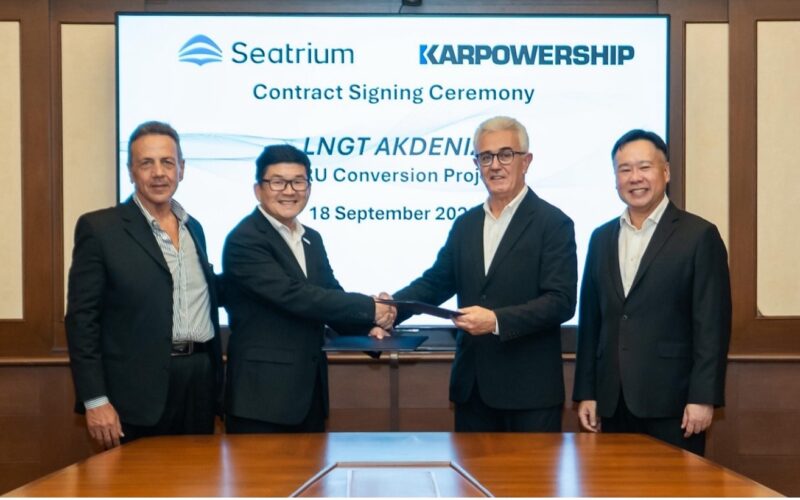
Seatrium Limited (SGX: 5E2) has secured another floating storage and regasification unit conversion from Karpowership, extending one of the Singapore marine engineering group’s most established repeat-customer relationships as demand grows for flexible LNG infrastructure. The LNGT Akdeniz project will become the ninth FSRU conversion undertaken by Seatrium for Karpowership and the second unit to emerge from a broader letter of intent covering three LNG carrier conversions and potential integration work on new-generation Powerships. Work is scheduled to begin in the first quarter of 2027, with LNGT Akdeniz designed for regasification capacity of up to 600 million standard cubic feet per day. The contract value has not been disclosed, making project execution, follow-on awards and the wider value of the Karpowership pipeline more important than attempting to infer immediate revenue from the announcement.
The October 5 award follows the recent naming and sailaway of LNGT Türkiye, which completed an earlier seven-vessel conversion programme that began in 2018. Seatrium is also working on LNGT Karadeniz, the eighth FSRU in the partnership and the first project to materialise from the companies’ newer letter of intent. Karpowership’s energy transition initiative, Kinetics, is expected to expand its LNG fleet to 12 vessels after LNGT Akdeniz is added, while Karpowership itself operates 45 Powerships with more than 8,500 megawatts of installed generating capacity. The relationship is therefore moving from a completed seven-vessel programme into a second phase combining larger FSRUs with the possibility of additional floating power integration work.
Why does LNGT Akdeniz matter more than another routine vessel conversion for Seatrium?
The strategic value of LNGT Akdeniz lies in repeatability. Seatrium is not acquiring a new customer or developing an unfamiliar engineering scope from the beginning; it is extending a programme with a counterparty that has already sent eight FSRU conversion projects through its yards. That accumulated experience can reduce engineering repetition, improve planning and allow lessons from earlier vessels to be applied to later conversions.
The new vessel is also part of what Seatrium describes as Karpowership’s next-generation FSRU series. Like LNGT Karadeniz, LNGT Akdeniz is designed for regasification capacity of up to 600 million standard cubic feet per day, making the two projects substantially more than floating LNG storage assets. The vessels are intended to receive LNG, store it and convert it back into gaseous form for delivery into power generation or other downstream infrastructure.
Seatrium’s scope covers engineering, conversion, integration, installation and commissioning of the regasification equipment and associated systems. The commercial attraction is that these projects require considerably more specialist work than straightforward repair and maintenance, creating an opportunity for Seatrium to capture higher-value engineering revenue within its Repairs and Upgrades segment.
Repeat designs can also improve yard efficiency. Once engineering teams have worked through a first unit, later vessels can potentially benefit from more mature designs, established supplier relationships and improved scheduling. The eventual margin contribution cannot be determined without contract economics, but the programme structure is consistent with Seatrium’s broader preference for repeat and series-based work that can provide greater execution certainty.
How does the ninth FSRU fit the larger Karpowership and Seatrium agreement?
The current expansion traces back to a letter of intent announced in 2025. That framework covered conversion, life extension and repair of three LNG carriers into FSRUs, together with integration of four new-generation Powerships and options covering another two Powership units.
LNGT Karadeniz became the first FSRU conversion to move from that framework into a firm project. LNGT Akdeniz is now the second. One additional FSRU conversion contemplated by the original letter of intent therefore remains a potential future opportunity, although it should not be treated as an awarded contract until the companies announce that it has formally materialised.
The Powership element could expand the relationship further. Karpowership’s business model combines floating electricity generation with increasingly integrated access to LNG supply, allowing gas to be delivered, regasified and used by floating power plants without requiring countries to construct all elements of conventional onshore infrastructure first. Seatrium’s engineering capabilities could therefore participate in both sides of that system, FSRUs handling LNG and Powerships generating electricity.
Not every potential unit in the framework is committed revenue for Seatrium. The distinction between the letter of intent, firm project awards and optional units is financially important because a large potential programme can create a valuable commercial pipeline without every component ultimately being executed.
The progression from LNGT Karadeniz to LNGT Akdeniz nevertheless increases evidence that the framework is converting into actual work rather than remaining a broad statement of intent. Another FSRU award or commencement of the Powership integration programme would strengthen that conclusion further.
Why are FSRU conversions attractive as countries seek faster LNG import capacity?
Floating storage and regasification units offer an alternative to conventional onshore LNG import terminals. Instead of constructing the entire storage and regasification chain on land, an LNG carrier can be converted into a vessel capable of receiving LNG, storing it and turning the liquid fuel back into gas for delivery ashore.
The attraction is flexibility. FSRUs can often be developed more quickly than large onshore terminals, particularly where suitable marine infrastructure exists, while the vessels can potentially be redeployed if market requirements change. For countries facing urgent gas shortages, rapidly growing electricity demand or a need to diversify fuel supplies, that mobility can have considerable strategic value.
Karpowership adds another dimension by combining FSRUs with floating power generation. The company’s Powership model is designed to deliver generation capacity without waiting for an entire conventional power station to be built onshore. Pairing an FSRU with floating power assets can therefore create an integrated LNG-to-power system in locations where both fuel-import and generation infrastructure are constrained.
The economics still depend heavily on LNG prices, utilisation, local infrastructure and the duration of the underlying power requirement. Floating infrastructure is not automatically cheaper than permanent land-based facilities over every project life. Its strongest proposition is speed, flexibility and the ability to deploy significant infrastructure where conventional development could take considerably longer.
That environment creates a specialist niche for Seatrium. Conversion projects require marine engineering, LNG handling expertise, integration of regasification modules and modification of existing vessel systems, giving established yards an advantage over businesses without a long conversion record.
What does the Karpowership relationship mean for Seatrium’s Repairs and Upgrades business?
Seatrium increasingly describes Repairs and Upgrades as a resilient source of recurring activity beneath its larger offshore newbuild and infrastructure projects. FSRU conversions fit particularly well within that strategy because they can combine the shorter-cycle characteristics of yard work with more complex engineering content than routine maintenance.
The segment also reduces dependence on individual multi-billion-dollar project awards. Seatrium’s largest offshore production and wind projects can extend over several years and create significant swings in order-book additions when contracts are signed. Repairs, LNG carrier work, conversions and upgrades provide a broader flow of smaller projects across the company’s yard network.
Seatrium reported revenue of S$5.6 billion for the first half of 2026, up 4.7% from a year earlier. Net profit climbed 158% to S$373 million, although that figure included gains from asset divestments. Excluding those gains, net profit increased 54% to S$212 million, while gross margin improved to 8.6% from 7.4%.
The margin improvement is particularly relevant when assessing new conversion work. Management has been emphasizing contract selectivity, execution discipline and a shift toward higher-value projects rather than pursuing order-book growth regardless of profitability. An undisclosed contract value means investors cannot judge LNGT Akdeniz on price alone, but repeat work with an established customer can support that strategy if the engineering and operational learning from earlier units translates into more efficient execution.
At June 30, Seatrium had a net order book of S$13.3 billion across 24 projects with deliveries extending to 2033. More than 95% comprised Series Build projects, while lower-margin legacy non-FPSO work had fallen to about 1% of the order book. Management also identified more than S$32 billion of opportunities over the following 24 months, including about S$2 billion across conversion opportunities.
Could LNGT Akdeniz improve Seatrium’s margins even though the contract value is undisclosed?
There is not enough disclosed information to calculate the financial return from LNGT Akdeniz. Seatrium has not published the contract price, estimated project margin, milestone-payment structure or expected revenue recognition schedule. Treating the award as immediately material to group earnings would therefore exceed the available evidence.
The project can still be strategically attractive without being individually transformative. Repeat conversions allow Seatrium to reuse engineering knowledge and supplier relationships, while the customer relationship reduces some of the commercial uncertainty associated with working with a new counterparty. The planned first-quarter 2027 start also provides additional workload visibility for the Repairs and Upgrades business.
The larger financial opportunity lies in programme economics. If LNGT Akdeniz is followed by the third FSRU contemplated under the letter of intent and Powership integration awards, Seatrium could convert a single customer relationship into a multi-year sequence of projects. That creates more potential value than judging the ninth conversion as an isolated vessel contract.
Execution remains the determinant. Conversion work involves integrating new equipment into an existing ship rather than constructing every system from a standardized newbuild design. Differences in vessel condition, equipment interfaces and commissioning requirements can create engineering challenges, meaning the value of repeat experience is realized only when it translates into schedule discipline and controlled costs.
Seatrium’s improving gross margin gives investors a useful benchmark against which future performance can be assessed. If project mix continues moving toward repeat, higher-quality contracts while margins progress, awards such as LNGT Akdeniz would support management’s claim that the business is shifting from recovery toward more durable value creation.
How does Seatrium’s current financial recovery change the significance of new FSRU awards?
The latest award arrives with Seatrium in a stronger financial position than during the earlier stages of its post-merger restructuring. First-half 2026 profitability improved materially, non-core asset divestments reduced structural costs and management continued working toward its fiscal 2028 steady-state targets.
The group has also been strengthening its capital structure. Earlier in 2026, Seatrium established a S$3 billion multicurrency debt issuance programme and issued S$400 million of 2.95% senior unsecured notes due in 2031. The longer-term objective is to diversify funding and provide greater flexibility as the company executes a large offshore and marine order book.
Capital returns have become more visible as well. In September, Seatrium announced a new S$200 million share buyback programme after completing an earlier S$100 million programme, indicating that the board sees sufficient balance-sheet capacity to return capital while continuing to fund operations and growth.
Those developments make order quality increasingly important. During a recovery phase, investors may focus heavily on rebuilding revenue and eliminating legacy losses. Once profitability stabilizes, attention shifts toward whether each incremental contract can support margins, cash generation and returns on capital.
FSRU conversions offer one route toward that goal because Seatrium already possesses the relevant yard infrastructure and accumulated engineering experience. The real evidence will come through group margins and cash flow rather than the number of vessel awards alone.
What does Seatrium’s share price say before investors react to the LNGT Akdeniz award?
Seatrium shares closed at S$2.03 on October 2, down 0.49% for the session. The LNGT Akdeniz announcement was released before the Singapore market opened on October 5, meaning there was no valid post-announcement share-price reaction available at the time of writing.
The stock had eased from S$2.15 on September 3 to S$2.03 by October 2, a decline of about 5.6% over that period. It was also down roughly 3.3% over the latest five trading sessions and around 6% since the start of 2026. The 52-week range stood at approximately S$1.92 to S$2.51, placing the latest close toward the lower half of that range.
Seatrium’s market capitalisation was approximately S$6.9 billion at the latest close. That valuation is being assessed against a business whose earnings have improved considerably, but whose future returns still depend on project margins, order replenishment and disciplined execution across a large portfolio of technically complex projects.
The ninth Karpowership FSRU is unlikely to determine the valuation by itself, particularly because the financial terms are undisclosed. A more meaningful market signal would come from a sequence of follow-on conversions, Powership integration contracts or additional LNG-related projects that strengthens order-book quality and supports earnings beyond the current project cycle.
What should investors watch as LNGT Akdeniz moves toward its 2027 yard start?
The first operational milestone is commencement of conversion work in the first quarter of 2027. Seatrium will then need to execute engineering, equipment installation, systems integration and commissioning while LNGT Karadeniz is also progressing through the next-generation FSRU programme.
The second milestone is commercial. The original letter of intent still leaves room for another FSRU conversion and potential integration of new-generation Powerships. Firm awards from those opportunities would extend the relationship from nine FSRUs into a considerably broader floating energy programme.
A third indicator will be Seatrium’s wider Repairs and Upgrades performance. Investors should look for evidence that repeated LNG, cruise, naval and offshore conversion work is providing a stable earnings base while group gross margins continue improving.
The Karpowership relationship already demonstrates unusual customer continuity. Seven FSRUs have been delivered since 2018, an eighth is under conversion and a ninth now has a scheduled 2027 start. That history reduces the significance of any single contract announcement but increases the strategic importance of the programme as a whole.
LNGT Akdeniz therefore matters because it shows the next phase is continuing to convert from framework agreements into firm work. Seatrium’s stronger financial position makes the next test more demanding: the company now needs these repeat contracts to contribute not simply to yard activity, but to the sustained margin, cash-flow and return improvements underpinning its move from restructuring toward long-term value creation.
What are the key takeaways from Seatrium’s LNGT Akdeniz FSRU contract?
- Seatrium has secured LNGT Akdeniz, its ninth FSRU conversion project for Karpowership.
- The project will convert an LNG carrier into a floating storage and regasification unit with capacity of up to 600 million standard cubic feet per day.
- Conversion work is scheduled to begin in the first quarter of 2027.
- Seatrium’s scope includes engineering, conversion, integration, installation and commissioning of regasification equipment and associated systems.
- LNGT Akdeniz will become part of the LNG fleet operated through Karpowership’s Kinetics initiative.
- Seven earlier FSRUs have already been delivered, while LNGT Karadeniz is currently the eighth conversion project in the partnership.
- LNGT Akdeniz is the second FSRU to become a firm project from the companies’ earlier letter of intent covering three conversions.
- The wider framework also contemplates integration of four new-generation Powerships and options for another two units.
- The contract value, expected margin and revenue contribution have not been disclosed.
- Seatrium reported first-half 2026 revenue of S$5.6 billion and net profit of S$373 million, with net profit excluding divestment gains rising 54% to S$212 million.
- The group held a S$13.3 billion net order book at June 30, with more than 95% comprising Series Build projects.
- Seatrium shares closed at S$2.03 on October 2, before the LNGT Akdeniz announcement, meaning there was no post-announcement market reaction available at the time of writing.
Discover more from Business-News-Today.com
Subscribe to get the latest posts sent to your email.