


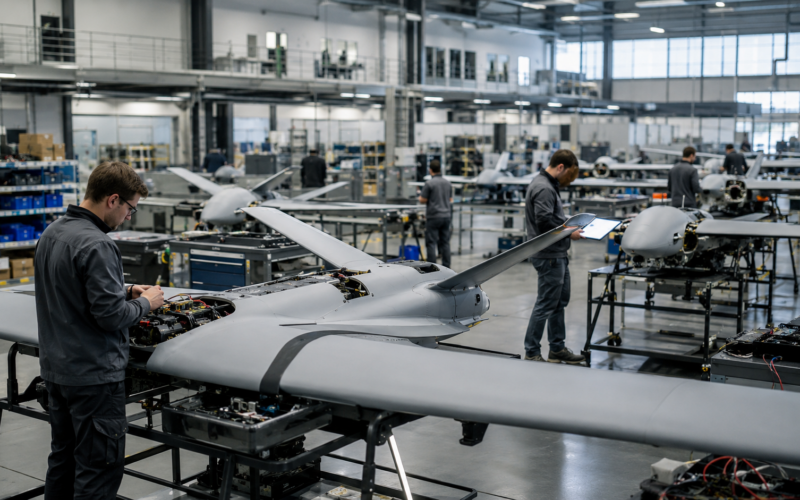
Schaeffler AG (XETR: SHA0) has entered a strategic partnership with French drone manufacturer Delair to industrialise production of military drones and interceptors in France. The companies plan to launch a production line capable of delivering around 100 units a day by November 2026, initially covering the Damoclès drone and Aspik interceptor. The agreement moves Schaeffler beyond conventional component supply into the higher-value tasks of serial assembly, production scaling and defence supply-chain development. For investors, the deal is another concrete step towards Schaeffler’s target of generating about 10 percent of revenue from new growth fields such as defence, New Space and humanoid robotics by 2035.
Why does the Schaeffler and Delair partnership matter beyond producing 100 drones a day?
The headline production target is significant because it suggests an annualised capacity of roughly 25,000 units if the line operates for around 250 production days. The actual output will depend on orders, utilisation rates, component availability and customer acceptance, but even partial utilisation would represent a substantial industrial ramp-up for a specialised European drone manufacturer. Delair gains access to manufacturing disciplines developed for high-volume automotive and industrial supply chains, while Schaeffler gains entry into a market where production reliability is becoming almost as important as aircraft performance.
Schaeffler is expected to support serial assembly, component supply and the broader industrialisation of Delair’s production system. That role is strategically different from simply selling bearings, actuators or other individual components into a defence programme. It provides Schaeffler with visibility into product architecture, manufacturing bottlenecks, supplier qualification, production testing and lifecycle support, all of which could help the company build reusable capabilities for future drone and aerospace programmes.
For Delair, the partnership addresses one of the central weaknesses facing many European defence technology companies. Smaller developers can often design effective platforms and demonstrate them in operational conditions, but they may lack the production engineering, procurement leverage and quality-control systems required for sustained output. A clever prototype can win attention, but governments ultimately procure delivered units, replacement systems and dependable production capacity. Factories are less glamorous than flight demonstrations, yet wars have an inconvenient habit of consuming equipment faster than presentation slides can replace it.

How could automotive-scale industrialisation change European military drone economics?
Automotive suppliers operate around repeatability, tight tolerances, supplier coordination, cost reduction and continuous production improvement. These capabilities are relevant to military drones because many unmanned systems increasingly need to be treated as scalable industrial products rather than bespoke aerospace programmes. The economics become particularly important for systems that may be used in large numbers, lost during operations or replaced frequently as electronic warfare and counter-drone technologies evolve.
Schaeffler could help Delair redesign assembly processes to reduce production time, standardise subassemblies and improve component availability. Even without changing the basic drone design, manufacturing engineering can lower labour hours per unit, improve testing throughput and reduce production defects. This can make a platform more competitive in export tenders, where buyers increasingly compare not only range, payload and endurance but also cost per mission, delivery schedules and the ability to replenish inventory.
The partnership also reflects a wider convergence between the automotive, industrial technology and defence sectors. European governments want faster defence production, while automotive suppliers face slower growth in parts of the traditional combustion-engine market and uneven electric-vehicle demand. Defence offers higher structural growth, longer procurement cycles and potentially more resilient demand, although it also introduces stricter security, export-control and customer-concentration risks.
This does not mean Schaeffler can simply transplant an automotive production line into defence and expect instant results. Military products require traceability, configuration control, secure data handling and extensive customer qualification. However, companies that can combine defence compliance with commercial manufacturing efficiency may gain an advantage over traditional suppliers whose production structures were designed for smaller volumes and much longer programme timelines.
What do the Damoclès and Aspik production plans reveal about France’s defence priorities?
The new French production line is intended to manufacture Delair’s Damoclès drone and the newly announced Aspik interceptor. Damoclès has already been qualified by France’s defence procurement authority and is used by the French Army, reducing some of the technical and procurement uncertainty that usually surrounds an early-stage platform. Aspik adds exposure to the rapidly expanding counter-drone market, where armed forces need lower-cost systems capable of intercepting hostile unmanned aircraft without relying exclusively on expensive missiles.
Producing both offensive or reconnaissance-capable drones and interceptors on a common industrial platform could give Delair greater flexibility. Demand patterns can change quickly depending on operational experience, government budgets and battlefield requirements. A production system designed around modular processes and shared components may allow the manufacturer to switch capacity between product families more easily than a line built around a single programme.
France also gains a domestically located production base supported by a major German industrial group. That structure fits Europe’s broader objective of reducing reliance on non-European suppliers for strategically important defence equipment. It could also create a foundation for multinational procurement if other European governments accept the platforms, although national certification requirements and fragmented purchasing processes remain barriers.
The location in France is strategically useful for Delair, but the partnership has a wider European character. Schaeffler contributes German manufacturing depth, Delair contributes French drone design and operational experience, and potential customers extend across European and allied markets. This type of cross-border industrial model could become more common as governments demand European sovereignty while also recognising that purely national supply chains may not deliver sufficient scale.
Can Schaeffler turn defence and New Space into a meaningful revenue engine by 2035?
The Delair agreement should be viewed alongside Schaeffler’s creation of STech Defence GmbH, an independent subsidiary intended to consolidate the group’s defence and New Space activities. Schaeffler has appointed experienced aerospace and defence executive Celia Pelaz to lead the business from October 2026. These moves suggest that defence is being built as an organised business platform rather than handled through occasional component contracts scattered across the wider group.
Schaeffler wants new growth areas outside its established businesses to account for approximately 10 percent of group revenue by 2035. The target also includes humanoid robotics and New Space, so defence alone will not need to deliver the full amount. Nevertheless, reaching that level will require more than pilot programmes and memoranda of understanding. Schaeffler will need recurring production contracts, proprietary product content and a growing pipeline of defence customers.
The company’s existing industrial capabilities provide a credible starting point. Schaeffler produces precision bearings, electric motors, power electronics, actuators, chassis systems and other motion-related technologies that can be adapted for drones, satellites, robotics and military vehicles. The Vitesco Technologies integration has further expanded the group’s electronics and electrification capabilities, potentially giving Schaeffler a broader technology base for autonomous and remotely operated systems.
The commercial challenge is that defence programmes can take time to convert into material revenue. Announced production capacity does not automatically become sales, and political enthusiasm does not always translate into funded orders. Schaeffler will therefore need to demonstrate that its new activities can contribute attractive margins and cash flow without distracting management from the integration, restructuring and operational improvement required in its much larger automotive and industrial businesses.
What are the biggest execution risks in reaching the November 2026 production target?
The first risk is timing. Moving from partnership announcement to a production line capable of 100 units a day within roughly five months requires rapid equipment installation, supplier qualification, worker training, process validation and testing capacity. Any bottleneck involving propulsion systems, electronics, communications modules, sensors or specialised materials could prevent the line from reaching its theoretical rate.
The second risk is demand visibility. Neither Schaeffler nor Delair disclosed the value of the partnership, committed order volumes or the expected financial contribution. A line capable of producing 100 units a day creates useful strategic capacity, but underutilised defence capacity can become expensive. Investors will need evidence of government orders, framework agreements or export customers before treating the output target as a dependable revenue forecast.
The third risk is product evolution. Drone designs are changing rapidly in response to electronic warfare, countermeasures and operational feedback. High-volume production can lower costs, but it can also create inventory risk if a design becomes outdated before units are delivered. The production system must therefore support frequent engineering changes without disrupting throughput or compromising quality.
Security and export controls create another layer of complexity. Drone manufacturing involves sensitive designs, software, communications technology and customer information. Schaeffler and Delair will need strong controls across employees, suppliers, data systems and physical production sites. Export approvals could also limit access to certain markets or delay deliveries even when commercial demand exists.
Why has Schaeffler stock weakened despite a broader strategic rerating story?
Schaeffler AG shares were recently quoted at around €9.05, with the stock down approximately 5.7 percent over the preceding week and about 3 percent over one month. The shares remained within a 52-week range of approximately €4.13 to €11.99. That places the stock about 24.5 percent below its 52-week high but roughly 119 percent above its low, indicating that the recent weakness follows a much larger medium-term rerating.
The short-term pullback should not automatically be interpreted as a negative verdict on the Delair agreement. The partnership was announced without order values, investment requirements, revenue guidance or margin targets, leaving limited information for investors to insert into financial models. The market is therefore more likely to treat the announcement as strategic evidence rather than a near-term earnings catalyst.
Investor sentiment appears balanced between optimism about Schaeffler’s portfolio transformation and caution about execution. The company is integrating Vitesco Technologies, navigating subdued demand in parts of the automotive market and funding growth initiatives across electrification, industrial technology, robotics, space and defence. That creates substantial optionality, but it also raises questions about management bandwidth and capital-allocation discipline.
Schaeffler has maintained 2026 guidance for revenue of approximately €22.5 billion to €24.5 billion, an adjusted operating margin of 3.5 percent to 5.5 percent and free cash flow before acquisitions of €100 million to €300 million. Against that scale, the Delair partnership is unlikely to transform group earnings immediately. Its importance lies in whether it becomes the first repeatable model for converting Schaeffler’s manufacturing platform into profitable defence production.
What should competitors and policymakers watch as automotive suppliers enter defence?
Automotive suppliers across Europe are evaluating whether production assets, engineering expertise and skilled workforces can be redirected towards defence. Schaeffler’s move follows a broader pattern in which manufacturers seek to combine commercial production methods with military technology. Renault Group, for example, is working with Thales to scale drone manufacturing in France, showing that the industrial crossover is no longer an isolated experiment.
Traditional defence contractors should watch whether these partnerships materially reduce unit costs and delivery times. Automotive companies may lack defence programme experience, but they bring procurement scale, automation expertise and mature production systems. Specialist defence manufacturers may respond by forming their own industrial partnerships, acquiring production capabilities or simplifying product designs for higher-volume assembly.
Policymakers will need to decide whether they are willing to support capacity before demand is fully contracted. Europe’s defence-production weakness has partly resulted from stop-start ordering, fragmented national requirements and limited long-term visibility for manufacturers. Companies will invest more confidently when governments provide multiyear procurement commitments rather than requesting emergency output after inventories are already depleted.
The Schaeffler and Delair partnership is therefore more than a factory-level agreement. It tests whether Europe can connect specialised defence innovation with large-scale industrial execution. Success would support Schaeffler’s diversification, strengthen Delair’s commercial position and provide governments with a more responsive supply base. Failure would show that manufacturing expertise alone cannot overcome uncertain orders, regulatory complexity and the rapid technical evolution of drone warfare.
What are the key takeaways from Schaeffler and Delair’s European drone manufacturing push?
- Schaeffler and Delair plan to establish French capacity for around 100 drones and interceptors a day by November 2026.
- The agreement moves Schaeffler deeper into serial defence production rather than limiting its role to individual component supply.
- Delair gains automotive-grade expertise in assembly, procurement, quality control and production scaling.
- The Damoclès drone offers an established starting platform because it has already been qualified for French military use.
- The Aspik interceptor gives the partnership exposure to growing European demand for lower-cost counter-drone systems.
- Schaeffler’s STech Defence GmbH structure shows that defence and New Space are becoming formal strategic businesses.
- The project supports Schaeffler’s goal of generating about 10 percent of revenue from new growth fields by 2035.
- Order visibility, supply-chain readiness and product obsolescence remain the biggest risks to the planned production ramp-up.
- Recent Schaeffler share-price weakness contrasts with a strong rise from the stock’s 52-week low, suggesting cautious rather than outright negative sentiment.
- Investors will need contract values, utilisation rates and margin evidence before assigning meaningful earnings value to the partnership.
Discover more from Business-News-Today.com
Subscribe to get the latest posts sent to your email.


