



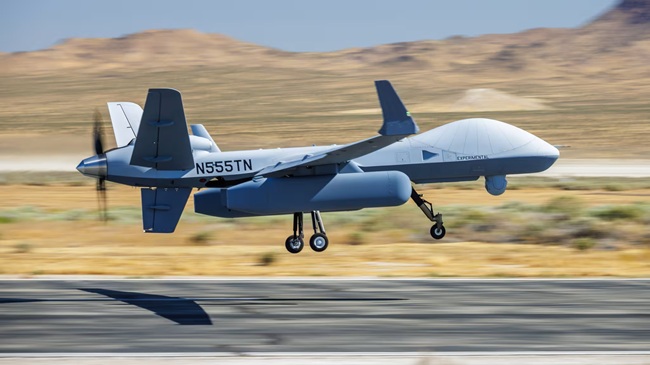
Saab AB (STO:SAAB-B) and General Atomics Aeronautical Systems have completed the first flight of an uncrewed airborne early warning solution by integrating Saab AB’s LoyalEye radar sensor with the MQ-9B remotely piloted aircraft. The test marks a strategic step toward giving unmanned aircraft a role that has traditionally required large crewed surveillance platforms, specialised operators and expensive mission systems. For Saab AB, the development strengthens its position in airborne early warning and sensor systems at a time when European defence demand remains structurally high but valuation scrutiny has become sharper. The announcement also gives General Atomics Aeronautical Systems a new way to extend the MQ-9B platform beyond intelligence, surveillance and reconnaissance into persistent airspace monitoring, missile warning and drone-swarm detection.
Why does the Saab and General Atomics uncrewed airborne early warning flight matter for modern air defence strategy?
The successful flight matters because airborne early warning has become one of the most important but capacity-constrained parts of modern air defence. Traditional airborne early warning aircraft provide long-range surveillance, command support and threat detection, but they are expensive to acquire, expensive to operate and not always available in the numbers required for sustained operations. By placing an airborne early warning sensor on the MQ-9B, Saab AB and General Atomics Aeronautical Systems are testing whether a lower-cost, long-endurance unmanned aircraft can fill gaps that crewed fleets alone cannot cover.
This is especially relevant as air forces face a far messier threat environment than they did a decade ago. Cruise missiles, one-way attack drones, low-flying aircraft, loitering munitions and electronic warfare threats all increase the need for persistent aerial surveillance. Ground-based radars remain essential, but terrain, curvature, mobility and survivability issues limit what they can see. Airborne sensors help close that gap, and an unmanned platform can stay aloft for long periods without exposing aircrew to contested airspace.
The operational proposition is therefore not just about replacing crewed airborne early warning aircraft. It is about adding a persistent layer that can operate where full-scale crewed airborne early warning and control assets may be too costly, too scarce or too risky to deploy continuously. That distinction matters because defence buyers rarely replace trusted high-end systems quickly. They are more likely to add new layers around them when the economics and mission profile make sense.
How could LoyalEye on MQ-9B change the economics of airborne early warning missions?
The central commercial argument behind the Saab AB and General Atomics Aeronautical Systems partnership is cost-per-hour surveillance. Large crewed airborne early warning platforms deliver high capability, but they carry high operating costs, complex crewing needs and fleet availability limitations. The MQ-9B, already positioned as a long-endurance remotely piloted aircraft, gives the partners a platform that can remain airborne for extended periods while carrying mission payloads that broaden its value to air forces and navies.
If LoyalEye can deliver useful surveillance quality from the MQ-9B, the economics of airborne early warning could shift for countries that cannot afford large fleets of crewed aircraft. Smaller NATO members, maritime nations, Indo-Pacific partners and Middle Eastern operators may see the model as a way to improve airspace awareness without buying a full traditional airborne early warning fleet. This is where the product could be most disruptive, not because it beats the biggest crewed systems outright, but because it may make persistent airborne surveillance available to more buyers.
The catch is that airborne early warning is not just about putting a radar in the sky. It also requires data processing, communications, integration with command networks, threat classification and operational trust. A cheaper aircraft that cannot feed usable, timely and secure information into a wider air defence system will not solve much. For Saab AB and General Atomics Aeronautical Systems, the next challenge is therefore to prove that the MQ-9B-LoyalEye combination can deliver mission-grade data, not just a successful flight profile.
Why is the MQ-9B platform becoming more important beyond conventional drone surveillance roles?
The MQ-9B has gradually moved from being viewed mainly as an intelligence, surveillance and reconnaissance aircraft toward becoming a modular mission platform. The addition of airborne early warning pods reinforces that shift. General Atomics Aeronautical Systems is trying to show that MQ-9B variants such as SkyGuardian, SeaGuardian, Protector and future short takeoff and landing configurations can support missions that go beyond traditional unmanned aircraft tasks.
That is a strategically useful pivot. Many armed forces already understand the MQ-9 family, its operating model and its endurance advantages. Adding airborne early warning capability gives existing or prospective customers a reason to think about the aircraft as part of air defence architecture, not only as a surveillance or strike-adjacent tool. For navies, the idea may be particularly attractive because ships without carrier-based airborne early warning aircraft often lack persistent wide-area aerial surveillance.
However, this also raises integration questions. Airborne early warning missions require secure communications links, resilient data pathways and compatibility with national or allied command systems. In a contested environment, the MQ-9B must also deal with survivability issues, including enemy fighters, long-range surface-to-air missiles and electronic attack. The platform’s value may be strongest in permissive, semi-permissive or standoff operating areas, unless supported by broader air defence and electronic protection measures.
What does this development signal for NATO, European defence buyers and Indo-Pacific air surveillance gaps?
For NATO and European defence buyers, the Saab AB and General Atomics Aeronautical Systems test arrives at a time when air and missile defence planning has moved back to the centre of military strategy. Russia’s war in Ukraine has shown how much damage can be caused by layered missile and drone attacks, while also exposing the challenge of maintaining constant airspace awareness over large areas. Europe does not simply need more weapons. It also needs more sensors, more redundancy and better real-time situational awareness.
The LoyalEye-MQ-9B combination could appeal to countries seeking a practical middle layer between ground-based radars and high-end crewed airborne early warning aircraft. It may also support maritime surveillance and littoral air defence, particularly where navies need persistent detection of aircraft, missiles and drones over wider sea areas. The Indo-Pacific relevance is equally clear, as dispersed islands, long coastlines and contested maritime spaces create a need for persistent airborne sensing without always deploying large crewed aircraft.
The strategic implication is that airborne early warning may become less platform-centric and more network-centric. Instead of relying on a small number of high-value crewed aircraft, future air defence architectures may combine crewed aircraft, unmanned aircraft, satellites, ground radars, naval sensors and passive detection systems. Saab AB is trying to place LoyalEye inside that broader networked future, while General Atomics Aeronautical Systems is giving MQ-9B a stronger argument for relevance in high-end defence planning.
How should investors read Saab AB stock sentiment after the LoyalEye and MQ-9B flight milestone?
Saab AB’s Series B shares were listed at SEK 517.50 on June 3, down 1.41 percent on the day, with a market capitalisation of about SEK 281.2 billion. The stock remains inside a wide 52-week range of SEK 426.60 to SEK 748.80, which shows both the strength of the longer defence re-rating cycle and the recent pressure on the shares after a sharp run-up in European defence names. The LoyalEye-MQ-9B flight test supports the company’s long-term sensor and surveillance narrative, but the market is unlikely to treat one technical milestone as a near-term earnings catalyst by itself.
For investors, the key issue is conversion. Saab AB has already benefited from elevated defence spending expectations across Europe, but future upside depends on order intake, production execution, margin discipline and export visibility. LoyalEye may help Saab AB defend its role in airborne early warning systems beyond traditional crewed platforms, particularly as countries look for scalable and modular solutions. That could support sentiment if the test phase leads to customer demonstrations, programme commitments or procurement discussions.
The caution is that defence technology milestones often travel a long road before they become material revenue contributors. Investors will want to see whether the several-month evaluation phase leads to a full capability demonstration, how potential customers respond, and whether integration on MQ-9B can be priced attractively. Saab AB’s strategic story remains strong, but the stock already carries expectations linked to European rearmament, which means execution has to keep jogging even when the market starts sprinting ahead.
What execution risks could slow the commercial adoption of uncrewed airborne early warning systems?
The first risk is capability validation. A first flight proves that the sensor and aircraft can operate together in an initial configuration, but defence buyers will require evidence across mission scenarios, weather conditions, sensor performance profiles and data-link environments. Airborne early warning customers are not buying a flying radar for decoration. They are buying confidence that the system can detect, track and share actionable information when the airspace becomes crowded, confusing and hostile.
The second risk is mission integration. LoyalEye on MQ-9B must connect cleanly into national command-and-control systems, allied data networks and air defence decision loops. That means cybersecurity, latency, interoperability and classification rules become part of the procurement conversation. A system that works well in isolation but struggles to feed allied networks will face adoption friction, especially among NATO buyers.
The third risk is survivability and doctrine. The MQ-9B has endurance advantages, but it is not a stealth aircraft designed to penetrate heavily defended airspace. Its airborne early warning role may therefore be strongest at range, over maritime zones, around defended corridors or in areas where air superiority is already contested in a manageable way. Defence buyers will need to decide whether the platform is a replacement, supplement or gap-filler for crewed systems. That doctrinal clarity will determine how quickly procurement interest becomes budget reality.
Could uncrewed airborne early warning become a bigger market than defence planners currently expect?
Uncrewed airborne early warning could become a larger market if air forces and navies conclude that persistent sensing is no longer affordable through crewed fleets alone. The demand signals are already visible. Airspace threats are multiplying, missile and drone attacks are becoming more common, and defence planners are looking for systems that can stay airborne longer without consuming scarce crewed aircraft hours. The market opportunity is not only in top-tier military powers but also in countries that need credible surveillance coverage without the cost of full-scale airborne early warning fleets.
Saab AB and General Atomics Aeronautical Systems are therefore testing more than a payload. They are testing a procurement category. If the MQ-9B-LoyalEye configuration proves operationally credible, other unmanned aircraft makers and sensor houses may accelerate similar combinations. That could create a competitive race involving radar suppliers, drone manufacturers, command-system providers and electronic warfare specialists.
The bigger message is that air surveillance is becoming distributed, just like strike, logistics and command systems. Large crewed aircraft will still matter, but they may increasingly operate alongside unmanned sensors that extend coverage, absorb routine missions and create redundancy. For defence buyers, that could improve resilience. For industry, it could open a new contest over who controls the sensor layer of the unmanned air defence stack.
Key takeaways on what Saab’s LoyalEye and MQ-9B flight means for air defence markets
- Saab AB and General Atomics Aeronautical Systems have moved uncrewed airborne early warning from concept toward operational testing by flying LoyalEye on the MQ-9B remotely piloted aircraft.
- The test matters because air forces and navies need more persistent aerial surveillance against cruise missiles, drones, aircraft and low-altitude threats without relying only on scarce crewed platforms.
- The MQ-9B-LoyalEye combination could appeal to countries that want airborne early warning coverage but lack the budget or fleet scale for traditional crewed airborne early warning aircraft.
- Saab AB could strengthen its sensor and surveillance portfolio if the technology advances from test flights to customer demonstrations, procurement pathways and allied integration programmes.
- General Atomics Aeronautical Systems gains a stronger argument for positioning MQ-9B as a modular mission platform rather than only an intelligence, surveillance and reconnaissance aircraft.
- The biggest adoption risks include mission-grade sensor validation, secure data-link integration, interoperability with command networks and survivability in contested airspace.
- NATO and Indo-Pacific defence buyers may see value in uncrewed airborne early warning as a distributed layer that complements ground radars, crewed aircraft and naval surveillance systems.
- Saab AB stock sentiment remains tied to broader European defence spending expectations, with the LoyalEye milestone supporting the strategic case but not yet creating a clear near-term earnings trigger.
- The full capability demonstration expected after the evaluation phase will be more important commercially than the first flight because procurement customers need repeatable mission evidence.
- If successful, uncrewed airborne early warning could become a meaningful new defence category, forcing radar suppliers and unmanned aircraft makers to compete for the next layer of airspace awareness.
Discover more from Business-News-Today.com
Subscribe to get the latest posts sent to your email.