

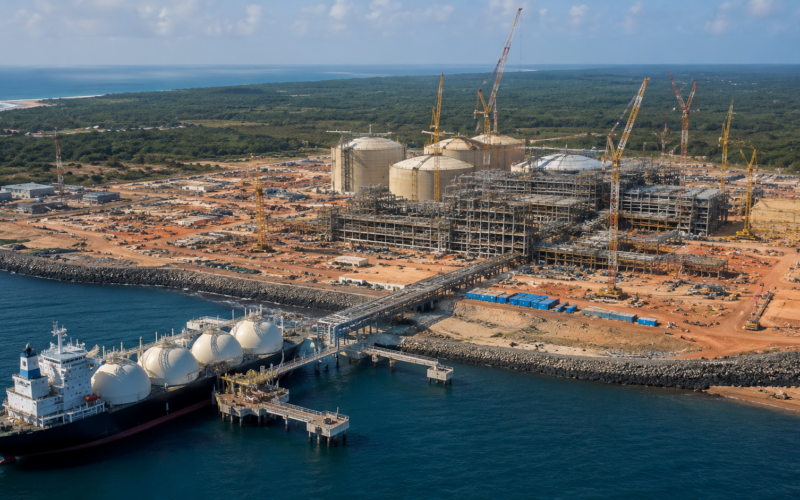
Exxon Mobil Corporation (NYSE: XOM), through ExxonMobil Moçambique, Limitada and its Area 4 partners, has committed approximately $1.1 billion to long-lead equipment and early work for the Rovuma LNG Phase 1 project in Mozambique, turning what had remained a repeatedly delayed liquefied natural gas development into a significantly more advanced pre-construction programme. The August 17 awards cover subsea production systems, controls, umbilicals, large-bore valves and several categories of offshore line pipe for an 18.6 million tonnes per annum LNG development in Cabo Delgado. Two days later, Cenergy Holdings disclosed that its Corinth Pipeworks business alone had secured a contract valued at between $200 million and $250 million for roughly 250 kilometres of offshore line pipe, providing a clearer indication of the scale behind the broader procurement package. Rovuma LNG has not yet reached a final investment decision, but the combination of billion-dollar equipment commitments, an EPC letter of intent and a targeted 2031 start-up makes the remaining FID decision considerably more consequential than an early-stage project approval.
ExxonMobil said the $1.1 billion programme was awarded on behalf of the Area 4 co-venturers, which include Empresa Nacional de Hidrocarbonetos, China National Petroleum Corporation, Eni S.p.A., Korea Gas Corporation and XRG. ExxonMobil holds a 25% indirect interest in Area 4 and acts as delegated operator for the construction and operation of Rovuma LNG, while Eni continues to lead the separate Coral floating LNG developments offshore Mozambique. Mozambique Rovuma Venture, the incorporated joint venture owned by ExxonMobil, Eni and China National Petroleum Corporation, holds a 70% participating interest in the Area 4 concession, with XRG, Korea Gas Corporation and Empresa Nacional de Hidrocarbonetos holding 10% each.
What exactly has ExxonMobil secured with the $1.1 billion Rovuma LNG awards?
The largest individual package went to OneSubsea UK Limited and OneSubsea AS for engineering, procurement, fabrication and manufacturing associated with subsea production systems, controls and umbilicals, with Aker Solutions Mozambique, Limitada supporting work inside the country. Advanced Technology Valve S.p.A. was selected for large-bore production valves, while Corinth Pipeworks Pipe Industry Single Member S.A. will manufacture submerged arc welded line pipe. Sumitomo Corporation of America has been assigned seamless line pipe, and Zhejiang Jiuli Hi-Tech Metals Co., Ltd. will supply mechanically lined pipe, induction bends, weld-overlay products and associated pipeline systems. ExxonMobil described the decision to place these orders ahead of FID as a way to begin manufacturing equipment with long delivery schedules and reduce the risk that critical components later become bottlenecks for project execution.
The procurement sequence is commercially important because long-lead items often sit on the critical path between an LNG investment decision and first production. Ordering them before FID increases the partners’ financial exposure if the development is delayed again, but it can also protect the proposed 2031 schedule by reserving manufacturing capacity before the full construction programme accelerates. Against outside estimates that have placed the overall Rovuma LNG development cost near $30 billion, the $1.1 billion now committed represents roughly 3.7% of that indicative project value. That remains a relatively small share of total prospective expenditure, but it is large enough to distinguish the current phase from preliminary engineering work that could be reversed with limited capital at risk.

Why does Corinth Pipeworks’ $200 million to $250 million package stand out?
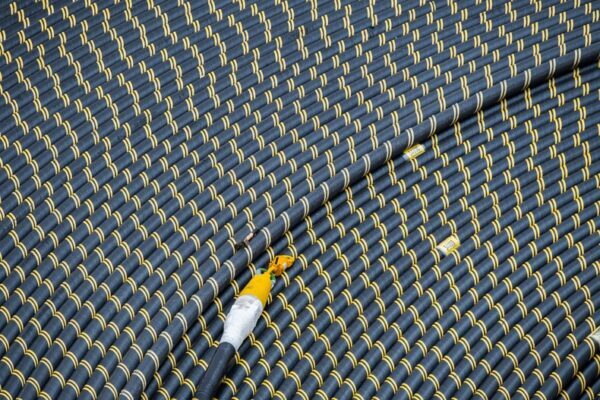
Cenergy Holdings provided one of the most detailed disclosures emerging from the procurement round when it said Corinth Pipeworks would manufacture approximately 250 kilometres of longitudinally submerged arc welded line pipe weighing about 120,000 tonnes. The pipes will range from 20 inches to 24 inches in diameter and will include anti-corrosion coating and concrete weight coating for the offshore pipeline network. Production is scheduled to take place at Corinth Pipeworks’ facilities in Thisvi, Greece, placing a substantial portion of Rovuma LNG’s offshore transportation infrastructure into an identifiable industrial manufacturing programme rather than an unspecified future tender.
At the disclosed value of $200 million to $250 million, the Corinth Pipeworks award represents approximately 18% to 23% of the entire $1.1 billion pre-investment package announced by ExxonMobil. That comparison shows that offshore line pipe is not a peripheral element of the current procurement phase and helps explain why the Area 4 partners are ordering materials well before the LNG plant itself reaches full construction. The award is also commercially significant for Cenergy Holdings because it extends Corinth Pipeworks’ exposure to large offshore gas developments and gives the manufacturer a direct role in one of Africa’s largest proposed LNG investments.
How far has Rovuma LNG moved beyond planning without reaching final investment decision?
The equipment awards follow another important step taken on August 10, when ExxonMobil selected the SMDC joint venture for limited engineering and procurement services supporting the project’s onshore LNG development. SMDC comprises Saipem S.p.A., McDermott Energy Solutions (UK) Ltd., Daewoo Engineering & Construction Co. Ltd. and China Petroleum Engineering & Construction Corporation. ExxonMobil has described the consortium as its selected EPC contractor, but the current legal and commercial instrument is a letter of intent covering limited engineering and procurement work, rather than evidence that a full final EPC contract has become unconditional.
That distinction keeps Rovuma LNG firmly in the pre-FID category even as the procurement profile increasingly resembles a project preparing for construction. The planned onshore facility is expected to use 12 modular liquefaction modules with combined production capacity of 18.6 million tonnes per year, with ExxonMobil currently anticipating start-up in 2031. The project therefore has an identified liquefaction configuration, an EPC consortium, a substantial long-lead equipment programme and a defined production target, while the final capital commitment from the partners remains outstanding.
The project has travelled a difficult route to reach this stage. Development was disrupted amid the deterioration in security conditions in Cabo Delgado in 2021, and ExxonMobil subsequently lifted force majeure in November 2025 as it resumed work toward a 2026 investment decision. The latest contract awards materially strengthen the execution pathway, but they do not eliminate security, financing, construction or schedule risks surrounding a multibillion-dollar development in a region that has experienced persistent insurgent violence.
Can ExxonMobil realistically preserve Rovuma LNG’s targeted 2031 start-up?
A 2031 start-up leaves roughly five years from the targeted 2026 FID to commercial LNG production, which places pressure on the partners to keep engineering, supplier mobilisation and early construction progressing in parallel rather than sequentially. The decision to commit $1.1 billion before FID appears designed partly around that schedule. Subsea systems, umbilicals, valves and specialised offshore pipe can require extensive design qualification, manufacturing and testing, making late procurement a potential source of multi-quarter or even multi-year slippage once the project moves into full execution.
The economics also depend on Rovuma LNG arriving into a global LNG market that will look considerably different by the early 2030s. Large new liquefaction volumes are already progressing in the United States, Qatar, Canada and other producing regions, increasing the importance of construction discipline and cost competitiveness for projects whose returns depend on decades of utilisation. Rovuma LNG has a substantial resource base and Atlantic Basin positioning, but its partners still have to translate those geological and geographic advantages into a development that can compete on delivered LNG cost after years of delay.
For Mozambique, the scale of the project makes execution unusually important. ExxonMobil has said Rovuma LNG could generate around $150 billion in government revenue during a 30-year operating life and has cited a Standard Bank macroeconomic study estimating that the development could add roughly $11 billion annually to Mozambique’s gross domestic product while supporting more than 150,000 jobs. Those numbers are projections rather than guaranteed outcomes and depend heavily on the final fiscal structure, LNG pricing, project uptime, local participation and the actual timing of production, but they illustrate why repeated delays to Rovuma LNG have carried national economic consequences as well as corporate ones.
What do the latest Rovuma LNG awards mean for ExxonMobil investors?
For Exxon Mobil Corporation shareholders, Rovuma LNG remains too early and too large a project to treat the $1.1 billion procurement package as an immediate earnings catalyst. The more relevant signal is portfolio optionality: ExxonMobil is moving another large-scale LNG development toward sanction while retaining the ability to evaluate economics, partner commitments and execution conditions before authorising the complete capital programme. The company ended August 21 at $165.11 on the New York Stock Exchange, down 0.63% for the session but about 3.1% above its August 14 close and approximately 8.8% above its July 21 level. With the shares still below their recent 52-week high of $176.41, the trading pattern suggests generally firm energy-sector sentiment rather than a clear market repricing specifically attributable to the Mozambique contracts.
The more important milestones will therefore be contractual and operational rather than daily share-price movements. A final investment decision would convert Rovuma LNG from a heavily advanced option into a committed multibillion-dollar development, while full EPC effectiveness, construction mobilisation and continued stability in Cabo Delgado would provide clearer evidence that the targeted 2031 start-up can hold. Until those events occur, the $1.1 billion package should be viewed as a substantial escalation of commitment without being confused with the final project sanction itself.
Discover more from Business-News-Today.com
Subscribe to get the latest posts sent to your email.