



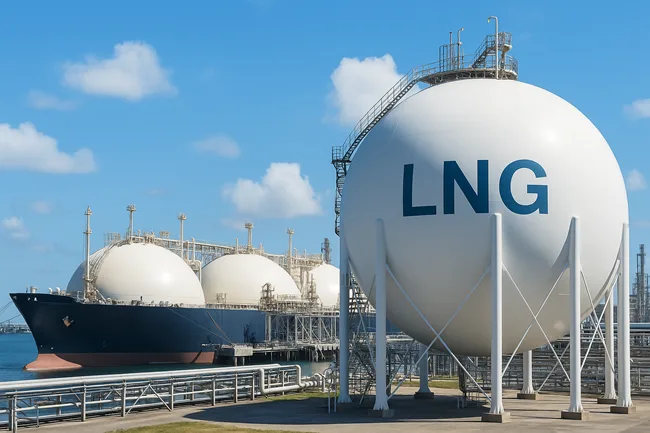
Cenergy Holdings S.A. (Euronext Brussels, Euronext Athens: CENER) has secured one of the largest recent orders for its steel pipes business after Corinth Pipeworks won a $200 million to $250 million line-pipe package for ExxonMobil-led Rovuma LNG Phase 1 in Mozambique. The contract covers approximately 250 kilometres and 120,000 tonnes of longitudinally submerged arc welded steel pipe for the offshore pipeline network, with manufacturing scheduled at Corinth Pipeworks’ Thisvi facility in Greece. The award arrives as ExxonMobil Moçambique, Limitada and the Area 4 partners commit around $1.1 billion to long-lead equipment and other pre-investment work while targeting a final investment decision during 2026. The distinction is crucial: Rovuma LNG has not yet received final investment approval, but the growing volume of procurement being locked in beforehand suggests the partners are increasingly willing to spend real money to reduce schedule and execution risk before taking the much larger capital decision.
Corinth Pipeworks’ package includes 20-inch to 24-inch diameter line pipe together with anti-corrosion coating and concrete weight coating for deepwater gas service. The order adds a substantial offshore project to a steel pipes business that entered the second half of 2026 with approximately €500 million of backlog, €311.5 million of first-half revenue and adjusted EBITDA of €51.8 million. For Cenergy Holdings, the significance therefore extends beyond association with a high-profile African LNG project because Rovuma can materially strengthen workload visibility at a segment that was already operating at a 16.6% adjusted EBITDA margin. For ExxonMobil and its partners, meanwhile, the award forms part of a wider effort to move critical equipment into manufacturing before FID, reducing the risk that long procurement lead times become the bottleneck if the project receives approval.
How significant is Corinth Pipeworks’ $200 million to $250 million Rovuma LNG order for Cenergy Holdings?
The most useful way to understand the contract is to compare it with the existing scale of Corinth Pipeworks rather than with the much larger overall cost of Rovuma LNG. Cenergy Holdings reported that its steel pipes segment generated €311.5 million of revenue during the first half of 2026, an 11% year-on-year increase, while adjusted EBITDA reached €51.8 million. The segment entered the end of June with an order backlog of approximately €500 million, which management said provided around 15 months of workload visibility. Against that operating base, a contract worth between $200 million and $250 million is clearly material even before allowing for differences in currencies, project timing and revenue-recognition schedules.
The order is also considerably larger than a routine commodity-pipe sale because Corinth Pipeworks is responsible for technically demanding offshore line pipe together with coating scopes required for subsea installation. Roughly 120,000 tonnes of steel pipe will be manufactured across about 250 kilometres of pipeline, making the project a significant production commitment for the Thisvi plant rather than a relatively short manufacturing campaign. Deepwater infrastructure also tends to reward suppliers capable of meeting tighter dimensional, welding, coating and quality-control requirements, which is consistent with Cenergy Holdings’ strategy of concentrating its steel pipes business on higher-specification projects rather than competing primarily on commodity volume.
That positioning matters to profitability. Steel pipes revenue grew faster than adjusted EBITDA during the first half, with the segment’s margin moderating from the unusually strong level recorded a year earlier to 16.6%. Management has repeatedly emphasised project mix and execution timing as major determinants of quarterly profitability, so the Rovuma contract should not be translated mechanically into a particular EBITDA contribution. What it does provide is another large, technically sophisticated offshore project of the type Corinth Pipeworks identifies as one of its strongest competitive areas.
The order also arrives after Cenergy Holdings committed additional capital to its steel pipes platform, including the acquisition and reactivation of an LSAW pipe facility in Hartlepool in the United Kingdom. The Rovuma package will be manufactured at Thisvi rather than Hartlepool, but the broader expansion reflects management’s confidence that demand for high-specification pipelines remains strong across conventional natural gas, carbon capture and other energy-infrastructure applications.
Why is ExxonMobil committing to Rovuma LNG equipment before the project reaches final investment decision?
The larger strategic story is the timing of the procurement.
ExxonMobil and its Area 4 partners have awarded approximately $1.1 billion of pre-investment contracts covering equipment and activities required for Rovuma LNG Phase 1. The packages include subsea production systems, large-bore production valves and offshore line pipe, with suppliers including OneSubsea, Corinth Pipeworks and other specialist manufacturers. The objective is to secure equipment that could otherwise create long delays once the partners formally sanction the project.
Large LNG developments cannot move seamlessly from FID to construction simply because financing has been approved. Subsea production equipment, valves, specialised pipe and major liquefaction components can require lengthy engineering, manufacturing and qualification cycles, particularly when global demand is competing for the same supplier capacity. Waiting until after FID to begin every procurement package could therefore add months or potentially years to a development schedule.
Pre-investment changes that equation by allowing selected suppliers to begin engineering, manufacturing preparation and equipment procurement before the entire project is sanctioned. The trade-off is that partners accept some capital exposure before FID in exchange for greater schedule certainty if approval is subsequently granted.
Rovuma LNG is now showing that pattern across both upstream and midstream work. Saipem, leading the SMDC joint venture with McDermott Energy Solutions, Daewoo Engineering & Construction and China Petroleum Engineering & Construction Corporation, signed a letter of intent covering limited preliminary engineering and procurement activities valued initially at $32 million. The final EPC award remains explicitly conditional on a positive FID and the required government and regulatory approvals.
The Corinth Pipeworks order therefore should not be described as proof that Rovuma LNG is fully sanctioned. It is better interpreted as evidence that the Area 4 partners are progressively removing procurement and execution obstacles while the final investment decision is still being prepared.
What does 250 kilometres of offshore line pipe reveal about the physical scale of Rovuma LNG Phase 1?
The Corinth Pipeworks scope helps make the project’s scale more tangible. Manufacturing approximately 250 kilometres of 20-inch to 24-inch offshore pipe means the upstream gas system will require a substantial subsea transportation network linking offshore production with the liquefaction infrastructure planned on the Afungi Peninsula.
Rovuma LNG Phase 1 is designed around approximately 18.6 million tonnes per year of liquefaction capacity. ExxonMobil has said the onshore development is expected to contain two LNG trains comprising 12 modular liquefaction units, with start-up currently anticipated in 2031 if the project progresses as planned.
That 18.6 million tonnes per year figure would place Rovuma among the larger individual LNG developments moving toward sanction globally. Scale can improve unit economics by spreading common infrastructure across higher output, but it also increases the amount of equipment, construction labour, logistics coordination and financing that must be assembled before first LNG.
The pipeline order illustrates how these dependencies begin offshore rather than at the liquefaction plant. Producing gas from Area 4 requires subsea wells and production systems, flow assurance, offshore pipelines and connections capable of carrying large gas volumes toward shore. Delays affecting one critical element can influence commissioning schedules for infrastructure elsewhere in the chain.
Securing pipe manufacturing early is therefore a form of schedule insurance. Corinth Pipeworks gains manufacturing visibility while ExxonMobil reduces the risk that specialised pipe capacity becomes scarce during the main construction period. The commercial importance is not simply the length of pipe being ordered, but its position on the project’s critical path.
How close is Rovuma LNG really to FID after $1.1 billion of pre-investment commitments?
The project is demonstrably closer to FID than it was when engineering work remained the primary visible activity, but the amount already committed should not be confused with certainty that sanction will occur.
ExxonMobil said on August 10 that the Area 4 partners continue to work toward FID during 2026. The company also identified 2031 as the anticipated start-up year, indicating that detailed execution planning is being organised around a defined development schedule rather than an open-ended concept.
The subsequent disclosure of approximately $1.1 billion of pre-investment awards materially strengthens that signal. Companies rarely commit such amounts to long-lead equipment unless they believe there is a credible route toward sanction, particularly when some of the equipment is highly specialised and difficult to redeploy. Nevertheless, final approval still depends on the partners concluding that project economics, financing, security arrangements, contractor readiness and regulatory conditions collectively justify committing the much larger development capital required.
Security remains one of the most important contextual factors. The broader Cabo Delgado region has faced a prolonged insurgency that disrupted LNG development earlier in the decade and increased the complexity of operating large construction sites. The current procurement programme indicates that ExxonMobil considers the risk manageable enough to continue advancing the development, but it does not eliminate the need for durable security throughout a construction programme extending for several years.
The project’s sheer capital scale also means FID will represent a much larger commitment than the pre-investment awards disclosed so far. The rational interpretation is therefore that the partners are spending to improve readiness while retaining the formal decision gate that separates preparatory work from full project sanction.
Why does Rovuma LNG matter strategically to ExxonMobil’s wider global LNG portfolio?
Rovuma LNG would give ExxonMobil another major source of LNG outside its established production centres and projects in the Americas, Middle East and Asia-Pacific. The geographical diversification is particularly relevant because global LNG buyers increasingly value supply portfolios capable of reducing dependence on any single producing region or shipping route.
Mozambique possesses large offshore gas resources, while Area 4 already supports the Coral South floating LNG development operated by Eni. Rovuma LNG would pursue those resources at a much larger onshore scale, creating a new long-duration export platform if the partners proceed.
The Area 4 ownership structure also spreads project exposure among several substantial energy companies. Mozambique Rovuma Venture, owned by ExxonMobil, Eni and China National Petroleum Corporation, holds a 70% participating interest in the Area 4 concession. XRG, Korea Gas Corporation and Mozambique’s Empresa Nacional de Hidrocarbonetos each hold 10%. ExxonMobil Moçambique serves as delegated operator for the Rovuma LNG development.
For Mozambique, the potential economic significance is even larger relative to the size of the domestic economy. ExxonMobil has said Rovuma LNG could generate approximately $150 billion in government revenues over a 30-year operating period, while citing a Standard Bank study estimating a possible annual economic contribution of around $11 billion. Those figures are forecasts rather than realised benefits and depend on the project being sanctioned, constructed and operated successfully, but they illustrate why Rovuma LNG carries national importance extending well beyond a conventional corporate investment.
The same scale makes execution risk consequential. A project intended to operate for decades can support government revenues, jobs, local procurement and infrastructure, but delays or cost escalation can postpone those benefits considerably. That is another reason the partners appear focused on reducing execution uncertainty before FID.
What could the Rovuma LNG contract mean for Cenergy Holdings’ backlog and earnings visibility?
Cenergy Holdings entered August with unusually strong group-level visibility. First-half revenue reached €1.15 billion, 13% higher year on year, while adjusted EBITDA increased 26% to €216 million and profit after tax climbed 45% to €138 million. The group’s backlog had reached approximately €3.9 billion, driven primarily by a very large cable order portfolio, and management upgraded full-year adjusted EBITDA guidance from €370 million to €400 million previously to a new range of €390 million to €420 million.
Within those results, however, the steel pipes segment represented the smaller backlog. Its approximately €500 million of orders contrasted with about €3.4 billion in cables, making a $200 million to $250 million offshore pipeline contract particularly meaningful for workload visibility in that business.
The precise impact on reported backlog will depend on Cenergy Holdings’ accounting and backlog-recognition criteria, as the company includes signed contracts as well as certain awards that have not yet become fully effective. Timing will also determine how much of the Rovuma work contributes to revenue during 2026, 2027 or subsequent periods. Investors therefore should not assume the entire award value will flow quickly through the income statement.
The strategic effect is clearer. Corinth Pipeworks now has another major international offshore project to run through Thisvi while it simultaneously expands its manufacturing footprint in the United Kingdom. That combination can improve utilisation and strengthen customer credentials, but it also increases the importance of delivering technically complex contracts on schedule and within expected margins.
Cenergy Holdings’ net debt increased to €433 million at the end of June from around €200 million at the end of 2025 as the group funded expansion and working capital. The steel pipes segment itself ended June with net debt close to €59 million after investing in the Hartlepool acquisition and increasing working capital. A larger backlog can support future cash generation, but only after procurement, manufacturing milestones and customer payments convert orders into cash.
How should investors interpret Cenergy Holdings shares around the Rovuma LNG award?
Cenergy Holdings had already experienced a strong longer-term rerating before the Rovuma announcement. Brussels-listed CENER closed August 18 at €22.80, compared with €20.34 on July 20, representing an increase of roughly 12% over that period despite considerable daily volatility. Available market data placed the stock’s 52-week range at approximately €10.34 to €28.20, meaning the shares remained below their annual high even after roughly doubling from the lower end of that range.
That performance cannot be attributed to Rovuma, which was announced only after the August 19 European session. Cenergy Holdings has benefited from a broader improvement in earnings, record group backlog, upgraded 2026 guidance and substantial power-cable contract wins during the year. The Rovuma order adds another positive catalyst, but its incremental valuation impact should be judged against a company that was already delivering stronger financial results.
The more relevant market question is whether Corinth Pipeworks can convert the award into profitable revenue without disrupting margins or working-capital discipline. Contract value attracts attention, but project-based industrial businesses ultimately create shareholder value through execution quality rather than the headline size of individual orders.
That distinction is especially important when the underlying customer project remains pre-FID. The award materially strengthens visibility for Corinth Pipeworks, but investors still need clarity on production timing, contractual effectiveness and the pace at which the work enters revenue and cash flow.
What would prove that Rovuma LNG has crossed from pre-FID momentum into irreversible execution?
The recent sequence of developments has unquestionably strengthened the case that Rovuma LNG is progressing. The partners have selected the SMDC consortium for the planned onshore EPC role, authorised limited engineering and procurement work, committed approximately $1.1 billion to pre-investment contracts and now placed a major offshore line-pipe package with Corinth Pipeworks. Taken together, those steps create a considerably more advanced project than one existing only in engineering studies.
The next decisive event, however, remains FID. A positive decision would convert the current chain of preparatory commitments into a fully sanctioned development and allow the main engineering, procurement and construction programme to proceed at scale. Government and regulatory approvals must also align with that decision, while long-term security and execution conditions in Cabo Delgado remain central to keeping the anticipated 2031 start-up schedule credible.
For Corinth Pipeworks, the immediate proof points are different. The company must convert the $200 million to $250 million award into manufacturing activity at Thisvi, manage raw-material and working-capital requirements, execute the coating scope to specification and protect the strong profitability achieved by the steel pipes segment during the first half.
The August 19 order therefore matters on two levels. For Cenergy Holdings, it substantially deepens the steel pipes order book with a technically demanding global offshore contract. For Rovuma LNG, it is another piece of evidence that ExxonMobil and its partners are increasingly willing to commit capital before the formal investment decision.
What remains unresolved is whether that pre-FID momentum culminates in full sanction during 2026. If it does, Corinth Pipeworks will have secured a place in the supply chain before one of the world’s larger planned LNG developments enters its main construction phase. If FID slips, the distinction between an awarded package and a fully executing project will become much more important.
Key takeaways from Corinth Pipeworks’ $200 million to $250 million Rovuma LNG contract
- Corinth Pipeworks has secured a $200 million to $250 million line-pipe package for Rovuma LNG Phase 1 in Mozambique.
- The contract covers approximately 250 kilometres and 120,000 tonnes of 20-inch to 24-inch LSAW offshore line pipe, including anti-corrosion and concrete weight coating.
- Manufacturing will take place at Corinth Pipeworks’ Thisvi facility in Greece.
- ExxonMobil and the Area 4 partners have committed approximately $1.1 billion to pre-investment equipment and other work as Rovuma LNG moves toward a targeted 2026 FID.
- Rovuma LNG Phase 1 is planned with approximately 18.6 million tonnes per year of liquefaction capacity and an anticipated 2031 start-up.
- The main onshore EPC award to the SMDC consortium remains conditional on a positive FID and required government and regulatory approvals.
- Cenergy Holdings’ steel pipes segment generated €311.5 million of first-half revenue and €51.8 million of adjusted EBITDA, with backlog of about €500 million before the Rovuma announcement.
- Group backlog stood near €3.9 billion at June 30, while Cenergy Holdings upgraded 2026 adjusted EBITDA guidance to €390 million to €420 million.
- The Rovuma package strengthens Corinth Pipeworks’ workload visibility, but revenue and earnings contribution will depend on project timing and execution.
- The clearest next catalyst is a positive Rovuma LNG final investment decision, which would move the project from increasingly substantial pre-investment activity into full-scale execution.
Discover more from Business-News-Today.com
Subscribe to get the latest posts sent to your email.