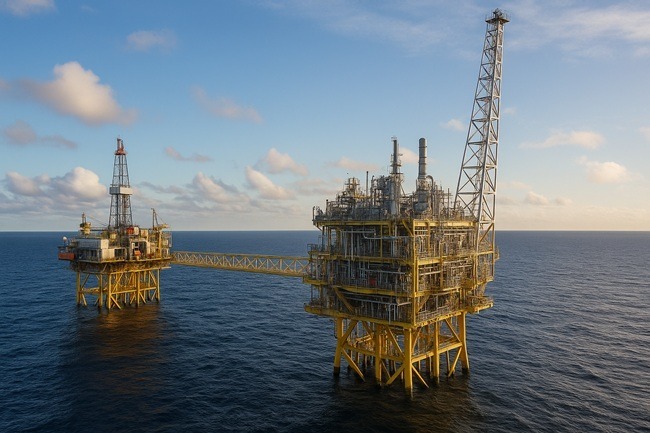





Rockhopper Exploration plc (AIM: RKH), the United Kingdom-based oil and gas company holding a 35% interest in the Sea Lion field offshore the Falkland Islands, faces a new test of its development timetable after project operator Navitas Petroleum disclosed that it was replacing two contractors amid pressure linked to Argentina’s opposition to oil exploration around the islands. The October 5, 2026 announcement introduced uncertainty around contractor continuity, although Navitas maintained that it did not currently expect a material adverse effect on the project. With first oil still targeted for the first quarter of 2028, the immediate financial question is whether replacement arrangements can preserve the critical development schedule without creating substantial additional costs.
The contractor development arrives during an important period for Rockhopper. Its September 30 half-year report confirmed that the initial Northern Development Area phase had been sanctioned and financed, with development drilling expected to begin in early 2027. The company also completed an approximately US$200 million equity financing programme during August and September, intended to support its development commitments, additional exploration activities and the accelerated development of later Sea Lion phases.
A further development followed on October 7, when Rockhopper entered into an agreement to acquire a 35% participating interest in the OSX-1 floating production, storage and offloading vessel through a special-purpose company. The US$44 million commitment will be funded from existing cash resources and relates to the planned Central Development Area expansion rather than the initial production phase scheduled for 2028. That distinction is important because the Sea Lion development involves separate vessels, production schedules and investment decisions.
The commercial stakes are substantial. Rockhopper’s latest independent technical assessment identifies approximately 110 million barrels of proved and probable oil reserves attributable to its 35% working interest, alongside additional contingent resources associated with subsequent development phases. However, reserves, financial valuation estimates and potential production capacity do not eliminate the risks involved in constructing and commissioning a remote offshore development.
The project’s next phase will therefore depend on more than securing capital and assembling equipment. Contractor availability, equipment refurbishment, drilling performance, regulatory conditions and the timely commissioning of production infrastructure must all align for Sea Lion to move from a sanctioned development into an operating oilfield.
Why are contractor replacements creating uncertainty around Sea Lion’s first-oil timetable?
The immediate source of concern is the October 5 disclosure by Navitas Petroleum, the operator of Sea Lion. According to the announcement released through Rockhopper, Navitas is taking steps to replace two contractors it described as being in breach of their contractual obligations. The disclosure followed reports involving a contractor that had indicated it would not undertake work associated with oil exploration and production in the Falkland Islands area.
Navitas linked the development to continuing efforts by the Argentine government to impose sanctions on entities participating in activities around the islands. Argentina maintains a sovereignty claim over the Falkland Islands, while the United Kingdom and Falkland Islands governments support the islanders’ right to self-determination. The competing political and legal positions form the background to the latest commercial uncertainty, but the contractor announcement does not establish that construction or drilling has stopped.
The operator stated that, based on information then available, it did not anticipate a material adverse effect on Sea Lion. Importantly, it also identified circumstances under which that assessment could change, including difficulties replacing the contractors, further supplier withdrawals, delays to project adjustments and additional geopolitical or regulatory developments.
Those qualifications matter because offshore oil developments depend on closely coordinated packages of specialist services. Equipment manufacture, marine logistics, drilling operations, vessel upgrades, installation work and commissioning often involve contractors whose activities must be completed in a defined sequence. A delay in one activity can affect subsequent work if sufficient schedule flexibility is unavailable.
However, the available announcement does not identify the contractors, the precise work packages affected or whether their activities fall on the critical path to initial production. It would therefore be premature to conclude that the Q1 2028 first-oil target has already slipped. Equally, the absence of an announced delay does not establish that the replacement process will be completed without additional cost or disruption.
The more useful test will be whether Navitas can confirm replacement arrangements and demonstrate continued progress against the existing development timetable. Evidence that long-lead equipment, vessel refurbishment and drilling preparations remain on schedule would support the operator’s assessment that the immediate financial consequences are manageable.

What must happen before Rockhopper can reach first oil in Q1 2028?
The first phase of Sea Lion development, known as Northern Development Area Phase 1, was sanctioned in late 2025. It comprises 11 wells and is intended to establish the first commercial production from a field originally discovered by Rockhopper in 2010. Development drilling is expected to commence early in 2027, providing a major operational milestone before the planned production start approximately one year later.
The initial development will use the Aoka Mizu floating production, storage and offloading vessel. The vessel is undergoing preparation and refurbishment work in Southeast Asia after leaving its previous operating location and completing initial survey activities. Its planned production capacity is approximately 55,000 barrels of oil per day, representing around 19,250 barrels per day attributable to Rockhopper’s 35% working interest at full nameplate throughput.
These figures describe processing capacity, not guaranteed production volumes. Actual output will depend on reservoir performance, successful well completion, facility availability and the rate at which production can be increased following commissioning. The schedule also relies on coordinating the vessel’s refurbishment and deployment with subsea infrastructure and the drilling programme.
The contractor issue introduces uncertainty because the importance of any replacement depends on the work being performed. A supplier responsible for non-critical activities might be replaced without affecting first oil, while a delay involving specialised offshore equipment or essential installation work could have a wider effect. The current public disclosures do not establish which situation applies.
Sea Lion also presents logistical challenges associated with its remote South Atlantic location. Major equipment and services must be transported over considerable distances, while offshore activities require suitable vessels, personnel and operational planning. These characteristics can reduce the flexibility available to recover from unforeseen delays, particularly when alternative suppliers or installation vessels must be secured.
The next useful operational evidence will concern continued progress with Aoka Mizu refurbishment, mobilisation of the drilling campaign and completion of essential infrastructure milestones. A confirmed schedule for replacement contractor activities would also help establish whether the programme’s remaining flexibility is sufficient.
Does Rockhopper’s US$44 million FPSO agreement strengthen the 2028 production plan?
Rockhopper’s October 7 agreement to acquire its 35% participating interest in the OSX-1 vessel marks a separate development milestone. The company has committed to subscribing for US$44 million of ordinary shares in a special-purpose company whose sole asset is the vessel. The amount represents approximately its proportional share of the previously disclosed US$125 million aggregate acquisition cost, with minor differences attributable to rounding.
The investment is intended to support the Central Development Area, located south of the initial Northern Development Area. This is a crucial distinction because OSX-1 is not the vessel scheduled to deliver Sea Lion’s first oil in Q1 2028. That responsibility rests with Aoka Mizu, while the second vessel is associated with a subsequent and potentially much larger development programme.
Navitas plans for the Central Development Area to comprise two phases involving approximately 38 wells. The first phase is expected to include 20 wells and the second another 18. The OSX-1 vessel is expected to provide approximately 125,000 barrels per day of additional oil-processing capacity, substantially increasing the field’s potential production infrastructure.
When combined with Aoka Mizu’s approximately 55,000-barrel-per-day capacity, the two-vessel development could support nameplate processing capacity of around 180,000 barrels per day. Rockhopper’s proportional interest in that combined capacity would be approximately 63,000 barrels per day, although this is an ownership-adjusted capacity calculation rather than a production forecast.
The Central Development Area remains at an earlier development stage. Navitas is targeting readiness for a final investment decision during the first half of 2028, with production from its initial phase potentially beginning towards the end of 2030. These dates depend on further engineering, approvals, funding and execution, and should not be confused with the sanctioned first phase’s production timetable.
The financial commitment also extends beyond buying the vessel. Rockhopper expects approximately US$1.4 million annually in net holding costs attributable to its interest, while further expenditure will be required for modification and eventual deployment. The US$125 million aggregate acquisition estimate does not represent the total cost of bringing the Central Development Area into production.
Rockhopper’s vessel participation could improve its position in the later development programme by establishing an ownership interest in a major production asset. However, the transaction creates a near-term cash commitment for a project that has not yet reached its final investment decision. The commercial benefits will depend on whether the vessel can be prepared economically and whether the larger development proceeds on the anticipated schedule.
Can Rockhopper’s US$200 million financing absorb additional Sea Lion development costs?
Rockhopper’s latest financial statements provide a stronger liquidity picture than would be suggested by its pre-production status alone. At June 30, 2026, the company held US$147 million in cash and term deposits, compared with US$171 million at the end of December 2025. During the first half, approximately US$44 million was spent on Sea Lion capital expenditure, partly offset by additional funding and other cash movements.
The company subsequently completed an equity financing programme that generated approximately US$200 million in gross proceeds. The transaction comprised a US$180 million placing and an approximately US$20 million open offer, with both components priced at 70 pence per new ordinary share. The fundraising provides additional resources for the later Sea Lion development, exploration and contingency requirements.
The proceeds were allocated across several purposes. Rockhopper identified approximately US$100 million for its expected Central Development Area funding needs, including participation in the OSX-1 vessel, through mid-2028. It also earmarked US$20 million for exploration and well-deepening activities, US$20 million for early project failure contingency provisions and US$60 million for broader Falkland Islands contingency requirements.
This allocation is particularly relevant to the contractor issue because the company has raised funds partly intended to provide flexibility against unexpected expenditure. However, the availability of contingency resources does not establish that every potential cost overrun or delay could be absorbed without changing the funding plan.
The US$44 million OSX-1 commitment represents approximately 22% of the gross amount secured in the latest equity financing. That is a comparison of financial scale rather than a statement that the vessel investment is financed exclusively from the new share proceeds. Rockhopper has specifically stated that the subscription will be funded from existing cash resources, while the broader capital programme includes several financing sources and obligations.
The June cash balance and September fundraising should also not be combined mechanically to produce a definitive October cash figure. Capital expenditure, corporate costs, financing expenses and other transactions occurred after the balance-sheet date, while the financing proceeds are disclosed on a gross basis. An updated cash reconciliation would be needed to establish the company’s precise liquidity position after the FPSO agreement.
The company’s half-year results nevertheless support a more constructive financing assessment than its historical development-stage position. Management has indicated that its existing arrangements are expected to fund planned activity through mid-2028 under current assumptions, with additional contingency available to address identified risks. That position gives Rockhopper financial flexibility, but its resilience will depend on project spending, debt availability and the timing of first oil.
How do Navitas funding arrangements and the US$350 million debt facility affect Rockhopper’s risk?
Rockhopper’s development financing includes arrangements with Navitas that reduce the amount of cash it must contribute during the construction period. The operator holds the remaining 65% interest in Sea Lion and has agreed to provide financing for a substantial portion of Rockhopper’s share of initial development expenditure.
Following the December 2025 final investment decision, Navitas agreed to provide an interest-free co-venturer loan covering two-thirds of Rockhopper’s share of Northern Development Area Phase 1 costs that are not met by third-party debt financing. This arrangement is distinct from an earlier pre-investment-decision loan, which carries an 8% annual interest rate.
At June 30, the interest-free co-venturer loan balance stood at approximately US$116.7 million. The figure is financially important because it represents funding associated with development expenditure, not revenue or a permanent reduction in Rockhopper’s economic obligations. The borrowing arrangements will ultimately interact with future production cash flows and the project’s financing structure.
Rockhopper also has access to a senior debt facility of US$350 million, representing its share of the US$1 billion project-level senior financing package. The Rockhopper portion was entirely undrawn at June 30, with the first drawdown then expected during the second quarter of 2027.
The debt facility provides an important source of committed project financing, but availability is subject to conditions precedent and relevant contractual requirements. The company assessed these conditions in its September interim report and indicated that they were reasonably capable of being satisfied in accordance with the current development timetable.
The company’s directors also examined potential increases in capital expenditure and other downside scenarios while preparing their going-concern assessment. They concluded that available financial resources and financing arrangements were sufficient to meet forecast expenditure through September 2027 under the scenarios considered. That accounting assessment covers a defined period and should not be interpreted as an unconditional guarantee of funding through every subsequent development stage.
Cost overruns could still affect the project’s financing position, particularly if they coincide with weaker oil prices, additional construction delays or changes in the availability of debt funding. The strength of Rockhopper’s position therefore lies in having several sources of capital and identified contingency mechanisms rather than being insulated from financial risk.
The most useful financing milestones will include satisfaction of the senior debt drawdown conditions, continued support from the co-venturer arrangements and updated forecasts showing how development expenditure compares with available resources.
What do Rockhopper’s reserves and US$2.95 billion project valuation actually represent?
Rockhopper’s updated independent reserves assessment provides a framework for understanding the potential commercial value of Sea Lion. Netherland, Sewell & Associates estimated approximately 314.2 million barrels of gross proved and probable reserves associated with the Northern Development Area’s first two phases. Rockhopper’s 35% interest corresponds to approximately 110 million barrels of those reserves.
The assessment separately identified approximately 219 million barrels of contingent resources attributable to Rockhopper. These resources are not equivalent to proved and probable reserves because their commercial development remains subject to further investment decisions and other conditions. They should therefore not be added to reserves and presented as an already sanctioned production base.
The independent assessment indicated a combined post-tax discounted value of approximately US$2.95 billion for Rockhopper’s interest in the evaluated 2P reserves and 2C resources, representing an increase of approximately US$788 million from the previous assessment. This valuation incorporates assumptions about future production, expenditure, oil prices and the accelerated development schedule.
The economic model uses a long-term Brent crude assumption of US$75.95 per barrel from 2028. Actual oil prices may differ materially, while delays, higher development costs or changes in operating performance could affect realised returns. Importantly, the contingent-resource component is not risk-adjusted for the possibility that development may not proceed as modelled.
The US$2.95 billion estimate is therefore neither Rockhopper’s current market capitalisation nor a guaranteed financial return. It is a modelled project valuation under specified assumptions, and the difference matters particularly while the company remains dependent on successful construction and the start of production.
What does Rockhopper’s October share-price decline indicate about Sea Lion’s execution risks?
Rockhopper shares closed at approximately 49 pence on October 7, compared with 60.7 pence on October 2, the final trading session before the latest contractor announcement. That represents a decline of approximately 19.3% across the period, highlighting the sensitivity of the company’s market valuation to developments affecting Sea Lion. The share-price movement cannot conclusively be attributed to the contractor disclosure alone, although the October 5 session was accompanied by substantially increased trading volume.
The market reaction illustrates the challenge of valuing a company approaching its first substantial production milestone. Rockhopper has secured financing, sanctioned the initial development and assembled significant production infrastructure, but the value of those commitments remains dependent on successful execution. A relatively small change in expectations about project timing, financing or production can therefore influence assessments of future cash flow.
The company’s October announcements present competing considerations. Contractor replacements introduce uncertainty about delivery schedules and potentially additional costs, while the OSX-1 agreement advances preparations for a larger development opportunity. The September equity financing provides financial flexibility, but it also increases the share capital over which future corporate value is distributed.
The distinction between the two development phases is especially important. The Aoka Mizu vessel is central to the Q1 2028 first-oil target, while OSX-1 supports a possible subsequent expansion towards the end of the decade. Progress on the larger development should not be treated as evidence that risks to the earlier production phase have been resolved.
The next operational milestones will provide clearer evidence. Replacement contractor arrangements, refurbishment progress, development drilling in early 2027 and the availability of senior debt funding will help determine whether Sea Lion remains on its announced schedule. Confirmed progress on these activities would provide a stronger basis for evaluating execution than short-term changes in the share price.
Rockhopper has moved substantially closer to production since sanctioning Sea Lion’s initial development in late 2025. Its financing arrangements, equipment preparations and additional FPSO investment demonstrate that the project has advanced beyond earlier planning stages. Nevertheless, the contractor disruption illustrates why development risk persists even after investment approval and major funding commitments.
The central financial question is whether Rockhopper and Navitas can maintain project continuity through the remaining construction and commissioning period without materially increasing costs or delaying cash generation. The Q1 2028 first-oil target remains unchanged, but preserving it will require tangible progress on contractor replacement, drilling and production infrastructure. Until those milestones are demonstrated, the project’s considerable resource potential must be assessed alongside the practical demands of bringing a remote offshore oilfield into production.
Discover more from Business-News-Today.com
Subscribe to get the latest posts sent to your email.