



Rockhopper Exploration plc (AIM: RKH) has reached financial close on the Sea Lion offshore oil project in the North Falkland Basin, finalizing a $2.1 billion funding package for Phase 1 and formally triggering its share placing and shareholder open offer. The company confirmed it is now fully funded for its equity portion of the project, which is being operated by Navitas Petroleum Development and Production Limited.
This milestone cements Rockhopper’s long-anticipated transition from exploration to full-scale development on Sea Lion, a field that has sat undeveloped for more than a decade despite multiple farm-outs, ownership changes, and market cycles.
How does financial close on Sea Lion reset Rockhopper’s trajectory as an oil junior?
With financial close now complete, Rockhopper moves from conceptual sanctioning to execution on Sea Lion, supported by a project framework that has dramatically evolved since its original discovery in 2010. The company’s $142 million placing proceeds—released from escrow upon admission to AIM—combined with loan support from Navitas Petroleum, eliminate immediate funding concerns tied to its 35 percent working interest.
Navitas Petroleum, holding the remaining 65 percent and operating the project, has executed all key commercial agreements, including an FPSO charter, drilling contracts, and subsea EPC deals. This signals high readiness to begin early works. Phase 1, targeting 170 million barrels of recoverable resources and peaking at 50,000 barrels per day, is now fully sanctioned.
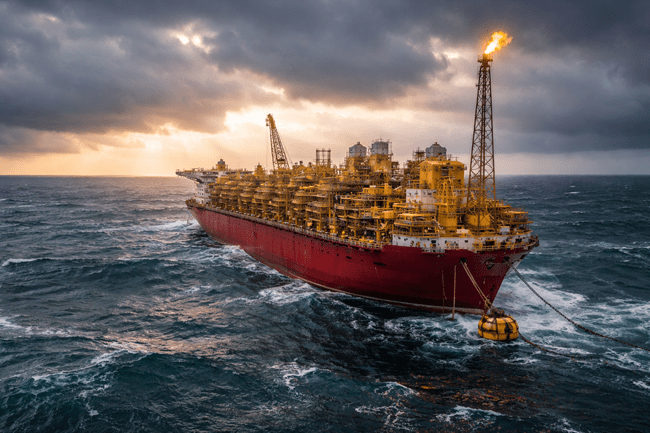
Rockhopper has structured its exposure through a blend of equity, shareholder warrants, and backstopped loans that defer cash outlays. Importantly, its equity contribution is limited to approximately $112 million (including a 5 percent overrun buffer), thanks to two separate loan tranches from Navitas. The pre-FID tranche carries an 8 percent interest rate, while the post-FID tranche is interest-free.
What makes this financing structure unusually favorable for a junior offshore operator?
Few sub-$500 million market cap oil companies secure development of a multi-phase offshore project with this level of financial leverage. The key lies in the cost-coverage loans from Navitas and the backstopped $350 million senior debt facility Rockhopper has now locked in.
These facilities allow Rockhopper to participate in a $2.1 billion total project without significant immediate dilution or high-risk cash outlays. Moreover, repayment for both loans is structured through Sea Lion’s future cash flows, reducing pre-production capital pressure.
This setup gives Rockhopper uncommon breathing room—at least until first oil, which is currently targeted for 2028. The senior debt will begin amortization from March 2029 and includes hedging covenants tied to 50 percent of proved developed producing volumes in year one post-completion.
Meanwhile, the equity open offer now launched allows existing shareholders to buy into the project at the placing price of 53 pence. Up to 13.2 million shares will be offered to raise an additional £7 million if fully subscribed.
Can Sea Lion finally deliver on its decade-old promise under Navitas leadership?
Sea Lion’s long dormancy stemmed less from geology and more from geopolitical, capital market, and operator hesitations. The project’s scale—over 1.7 billion barrels in place, with more than 500 million barrels of 2C recoverable resources independently audited—has never been in doubt.
Now with Navitas Petroleum, a specialist in marginal offshore projects, leading the development, the risk-reward equation appears more balanced. Navitas has completed multiple FPSO-driven and modular field developments and is better suited than its predecessor, Premier Oil, to navigate cost, logistics, and execution risks.
Phase 1’s $1.3 billion pre–first oil capex sits well below earlier estimates. In addition, key contracts such as drilling rig deals, SURF EPCI work, and FPSO lease agreements are already in place. This materially reduces pre-construction uncertainty.
Further upside exists through the Isobel-Elaine discovery and a potential second development phase that could recover another 149 million barrels. These could be funded by cash flows from Phase 1.
What early risks could derail Sea Lion’s development timeline before first oil in 2028?
While financial close unlocks construction, multiple execution and regulatory risks remain. Most immediately, Rockhopper must secure £52.5 million in Early Project Failure (EPF) cover to satisfy Falkland Islands Government (FIG) requirements. The company is exploring surety bonds and other credit-backed instruments to meet this obligation, which must be addressed well before the first well is spudded in late 2026 or early 2027.
There is also residual risk around final project cost inflation. If additional overruns arise before first oil, Rockhopper may face a new equity requirement, especially if open offer proceeds or underwriting warrant exercises fall short.
Another element to monitor is the £30 million tax settlement agreement with the Falkland Islands Government, which includes stepped annual payments from first oil through the fifth anniversary. These obligations will flow from project cash flows but could weigh on distributable surplus in the early years.
How are markets and investors likely to respond to this development in 2026?
Investor sentiment toward Rockhopper has remained subdued through much of 2025, with share performance closely tied to political and financing milestones rather than oil price dynamics. Now that financial close has crystallized, trading volumes may reflect a reassessment of risk-adjusted NAV, especially as institutional funds revisit Sea Lion’s NPV of $4.3 billion (Phase 1+2) and Rockhopper’s $1.85 billion post-tax NPV10 based on its net 2C resources.
The 80 pence strike price on the 50.3 million underwriting warrants could act as a long-term ceiling, but short-term re-rating potential remains if execution progresses smoothly. Visibility into actual construction, pre-drilling, and early procurement milestones will be key to maintaining investor confidence through 2026.
As financial risk abates and operational activity ramps up, Rockhopper may find itself in a stronger position to attract new institutional capital or strategic interest, particularly if oil prices remain stable above $70 per barrel.
Key takeaways on Rockhopper’s financial close and Sea Lion project development
- Rockhopper Exploration has reached financial close on the $2.1 billion Sea Lion project, transitioning into the development phase with Navitas Petroleum.
- The company has completed its $142 million share placing and launched an open offer to raise up to £7 million from existing shareholders.
- Navitas will operate the project and has executed all key contracts including FPSO, drilling, and subsea EPC agreements.
- Rockhopper’s equity exposure is reduced through two structured loans from Navitas, with repayment from project cash flows post–first oil.
- Senior debt facility terms require hedging and carry a 7-year tenor, with repayments beginning in 2029.
- First oil from Phase 1 is targeted for 2028, unlocking 50,000 barrels per day and up to 170 million recoverable barrels.
- Major near-term risk includes securing £52.5 million in Early Project Failure coverage before drilling begins.
- Investor focus now shifts to procurement, pre-drill operations, and execution discipline heading into 2026.
Discover more from Business-News-Today.com
Subscribe to get the latest posts sent to your email.