

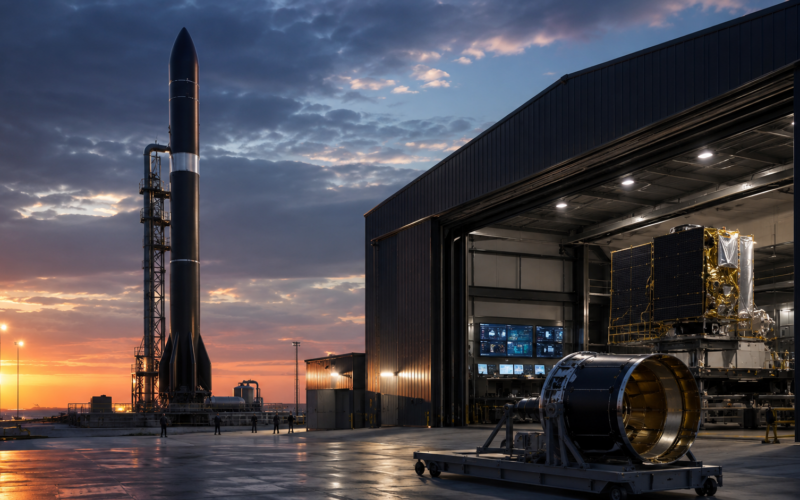
Rocket Lab Corporation (Nasdaq: RKLB) enters its second-quarter earnings report on August 10 with investor expectations running considerably higher than they were only a few weeks ago. The space company, which combines Electron and HASTE launch services with satellite manufacturing, spacecraft components and the developing Neutron medium-lift rocket, closed at US$82.83 on August 7 after jumping 9.46% in the final U.S. trading session before results. Rocket Lab has also announced two large United States Space Force awards since late July and completed its 92nd Electron mission on August 6, giving investors plenty of operational momentum to weigh against a market capitalisation of roughly US$50.1 billion. The immediate question is whether tonight’s numbers can show that revenue, margins and backlog conversion are growing quickly enough to support a valuation that already assumes substantial future expansion.
What does Rocket Lab currently do beyond launching Electron rockets?
Rocket Lab has evolved considerably from the small-launch company many retail investors first encountered when RKLB entered public markets. Launch Services remains one of its two reporting segments, covering Electron orbital launches and HASTE suborbital missions, while Space Systems includes spacecraft manufacturing, satellite components and related services. Rocket Lab is also developing Neutron, a reusable medium-lift launch vehicle intended to address larger commercial constellations and national-security missions.
That broader mix already shows up clearly in the financial statements. In the first quarter of 2026, Space Systems generated US$136.7 million of revenue compared with US$63.7 million from Launch Services, meaning roughly two-thirds of quarterly revenue came from activities outside launch services. Space Systems generated US$48.3 million of segment gross profit, while Launch Services contributed US$28.2 million.
This distinction matters when assessing RKLB. Electron launch cadence remains highly visible and often drives retail attention, but Rocket Lab’s valuation increasingly reflects an attempt to build an integrated space company spanning rockets, satellites, components and potentially recurring communications services. The proposed acquisition of Iridium Communications Inc. would push that strategy much further by adding an operating satellite network, globally coordinated spectrum and recurring communications revenue, although the transaction is not expected to close until mid-2027 and remains subject to approvals and other conditions.
Tonight’s earnings therefore need to be read as more than a launch-company report. Investors will be looking for evidence that Rocket Lab’s expanding portfolio can produce growth across both existing segments while the company simultaneously funds Neutron development and prepares for a much larger strategic combination.

Why has RKLB stock rallied into the August 10 earnings report?
Rocket Lab closed at US$82.83 on August 7, up 9.46% during the session and 17.6% from its August 3 close of US$70.43. Despite that sharp five-session recovery, the stock was still about 0.7% below its July 7 close of US$83.41 and approximately 45.1% below its 52-week high of US$151. The 52-week range stood at US$37.57 to US$151.00.
The latest move coincided with several favourable operating announcements. Rocket Lab successfully completed its 92nd Electron mission on August 6, deploying another synthetic aperture radar satellite for Japanese customer iQPS. It had already signed another three dedicated Electron missions for iQPS in late July, adding future missions to an increasingly visible launch manifest.
Defence awards added another layer. On July 27, Rocket Lab announced a US$266 million United States Space Force contract covering 12 suborbital launches with provision for up to six additional launches. On August 4, the company announced a separate US$397 million Space Force contract under the Space-Based Airborne Moving Target Indicator programme, involving the development, launch and operation of multiple Flatellite spacecraft, with Neutron expected to provide launch services.
The combined headline values of those two awards amount to US$663 million, but investors should not treat that number as equivalent to immediately guaranteed revenue. The US$397 million contract includes an option for additional spacecraft within its total value, while the US$266 million programme includes potential additional launches. The more useful conclusion is that Rocket Lab is winning larger contracts that use multiple parts of its platform rather than relying solely on individual Electron missions.
Retail attention has consequently shifted back toward the stock ahead of earnings. The challenge is that the share-price recovery also raises the performance threshold for tonight’s report.
What does Rocket Lab need to deliver in Q2 earnings?
Rocket Lab guided for second-quarter revenue of US$225 million to US$240 million after generating a record US$200.3 million in the first quarter. The midpoint of the Q2 range is US$232.5 million, which would represent approximately 61% growth from the US$144.5 million reported in the second quarter of 2025. Published analyst estimates have clustered close to US$231 million to US$232 million, meaning Wall Street expectations sit broadly around the middle of management’s own range.
There is an important scale point hidden inside those numbers. If Q2 revenue lands exactly at the US$232.5 million midpoint, Rocket Lab would produce approximately US$432.8 million of revenue during the first half of 2026. That would equal about 72% of the company’s entire US$602 million revenue generated during full-year 2025.
Revenue alone will not determine whether the report strengthens the investment case. Rocket Lab guided for GAAP gross margin of 33% to 35%, compared with the record 38.2% achieved in Q1, and non-GAAP gross margin of 38% to 40%. Management also expected an adjusted EBITDA loss of US$20 million to US$26 million.
That combination makes the earnings setup particularly interesting. Rapid revenue growth is already expected, so merely delivering another quarterly record may not be enough to change the market debate. Investors will be watching whether margins remain disciplined as programme mix changes and whether operating losses are progressing in a direction consistent with eventual profitability.
Rocket Lab reported a first-quarter net loss of US$45.0 million, improving from US$60.6 million a year earlier. Operating cash outflow was US$50.3 million during the quarter, while purchases of property, equipment and software were US$27.1 million. Those figures are manageable relative to Rocket Lab’s liquidity, but they reinforce why continued margin improvement remains important as the business grows.
Why could Neutron matter more than the headline earnings beat?
Neutron remains one of the largest variables embedded in Rocket Lab’s longer-term valuation. The medium-lift rocket is intended to move the company into a much larger addressable launch market than Electron while supporting constellation deployment and United States national-security missions.
At the first-quarter update, Rocket Lab said first-flight hardware integration was progressing alongside Archimedes engine qualification, second-stage development and work on Neutron’s reusable fairing system. Management continued to target the rocket’s debut later in 2026.
That timetable deserves close attention in tonight’s update because Neutron increasingly connects several parts of the broader strategy. Rocket Lab has already signed dedicated Neutron launch contracts, and the newly announced Space Force SB-AMTI programme is expected to use Neutron to launch Rocket Lab-built Flatellites. The company has also been selected to compete for missions under the United States Space Force’s National Security Space Launch Phase 3 Lane 1 programme.
The upside scenario is therefore larger than simply adding another rocket to the product portfolio. Successful Neutron execution could allow Rocket Lab to manufacture spacecraft, launch them and operate integrated missions while participating in contracts that are difficult to address with Electron alone.
The risk is equally straightforward. Neutron remains under development, and launch-vehicle schedules can move as testing identifies engineering issues. A material change to the 2026 debut timetable would affect assumptions about when medium-lift launch revenue can begin contributing meaningfully. Tonight’s comments on hardware readiness, Archimedes testing and launch timing could therefore have more influence on investor sentiment than a modest revenue beat or miss.
How does the proposed Iridium acquisition change the RKLB investment case?
Rocket Lab’s agreement to acquire Iridium Communications is potentially transformational. Under the proposed transaction, Iridium shareholders would receive US$27 in cash plus Rocket Lab shares calculated under an exchange-ratio collar, giving the deal a notional value of US$54 per Iridium share and an enterprise value of approximately US$8 billion. Completion is expected in mid-2027, subject to Iridium shareholder approval, regulatory approvals and other closing requirements.
Iridium generated US$871.7 million of revenue and US$495 million of OEBITDA in 2025, according to transaction materials cited by Rocket Lab. Adding that recurring communications business would materially change the financial profile of a company that generated US$602 million of its own revenue in 2025. It would also give Rocket Lab access to Iridium’s satellite network, L-band spectrum and established customer base across government, maritime, aviation and industrial markets.
The financing structure is one reason the transaction remains an important investor watchpoint. Rocket Lab has secured commitments for a US$3.6 billion 364-day senior secured bridge facility and has said it intends to fund the cash portion through a combination of balance-sheet cash and other debt and equity financing sources. The exact eventual financing mix therefore matters for both leverage and the future share count.
Rocket Lab was not short of liquidity before announcing Iridium. At March 31, it held approximately US$1.21 billion of cash and cash equivalents and US$271.3 million of marketable securities, for a combined total of roughly US$1.48 billion. However, US$450.3 million of first-quarter financing inflows came from at-the-market equity offerings, demonstrating that access to equity capital has already contributed materially to the stronger balance sheet.
The relevant question is not whether Rocket Lab has access to financing. It clearly has demonstrated access. The question is whether the combined business can ultimately generate returns that justify the cost, debt and equity complexity involved in executing an US$8 billion acquisition while continuing to fund Neutron and organic expansion.
Is Rocket Lab’s US$50bn market value already pricing in years of growth?
At the August 7 closing price of US$82.83, market data placed Rocket Lab’s equity value at approximately US$50.1 billion. That is a substantial valuation relative to the company’s present revenue base. Compared with US$602 million of revenue reported for 2025, the current market capitalisation is roughly 83 times last year’s sales.
That ratio should not be treated as a conventional valuation verdict by itself. Rocket Lab is growing rapidly, Q1 revenue increased 63.5% year on year, Q2 guidance implies another major increase, and the proposed Iridium acquisition could dramatically alter the future revenue and cash-flow mix if it closes. High-growth aerospace businesses with large defence opportunities are also not assessed solely on current earnings.
The ratio does show how much future execution matters. A US$50 billion equity value leaves relatively little room for the market to ignore prolonged delays in Neutron, slower contract conversion or weaker margins simply because the long-term space opportunity remains attractive.
There is also evidence that valuation expectations have already reset considerably from the May peak. RKLB remains about 45% below its 52-week high even after its sharp recent rebound. That creates a more balanced market setup than at US$150, but it does not make the shares inexpensive on current financial metrics.
For retail investors encountering RKLB through its recent 9.5% daily gain, this distinction is important. Rocket Lab can continue becoming a substantially larger business while the stock still experiences significant volatility if operating results do not keep pace with the expectations embedded in its valuation.
Rocket Lab stock key takeaways before Q2 earnings
- Rocket Lab reports second-quarter 2026 results after the U.S. market close on August 10, with management guiding for US$225 million to US$240 million of revenue.
- RKLB closed at US$82.83 on August 7, up 9.46% for the day and about 17.6% from August 3, but remains roughly 45% below its 52-week high.
- At the midpoint of Q2 guidance, first-half 2026 revenue would reach about US$432.8 million, equivalent to roughly 72% of Rocket Lab’s entire 2025 revenue.
- Recent United States Space Force awards show Rocket Lab winning larger integrated defence programmes, although headline contract values containing options should not be treated as immediately recognised revenue.
- Neutron’s development timetable remains one of the most important operational proof points because the rocket is increasingly tied to future commercial and national-security opportunities.
- The proposed US$8 billion Iridium Communications acquisition could transform Rocket Lab’s revenue mix, but its eventual debt and equity financing structure remains an important consideration.
- With an equity value around US$50.1 billion, stronger revenue growth alone may not settle the valuation debate. Sustained margins, Neutron execution and eventual cash-flow progress remain important evidence.
What would strengthen or weaken the Rocket Lab investment case tonight?
Rocket Lab arrives at its second-quarter report with substantially more operating evidence than it had a year ago. First-quarter revenue reached a record US$200.3 million, the March backlog exceeded US$2.2 billion, Electron continues to launch at high cadence, and recent defence awards demonstrate that government customers are willing to contract Rocket Lab for broader combinations of launch, spacecraft and mission capabilities.
A stronger investment case would emerge if Q2 revenue reaches or exceeds the upper half of the US$225 million to US$240 million guidance range while margins remain resilient, backlog continues expanding and management maintains confidence in a 2026 Neutron debut. Clearer information on how recent Space Force awards enter the delivery schedule and additional detail on Iridium financing would also help investors judge how rapidly today’s opportunities can become future revenue and cash flow.
The thesis would weaken if revenue growth begins slowing faster than expected, gross margins deteriorate materially, Neutron’s timetable moves further out or the cost and financing requirements associated with the Iridium transaction become substantially heavier than investors currently anticipate. Rocket Lab still has substantial liquidity, so the immediate issue is not a near-term funding shortage. It is whether the company can translate that capital into operating growth at a rate capable of supporting its valuation.
Tonight’s earnings therefore carry an unusually clear set of measurable tests. Rocket Lab does not need to prove that demand for space infrastructure exists. Its growing backlog, launch manifest and government awards already provide evidence of demand. What investors need next is stronger proof that Rocket Lab can convert that opportunity into revenue, margins and ultimately cash generation quickly enough to justify what the market is already pricing into RKLB.
Discover more from Business-News-Today.com
Subscribe to get the latest posts sent to your email.