




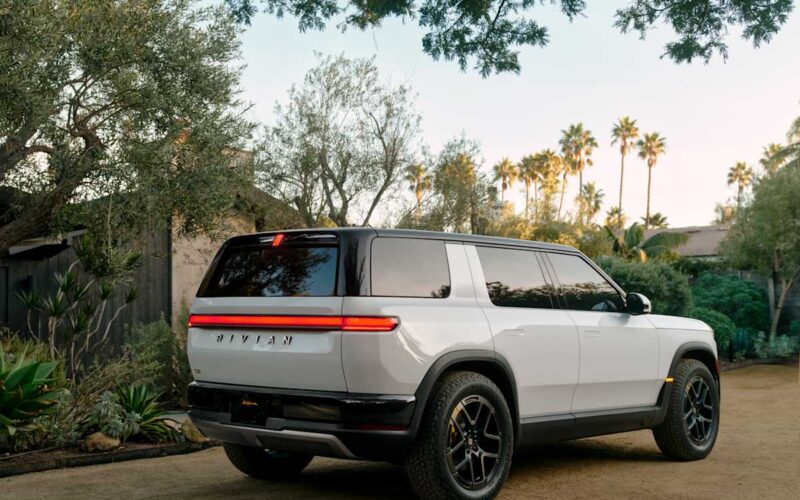
Rivian Automotive, Inc. (Nasdaq: RIVN) raised its full-year 2026 delivery guidance to a range of 65,000 to 70,000 vehicles, up from a prior forecast of 62,000 to 67,000, after reporting second-quarter production and delivery figures that comfortably exceeded both the company’s own outlook and Wall Street’s expectations. Rivian delivered 12,194 vehicles and produced 12,613 during the quarter ended June 30, well above its guided range of 9,000 to 11,000 units and ahead of the FactSet analyst consensus of 11,000. Shares surged as much as 13% intraday to $18.98 before closing near $18.63, up 8.44% on the session, and the stock continued climbing into the following trading day, touching $19.79 before settling around $18.58, comfortably within a 52-week range spanning $11.57 to $22.69. The beat stands in sharp contrast to rival Lucid Group, which missed Wall Street’s second-quarter expectations on the same day and announced a leadership shakeup under new Chief Executive Officer Silvio Napoli, underscoring how differently the two premium electric vehicle makers are currently executing against a demand environment that remains challenging for the sector broadly.
What drove the delivery beat and why the R2 launch is central to the guidance raise
Rivian’s outperformance stemmed from three distinct product lines rather than a single driver, which matters for how durable investors should consider this beat. Management specifically credited robust quarter-over-quarter growth in its electric delivery van, sold primarily to commercial fleet customers including Amazon, alongside continued demand for the flagship R1T pickup truck and R1S sport utility vehicle, the company’s original premium product line that has anchored Rivian’s brand identity since launch. The third and most consequential factor was the beginning of customer deliveries for the R2, Rivian’s mass-market mid-size SUV, which started on June 9 after the company began volume, saleable production in late April, meaning the second quarter captured only a few weeks of R2 handovers within the reported delivery total.
That timing detail is the key to understanding why management felt confident raising full-year guidance based on a partial quarter of R2 deliveries. Rivian delivered 22,559 vehicles across the first half of 2026, which means the company now needs between 42,441 and 47,441 units in the second half to hit its newly raised range, equivalent to roughly 21,220 to 23,720 deliveries per quarter across the third and fourth quarters, nearly double the pace achieved in the first half. That is an aggressive ramp to project, and it rests almost entirely on R2 volume scaling meaningfully faster than the partial-quarter contribution seen in the second quarter, a assumption that carries real execution risk even though Rivian’s own commentary characterizes the guidance increase as reflecting “the progress” made and improved visibility into second-half production capacity rather than aspirational optimism.
The R2’s importance to Rivian’s broader strategy extends well beyond this single guidance revision. The vehicle is priced meaningfully below Rivian’s premium R1 lineup, opening the company to a substantially larger pool of prospective buyers, and management has previously described the R2 launch as Rivian’s version of a “Model 3 moment,” referencing Tesla’s earlier transition from a premium-only manufacturer into one capable of mass-market volume. Rivian’s own bill of materials cost reduction on the R2, reported at approximately 50% lower than its R1 platform, is central to the company’s separate, longer-term objective of achieving positive automotive gross profit by the end of 2026, a milestone the company has not yet reached and one that depends heavily on R2 production scaling efficiently rather than encountering the kind of supply chain or quality issues that have periodically slowed premium EV manufacturers during previous model ramps.

Why analyst sentiment remains more cautious than the stock’s rally suggests
Despite the sharp two-day share price increase following the delivery beat, Wall Street’s aggregate positioning on Rivian remains notably more measured than the stock’s momentum implies. A poll of 26 analysts by S&P Global places Rivian’s consensus rating at Hold, with an average price target of $18.19, a figure that sits essentially in line with, and by some measures below, where the stock has traded in the days immediately following this guidance raise. That disconnect between a strong operational beat and a tepid aggregate analyst price target reflects a broader tension in how the sell side is weighing Rivian’s improving delivery execution against unresolved questions about unit economics, cash burn, and competitive positioning heading into a critical stretch of R2 scaling.
Individual analyst actions around this news illustrate that tension directly. Mizuho Securities issued a Sell rating on Rivian just days before the delivery beat, a contrarian call that aged poorly in the immediate aftermath but reflects genuine skepticism among more bearish analysts about whether Rivian’s current valuation, with a market capitalization near $22.5 billion against trailing twelve-month revenue of $5.53 billion and a net margin of negative 63.6%, adequately prices in the execution risk embedded in scaling R2 production to the pace implied by the raised guidance. At the other end of the spectrum, some analysts have set price targets as high as $25, implying nearly 50% upside from recent trading levels, illustrating a wide dispersion of views that mirrors the genuine uncertainty about which trajectory, continued acceleration or a stumble in second-half execution, more accurately describes Rivian’s near-term path.
Rivian’s underlying financial profile explains much of this caution. The company’s EBITDA remains deeply negative at approximately negative $2.97 billion, with an EBITDA margin near negative 52%, figures that describe a business still losing substantial money on each vehicle sold even as delivery volumes climb. Achieving positive automotive gross profit, the narrower milestone management has targeted for the end of 2026, is a meaningfully lower bar than overall profitability, and investors should recognize that even a fully successful R2 ramp reaching the top end of guidance would likely still leave Rivian generating substantial losses on a consolidated basis for some time afterward, a reality the stock’s rally on delivery news alone does not fully address.
How Rivian’s ownership structure and strategic partnerships shape its competitive position
Rivian’s shareholder base has shifted meaningfully since its initial public offering in ways that speak to how strategic investors are positioning around the company’s next growth phase. Volkswagen’s stake has grown to approximately 16%, representing more than 209 million shares, reflecting the German automaker’s deepening technology and manufacturing partnership with Rivian that includes joint development of vehicle software architecture. Amazon’s holding, by contrast, has diluted to roughly 12% from approximately 20% at the time of Rivian’s IPO, a natural consequence of Amazon not participating proportionally in subsequent capital raises even as its commercial relationship with Rivian through the electric delivery van program remains a meaningful and growing contributor to delivery volume, as reflected in this quarter’s results.
Beyond its automaker and e-commerce partners, Rivian has cultivated relationships extending into adjacent technology and mobility categories that diversify its long-term revenue potential beyond direct vehicle sales. Uber has committed $1.25 billion tied to a planned deployment of 10,000 R2 vehicles configured for autonomous robotaxi service, a commitment that gives Rivian both a committed volume purchaser for a portion of R2 production and a foothold in the autonomous ride-hailing market without requiring Rivian to build out its own robotaxi operating business from scratch. A separate expanded partnership with AT&T adds 5G connectivity and AI-enabled features across Rivian’s vehicle lineup, part of a broader strategy of monetizing software and services revenue alongside hardware sales, a model increasingly common across the automotive industry as manufacturers seek higher-margin recurring revenue streams to offset thin or negative margins on vehicle production itself.
These partnerships collectively represent optionality rather than near-term financial contribution, and investors should weigh them as strategic hedges against Rivian’s core execution risk rather than as offsetting factors that reduce the importance of the R2 ramp succeeding on its own terms. If R2 production and delivery scale as guidance implies, the Uber robotaxi commitment and AT&T connectivity partnership become incremental upside on top of an already successful core business. If R2 scaling falls short of the aggressive second-half pace guidance now assumes, these adjacent partnerships provide limited insulation against the more fundamental problem of a mass-market vehicle program failing to reach the volume needed to meaningfully improve Rivian’s unit economics.
What the competitive contrast with Lucid and Tesla reveals about the EV market’s current divide
The timing of Rivian’s delivery beat alongside Lucid’s simultaneous miss on the same reporting day offers a useful window into how differently premium EV manufacturers are currently navigating a demand environment that remains genuinely mixed rather than uniformly weak or strong. Lucid’s shortfall, paired with new Chief Executive Officer Silvio Napoli’s announcement of a leadership team reshuffle, suggests a company still working through operational and strategic uncertainty at a moment when Rivian is demonstrating the opposite: a management team executing a multi-year product roadmap, culminating in the R2 launch, that appears to be translating into tangible delivery momentum rather than remaining a forward-looking promise.
Tesla’s own second-quarter delivery figure of 480,126 vehicles, dwarfing Rivian’s 12,194, provides essential scale context for interpreting Rivian’s beat. Rivian’s delivery growth, however encouraging in percentage terms, remains a rounding error relative to Tesla’s production scale, and the raised full-year guidance of 65,000 to 70,000 vehicles for all of 2026 represents roughly what Tesla delivers in a single week at its current run rate. That scale gap is not a knock on Rivian’s execution so much as a reminder that Rivian remains, even after this guidance raise, a company still building toward automotive-industry-relevant volume rather than one already operating at a scale where per-vehicle cost efficiencies from manufacturing scale are fully realized, a structural disadvantage that will persist until R2 volume, and any future lower-cost variants Rivian has signaled, such as a sub-$45,000 version targeted for 2027, meaningfully close the gap.
For investors, the more relevant near-term comparison may be less about Tesla’s absolute scale and more about whether Rivian’s execution trajectory relative to its own prior guidance, three consecutive upward or in-line delivery outcomes would meaningfully change the market’s Hold-leaning consensus, continues in the same direction through the back half of 2026. Rivian’s second-quarter financial results, scheduled for release on July 30, will be the next concrete data point testing whether the delivery strength translated into the margin progress needed to validate the stock’s recent rally beyond a single quarter’s operational beat.
Key takeaways on what Rivian’s raised delivery guidance means for the company and the EV sector
- Rivian raised full-year 2026 delivery guidance to 65,000 to 70,000 vehicles from 62,000 to 67,000, after second-quarter deliveries of 12,194 units beat both company guidance of 9,000 to 11,000 and Wall Street’s consensus of 11,000.
- The raised guidance implies second-half deliveries of 42,441 to 47,441 vehicles, nearly double the pace achieved in the first half, resting heavily on the R2 mid-size SUV scaling well beyond the partial-quarter contribution captured in the second-quarter results.
- Shares rose as much as 13% intraday and continued climbing the following session, but the analyst consensus rating remains Hold with an average price target near $18.19, reflecting persistent skepticism about execution risk despite the operational beat.
- Rivian’s EBITDA margin remains deeply negative at approximately negative 52%, meaning even a fully successful R2 ramp reaching the top of guidance would likely leave the company generating substantial losses well beyond 2026.
- Mizuho’s Sell rating issued just before the delivery beat illustrates a genuine bearish case still held by some analysts, contrasted against price targets as high as $25 from more bullish coverage, reflecting wide disagreement about Rivian’s near-term trajectory.
- Volkswagen’s growing 16% ownership stake and Amazon’s diluted but still meaningful roughly 12% holding position two very different strategic investors around Rivian’s manufacturing technology and commercial delivery van businesses respectively.
- Uber’s $1.25 billion commitment tied to 10,000 R2 robotaxi vehicles and an expanded AT&T connectivity partnership provide strategic optionality but do not substitute for R2’s core consumer volume ramp succeeding on its own terms.
- Lucid Group’s simultaneous second-quarter miss and leadership shakeup under new CEO Silvio Napoli highlights a genuine divergence in execution among premium EV manufacturers navigating a mixed demand environment.
- Rivian’s full-year delivery target remains roughly equivalent to what Tesla produces in about a week at its current scale, underscoring that Rivian remains early in building toward automotive-industry-relevant manufacturing volume despite this quarter’s encouraging beat.
- Rivian’s July 30 second-quarter financial results will be the next material test of whether delivery strength is translating into the margin progress needed toward the company’s stated goal of positive automotive gross profit by the end of 2026.
Discover more from Business-News-Today.com
Subscribe to get the latest posts sent to your email.