
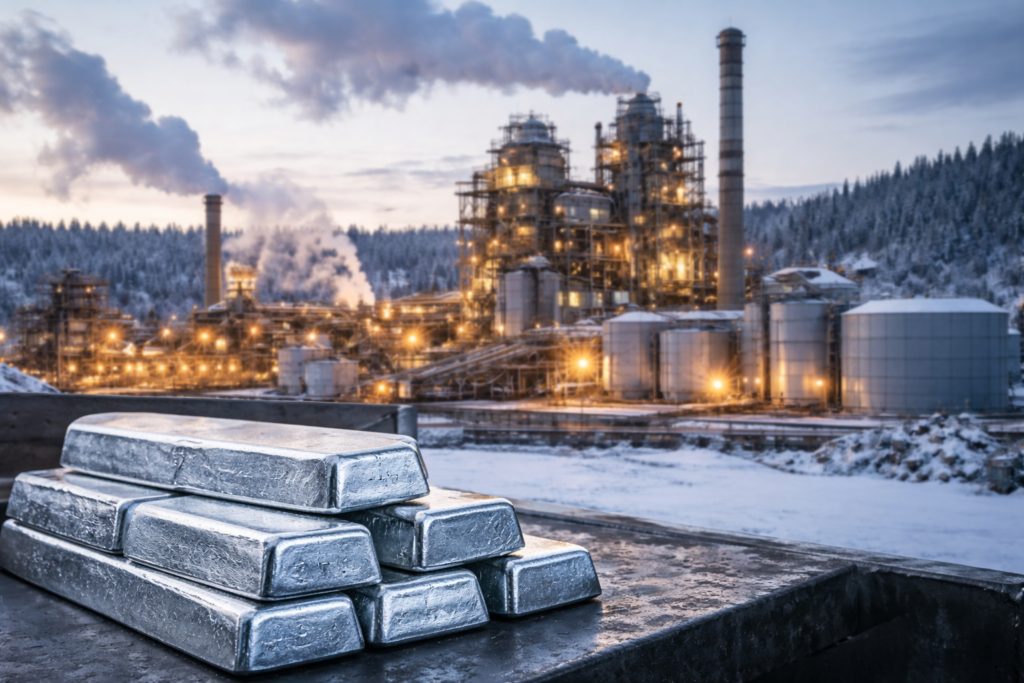
Rio Tinto (NYSE: RIO, LSE: RIO) has secured conditional funding of up to C$18.9 million from the Government of Canada to support the development of a gallium extraction and processing project at its Vaudreuil alumina refinery in Quebec. The non-repayable contribution is designed to help advance research, pilot-scale production, and potential commercialization of gallium metal derived from bauxite refining streams. For Rio Tinto, the move signals a calculated expansion beyond bulk commodities into higher-value critical minerals. For Ottawa, it reinforces a broader industrial policy push to secure domestic supply of technology metals amid tightening global trade dynamics.
Why is Rio Tinto moving into gallium production in Quebec now, and what has changed in global supply dynamics?
Gallium has quietly shifted from niche semiconductor input to geopolitical flashpoint. The metal is essential in gallium nitride and gallium arsenide compounds used in advanced chips, power electronics, 5G infrastructure, electric vehicles, and defense systems. Historically, China has dominated primary gallium production, controlling the majority of global refined output. Export controls and trade tensions have heightened concerns among Western governments and semiconductor manufacturers about supply security.
Rio Tinto’s Quebec alumina operations generate gallium as a byproduct of bauxite processing. Until recently, recovering it at scale was economically marginal. What has changed is price volatility, policy alignment, and strategic urgency. Canada has positioned critical minerals as a pillar of industrial strategy, particularly those linked to clean technology and advanced manufacturing. By supporting gallium extraction, Ottawa is effectively encouraging vertical integration within domestic resource streams rather than relying on imports.
From Rio Tinto’s perspective, the capital commitment is modest relative to its balance sheet, but strategically meaningful. The group has been under pressure to demonstrate portfolio diversification beyond iron ore, where earnings concentration remains significant. Copper, lithium, and battery materials have drawn attention. Gallium adds a smaller but symbolically important line item aligned with semiconductor supply chain resilience.
How does this funding fit within Canada’s broader critical minerals industrial policy framework?
The Canadian government has rolled out incentives, tax credits, and funding programs aimed at strengthening domestic processing capacity. Unlike traditional mining subsidies focused solely on extraction, recent policies emphasize midstream and downstream value addition. Processing and refining capabilities often determine where value accrues.
By allocating up to C$18.9 million in non-repayable funding, Ottawa is signaling that gallium sits within its strategic minerals priority list. The choice of Quebec is also significant. The province already hosts aluminum, aerospace, and technology manufacturing ecosystems. Anchoring gallium production locally could reinforce regional supply chains tied to semiconductor fabrication and advanced materials research.
Conditional funding structures typically tie disbursement to milestones, technology validation, and scaling benchmarks. That implies Rio Tinto must demonstrate technical viability and commercial competitiveness before full funds are released. In effect, public capital is de-risking early-stage processing innovation without transferring operational risk entirely to taxpayers.
What does this mean for Rio Tinto’s capital allocation discipline and portfolio evolution?
Rio Tinto reported strong cash flows in recent years, largely driven by iron ore margins. Investors have consistently scrutinized how management redeploys that capital. Large-scale acquisitions carry integration risk. Smaller, strategic processing investments often deliver optionality with limited downside.
The gallium initiative is unlikely to materially shift near-term earnings. However, it provides exposure to a metal with structurally rising demand curves. Gallium nitride technology is increasingly used in fast-charging systems, renewable energy converters, and high-frequency communications equipment. Even incremental participation positions Rio Tinto as a credible Western supplier at a time when supply chain diversification commands policy support and potentially premium pricing.
From a capital discipline standpoint, leveraging existing alumina infrastructure reduces greenfield risk. Instead of building a new mine, Rio Tinto is optimizing value extraction from current refining streams. This improves return on invested capital if processing costs remain competitive.
How is the stock reacting, and does market sentiment reflect the strategic importance?
As of the latest available trading session, Rio Tinto (NYSE: RIO) has traded within its broader 52-week range amid commodity price fluctuations, with iron ore prices continuing to influence sentiment more heavily than specialty metals initiatives. Short-term stock movements following the gallium funding announcement have been modest, reflecting the project’s relatively small financial scale compared to Rio Tinto’s multibillion-dollar revenue base.
Over the past month, Rio Tinto shares have tracked broader mining sector trends, influenced by Chinese demand indicators and global growth outlooks. The gallium project does not immediately alter earnings guidance or dividend outlook, which explains the limited price reaction. However, institutional investors focused on critical minerals exposure may view the move as incremental positive positioning rather than transformative change.
The divergence between strategic signaling and short-term share performance underscores a recurring theme in mining equities. Markets often price bulk commodity exposure more aggressively than emerging specialty metals pipelines. Over time, as production scales and revenue visibility improves, valuation multiples can adjust.
Could gallium become a meaningful revenue contributor, or is this primarily strategic positioning?
Global gallium markets are relatively small compared to copper or aluminum. Revenue impact in the early years will likely be limited. The more compelling angle lies in strategic leverage. If Rio Tinto successfully establishes commercial-scale production in Quebec, it could secure long-term offtake agreements with semiconductor or defense manufacturers seeking non-Chinese supply.
Such agreements often provide pricing stability and potential premiums linked to supply assurance. In that scenario, gallium functions as a high-margin niche product within a diversified portfolio. The key determinant will be cost competitiveness. Extracting gallium from alumina refining streams must be economically viable against global supply benchmarks.
If technological improvements reduce processing costs, Rio Tinto could scale incrementally without heavy capital outlays. Conversely, if extraction proves more complex or energy-intensive than anticipated, production could remain pilot-level.
What are the execution and geopolitical risks attached to this initiative?
Technically, gallium extraction from bauxite residue streams is feasible but requires specialized processing steps. Pilot programs must validate yield consistency, purity standards, and environmental compliance. Scaling from laboratory success to steady industrial throughput is often where cost overruns emerge.
Geopolitically, the project aligns with Western supply diversification, but trade retaliation risks cannot be ignored. If global gallium supply tightens further due to export controls, pricing could spike, benefiting new entrants. Alternatively, oversupply triggered by coordinated Western expansion could compress margins.
Environmental scrutiny is another consideration. Refinery modifications and residue handling must meet provincial and federal standards. Quebec’s regulatory environment is rigorous, and permitting delays could slow commercialization timelines.
Does this signal a broader pivot by Rio Tinto toward semiconductor-linked materials?
Rio Tinto has steadily increased its exposure to future-facing materials, including lithium through its Rincon project in Argentina and copper investments aligned with electrification trends. Gallium adds semiconductor adjacency. While not yet a core business line, it hints at management’s recognition that energy transition and digitalization demand more than traditional bulk metals.
If successful, the Quebec gallium project could serve as proof of concept for extracting additional critical minerals from existing operations. Many mining and refining processes generate trace elements historically treated as waste. Technological innovation can convert those residues into revenue streams.
The larger question is whether Rio Tinto will systematically pursue such opportunities across its global asset base. That would represent a structural shift in value capture philosophy rather than a one-off initiative.
What are the key takeaways for executives, investors, and policymakers evaluating Rio Tinto’s gallium move?
- The C$18.9 million conditional funding signals formal alignment between Rio Tinto and Canadian critical minerals policy objectives.
- Gallium production leverages existing alumina infrastructure, limiting capital intensity while expanding product diversity.
- Immediate financial impact is modest, but strategic positioning within semiconductor supply chains could create long-term optionality.
- Market reaction has been muted, reflecting gallium’s small revenue footprint relative to iron ore dominance.
- Canada is reinforcing domestic midstream processing capacity rather than focusing solely on raw material extraction.
- Execution risk centers on technical scalability, cost competitiveness, and environmental compliance.
- Successful commercialization could enable long-term offtake agreements with Western semiconductor and defense manufacturers.
- The initiative supports Rio Tinto’s broader narrative of diversification into energy transition and technology-linked metals.
- Competitive dynamics may intensify if other Western producers accelerate similar projects in response to export controls.
- The project illustrates how incremental processing innovation can unlock value from existing industrial assets without large acquisitions.
Discover more from Business-News-Today.com
Subscribe to get the latest posts sent to your email.