




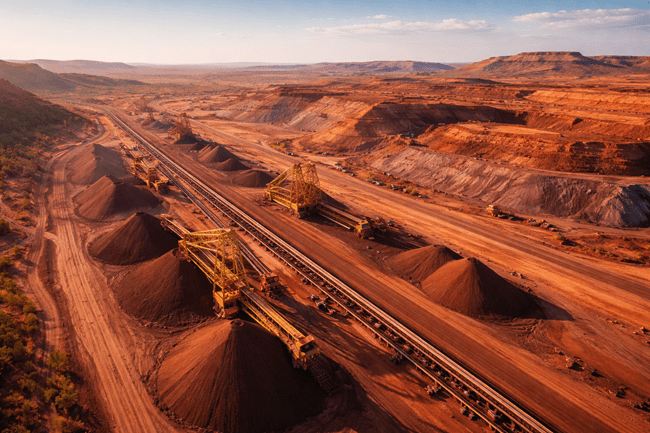
Rio Tinto Limited and BHP Group Limited have signed two non-binding memoranda of understanding to jointly explore extraction opportunities across their adjacent Yandicoogina and Yandi operations in Western Australia’s Pilbara region. The collaboration targets up to 200 million tonnes of iron ore by leveraging Rio Tinto’s processing infrastructure to unlock ore from both companies’ deposits. The move represents a strategic shift toward capital-efficient resource development and adds potential runway to legacy mining assets facing declining productivity.
Why are Rio Tinto and BHP collaborating again in Pilbara, and why now?
The latest joint effort between Rio Tinto and BHP is anchored in a shared imperative to extend asset life without triggering fresh rounds of high-capital expenditure. While their collaboration is not new, the scope of this new arrangement signals a deliberate pivot in Pilbara strategy. Rather than build new standalone infrastructure, the two mining giants intend to co-develop adjacent ore bodies by optimizing shared logistics, processing facilities, and haulage routes.
Specifically, the two companies will explore the development of Rio Tinto’s Wunbye deposit and assess whether ore from BHP’s Yandi Lower Channel Deposit can be processed at Rio Tinto’s existing wet plants. The agreement builds upon the 2023 Mungadoo Pillar deal, which allowed both companies to access and mine ore along their shared tenure boundary.
Timing is a crucial factor. Global iron ore markets are stabilizing, but cost discipline remains paramount as stakeholders demand both capital efficiency and environmental restraint. In this environment, maximizing existing operational footprints becomes more valuable than breaking ground on new projects. The proposed joint mining approach minimizes the need for new environmental approvals, reduces capital intensity, and aligns with regulatory preferences for lower-impact development in Western Australia’s Pilbara.
Rio Tinto and BHP are also responding to an industry-wide transition. Declining ore grades, heritage sensitivities, and emissions expectations are forcing miners to think creatively about how to maintain production. By sharing access to ore bodies and processing routes, both companies stand to generate returns without pushing the ESG risk envelope.
How does this proposed iron ore venture differ from previous joint efforts in the Pilbara?
What sets this announcement apart is not just the ore volume being targeted but the deeper integration of asset strategies across companies that have historically competed for Pilbara throughput dominance. The 200 million tonne figure represents a material uplift in iron ore recovery, with minimal greenfield exposure. Unlike conventional joint ventures where ownership and revenues are typically split on formal equity terms, this arrangement remains governed by non-binding memoranda, providing optionality and flexibility.
The structure is inherently modular. It allows both Rio Tinto and BHP to test compatibility, throughput logistics, and commercial frameworks without committing upfront capital or merging ownership rights. This is increasingly becoming the preferred approach in mature mining jurisdictions where development timelines can be protracted and stakeholder engagement must be sequenced carefully.
By initiating a conceptual study followed by an order-of-magnitude evaluation, both companies retain the right to proceed independently or together based on viability. This phased, study-first approach reduces project risk and enables alignment with joint venture stakeholders, Traditional Owners, and regulators before any investment decision is made. A final investment decision is anticipated later this decade, with first ore potentially delivered in the early 2030s.
The collaboration also highlights a growing comfort among top-tier miners to adopt “shared infrastructure without shared equity” models, where proximity and logistical efficiency override historical rivalries. This format could serve as a template for similar partnerships across other mineral-rich geographies where stranded assets and ESG constraints limit standalone feasibility.
What execution and regulatory risks could impact the outcome of the Wunbye and Yandi development?
While the strategic logic of the collaboration is clear, execution remains contingent on several moving parts. The most immediate hurdle is regulatory approval, particularly around land access and heritage management. Both deposits lie within tenures that require Traditional Owner consultation, environmental impact assessments, and potential joint venture alignment. Rio Tinto in particular continues to face heightened scrutiny following the 2020 Juukan Gorge incident, which reset expectations around cultural heritage protections.
Technical compatibility is another consideration. While Rio Tinto’s processing plants may offer a lower-cost path to monetization for BHP’s ore, the metallurgical characteristics of the Yandi Lower Channel Deposit must align with existing flowsheets. Processing mismatches could compromise recoveries or necessitate retrofitting, which would erode the capital-light advantage.
Operationally, blending strategies, haul distances, and infrastructure scheduling must be carefully coordinated to prevent bottlenecks. Both companies operate autonomous haulage and processing schedules that may need to be re-optimized for shared use.
From a labor and community standpoint, co-utilization of facilities could introduce industrial relations complexity, especially where union agreements or site management structures differ. These are not insurmountable obstacles, but they underscore the need for meticulous integration planning before execution.
How does this initiative align with Rio Tinto and BHP’s broader iron ore portfolio strategies?
For Rio Tinto, the Wunbye opportunity fits into a larger portfolio optimization program that emphasizes return on capital and productivity over scale. The company has been rebalancing its iron ore strategy by enhancing automation, boosting throughput at existing hubs, and deferring marginal expansion. Unlocking Wunbye through joint use of nearby assets gives Rio Tinto a low-cost extension to the Yandicoogina production corridor.
For BHP, the move reflects a pragmatic approach to winding down Yandi, one of its oldest iron ore hubs, without abrupt closure. The Yandi Lower Channel Deposit allows for legacy recovery with minimal overhead, particularly as BHP focuses new development capital on South Flank and on diversification into copper and potash.
Both companies have also adopted a more cautious approach to large-scale iron ore development. While Simandou in Guinea and Carajás in Brazil are shaping the next wave of global iron ore supply, the Pilbara remains the most cost-competitive region in terms of infrastructure density, government support, and shipping logistics. Maintaining throughput via brownfield enhancement makes strategic sense.
This deal signals that both Rio Tinto and BHP view Pilbara not only as an ore source but as an optimization canvas. Brownfield optimization, haulage collaboration, and orebody co-development have emerged as preferred levers for sustaining volume and margin in a high-scrutiny, low-tolerance investment cycle.
What broader mining industry trends does this collaboration reflect?
Rio Tinto and BHP’s Pilbara collaboration reflects a structural shift in global mining strategy. Capital efficiency, ESG alignment, and regulatory pragmatism are increasingly dictating development decisions. Gone are the days when billion-dollar expansions and standalone infrastructure were the primary metrics of mining strength.
Instead, mining majors are leaning into collaborative frameworks that allow for resource sharing, processing harmonization, and faster path-to-production metrics. These approaches are particularly relevant in high-stake jurisdictions like Western Australia, where environmental licensing and heritage engagement are tightly regulated.
The deal also mirrors broader consolidation in operational thinking. From Anglo American’s copper reconfiguration to Glencore’s asset spin-offs, global miners are reassessing how to extract more value from less capital. Joint-use models reduce the need for duplicate haul roads, processing plants, and energy inputs—making them both economically and environmentally appealing.
If successful, the Wunbye and Yandi co-development could become a reference case for similar arrangements in lithium, nickel, and rare earth projects where capex is a key constraint. Junior and mid-tier miners may seek to align with larger players not through mergers but through infrastructure access agreements, echoing the Rio Tinto–BHP model.
What is the early market response and how are investors interpreting this strategy?
The market response to the announcement has been muted, which is consistent with the early-stage nature of the MOUs. Neither Rio Tinto nor BHP saw meaningful share price movement following the news. However, institutional commentary suggests the strategy is being interpreted as a positive signal of capital discipline.
Sell-side analysts covering both companies highlighted the strategic use of infrastructure as a method to de-risk volume while preserving margins. Institutional investors focused on long-term free cash flow and dividend integrity are likely to view this collaboration favorably, as it aligns with recent guidance trends and operational cost controls.
Crucially, both Rio Tinto and BHP continue to prioritize shareholder returns over growth-at-any-cost strategies. Any capex-light pathway that extends mine life while supporting existing logistics chains is likely to be seen as a low-risk, high-leverage value play.
With iron ore prices fluctuating within a relatively stable $110 to $130 per tonne band in early 2026, this type of asset-light volume addition may allow the companies to opportunistically capture pricing upside without risking margin compression.
What are the strategic implications of the Rio Tinto and BHP Pilbara iron ore collaboration for miners and investors?
- Rio Tinto and BHP signed two new memoranda of understanding to jointly explore 200 million tonnes of iron ore in Pilbara’s Wunbye and Yandi Lower Channel deposits.
- The collaboration aims to use existing processing infrastructure to unlock stranded ore with minimal capital investment, reflecting a shift toward capex-light strategies.
- Both companies are prioritizing productivity and mine life extension over greenfield expansion in response to evolving ESG, regulatory, and commodity market dynamics.
- The agreement mirrors broader industry moves toward modular throughput boosts, shared infrastructure, and boundary mining as viable alternatives to new mines.
- Operational execution will hinge on regulatory approvals, Traditional Owner consultations, and technical validation of ore compatibility between assets.
- The approach could influence future mining strategies in Western Australia and beyond, particularly in battery minerals where infrastructure sharing is critical.
- Investor sentiment was neutral-to-positive, with the deal seen as evidence of disciplined capital allocation rather than an immediate production catalyst.
- This could be the beginning of more informal alliances in resource-rich geographies where infrastructure duplication is no longer economically or politically viable.
Discover more from Business-News-Today.com
Subscribe to get the latest posts sent to your email.

