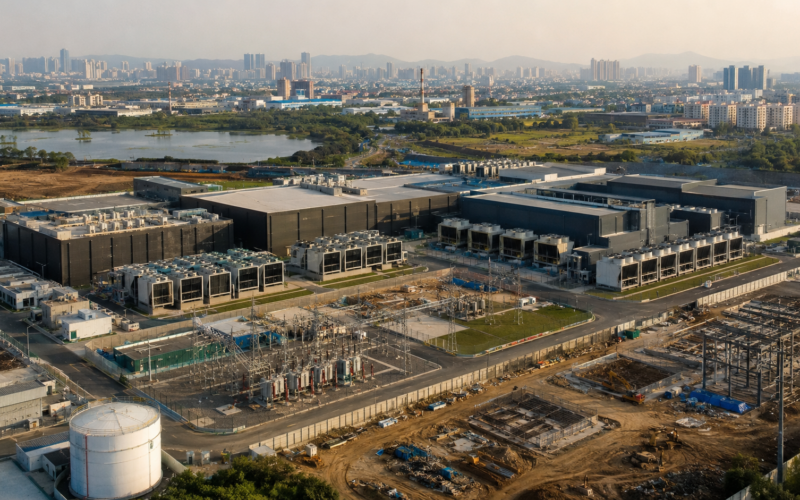
STT Global Data Centres India Private Limited has acquired an industrial land parcel in Navi Mumbai from Repro India Limited (NSE: REPRO, BSE: 532687) for ₹282 crore, strengthening its position in one of India’s most important data centre corridors. The transaction covers a 3.48-acre property in the TTC Industrial Area, Mahape, along with an existing built-up structure, giving STT Global Data Centres India Private Limited a strategically located asset in the Mumbai Metropolitan Region. The deal is significant because data centre operators are competing aggressively for land parcels that can support power-intensive cloud, artificial intelligence and enterprise digital workloads. For Repro India Limited, the sale also draws attention to asset monetisation at a time when its share price remains well below its 52-week high.
Why does STT Global Data Centres’ Navi Mumbai land purchase matter for India’s data centre market?
STT Global Data Centres India Private Limited’s Navi Mumbai purchase matters because data centre capacity in India is increasingly becoming a real estate, power and connectivity contest before it becomes a technology contest. Operators need land parcels that can support high-density infrastructure, reliable power access, fibre connectivity, cooling systems, security controls and future expansion. In that sense, the ₹282 crore transaction is not simply a property acquisition. It is a capacity option in a market where every suitable industrial plot near Mumbai now carries strategic value.
Navi Mumbai has become one of the most important data centre zones in India because it offers proximity to Mumbai’s financial ecosystem while providing relatively more scalable industrial land than the island city. The location connects enterprise demand, subsea cable relevance, cloud infrastructure requirements and a mature power distribution ecosystem. For data centre operators, those ingredients are more useful than a glossy brochure and a ribbon-cutting ceremony, though the latter usually arrives eventually.
The deal also reflects how artificial intelligence is changing data centre planning. Traditional enterprise colocation demand was already growing, but artificial intelligence workloads require denser power usage, stronger cooling design and more resilient uptime standards. That makes future-ready land parcels far more valuable. STT Global Data Centres India Private Limited appears to be adding capacity in a region where demand visibility is improving, but where project execution will still depend heavily on power availability, regulatory approvals and capex discipline.

How does the Navi Mumbai acquisition strengthen STT Global Data Centres’ India expansion strategy?
The Navi Mumbai acquisition strengthens STT Global Data Centres India Private Limited’s India strategy by adding another physical foothold in a market where scale increasingly determines competitiveness. Data centre customers, especially hyperscalers, banks, technology companies and artificial intelligence-driven enterprises, prefer operators that can offer multiple locations, high reliability and long-term expansion pathways. A single facility can win customers. A campus strategy can retain them.
The acquired parcel sits in a corridor where STT Global Data Centres India Private Limited already has a presence, which matters operationally. Clustering data centre assets in the same region can improve network connectivity, vendor coordination, workforce utilisation and customer migration options. It can also create procurement efficiencies across power systems, cooling infrastructure, facility management and security operations. The strategic benefit comes from building density in the right market, not merely from adding another pin on a map.
However, the acquisition also raises the execution bar. Buying land is the easy headline. Turning that land into a compliant, power-secure, high-uptime data centre is the hard part. Data centre development requires large capital commitments, long technical planning cycles and careful management of environmental, electrical and municipal requirements. If STT Global Data Centres India Private Limited can integrate the parcel into its broader Navi Mumbai footprint efficiently, the deal could enhance its ability to serve hyperscale and enterprise customers. If project timelines slip, the capital could remain tied up before revenue generation begins.
Why is Navi Mumbai becoming a critical hub for cloud, AI and enterprise data infrastructure?
Navi Mumbai is becoming critical because India’s digital economy needs infrastructure close to demand centres but outside the most congested parts of Mumbai. The Mumbai Metropolitan Region remains India’s deepest data centre market because of its financial institutions, telecom links, enterprise customers and connectivity advantages. Navi Mumbai adds a practical expansion layer by offering industrial layouts, transport access and data centre clustering potential that are difficult to achieve in more constrained urban pockets.
This clustering effect can become self-reinforcing. Once a region develops a concentration of data centres, it attracts fibre providers, specialised contractors, power infrastructure upgrades, security vendors and skilled technical workers. Customers also become more comfortable placing workloads in a known digital infrastructure zone. That is why Navi Mumbai’s importance is not only about individual land transactions. It is about the formation of a digital industrial district.
The risk is that success can create its own bottlenecks. Data centres are heavy consumers of power and water, and artificial intelligence workloads can intensify those demands. If multiple operators build aggressively in the same corridor, local utilities and regulators may face pressure to ensure grid stability, sustainable cooling practices and land-use compatibility. Navi Mumbai’s rise as a data centre hub will therefore depend not only on private investment but also on public infrastructure coordination. The servers may be digital, but the constraints are still very physical.
What does the Repro India asset sale signal for listed-company investors?
For Repro India Limited, the Navi Mumbai land sale gives investors a clearer asset monetisation event at a time when the company’s stock has been under pressure. Repro India Limited shares closed at ₹351.25 on June 5, 2026, compared with a 52-week high of ₹590.15 and a 52-week low of ₹307.05. The stock has declined over the past year, which means investors are likely to examine whether the ₹282 crore transaction improves balance-sheet flexibility, liquidity or strategic repositioning.
The sale also raises a capital allocation question. Investors will want to know whether Repro India Limited uses the proceeds to strengthen its core publishing services business, reduce liabilities, fund digital initiatives or return capital in some form. Asset sales can be value-accretive when they sharpen the balance sheet and support a clearer operating strategy. They can also disappoint if proceeds are absorbed without a visible improvement in growth, margins or cash flow.
From a sentiment perspective, the transaction may help draw attention to hidden or underappreciated asset value within Repro India Limited. However, investors should be careful not to confuse one-time monetisation with recurring business momentum. The market will eventually ask what the company earns after the land sale, not merely what it realised from the land sale. That is the tricky part with asset monetisation. It creates a cleaner story, but only temporarily, unless the operating story also improves.
How could this deal affect competition among India’s data centre operators?
The transaction reinforces the competitive intensity among India’s data centre operators, especially in Mumbai and Navi Mumbai. Operators are racing to secure land, power access and customer commitments before demand becomes even more concentrated around artificial intelligence, cloud migration, fintech workloads and enterprise digital transformation. In this environment, land acquisition is not a back-office real estate function. It is a front-line strategic weapon.
STT Global Data Centres India Private Limited competes in a market that includes domestic and global operators with deep capital access. The competitive battle is likely to move beyond capacity announcements into energy efficiency, uptime credibility, speed of delivery, sustainability claims and customer concentration risk. Hyperscale customers may demand lower costs and higher technical standards, which can compress margins even as demand rises. Growth will be available, but it will not be free.
The Navi Mumbai deal also suggests that data centre operators may continue buying industrial assets from companies in unrelated sectors. As data infrastructure becomes more valuable, landowners with suitable parcels could find themselves sitting on assets that are strategically more useful to digital infrastructure players than to their existing operations. That could create a wider wave of industrial land monetisation, especially in metro-linked corridors with strong power and fibre availability.
What are the biggest execution risks after STT Global Data Centres’ Navi Mumbai purchase?
The first major risk is power availability. Data centres require uninterrupted electricity, backup systems and redundancy planning. Artificial intelligence workloads increase the pressure because they can demand higher rack densities and more intensive cooling. If power infrastructure does not scale in line with data centre development, operators may face higher costs or slower commissioning timelines.
The second risk is regulatory and environmental scrutiny. Data centres are often presented as clean digital infrastructure, but they consume significant energy and can place pressure on local resources. Operators will need to show that capacity expansion is consistent with sustainability expectations, municipal planning norms and state-level infrastructure goals. In a market where public attention to energy use is rising, efficiency will become more than a marketing line.
The third risk is capital discipline. Data centre projects require heavy upfront investment before revenues mature. If operators overbuild ahead of demand, returns can soften. If they build too slowly, competitors can capture customer commitments. STT Global Data Centres India Private Limited must therefore balance speed with utilisation visibility. The ₹282 crore land acquisition improves optionality, but the real value will emerge only if capacity is brought online at the right cost, at the right time and for the right customers.
What does the Navi Mumbai transaction reveal about India’s digital infrastructure cycle?
The transaction reveals that India’s digital infrastructure cycle has entered a more asset-heavy phase. The first wave of digital growth was often discussed through apps, platforms, telecom usage and software services. The current wave is increasingly about physical capacity, including data centres, power lines, cooling systems, fibre networks and industrial land. The cloud may sound weightless, but it needs a lot of concrete.
This shift has broad implications for infrastructure investors, utilities, real estate developers and state governments. Data centre investment can attract high-value tenants, create skilled jobs and deepen a region’s role in the digital economy. At the same time, it can intensify competition for land and electricity. The states that manage power reliability, permitting speed and sustainability expectations well are likely to capture a larger share of the next data infrastructure cycle.
For STT Global Data Centres India Private Limited, Navi Mumbai offers a strategically relevant expansion base. For Repro India Limited, the sale offers an asset monetisation event that could support balance-sheet or business strategy decisions. For India’s infrastructure market, the deal is another signal that data centres are no longer a niche technology asset. They are becoming core industrial infrastructure for artificial intelligence, cloud computing, finance, e-commerce and enterprise technology.
Key takeaways on what STT Global Data Centres’ Navi Mumbai deal means for India’s digital infrastructure market
- STT Global Data Centres India Private Limited’s ₹282 crore acquisition strengthens its presence in Navi Mumbai, one of India’s most important data centre corridors.
- The transaction shows how industrial land near Mumbai is becoming increasingly valuable as data centre operators compete for power-ready and connectivity-rich locations.
- Navi Mumbai’s role in India’s data centre market is expanding because it combines proximity to Mumbai’s enterprise demand with better scalability for industrial infrastructure.
- Artificial intelligence workloads are likely to increase demand for high-density data centres, making early land acquisition a strategic advantage for operators with strong capital access.
- Repro India Limited’s sale gives investors a clear asset monetisation event, but the long-term stock impact will depend on how the company deploys the proceeds.
- Repro India Limited’s share price remains far below its 52-week high, suggesting that investors still need stronger evidence of operating recovery beyond asset sales.
- Data centre competition in India is moving beyond capacity announcements into power procurement, cooling efficiency, uptime credibility and speed of delivery.
- The deal may encourage more industrial landowners in metro-linked corridors to monetise assets as digital infrastructure operators seek suitable expansion sites.
- STT Global Data Centres India Private Limited still faces execution risks around permitting, power availability, sustainability expectations and customer utilisation.
- The acquisition reinforces the view that India’s digital economy is becoming more infrastructure-intensive, with data centres emerging as core industrial assets rather than back-end technology facilities.
Discover more from Business-News-Today.com
Subscribe to get the latest posts sent to your email.