


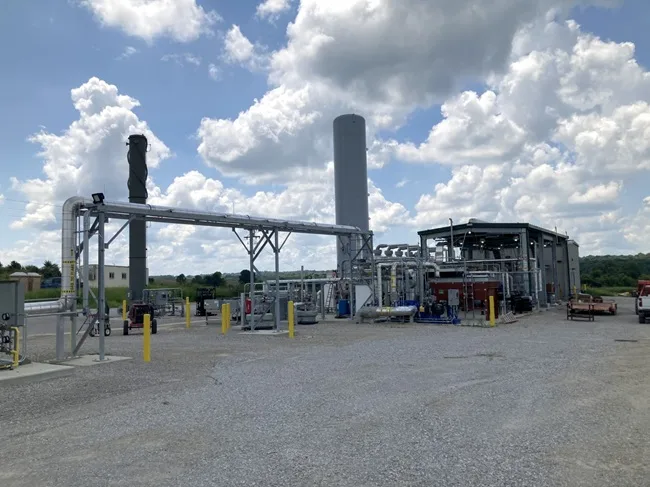
Redtail Renewables, a Boston-backed renewable natural gas (RNG) developer based in Indianapolis, has entered into a strategic joint venture with Pacolet Milliken to expand RNG infrastructure across the United States. The new entity, RPM Holdings, launches with the acquisition of a nearly operational RNG facility at the West Daviess County landfill near Owensboro, Kentucky, marking a key milestone in Redtail’s post-launch scale-up.
The Owensboro RNG project, slated to go online by year-end, is expected to produce up to 500,000 MMBtu annually, backed by a long-term offtake contract. The facility is designed to capture methane emissions from decomposing waste and convert it into pipeline-quality RNG—a critical step in decarbonizing utility and transportation sectors.
Pacolet Milliken, a Greenville-based investment firm with a growing decarbonization-focused portfolio, has joined Redtail in RPM to accelerate landfill gas capture projects across North America. The joint venture is already in advanced planning for a second RNG facility expected to break ground before the end of the year.
How does the Owensboro RNG project strengthen Redtail’s landfill gas development portfolio?
For Redtail Renewables, the Owensboro project signals both execution capability and momentum in the highly competitive RNG development sector. The facility, located at the West Daviess County landfill, is near mechanical completion and will begin commercial operations within the next quarter. Once online, the plant will process landfill methane into renewable natural gas, displacing fossil fuels in transportation and industrial use cases.
The project’s estimated output of 500,000 MMBtu per year aligns with growing demand from gas utilities and fleet operators seeking to reduce carbon intensity. Notably, the long-term offtake agreement de-risks revenue streams and provides a stable cash flow foundation for RPM’s broader growth plans. Analysts tracking the RNG sector see projects with contracted offtake as prime assets amid volatile carbon credit pricing and federal subsidy recalibrations.
What role does Pacolet Milliken play in scaling Redtail’s RNG ambitions through RPM Holdings?
The formation of RPM Holdings allows Redtail to tap into Pacolet Milliken’s infrastructure capital and portfolio synergies. The investment firm, which manages power, renewables, and utility assets across the U.S., views RNG as a key pillar of its decarbonization thesis. By co-developing projects with Redtail, Pacolet gains both vertical integration and operational leverage—especially in segments where landfill gas capture overlaps with regulated electric infrastructure.
Pacolet’s Chief Investment Officer for Power & Infrastructure, Lance Jordan, stated that the joint venture “enhances our ability to deliver meaningful climate impact while accelerating RNG growth.” While no financial terms were disclosed, institutional observers suggest RPM’s structure provides Redtail with long-term access to capital for development, engineering, and construction (EPC) execution—without the short-term pressures of public equity markets.
What is the significance of Redtail’s acquisition in New York and how does it fit into future plans?
Alongside the Kentucky acquisition, Redtail Renewables has also acquired a second RNG project at the Oneida-Herkimer Regional Landfill in Boonville, New York. While the Owensboro plant is closer to commissioning, the Boonville project remains under development and construction. With two active sites now under RPM’s banner, Redtail is signaling a clear strategy to establish a regional footprint anchored in landfill partnerships.
Redtail’s pipeline is expected to include additional landfill and dairy-based RNG projects over the next 12 months. CEO Casey Holsapple emphasized that RPM’s platform will focus on “mitigating methane emissions from landfills,” aligning with broader federal and state-level methane abatement goals. Institutional interest in methane-derived RNG has surged since the U.S. Environmental Protection Agency’s 2024 methane regulation updates, further validating the RPM model.
How is Redtail Renewables positioned within the fast-growing U.S. RNG developer ecosystem?
Founded in 2023 by Casey Holsapple, a former Kinetrex Energy executive, Redtail Renewables has quickly established itself as a credible RNG player with capital backing from Inyarek Partners, a Boston-based private equity firm. Holsapple was previously instrumental in building Kinetrex’s RNG platform, which was acquired by Kinder Morgan (NYSE: KMI) in 2021. His brother, Corey Holsapple, serves as Redtail’s CFO, bringing prior experience in banking and consulting.
Redtail’s stated model relies on faster construction timelines, feedstock partnerships with municipal and private landfills, and integration with offtake clients in logistics, industrials, and utilities. The American RNG developer’s pipeline is being closely watched by institutional investors tracking the RNG sector’s shift from pilot projects to scalable infrastructure plays.
Inyarek Partners, which provided the equity commitment that enabled Redtail’s formation, reiterated its bullish stance. Paul Kaboub, partner and co-founder at Inyarek, noted that RPM “immediately delivers with these project acquisitions,” and praised Redtail’s ability to “execute on attractive opportunities in the current industry environment.”
How are analysts assessing the commercial impact and investor confidence around RPM Holdings?
While Redtail is privately held, the launch of RPM Holdings and its inaugural project activity has caught the attention of energy transition-focused institutional investors. Analysts see Redtail’s approach—securing offtake contracts, accelerating time-to-commercial operation, and aligning with decarbonization mandates—as highly bankable in a market where project viability often hinges on subsidy stability and interconnection timing.
With landfill gas projects receiving renewed interest under the Inflation Reduction Act’s clean fuel production tax credits (45Z), the Owensboro RNG facility could benefit from both monetizable tax credits and low-carbon fuel standard (LCFS) markets depending on downstream routing.
From an ESG lens, RPM’s methane capture projects are expected to deliver meaningful GHG abatement at relatively low marginal cost—making them attractive to impact-focused capital providers and municipal partners. The embedded long-term revenue contracts, combined with Redtail’s experienced development team, give RPM credibility as a repeatable RNG platform builder.
What lies ahead for Redtail Renewables and its national RNG pipeline strategy?
With RPM Holdings established and two landfill RNG projects secured, Redtail Renewables is now in active pursuit of additional landfill partnerships and site acquisitions. The company is currently vetting multiple sites across the Midwest and Northeast U.S., with expectations to close at least one more acquisition by the end of the calendar year.
Redtail has also begun engaging with third-party RNG marketers and regulated gas utilities to explore bundling RNG offtake with carbon credits and energy attribute certificates (EACs). While early-stage, such bundling could help smooth out revenue variability tied to RNG spot pricing and regulatory incentives.
Legal counsel for the acquisitions was provided by Skadden, Arps, Slate, Meagher & Flom LLP, indicating a robust legal infrastructure supporting future growth.
Discover more from Business-News-Today.com
Subscribe to get the latest posts sent to your email.