
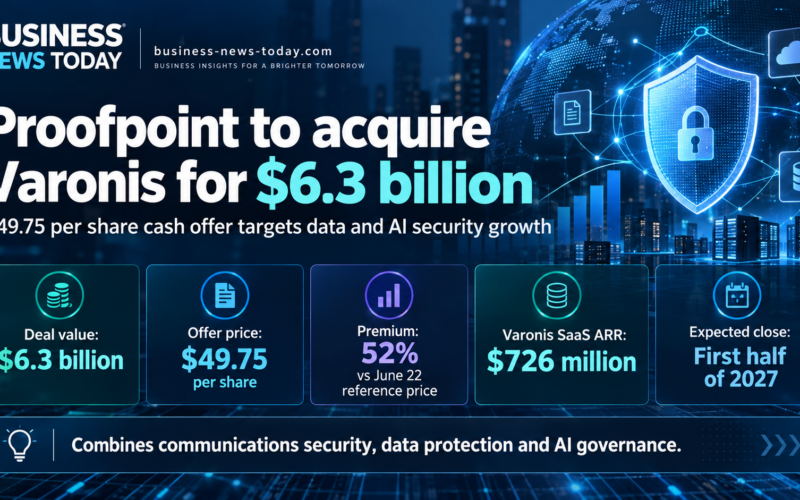
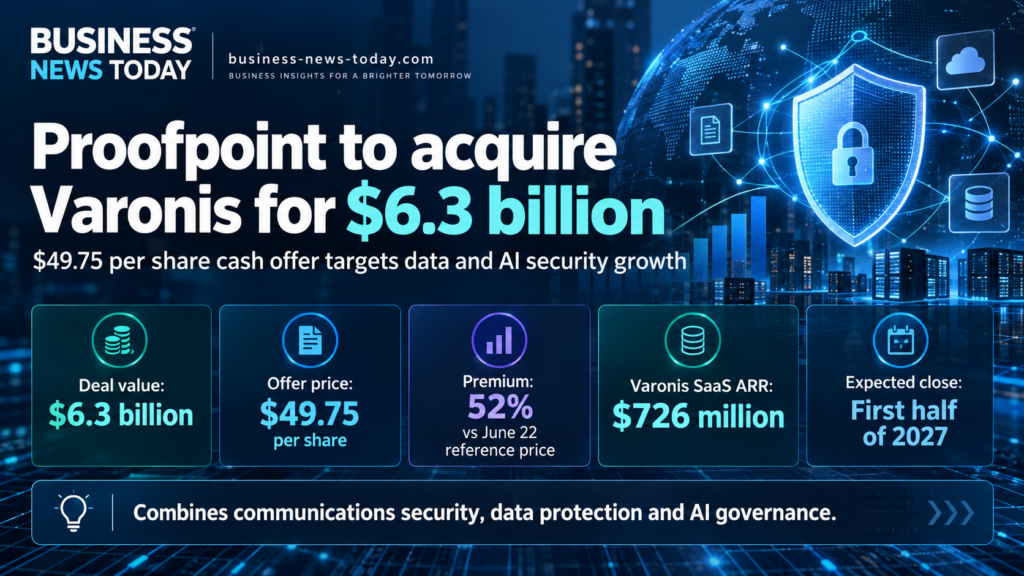
Proofpoint, Inc., the privately held cybersecurity company owned by Thoma Bravo, has entered into a definitive agreement to acquire Varonis Systems, Inc. (NASDAQ: VRNS) in an all-cash transaction valued at approximately $6.3 billion. Announced on October 15, 2026, the agreement provides Varonis shareholders with $49.75 per share, representing a 52% premium to the company’s June 22 closing price before initial takeover speculation emerged. The combination will bring together Proofpoint’s email, collaboration, insider threat and AI agent security capabilities with Varonis’ data discovery, access governance and automated data protection platform. The companies expect the transaction to close during the first half of 2027, subject to shareholder approval and regulatory clearances, with Thoma Bravo arranging committed equity and debt financing. The acquisition reflects increasing demand for security platforms that protect not only employees and communications but also the sensitive enterprise data accessed by artificial intelligence systems, although the transaction’s premium valuation places considerable importance on successful integration and future commercial growth.
What does Proofpoint’s $6.3 billion acquisition mean for Varonis shareholders and its market valuation?
The offer provides Varonis shareholders with a fixed cash consideration of $49.75 per share, replacing their prospective exposure to the company’s independent business performance with a payment conditional on completion. The stated transaction value of approximately $6.3 billion differs from the roughly $5.71 billion equity value associated with the offer, reflecting the distinction between enterprise-level transaction valuation and consideration attributable to shareholders. The companies have not presented the $6.3 billion figure as a direct cash distribution to common shareholders. The agreed per-share consideration is therefore the more relevant measure for holders of Varonis common stock.
The offer carries a substantial premium to Varonis’ share price before reports of a possible transaction began influencing trading. Shares closed at $32.71 on June 22, the last full trading session before initial takeover speculation, making the agreed price approximately 52.1% higher. The consideration also represents a premium of approximately 17.5% to the September 1 closing price of $42.35, immediately before additional reports concerning a potential sale. These reference periods are important because the company’s share price had already incorporated takeover expectations before the definitive agreement was announced.
Varonis shares closed at approximately $47.34 on October 15, rising around 0.6% during the regular Nasdaq session before the announcement was published. The stock subsequently traded near $48.65 in extended-hours trading, according to MarketWatch, reflecting an increase of approximately 2.8% from the regular-session close. At that after-hours price, the shares remained $1.10 below the agreed cash consideration, equivalent to a discount of approximately 2.2% to the offer price. The residual discount reflects the time required to complete the acquisition and risks associated with closing, rather than establishing a specific probability of success.
The fixed-price structure provides shareholders with greater certainty about the consideration they would receive if the transaction closes. However, the agreement does not provide participation in any subsequent appreciation of Varonis’ business after it becomes privately owned by Proofpoint. The board’s decision therefore involves weighing the immediate cash offer against the uncertain value of continuing as an independent company. Varonis stated that an independent board committee had conducted a comprehensive evaluation involving outreach to prospective financial and strategic buyers before the agreement was reached.
Why is Thoma Bravo combining Proofpoint and Varonis to build a broader data and AI security platform?
Proofpoint has historically been associated with protecting employees and organizations against email-based attacks, phishing, malicious communications and related cybersecurity threats. Its platform has expanded into collaboration security, data loss prevention, insider threat management and tools intended to secure the interaction between employees and AI agents. Varonis operates closer to the data itself, identifying sensitive information, monitoring access permissions, detecting unusual activity and reducing exposure across cloud and enterprise environments. Combining the businesses could allow customers to connect threat activity with information about the data potentially affected by that activity.
Proofpoint Chief Executive Officer Sumit Dhawan has positioned the proposed acquisition around the changing relationship between people, enterprise information and AI systems. As AI agents are granted access to documents, applications and internal databases, conventional security controls must account for software that can retrieve and process information autonomously. A compromised account or overly broad permission can potentially expose sensitive information even when the underlying data has not been transferred outside the organization. The combined platform is intended to address these risks by correlating communications, identities, permissions and actual data usage.
Varonis brings established capabilities in data security posture management, data access governance and automated remediation of excessive permissions. Its platform helps organizations identify sensitive information stored across their technology environments and determine which users or systems can access it. These capabilities could complement Proofpoint’s visibility into threats arriving through email and collaboration tools, including those involving compromised accounts or malicious insiders. A unified offering could potentially shorten the process of identifying a threat, assessing the information at risk and restricting access.
The strategic rationale is strongest where the companies’ products address different stages of the same security incident. For example, Proofpoint might identify suspicious activity linked to an employee account, while Varonis could establish which sensitive files that account can access and whether unusual data activity has occurred. Combining those signals may help security teams prioritize incidents according to the actual information exposed rather than relying solely on the severity of the originating threat. However, this capability will depend on the successful integration of data models, detection systems, workflows and customer environments after closing.
The transaction also reflects changing customer preferences within cybersecurity procurement. Large enterprises frequently operate multiple security platforms, creating overlapping alerts, duplicated administration and difficulty connecting incidents across systems. Vendors capable of consolidating related capabilities may find opportunities to expand existing customer relationships and compete for larger contracts. Nevertheless, customers will judge the combined offering on operational performance, pricing and ease of deployment rather than the breadth of its product catalogue alone.
How does the Varonis Atlas platform strengthen Proofpoint’s position in enterprise AI governance?
Varonis has expanded from conventional data access monitoring towards securing AI applications and the information they use. In March 2026, the company introduced Varonis Atlas, an AI security platform designed to identify AI systems, evaluate security configurations, enforce runtime controls and support governance requirements. Its scope includes internally developed AI applications, third-party AI services and unauthorized systems that may operate without full visibility from corporate security teams. The acquisition would give Proofpoint an established set of capabilities in a market where enterprises are trying to expand AI adoption without creating uncontrolled access to confidential data.
The relationship between AI systems and sensitive information creates challenges that conventional user-focused security tools cannot fully resolve. An AI assistant might be authorized to retrieve documents from several business applications, but those applications may contain files with outdated permissions or information that should not be available to the requesting user. If access controls are excessive, the AI system could expose information that employees would not ordinarily encounter during their work. Varonis’ data discovery and permission management capabilities address the underlying exposure, while Proofpoint’s threat monitoring and data loss prevention tools provide complementary controls around communications and information movement.
Varonis has also expanded its technology integrations with major AI development platforms. During the second quarter of 2026, the company announced deeper integration with Anthropic’s Claude Enterprise, Claude Platform, Claude Code and Claude Cowork offerings. It also disclosed support for Cursor, extending security visibility into AI-assisted software development. These integrations illustrate how data security vendors are expanding their coverage beyond conventional cloud repositories into environments where AI applications actively retrieve and modify information.
The combined platform could appeal particularly to regulated industries and large organizations with complex data estates. Financial institutions, healthcare providers and multinational corporations must control access to sensitive information while maintaining records of data handling and administrative activity. Security tools capable of connecting user behaviour, AI application activity and underlying data permissions could improve the quality of investigation and governance. However, the acquisition announcement does not establish that the companies have already developed a fully integrated product or that customers can immediately access unified capabilities.
Proofpoint intends to accelerate integration following completion, including combining technologies, coordinating sales activities and developing a consolidated platform proposition. That process will require maintaining existing customer protections while new integrations are introduced. Compatibility across cloud services, endpoint systems and enterprise applications will remain important because customers may not use all the products supplied by either company. The commercial opportunity therefore depends on demonstrable improvements in security operations rather than the assumption that combining two platforms automatically delivers a more effective system.
Does Varonis’ $726 million SaaS revenue run rate justify Proofpoint’s acquisition valuation?
Varonis’ latest published results provide context for the acquisition price. During the second quarter of 2026, the company generated $180.0 million in revenue, an increase of approximately 18.3% from $152.2 million a year earlier. Software-as-a-service revenue increased from $105.9 million to $171.7 million, reflecting the company’s transition away from traditional term-based licensing. SaaS accounted for approximately 95.4% of quarterly revenue, compared with around 69.6% in the prior-year period.
Annual recurring revenue from SaaS contracts reached $726.0 million at June 30, increasing 52% year over year. The growth figure includes customers converting from older licensing arrangements, meaning it should not be interpreted entirely as newly generated demand. Excluding conversions, SaaS ARR increased 25%, providing a more focused indication of underlying subscription expansion. The company also reported more than 20% growth in SaaS ARR from new customers, suggesting that the transition involved additional business rather than only migration of existing accounts.
The acquisition announcement values Varonis at approximately 8.4 times trailing 12-month revenue, calculated using enterprise value, and 53 times trailing free cash flow, calculated using equity market capitalization. These are substantial transaction multiples, particularly for a company that remains loss-making under generally accepted accounting principles. They reflect expectations that recurring revenue growth, product differentiation and potential integration benefits can support future cash generation. However, those benefits must be realized over time rather than being treated as part of current earnings.
Varonis reported a second-quarter GAAP operating loss of $40.6 million, compared with a loss of $36.6 million a year earlier. On a non-GAAP basis, it generated operating income of $3.7 million, compared with a loss of $1.9 million in the prior-year period. The difference reflects adjustments including stock-based compensation and other excluded expenses, making it important to distinguish adjusted profitability from statutory earnings. The company generated $69.1 million in free cash flow during the first six months of 2026, down from $82.7 million a year earlier.
Before the acquisition announcement, Varonis had forecast full-year revenue between $735 million and $739 million, representing 18% to 19% annual growth. It also expected year-end SaaS ARR of $819 million to $850 million and full-year free cash flow between $105 million and $110 million. These forecasts provide a benchmark against which the acquisition valuation can be assessed, but they are management expectations rather than completed financial results. Varonis is scheduled to publish its September-quarter results on November 3, giving shareholders another opportunity to evaluate operating performance before the proposed transaction closes.
How will Thoma Bravo finance the Proofpoint and Varonis acquisition, and what financial obligations follow?
The transaction will be financed through a combination of committed equity and debt funding arranged by Thoma Bravo and Proofpoint. Thoma Bravo-managed funds have committed equity contributions, while financial institutions have agreed to provide debt financing subject to the relevant financing documents. Ontario Teachers’ Pension Plan has separately agreed to invest in Proofpoint in connection with the acquisition. The companies have not disclosed a complete public breakdown of the final equity and debt contributions or the resulting financing costs.
The financing commitments are particularly relevant because the acquisition is entirely cash-funded from the perspective of Varonis common shareholders. The merger agreement states that Proofpoint’s obligation to complete the acquisition is not conditional on obtaining financing, although the underlying funding commitments contain customary conditions. This provides a stronger contractual framework than an acquisition requiring the buyer to arrange financing after signing. Nevertheless, financing commitments do not mean the purchase price has already been paid or that all closing conditions have been satisfied.
The use of debt also creates financial obligations for the enlarged privately held business. Debt servicing could influence the pace of future acquisitions, research spending and integration investment, depending on the final capital structure and operating cash generation. Proofpoint is not currently required to publish the same level of ongoing financial information as a publicly listed company, limiting visibility into its existing leverage and profitability. Without detailed consolidated financial statements and final financing terms, it would be inappropriate to calculate the combined company’s leverage ratio or interest coverage.
Varonis itself reported $911.5 million in cash, deposits and marketable securities at June 30, 2026, and has outstanding convertible senior notes due in 2029. The merger agreement identifies completion as an event affecting the treatment of those notes under their governing indenture. These obligations form part of the broader transaction financing and capital structure considerations but do not change the stated $49.75 cash consideration for eligible common shares. The final financial effects will depend on the applicable note provisions and completion arrangements.
What regulatory approvals, breakup fees and closing conditions could affect the $6.3 billion transaction?
Varonis’ board has unanimously approved the merger agreement, but shareholders must still vote on the proposed acquisition. Completion requires support from holders representing at least a majority of the voting power of outstanding shares entitled to vote. The agreement also requires satisfaction of United States antitrust waiting-period requirements under the Hart-Scott-Rodino Act and specified foreign regulatory approvals. The companies currently expect the transaction to close during the first half of 2027.
The October 15 regulatory filing establishes July 15, 2027, as the principal contractual termination date, subject to a possible three-month extension for outstanding regulatory approvals. This creates a defined timeframe for obtaining the necessary clearances and completing the transaction. The deadline does not guarantee closing by that date, because termination rights and extensions depend on the detailed contractual conditions. Regulatory review could examine the competitive implications of combining the companies’ capabilities in data security, data loss prevention and related cybersecurity services.
The agreement also contains material termination payments. Varonis may be required to pay Proofpoint approximately $211.7 million under specified circumstances, including certain changes in its board recommendation or termination to enter into a superior proposal. Proofpoint may be required to pay Varonis approximately $423.3 million in defined buyer-default circumstances. These payments are conditional contractual protections rather than sums currently payable or guaranteed compensation for every possible failure to close.
The agreement generally restricts Varonis from actively soliciting competing proposals while allowing specified responses to potentially superior unsolicited offers. Chief Executive Officer Yaki Faitelson has also agreed to vote shares representing approximately 0.67% of Varonis’ outstanding stock in favour of the transaction, subject to the support agreement’s conditions. His commitment does not constitute approval by shareholders collectively or remove the need for a formal vote. The company has indicated that its board’s independent evaluation involved outreach to multiple potential buyers before selecting the Proofpoint transaction.
Until closing, Proofpoint and Varonis will continue operating as separate businesses. That requirement means the announced combination should not be described as an already completed integration, particularly regarding pricing, personnel, product development and customer contracts. On completion, Varonis is expected to become a wholly owned subsidiary of Proofpoint and its shares will be delisted from Nasdaq. Customers and investors will therefore face different considerations during the interim period than after the transaction closes.
Why does Proofpoint’s acquisition of Varonis signal further consolidation in the cybersecurity industry?
Thoma Bravo acquired Proofpoint for approximately $12.3 billion in 2021, taking the email security business private and creating a platform for further expansion. The proposed Varonis acquisition represents a major investment in broadening Proofpoint’s capabilities beyond its original threat protection focus. It also reflects a wider shift in cybersecurity purchasing towards integrated systems that can address identities, communications, information access and AI activity. As enterprises deploy more automated software, security vendors are increasingly competing over the ability to provide coordinated protection across those environments.
The companies say their combined operations will serve more than 16,000 enterprises and millions of organizations worldwide. Proofpoint already reports relationships with more than 80 Fortune 100 companies and more than 14,000 large enterprises, creating substantial opportunities to introduce Varonis’ data security capabilities to existing customers. Varonis, meanwhile, could potentially offer Proofpoint’s email and collaboration security products through its own enterprise relationships. These opportunities may reduce the cost of acquiring additional customers, although the companies have not disclosed quantified revenue synergies or a timetable for achieving them.
Competition will remain substantial. Microsoft, Palo Alto Networks, IBM and specialized data security providers offer overlapping capabilities across cloud security, identity protection, information governance and threat detection. Customers may welcome a broader security platform but still choose independent providers for particular functions. Proofpoint will need to demonstrate that integrating Varonis produces better security outcomes and more efficient operations than connecting competing products through existing enterprise security architectures.
The transaction is also a test of the financial value attributed to AI security capabilities. Varonis’ rapid SaaS expansion and growing AI security portfolio provide a rationale for the purchase, but the company is still reporting GAAP operating losses. Proofpoint’s private ownership may give management flexibility to invest over a longer period, while acquisition debt could introduce additional pressure to improve profitability. The combination will create a larger cybersecurity platform, but its eventual economic return will depend on product integration, customer retention, revenue expansion and cash generation.
What are the next milestones for Proofpoint and Varonis before the expected 2027 closing?
Varonis’ November 3 quarterly results will be the next scheduled financial disclosure, providing updated information about subscription growth, profitability and cash generation. The company will publish the results without conducting its usual earnings conference call because of the pending acquisition. Shareholder approval and regulatory clearances will then determine whether the transaction can proceed within the first half of 2027. The contractual July 15 termination date, subject to an applicable extension, provides a further boundary for assessing progress.
For Varonis shareholders, the transaction establishes a defined cash consideration and reduces exposure to the company’s independent growth prospects if completed. For Proofpoint and Thoma Bravo, the acquisition adds a substantial recurring-revenue data security business at a valuation that anticipates continued commercial expansion. The strongest evidence supporting the strategic rationale would be the delivery of integrated security capabilities, sustained subscription growth and improved combined operating economics. Until the required approvals are received and financing is completed, the $6.3 billion combination remains an agreed transaction rather than an accomplished acquisition.
What are the key takeaways from Proofpoint’s $6.3 billion proposed acquisition of Varonis?
- Proofpoint has agreed to acquire Varonis Systems in an all-cash transaction valued at approximately $6.3 billion.
- Varonis shareholders will receive $49.75 per share if the transaction closes, representing a 52% premium to the June 22 reference price.
- The offer values Varonis equity at approximately $5.71 billion, distinct from the overall transaction value.
- Thoma Bravo is providing committed equity financing and has secured debt financing commitments, with Ontario Teachers’ Pension Plan also investing in Proofpoint.
- The acquisition combines Proofpoint’s communications and threat security capabilities with Varonis’ data access governance, data security and AI protection technologies.
- Varonis reported $726 million in SaaS annual recurring revenue at June 30, representing 52% reported growth and 25% growth excluding conversions.
- The transaction represents approximately 8.4 times trailing revenue on an enterprise value basis and 53 times trailing free cash flow on an equity value basis.
- Regulatory approvals and a Varonis shareholder vote are required before the expected first-half 2027 closing.
- Conditional termination fees of approximately $211.7 million and $423.3 million provide contractual protections in specified circumstances.
- Successful integration, recurring revenue expansion and measurable customer benefits will determine whether the enlarged platform justifies its acquisition economics.
Discover more from Business-News-Today.com
Subscribe to get the latest posts sent to your email.