

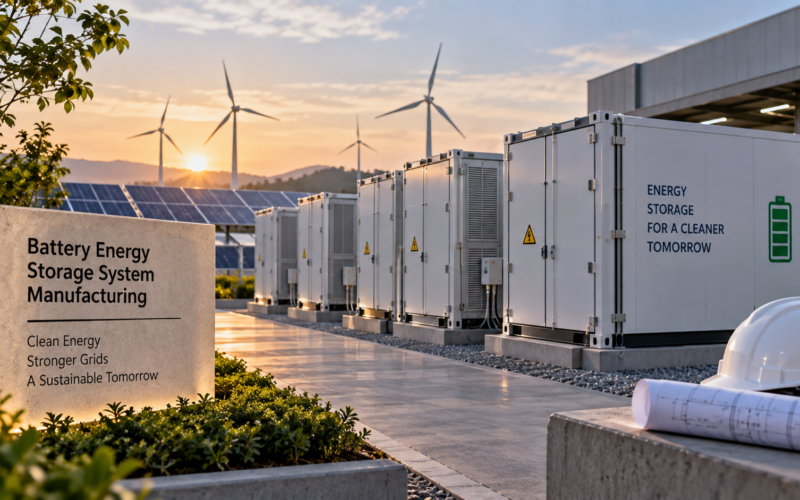
Premier Energies Limited (NSE: PREMIERENE) is preparing a significant move beyond solar cells and modules into battery energy storage system manufacturing through a proposed 12 GWh facility at Seetharampur in Telangana. In its September 10 stock-exchange filing, Premier Energies said wholly owned subsidiary Premier Battery Technologies Private Limited had entered into a binding term sheet with RCT Energy India Private Limited, part of Germany’s RCT Group, to establish Premier Energies Storage Solutions Private Limited as the strategic joint-venture vehicle. The first phase is planned at 6 GWh during FY27-28, followed by expansion toward the full 12 GWh manufacturing capacity.
The transaction is important partly because of what Premier Energies has not disclosed. There is currently no announced project capex for either the initial 6 GWh line or the eventual 12 GWh facility, so attaching a speculative rupee investment number to the project would be premature. The binding term sheet establishes the proposed ownership, capacity and business direction, but definitive agreements and the detailed capital structure remain milestones still to be completed.
How will ownership of Premier Energies’ 12 GWh battery-storage venture work?
Premier Battery Technologies is proposed to own 85% of the joint venture initially, while RCT Energy India will hold 15%. RCT has an option to increase its interest to 20%, which would reduce Premier Battery Technologies’ stake to 80%. The partners intend to conclude definitive agreements, including a shareholders’ agreement, following the binding term sheet.
That structure leaves Premier Energies firmly in control of the manufacturing platform while using RCT’s energy-storage engineering and international experience to shorten the learning curve. RCT brings more than 10 GW of global BESS experience, according to the companies’ project communications, while Premier contributes an existing manufacturing footprint, Indian customer relationships and an established renewable-energy supply chain.
The ownership model also matters financially. Premier will carry most of the economic upside if the venture succeeds, but it is also likely to carry most of the capital requirement unless the definitive agreements introduce additional funding mechanisms. Until capex and financing are disclosed, the 85:15 split should therefore be viewed primarily as a control structure rather than evidence of precisely how plant expenditure will be funded.
Why is the first 6 GWh phase more important than the 12 GWh headline?
The project is designed to reach 12 GWh, but the executable near-term milestone is the first 6 GWh phase planned during FY27-28. That means half of the eventual nameplate manufacturing capacity is expected to be established before the partners proceed toward the second half of the programme.
Phasing reduces utilisation risk. Battery-storage manufacturing capacity can become expensive if built significantly ahead of orders, while a staged approach allows Premier and RCT to test domestic and international demand before committing the full operating footprint.
The plant is intended to serve commercial and industrial customers as well as utility-scale storage applications, creating a wider demand pool than a factory dependent on only one segment. It is also being designed with exports in mind, which could provide additional utilisation if India’s BESS procurement cycle develops unevenly.
The first 6 GWh is therefore the more useful number for investors. A factory can announce 12 GWh of eventual potential, but commercial proof begins when Phase 1 is commissioned, qualified by customers and starts generating shipments.
Why does battery storage fit Premier Energies’ existing solar manufacturing strategy?
Premier Energies has rapidly expanded its solar manufacturing base and ended Q1 FY27 with an order book of approximately ₹15,000 crore across cells, modules and its transformer operations. Q1 total revenue increased 34% year on year to about ₹2,508 crore, EBITDA reached ₹759 crore and PAT rose 53% to ₹472 crore.
Solar manufacturing and battery storage address different parts of the electricity value chain. Solar modules generate power when sunlight is available, while battery systems allow electricity to be stored and discharged when generation and demand do not coincide.
As India installs more variable renewable capacity, the commercial value of storage increases because developers and utilities need ways to provide firmer power, shift solar output into evening demand periods and manage grid fluctuations.
Premier’s move therefore has a clear industrial logic. Instead of remaining only a supplier of generation hardware, the company is attempting to add an adjacent product that becomes more important precisely as solar deployment increases.
How demanding is the BESS expansion alongside Premier Energies’ existing capex programme?
Premier is already in a substantial solar manufacturing expansion cycle. Management said during its Q1 earnings discussions that the company was progressing approximately ₹1,250 crore of solar-related capex and another ₹250 crore associated with its transformer business, while its new 7 GW TOPCon cell line was moving toward commissioning.
A new battery manufacturing platform adds another execution stream. Equipment procurement, supply-chain qualification, testing systems, customer certification and battery technology management differ from producing solar cells and modules.
Premier nevertheless enters this diversification with strong earnings and a significant order book. Q1 EBITDA margin was 30.3% and PAT margin 18.8%, giving the company substantially more internally generated capital than many early-stage battery manufacturers.
The unresolved question is how much capital BESS manufacturing will require. Without a disclosed project cost, investors cannot yet determine whether the venture represents a modest adjacency funded internally or another large capex cycle layered on top of Premier’s solar expansion.
What are the milestones that would turn the 12 GWh plan into an operating business?
The first is execution of the definitive joint-venture documents. A binding term sheet is more advanced than an exploratory memorandum, but the shareholder and operating agreements still need to formalise governance, financing and commercial responsibilities.
The second is disclosure of project capex and the commissioning schedule for the first 6 GWh phase. Those numbers will allow investors to estimate capital intensity and compare Premier’s proposed facility with other Indian BESS manufacturing projects.
The third is customer conversion. Manufacturing capacity creates value only when Premier Energies Storage Solutions wins orders from utilities, renewable developers, commercial customers or export buyers.
Premier already has scale in solar manufacturing and a ₹15,000 crore order book in its existing businesses. Its BESS venture therefore begins with industrial credibility, but the investment case will become much clearer when the company tells investors what the 6 GWh first phase costs and who is prepared to buy its output.
Discover more from Business-News-Today.com
Subscribe to get the latest posts sent to your email.