





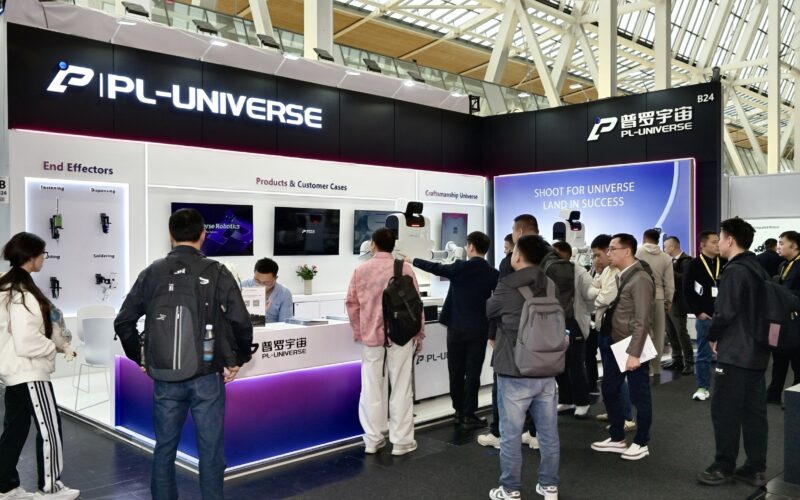
PL-Universe Robotics used its first major European showcase at Hannover Messe 2026 to position its industrial embodied AI robot platform as a potential answer to Europe’s growing demand for flexible, high-precision manufacturing automation. The Suzhou-based robotics company presented its ProWhite industrial robot and related embodied AI solutions to European industrial visitors, framing the debut as the start of a broader regional expansion strategy. The announcement matters because embodied AI is moving from research demonstrations into factory-grade use cases at a time when manufacturers are under pressure to cut changeover times, reduce labour dependency and improve production consistency. For PL-Universe Robotics, the European debut is not just a trade fair appearance. It is an early test of whether Chinese robotics developers can convert technical claims into trusted industrial deployments across one of the world’s most demanding manufacturing markets.
Why does PL-Universe Robotics’ Hannover Messe 2026 debut matter for Europe’s industrial automation market?
PL-Universe Robotics’ appearance at Hannover Messe 2026 places the company inside a wider shift in European manufacturing, where artificial intelligence, robotics and flexible automation are becoming central to competitiveness rather than optional digital upgrades. Hannover Messe 2026 ran from April 20 to April 24 in Germany, with industrial artificial intelligence, autonomous robots and smart factory applications positioned as major themes of the event. That context is important because PL-Universe Robotics is entering Europe at a moment when factories are not merely asking whether robots can automate repetitive work, but whether robotic systems can adapt quickly enough to changing production runs.
The company’s message is built around embodied AI, a term that refers to artificial intelligence systems embedded in physical machines that can perceive, decide and act in real environments. In manufacturing, that promise is more practical than futuristic. A robot that can handle flexible workflows, adjust to different production needs and reduce commissioning time could help manufacturers respond to shorter product cycles, customised orders and volatile supply chains. The attraction for European industry is clear: if a robot can reduce the friction between product design, line setup and quality control, it can turn automation from a fixed asset into a more adaptable production tool.
The harder question is whether PL-Universe Robotics can prove that its systems are durable, serviceable and safe enough for European factories. Trade fair demonstrations can generate visibility, but industrial buyers usually move slowly when production continuity, worker safety and quality assurance are at stake. For a young robotics company founded in January 2025, the Hannover Messe debut creates awareness, but it also raises expectations. European customers will likely evaluate not only the robot’s motion accuracy, but also uptime, integration with existing factory systems, after-sales support, compliance readiness and total cost of ownership.
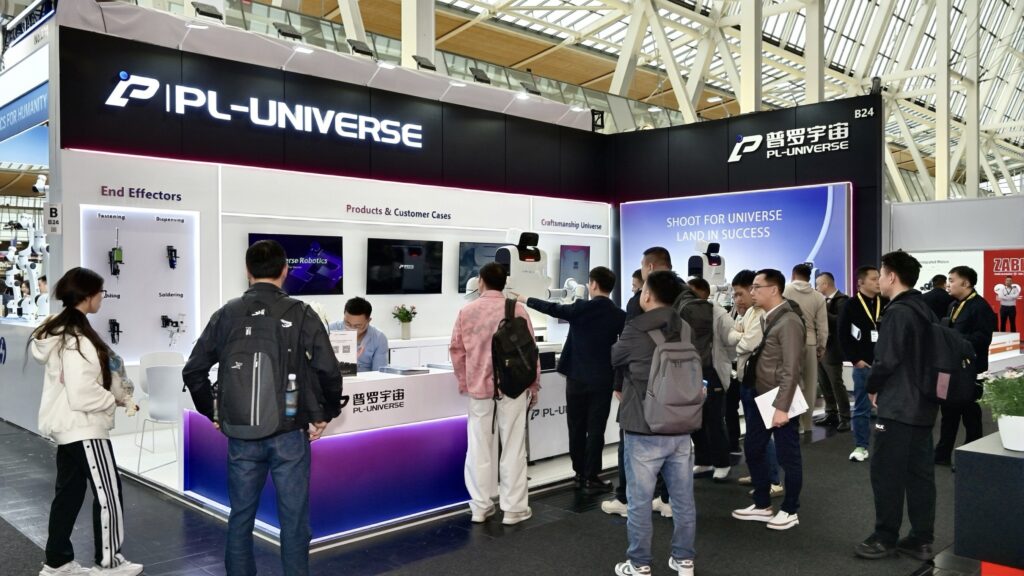
How does the ProWhite embodied AI robot target flexible manufacturing and high-precision production?
PL-Universe Robotics highlighted several performance claims around its industrial embodied AI solutions, including absolute positioning accuracy of plus or minus 0.05 millimetres, line changes in seconds, a 90 percent reduction in production changeover and commissioning time, an 80 percent reduction in line change costs and a yield rate above 99 percent. These figures directly target the pain points of manufacturers that operate in sectors such as consumer electronics, automotive components and precision assembly. In these environments, production flexibility is valuable only if it does not compromise repeatability.
The company’s ProWhite robot is positioned as an industrial embodied AI robot designed for intelligent manufacturing and collaborative operations. Hannover Messe’s exhibitor listing described ProWhite as a humanoid robot built for manufacturing use cases, which suggests PL-Universe Robotics is not pitching a general-purpose novelty robot, but a factory-oriented machine intended for practical deployment. That positioning matters because the market is increasingly crowded with humanoid robotics claims, many of which remain closer to demonstration-stage concepts than deployable production equipment.
The strategic bet is that factories will increasingly want robots that can handle tasks across multiple scenarios rather than remain locked into rigid, single-purpose automation cells. Traditional industrial robots are powerful and reliable, but they often require expensive programming, fixtures, safety planning and line redesign. If PL-Universe Robotics can reduce the cost and time required to move between tasks, it could address a genuine manufacturing bottleneck. However, the difference between technical capability and procurement adoption is substantial. Buyers will want hard proof across long production runs, different materials, variable lighting, human-machine interaction conditions and maintenance cycles.
Why is Europe a difficult but attractive market for Chinese embodied AI robotics companies?
Europe is attractive for robotics developers because it has a deep base of advanced manufacturers, high labour costs, strong demand for productivity tools and a long tradition of industrial automation adoption. Germany, in particular, remains a symbolic and practical gateway because of its automotive, machinery, electronics and precision engineering clusters. A successful European entry can give an Asian robotics company credibility that extends beyond one region, especially if deployments occur inside demanding industrial environments.
At the same time, Europe is not an easy market for a newly founded Chinese robotics company. European industrial buyers are cautious about equipment reliability, cybersecurity, data handling, worker safety, certification and long-term vendor support. For PL-Universe Robotics, a European strategy will likely require more than export sales. It may need local partners for integration, maintenance, spare parts, compliance documentation and industry-specific deployment support. The company has said that it intends to strengthen local partnerships, which is a sensible direction because European automation adoption often depends on systems integrators as much as robot manufacturers themselves.
The geopolitical layer cannot be ignored either. Chinese companies had a strong presence at Hannover Messe 2026, with around 700 exhibitors, making China the second-largest exhibitor group after Germany. That scale shows the ambition of Chinese industrial technology providers, but it also means European buyers and policymakers will be weighing cost and innovation benefits against strategic dependency concerns. For PL-Universe Robotics, the practical challenge is to present itself not merely as a lower-cost robotics exporter, but as a credible industrial technology partner that can fit into European manufacturing standards and supply chains.
What does the JD.com partnership signal about PL-Universe Robotics’ global commercialization model?
PL-Universe Robotics’ global ambitions did not begin at Hannover Messe. In November 2025, the company announced the launch of ProWhite Robot 2.0 and a dexterous hand product alongside an exclusive global online sales partnership with JD.com. That earlier move is strategically relevant because it suggests PL-Universe Robotics is experimenting with a hybrid commercialization model that combines robotics hardware, e-commerce-enabled distribution and overseas market development.
The JD.com partnership could help PL-Universe Robotics with visibility, logistics and overseas sales infrastructure, but industrial robots are not ordinary e-commerce products. Factory buyers do not typically make deployment decisions through online channels alone. They require application engineering, integration planning, site testing, technical training and after-sales service. The partnership may therefore be more useful as a distribution and market access layer than as a complete route to industrial adoption.
The interesting part is what this model says about the changing robotics market. If embodied AI robots become more standardised and modular, some parts of the buying process could become more platform-driven. Buyers may compare models, specifications and service packages online before engaging integrators for deployment. PL-Universe Robotics appears to be positioning itself early for that possibility. The risk is that the company may face a gap between online reach and offline execution. In robotics, a purchase order is not the finish line. It is where the engineering headache usually begins, and factories have a world-class talent for finding every hidden weakness in a machine.
How could embodied AI robots change the economics of smart manufacturing if deployment claims hold up?
If PL-Universe Robotics’ performance claims translate into repeatable factory results, the economics could be meaningful. A 90 percent reduction in changeover and commissioning time would be especially relevant for manufacturers handling shorter production cycles. Automotive suppliers, electronics manufacturers and contract manufacturing plants increasingly need to switch between products without losing excessive time to reconfiguration. Faster line changes can improve asset utilisation, reduce downtime and allow factories to accept more varied orders without building entirely separate lines.
The claim of an 80 percent reduction in line change costs is also commercially significant because automation investments are often limited by payback uncertainty. A robot that can be redeployed across tasks offers a different investment profile from a fixed automation system designed around one process. That could make robotics more attractive to mid-sized manufacturers that cannot justify large-scale dedicated automation for every product variant. In theory, embodied AI could democratise some advanced automation capabilities, although in practice pricing, training, maintenance and integration complexity will determine how far that promise travels.
The yield-rate claim above 99 percent is equally important because productivity gains mean little if quality slips. High-precision manufacturing depends on consistency, not merely speed. If embodied AI systems can maintain accuracy while supporting flexible line changes, they could help manufacturers balance customisation with quality assurance. However, this is where buyers will demand evidence. A trade fair claim must become a factory case study, then a reference deployment, then a repeatable commercial model. Until that chain is visible, the technology should be treated as promising rather than proven at scale.
What competitive pressure could PL-Universe Robotics create for established automation and robotics suppliers?
PL-Universe Robotics is entering a market where established automation suppliers already have strong relationships with European manufacturers. Incumbents benefit from trusted service networks, safety certification experience, integration ecosystems and long deployment histories. That gives them a major advantage when procurement teams are risk-averse. However, younger robotics companies can still create pressure if they offer faster deployment, lower integration complexity or more adaptable task handling.
The competitive threat is not necessarily that PL-Universe Robotics immediately displaces established robotics leaders. The more realistic scenario is that companies like PL-Universe Robotics push the market narrative toward embodied AI, forcing incumbents to explain how their own automation platforms handle perception, task flexibility and autonomous decision-making. In that sense, the company’s European debut may influence the competitive conversation even before it wins large-scale factory deployments.
For European manufacturers, this could be useful. More competition in embodied AI robotics may accelerate product development, reduce costs and widen the range of available automation options. For incumbents, the pressure will be to prove that reliability and legacy integration can coexist with more adaptive AI-driven functionality. For challengers, the burden will be to prove that smart robots are not just impressive on a show floor, but boringly dependable on a factory floor. In industrial automation, boring is not an insult. It is often the highest compliment.
What execution risks could slow PL-Universe Robotics’ European expansion after Hannover Messe 2026?
The first execution risk is localisation. European manufacturers will expect documentation, technical support, safety validation and service responsiveness suited to local industrial norms. A company can have a strong robot and still struggle if customers cannot access support quickly or if integrators are not trained to deploy the system effectively. Local partnerships could reduce that risk, but partnership quality will matter more than partnership quantity.
The second risk is proof of scalability. PL-Universe Robotics has described ProWhite as a mass-produced industrial-grade universal embodied robot, and the company says it collaborates with clients in sectors such as 3C electronics and automotive manufacturing. That is encouraging, but European buyers will look for evidence of deployments under conditions comparable to their own factories. They will also want clarity on lifecycle costs, spare parts availability, software update policies, cybersecurity controls and compatibility with existing manufacturing execution systems.
The third risk is market timing. Embodied AI is attracting attention, but factory capital expenditure cycles can be cautious, especially when economic uncertainty affects European industrial investment. Manufacturers may pilot new robotics systems before committing to multi-site rollouts. That makes reference customers and measurable return on investment critical. PL-Universe Robotics’ Hannover Messe debut opens doors, but the company’s European expansion will depend on what happens after the demos, when procurement, engineering, compliance and finance teams begin asking less glamorous questions.
Could PL-Universe Robotics’ European push signal a broader shift in China’s industrial technology exports?
PL-Universe Robotics’ debut fits into a broader pattern of Chinese companies moving up the industrial technology value chain. The story is no longer only about exporting lower-cost manufactured goods. Increasingly, Chinese companies are presenting advanced automation, robotics, electric mobility, industrial software and AI-enabled systems to global markets. Hannover Messe 2026’s large Chinese exhibitor base shows how aggressively that shift is being taken to Europe.
For Europe, this creates both opportunity and tension. European manufacturers need productivity gains, and Chinese automation suppliers may offer fast innovation cycles and competitive pricing. However, strategic sectors will also face questions about supply-chain dependence, data governance and industrial sovereignty. The result may not be a simple embrace or rejection of Chinese robotics. More likely, European buyers will segment use cases, adopt where the value proposition is clear, and apply tighter scrutiny in sensitive or mission-critical environments.
For PL-Universe Robotics, the strategic opening is real but conditional. The company has arrived in Europe at the right thematic moment, when smart manufacturing, industrial AI and robotics are high on the agenda. The next phase will be less about visibility and more about validation. If PL-Universe Robotics can convert Hannover Messe interest into pilot projects, local partnerships and measurable factory outcomes, its European debut could become an important step in the commercialisation of embodied AI robotics. If not, it risks becoming another impressive robotics showcase in a market that has seen plenty of them.
Key takeaways on what PL-Universe Robotics’ Hannover Messe debut means for embodied AI robotics
- PL-Universe Robotics’ European debut at Hannover Messe 2026 positions the company inside the fast-growing conversation around embodied AI, flexible manufacturing and factory-grade robotics.
- The company is targeting a real industrial pain point: manufacturers need automation systems that can adapt to shorter product cycles without sacrificing precision or yield.
- PL-Universe Robotics’ claims around fast line changes, lower changeover costs and high positioning accuracy are strategically important, but European buyers will require proof from real factory deployments.
- The ProWhite robot’s positioning as an industrial embodied AI platform gives PL-Universe Robotics a clearer commercial angle than generic humanoid robotics demonstrations.
- Europe offers a valuable but demanding market, where safety, reliability, certification, cybersecurity and service infrastructure can decide adoption as much as robot performance.
- The JD.com global sales partnership suggests PL-Universe Robotics is experimenting with a broader commercialization model, although industrial robotics will still require deep offline support.
- Chinese robotics companies are using platforms such as Hannover Messe to challenge the perception that advanced factory automation remains dominated by legacy Western and Japanese suppliers.
- Established automation companies may not face immediate displacement, but they could face stronger pressure to integrate embodied AI capabilities into their own platforms.
- The biggest execution risk for PL-Universe Robotics is the gap between trade fair visibility and scalable European industrial adoption.
- The company’s next milestone will be whether it can convert Hannover Messe interest into credible European pilots, reference customers and local integration partnerships.
Discover more from Business-News-Today.com
Subscribe to get the latest posts sent to your email.


