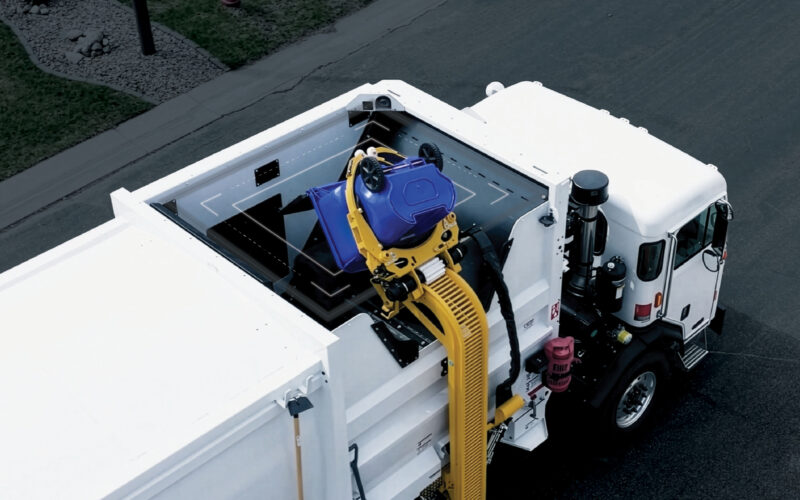
Oshkosh Corporation (NYSE: OSK), the Wisconsin-based manufacturer of purpose-built vehicles and equipment, has launched an AI-powered material contamination detection system through its McNeilus Truck and Manufacturing subsidiary, developed in partnership with Paris-based waste data specialist Lixo. The technology uses computer vision, machine learning, edge computing, and cloud analytics to identify more than 80 categories of contaminants in real time as waste is deposited into a collection vehicle’s hopper during routine refuse and recycling operations. The announcement, made on 19 March 2026, positions Oshkosh squarely within the accelerating intersection of municipal infrastructure and applied AI, a segment the company has been methodically building toward over several years. OSK shares closed at approximately $147 on 13 March, down around 17% from a February all-time high of $177.94, though the stock has gained roughly 36% over the trailing twelve months.
Why is real-time contamination detection now a commercial priority for North American refuse operators?
Contamination has long been the silent tax on recycling economics. When households or commercial premises deposit non-recyclable materials into recycling streams, the consequences cascade quickly: material recovery facilities reject entire loads, recycling revenues collapse, and municipalities absorb fines or landfill diversion penalties. Regulatory pressure has been intensifying across North American states and provinces as jurisdictions tighten extended producer responsibility frameworks and landfill diversion targets. For waste haulers, the ability to document contamination at the point of collection rather than at the processing facility represents a meaningful shift in where liability is identified and who is responsible for it.
Prior to systems of this type, contamination data was largely retrospective. Facility operators would flag problem loads, but tracing the source back to a specific address or collection route was difficult and legally fraught. The commercial logic behind real-time, route-level contamination visibility is therefore not purely operational but also tied to contract performance, municipal compliance reporting, and ultimately the pricing power that haulers can exercise with clients when they carry data rather than anecdotes.

How does the McNeilus and Lixo AI system actually work during a live collection route?
The system integrates directly into the vehicle’s hopper mechanism. As material is deposited, cameras capture imagery which is processed immediately by machine learning models running on an onboard edge computing unit. Edge processing is deliberate: it avoids latency associated with round-trip cloud calls and ensures the system continues to function even without continuous connectivity, a practical requirement for refuse vehicles operating across suburban and rural routes. Classified results are then uploaded automatically to a secure cloud dashboard, which integrates with McNeilus’ ClearSky Intelligence telematics platform alongside fleet health and payload data.
Lixo brings the AI architecture and training data. The Paris-based company has spent close to five years developing contamination detection solutions, has patented the underlying technology, and reports that its systems analyze more than 300,000 bins daily across European operations. That scale matters for model accuracy: waste composition varies significantly by geography, seasonality, and collection type, and models trained on large, diverse datasets generalize more reliably across new markets. The North American rollout represents Lixo’s first major commercial push into the region, and the McNeilus distribution relationship provides immediate access to haulers across residential, commercial, and industrial segments.
The system is capable of identifying more than 80 contaminant types including plastic bags, yard waste, textiles, and hazardous materials, and the machine learning architecture is designed to continue improving as it processes new data. That ongoing learning capability matters because waste composition is not static: new packaging formats, regulatory changes affecting what is recyclable, and shifts in consumer behavior all alter what shows up in the stream. A static model becomes stale; an adaptive one builds competitive moat over time.
What is the retrofit strategy and why does it matter for Oshkosh’s addressable market size?
One of the more strategically significant elements of the launch is the dual deployment model. The contamination detection system is available both as a factory-installed option on new McNeilus vehicles and as a retrofit kit compatible with any brand of side-loader or front-loader truck. The retrofit pathway is not a concession to the installed base; it is a deliberate expansion of the addressable market. Municipal and private hauler fleets carry vehicles with average service lives of ten to fifteen years. Requiring new vehicle purchases as the entry point would limit near-term penetration dramatically. By offering a retrofit option that works across competitor OEM platforms, McNeilus transforms this from a truck-purchase decision into a fleet-upgrade decision.
The implication for Oshkosh’s Vocational segment revenue model is also worth noting. Hardware retrofit kits create a separate revenue stream from vehicle sales, and cloud-based analytics dashboards carry the natural structure of subscription or recurring service fees. Oshkosh has not disclosed commercial pricing or anticipated attach rates, but the architecture is clearly oriented toward a software-and-services layer sitting on top of the physical vehicle business, a model that tends to attract better valuation multiples than pure-play equipment manufacturing.
How does this development fit Oshkosh’s broader AI and connected vehicle technology strategy?
McNeilus’ contamination detection launch is not an isolated product announcement. It sits within a broader technology agenda that Oshkosh has been articulating across its segments, centered on four pillars: autonomy, artificial intelligence, connectivity, and electrification. The McNeilus Volterra all-electric front-loader, introduced at CES 2025, established the brand’s credentials in the electrification dimension. At CES 2026, Oshkosh presented an updated version of HARR-E, an autonomous electric refuse robot designed for on-demand residential collection in planned communities and campuses. The contamination detection system adds the data intelligence layer to what is effectively a portfolio approach to modernizing refuse operations.
ClearSky Intelligence, the telematics backbone into which contamination data now integrates, gives Oshkosh an increasingly rich operational dataset spanning fleet health, payload, route efficiency, and now waste composition. Each additional data stream increases the stickiness of the platform and raises the switching cost for customers who have built workflows around it. This is the architecture of a software platform business layered onto a durable industrial asset base, and it is a deliberate strategic direction rather than a feature-level addition.
What are the competitive implications for other refuse vehicle manufacturers and waste technology providers?
The North American refuse vehicle market is not large by industrial standards but it is deeply relationships-driven, with McNeilus, Heil Environmental, and Labrie Environmental Group among the major OEM participants. The introduction of AI-enabled contamination detection as a factory-integrated and retrofit option raises the competitive specification floor. Peers that lack equivalent capability will face pressure at the point of municipal procurement, where sustainability data requirements are increasingly embedded in contract performance criteria rather than treated as optional features.
The more immediate competitive consideration, however, may be on the technology side. Companies like Compology (now part of Waste Connections) and ReCommunity have built businesses around waste stream analytics and camera-based monitoring. The McNeilus and Lixo partnership effectively brings a direct AI contamination detection capability to the OEM layer of the value chain, which is closer to the customer’s daily operational workflow than a standalone software solution attempting to retrofit its way onto mixed-brand fleets. Whether that OEM proximity translates into stronger commercial pull remains to be validated at scale, but the structural advantage is real.
What does the market say and how are analysts positioned on OSK heading into 2026?
OSK shares have had a volatile start to 2026. After reaching an all-time closing high of $177.94 on 24 February, the stock pulled back to approximately $147 by 13 March, a decline of roughly 17% in less than three weeks, reducing market capitalisation to around $9.2 billion from a recent peak above $10.8 billion. The broader context matters here: Oshkosh’s one-year gain of approximately 36% reflects genuine fundamental momentum, with the company benefiting from strong municipal spending, defense contract activity through the Transport segment, and ongoing demand for access equipment through the JLG-branded Access segment.
Analyst positioning is mixed at present. Truist Securities maintained a Buy recommendation in October 2025. Morgan Stanley and Bernstein both maintained neutral-to-market-perform postures in December 2025, while Argus Research held a Buy. The contamination detection launch is unlikely to move near-term earnings estimates in isolation. Its significance is more strategic than financial at this stage: it demonstrates that McNeilus can bring a commercially viable, patented, and already-deployed AI capability to North American customers without requiring years of internal model development. The asset-light approach of licensing Lixo’s AI rather than building from scratch is operationally sensible given that waste stream classification is not a core Oshkosh competency, and Lixo’s European training data provides a meaningful head start.
Key takeaways on what McNeilus AI contamination detection means for Oshkosh, its competitors, and the waste industry
- Oshkosh’s McNeilus unit has entered the AI-enabled waste analytics market in North America through a partnership with Lixo, a patented European technology with validated scale of more than 300,000 daily bin analyses.
- The system’s retrofit compatibility with any brand of side-loader or front-loader significantly expands Oshkosh’s addressable market beyond its own new vehicle sales.
- Edge computing architecture enables continuous operation on rural and low-connectivity routes, addressing a practical deployment constraint that would otherwise limit commercial viability.
- Integration with the ClearSky Intelligence telematics platform creates a unified data layer across fleet health, payload, and contamination visibility, raising customer switching costs over time.
- The recurring analytics dashboard structure opens a software and services revenue channel that could attract higher valuation multiples than equipment manufacturing alone.
- Competing OEM refuse vehicle manufacturers face a rising specification bar; peers without comparable AI capability will be disadvantaged in municipal procurement cycles with sustainability performance criteria.
- OSK’s stock pullback of approximately 17% from its February 2026 all-time high may reflect sector rotation or macro factors rather than deteriorating fundamentals, given the company’s one-year gain of around 36%.
- Analyst consensus remains mixed with Buy ratings from Truist and Argus offset by neutral postures from Morgan Stanley and Bernstein, suggesting the market is still evaluating the pace and scale of Oshkosh’s technology transition.
- Lixo’s North American entry via McNeilus represents a significant go-to-market validation for the Paris-based firm and sets a template for European waste AI companies seeking access to the North American municipal infrastructure market.
- The launch reinforces Oshkosh’s four-pillar technology strategy of autonomy, AI, connectivity, and electrification, with contamination detection adding the data intelligence layer to a portfolio that already includes electric vehicles and autonomous refuse robots.
Discover more from Business-News-Today.com
Subscribe to get the latest posts sent to your email.