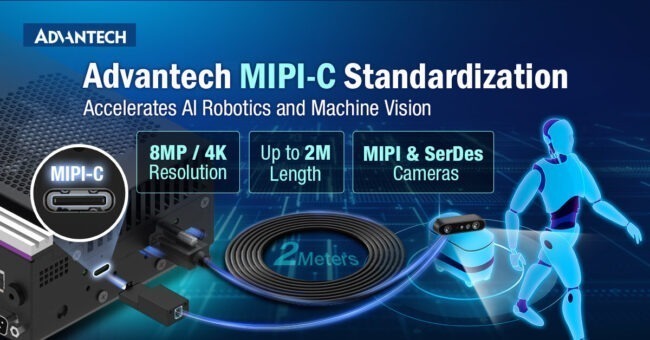
Advantech Co., Ltd. (TWSE: 2395) has launched MIPI-C, a new open interface specification that extends traditional MIPI CSI-2 signaling over USB Type-C. The new standard enables more robust, long-range, and industrial-grade integration of camera modules into edge AI systems used in robotics, machine vision, and automation. The company is opening all associated patents and technical specifications in a bid to standardize camera connectivity and catalyze global ecosystem adoption.
This shift marks a strategic expansion in Advantech’s role from embedded systems provider to standards orchestrator, with MIPI-C positioned as the connective tissue for next-generation edge AI platforms.

How does Advantech’s MIPI-C address legacy issues in camera module design for AI robotics?
For developers and manufacturers building robots, autonomous systems, or industrial vision pipelines, the use of traditional MIPI CSI-2 interfaces has long created serious integration limitations. The original MIPI standard, while effective for short-range signal transmission within compact hardware systems, typically supports transmission distances of only 20 centimeters. That makes multi-camera or flexible cable deployments difficult and introduces reliability risks in real-world industrial or robotic use cases.
Advantech’s MIPI-C specification resolves this by encapsulating native MIPI signals into a USB Type-C connector format, dramatically expanding the transmission range to two meters while maintaining signal integrity. This provides a major leap forward in flexibility for camera placement, especially in humanoid robots, autonomous mobile robots, and factory automation arms. The standard introduces differential signaling, metal shielding, and EMI-resistant features to ensure that high-bandwidth data remains uncompromised even in noisy electromagnetic environments.
A single Type-C cable under MIPI-C supports video, control signals, and power delivery, eliminating the need for multiple cables and custom power arrangements. This one-cable solution reduces complexity in system architecture and minimizes failure points. From a latency and bandwidth perspective, MIPI-C maintains the real-time performance required by edge AI inference tasks such as defect detection, robotic navigation, and 3D vision processing. It also supports 2K to 4K resolution imaging, which is increasingly necessary in environments where AI models require high-quality visual input for decision-making.
Advantech’s industrial-grade enhancements include auto device identification, over-current protection, LED diagnostics, and a mechanical design that reduces misconnection risk. Collectively, these features make MIPI-C a reliability-focused interconnect for harsh environments and production-scale robotics.
Which hardware platforms are adopting MIPI-C in the first wave of integration?
Advantech is launching MIPI-C in two structured phases. The first phase focuses on market validation through integration into existing AI edge platforms and developer ecosystems. The company has partnered with imaging module vendors such as Appro.Pho and Orbbec to introduce MIPI-C-enabled camera modules that are already deployed across Advantech’s flagship AI systems.
These include the AIR-055 system featuring Qualcomm’s Dragonwing IQ-9075 chip, the AIR-075 powered by NVIDIA’s Jetson Thor platform, and the ARK-2252 built on the latest Intel Core Ultra processors. These platforms span the breadth of industrial AI use cases and confirm MIPI-C’s cross-compatibility with ARM, x86, and GPU-based computing environments. Each device includes ready-to-use driver support and reference code, which is expected to lower the barrier for systems integrators and independent software vendors seeking to accelerate time-to-deployment.
The second phase focuses on ecosystem expansion. Advantech plans to collaborate with three to five key industry players, including camera vendors and silicon partners, to co-develop motherboard specifications based on MIPI-C. This collaborative effort aims to elevate MIPI-C from a proprietary connector innovation into a true open standard for the visual AI stack. By standardizing across multiple platforms and chipsets, Advantech is signaling its ambition to move beyond hardware sales and shape the future of AI imaging infrastructure.
Why is Advantech opting for an open standard approach instead of proprietary control?
Advantech’s decision to open-source MIPI-C’s technical specifications and patent framework reflects a deliberate strategic shift. Rather than locking customers into a proprietary ecosystem, the company is betting that industry-wide standardization will unlock a larger and more sustainable market. Open standards reduce vendor friction, increase developer trust, and accelerate component interoperability, particularly in edge AI where modularity is essential.
This playbook has been validated in adjacent technology stacks. NVIDIA’s CUDA programming model became a dominant force in AI compute by being freely accessible. Similarly, Intel’s OpenVINO toolkit expanded inference workloads by standardizing model deployment. Advantech is applying similar logic to the camera interconnect layer in machine vision, which has historically remained fragmented, opaque, and vendor-specific.
By promoting MIPI-C under the banner of “Standardization × Ecosystem,” Advantech is framing the interface as a public utility for edge imaging. This framing enables horizontal collaboration across hardware manufacturers, sensor makers, AI chip designers, and system integrators. If successful, MIPI-C could emerge as the default cable interface for industrial and mobile vision systems globally.
What risks could impede the adoption of MIPI-C across the machine vision landscape?
Despite the engineering and ecosystem strengths of MIPI-C, widespread adoption will require careful navigation of several execution risks. First, chipset vendors must integrate MIPI-C compatibility into their board-level designs for true cross-platform reach. If Qualcomm, NVIDIA, and Intel do not adopt the connector as a native interface, OEMs will be forced to add bridge circuitry or avoid the standard altogether.
Second, camera module partners must expand their portfolio of MIPI-C-compatible products quickly. If the ecosystem is limited to a narrow set of vendors or imaging modalities, adoption may be restricted to pilot-scale deployments. USB3 Vision, Camera Link, and GigE Vision already dominate industrial environments, and changing that entrenched behavior requires substantial technical and economic incentive.
Third, latency performance, multi-camera synchronization, and EMI resilience must be stress-tested in real-world production environments. Roboticists and industrial automation teams will assess the reliability of MIPI-C under conditions of high vibration, variable temperature, and electrical interference. Any performance inconsistencies could limit trust in the standard.
Lastly, the governance structure around the MIPI-C standard will need to be robust and inclusive. Without transparent documentation, roadmap visibility, and multi-vendor steering input, the open standard promise may ring hollow. Whether Advantech can establish an open hardware working group or coordinate with existing standards bodies will determine the long-term credibility of MIPI-C.
What does this launch signal about Advantech’s broader position in edge AI and robotics?
The MIPI-C initiative signals a deliberate shift in how Advantech defines its value proposition. Rather than solely offering compute boards and industrial PCs, the company is now positioning itself as an infrastructure architect for AI-powered machines. This mirrors the strategic pivot seen in companies like ABB in automation or Schneider Electric in energy management, where product offerings are increasingly bundled with platform governance and ecosystem enablement.
Advantech already controls a sizable share of embedded systems used in transportation, medical imaging, industrial monitoring, and intelligent edge compute. By layering MIPI-C as a unifying interconnect standard across these domains, the company is trying to lock in future hardware relevance and reduce churn risk as customers upgrade to newer AI workloads. If it succeeds, Advantech may become a default component vendor in AI-first robotics infrastructure.
Furthermore, MIPI-C’s timing is aligned with industry tailwinds. The growth of humanoid robots, AI-enhanced AMRs, and intelligent manufacturing cells requires high-fidelity vision systems that are easy to deploy and scale. Standardized cabling and reduced integration time could become critical enablers of this transition. By solving these problems at the interface level, Advantech is aligning itself with the most urgent technical needs in applied robotics and industrial vision.
What are the key takeaways from Advantech’s MIPI-C standardization initiative?
- Advantech has launched MIPI-C, a new open standard extending MIPI CSI-2 over USB Type-C to address integration challenges in AI robotics and machine vision.
- MIPI-C enables up to 2 meters of transmission range with industrial-grade EMI protection, allowing flexible, low-latency multi-camera setups for edge AI applications.
- The company is opening its entire MIPI-C specification and patent portfolio to accelerate adoption across hardware, silicon, and imaging ecosystems.
- Initial integration includes Qualcomm, NVIDIA, and Intel-based edge AI systems, signaling cross-platform ambition from the outset.
- Advantech is positioning MIPI-C not as a proprietary product but as a foundational standard to drive broader interoperability and modularity in machine vision.
- Execution risks include chipset vendor buy-in, camera module partner engagement, and governance transparency across the emerging ecosystem.
- If widely adopted, MIPI-C could become a de facto interconnect standard for next-generation humanoid robots, autonomous mobile robots, and smart manufacturing lines.
- The launch signals Advantech’s ambition to shift from embedded supplier to platform orchestrator in the edge AI and industrial automation value chain.
Discover more from Business-News-Today.com
Subscribe to get the latest posts sent to your email.