



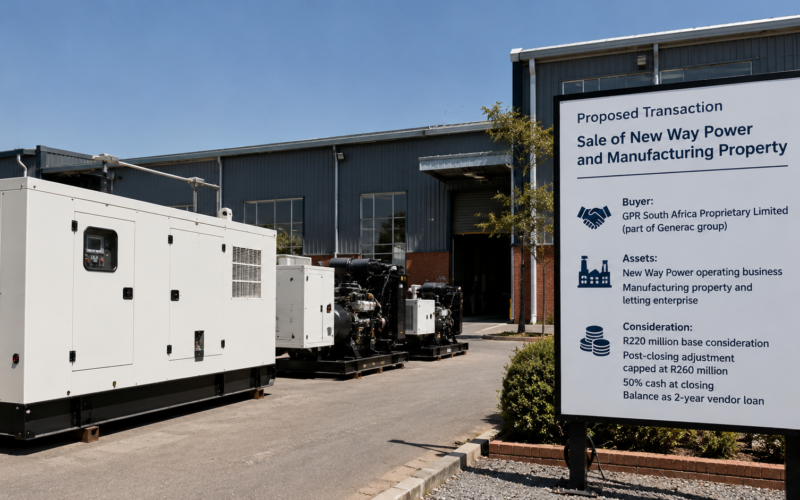
enX Group Limited (JSE: ENX) is heading toward a shareholder vote on the proposed sale of New Way Power and its manufacturing property. The transaction carries a base consideration of R220 million, with a post-closing adjustment capped at R260 million. New Way Power is the largest asset remaining in the enX portfolio. Only half of the consideration will be received in cash initially, with the balance structured as a two-year vendor loan. The central question is therefore shifting from what enX can sell to how much cash ultimately reaches shareholders, and when.
The buyer is GPR South Africa Proprietary Limited, part of the international Generac group. New Way Power will sell its operating business, while enX Ventures PL Proprietary Limited will separately sell the manufacturing property and related letting enterprise. The transactions are inter-conditional and are intended to close together.
The R220 million base consideration consists of R130 million for the New Way Power business and R90 million for the property and letting enterprise. A post-closing calculation can increase the total consideration, but it cannot exceed R260 million. Shareholders are due to vote on the transaction at a general meeting on August 27, 2026.
For enX, this is more than another portfolio disposal. The group has already sold several major businesses and returned substantial amounts of capital to shareholders. Selling New Way Power would remove its largest remaining operating asset and push enX considerably further along its value-realisation strategy.
Why does the R220 million New Way Power sale matter so much to enX Group shareholders?
The scale of the transaction becomes clearer when compared with enX’s equity value. A recent market-data snapshot placed enX’s market capitalisation at approximately R365 million, with the shares around R2.01. On that reference point, the R220 million base consideration represents about 60% of the company’s market value.
If the consideration reaches the R260 million maximum, the ratio rises to roughly 71%. Expressed across approximately 181.4 million shares in issue, the base transaction value is equivalent to around R1.21 per enX share. The maximum consideration is equivalent to about R1.43 per share.
Those figures should not be interpreted as an expected shareholder distribution. Transaction costs, taxes, liabilities, retained obligations, working capital, management incentives and cash reserves must all be considered before capital can be returned. Half of the transaction consideration will also not arrive as immediate cash.
The comparison nevertheless shows why the disposal is central to the current enX investment case. The company is proposing to sell an asset package whose headline consideration represents a substantial percentage of its recent quoted market value.
It also changes what investors would own after completion. New Way Power designs, manufactures, services, rents and maintains prime and standby power systems across Southern Africa. Its activities include generators, monitoring and controls, aftermarket parts and renewable-energy solutions. Once that business is sold, enX will be much more dependent on cash realisation, retained assets and the orderly settlement of remaining obligations than on conventional operating growth.

Is enX selling New Way Power below book value, or does the R260 million ceiling change the comparison?
The transaction presents an interesting valuation comparison. Management accounts for the six months ended February 28, 2026 placed the net assets of the New Way Power sale business at R156.7 million. The net assets of the property and letting enterprise were R93.5 million.
Combined, those figures equal approximately R250.2 million. The R220 million base purchase consideration is therefore about 12% below that combined net-asset figure. At the R260 million maximum, the transaction would instead sit about 4% above it.
That does not mean enX is necessarily selling the businesses at a 12% economic discount. Book value and market value are different measures. Working capital, asset quality, future profitability, customer relationships, capital requirements and strategic value all influence what a buyer is willing to pay.
The transaction also includes a mechanism that can raise the New Way Power consideration after closing. The calculation takes account of tangible assets, inventory, prepayments and specified liabilities at the closing date. The R260 million cap limits the maximum aggregate consideration.
Operating performance provides additional context. For the six months ended February 2026, the New Way Power sale business recorded a R4.5 million loss before tax. The letting enterprise generated a R2.4 million profit before tax. Combined, the assets therefore produced a modest pre-tax loss during that reporting period.
That makes the disposal less straightforward than comparing R220 million with R250.2 million of book assets. enX is monetising an asset package at a time when current earnings have weakened, while transferring future working-capital and operating risks to a strategic industry buyer.
Generac is also not simply a financial purchaser. GPR South Africa is ultimately part of Generac Holdings, an international power-generation and energy-technology group. A strategic operator may be able to extract value from New Way Power that differs from the value available to enX as a smaller listed owner.
Why has lower load shedding changed the economics behind enX selling New Way Power?
South Africa’s improved electricity availability has created an unusual problem for companies exposed to standby generation. The reduction in load shedding is positive for the wider economy, but it has softened demand in parts of the backup-power market that expanded rapidly during more severe electricity shortages.
enX has specifically identified reduced load shedding and prevailing market conditions as factors that moderated earnings in the power sector. Its interim results also showed weaker activity across its continuing operations. Revenue for the six months ended February 2026 fell 37% to R121.8 million from R194.2 million.
Part of that decline reflected the timing of large data-centre projects, which can make revenue uneven between reporting periods. enX also reported softer traditional generator sales and rental demand. Continuing operations moved from a R16 million pre-tax profit in the comparable period to a R6 million loss.
This creates the strategic tension behind the disposal. New Way Power retains an established position in power infrastructure and has exposure to large commercial and data-centre customers. However, enX would need to continue funding working capital and accepting the cyclicality of project orders if it retained the business.
The proposed sale converts that operating exposure into a defined transaction value. Generac, meanwhile, gains an established Southern African operation that can be integrated into a much larger international power-equipment platform.
For enX shareholders, the question is therefore not whether standby generation still has a market. It clearly does. The more relevant question is whether enX can earn a better risk-adjusted return by continuing to own New Way Power or by crystallising value and returning surplus capital.
Why does the two-year vendor loan delay part of the value enX could return to shareholders?
The payment structure is one of the most important features of the transaction. Only 50% of the aggregate purchase consideration will be settled in cash. The other 50% will become a vendor loan owed to New Way Power.
At the R220 million base consideration, that means approximately R110 million arrives through the cash component. The remaining R110 million becomes the principal vendor-loan balance. If the final consideration reaches R260 million, the overall cash and vendor-loan components could each rise to R130 million.
Using the recent R364.6 million market-capitalisation reference, the initial R110 million cash component is equivalent to roughly 30% of enX’s quoted equity value. That is substantial, but it demonstrates why the R220 million headline should not be treated as immediately distributable cash.
The vendor loan runs for two years from closing and bears interest at the prime rate. Accrued interest is payable quarterly. The outstanding principal is due at the end of the two-year period, subject to permitted set-offs.
GPR can set off proven warranty or indemnity claims and certain undisputed or finally determined transitional obligations against the loan. The structure therefore retains some transaction exposure for enX after the operating business changes hands.
There is an important protection on the other side. PR Industrial, GPR’s parent company in the Generac structure, has provided an irrevocable and unconditional guarantee covering amounts payable by GPR under the loan account.
The arrangement gives enX an interest-bearing receivable rather than immediate cash. It also means future shareholder distributions are likely to occur in stages rather than through one large payment immediately after completion.
That fits with the board’s stated approach. enX has said surplus capital would be returned subject to solvency, liquidity, working-capital requirements and actual cash realisations. The company must also account for wind-down expenses, debtor collections, creditor settlements, warranties, taxes and appropriate liquidity reserves.
Why does Craig Silver’s 30% incentive matter to the August 27 enX shareholder vote?
A second resolution adds an unusual governance dimension to the transaction. Shareholders are being asked to approve an amended management incentive for Craig Silver, chief executive officer of New Way Power.
The percentage can easily be misunderstood. Silver is not being awarded 30% of the R220 million transaction consideration.
Under the proposed arrangement, he would participate in 30% of a defined residual value ultimately realised and distributed from New Way Power to enX Trading Investments. That residual value is calculated after accounting for the applicable notional initial value, notional financing cost, transaction costs and other agreed adjustments.
The arrangement also excludes proceeds from the R90 million sale of the enX Ventures property and letting enterprise. Payment would occur in cash tranches when funds are distributed from New Way Power to enX Trading after the transaction and related asset realisations.
The percentage remains notable because enX’s standard management incentive framework ordinarily contemplated aggregate executive participation of up to 15% for the relevant segment. The proposed Silver award exceeds that threshold and therefore requires shareholder approval.
The board has linked the arrangement to Silver’s role in New Way Power’s turnaround, previous disposal efforts, transaction execution and the transition to the new owner. Silver is also expected to remain involved with the New Way Power business for a transitional period of up to two years.
The most important structural point is that the resolutions are connected. Approval of the Silver incentive is a suspensive condition of the New Way Power transaction. If shareholders do not approve the incentive, the disposal will not proceed under the current structure.
That turns the August 27 meeting into more than a simple vote on whether R220 million is an acceptable transaction value. Shareholders are effectively being asked to approve the disposal and the associated management-retention economics as an integrated package.
What does enX Group’s R1.92 special distribution reveal about its capital-return strategy?
enX already has a substantial record of returning disposal proceeds and surplus capital to shareholders. The latest example was the R1.92-per-share special distribution paid on June 29, 2026.
With approximately 181.4 million shares in issue, that distribution amounted to around R348 million. It followed the April completion of the disposal of enX’s remaining interest in West African International, which generated R294.7 million of proceeds. An associated R107.3 million escrow security was subsequently released in May.
The June payment was not an isolated event. enX’s corporate history records distributions of R1.55 and R1.30 per share during 2025, while shareholders received R6.00 per share in 2024. Combined with the latest R1.92 payment, those distributions total R10.77 per share since 2024.
That history helps explain why the New Way Power transaction should be analysed differently from a conventional acquisition-led industrial growth story. enX has progressively reduced its operating portfolio and returned capital as assets have been monetised.
The latest share-price history also needs to be interpreted in that context. enX closed at R4.60 immediately before trading ex the R1.92 distribution in June and subsequently repriced sharply lower. A large part of that movement was mechanical because new buyers were no longer entitled to the distribution.
A recent ShareData snapshot subsequently placed the shares around R2.01 and the market capitalisation near R364.6 million. That market value cannot be compared directly with older pre-distribution prices without accounting for capital already returned to shareholders.
The more useful question is what value remains inside enX after each successive distribution. The New Way Power transaction would move that calculation forward again by converting the largest remaining business into cash, a vendor receivable and residual realisation opportunities.
What would enX Group look like after New Way Power is sold to Generac?
The transaction would materially reduce enX’s remaining operating footprint. New Way Power is described by the company as the largest asset in its portfolio. Power O2, another business within the broader power segment, is expected to be wound down after completion.
Certain New Way Power assets excluded from the Generac transaction are also expected to be sold separately. enX intends to maximise cash realisation from those assets while settling the liabilities and obligations left behind.
That means the investment case increasingly resembles a realisation process rather than a diversified industrial operating strategy. The value of enX would depend progressively on cash already held, cash received at closing, recoveries from retained assets, the two-year vendor loan and the costs required to complete the remaining wind-down.
This can simplify the valuation story, but it does not make it risk-free. A rand of headline disposal proceeds does not necessarily become a rand available for distribution. Taxes, warranties, incentives, transition costs, liabilities and liquidity reserves can reduce the final amount.
Timing also matters. The vendor loan means a meaningful portion of transaction value remains outstanding for two years. That creates a gap between recognising an asset sale and converting the entire consideration into distributable cash.
The potential attraction is greater visibility. Operating businesses can require continuing working capital and can experience earnings volatility. Cash and contractual receivables are easier to value, provided investors have confidence in their recoverability and the cost of completing the wind-down.
The next phase of the enX story may therefore be judged less through revenue growth and more through a simpler metric: how efficiently management converts remaining assets into net cash per share.
What must happen before enX can complete the New Way Power transaction?
The immediate catalyst is the August 27 shareholder meeting. Because New Way Power constitutes the greater part of enX’s assets or undertaking under the Companies Act, the transaction requires approval through a special resolution.
Shareholders must separately approve the Craig Silver incentive through an ordinary resolution. The two approvals are inter-conditional under the transaction structure.
The last day to trade enX shares in order to be eligible to vote was August 11, 2026. The voting record date is August 14. This means investors acquiring shares after the August 11 settlement cut-off do not acquire voting eligibility for the August 27 meeting through those purchases.
Several other conditions must also be satisfied. These include required third-party arrangements, environmental due diligence relating to the property, exchange-control requirements and receipt of a compliance certificate from the Takeover Regulation Panel. Certain court rights available to dissenting shareholders under the Companies Act must also run their course where applicable.
The current timetable anticipates the transaction becoming unconditional in September if those conditions are satisfied and no relevant court process delays completion. Implementation is presently expected on October 1, 2026.
There is also a defined material-adverse-change mechanism before closing. Among the specified circumstances is termination of New Way Power’s services and products agreement with Teraco Data Environments. That provision underscores the importance of maintaining key commercial relationships through the transition period.
Can the New Way Power sale create more value than enX could earn by keeping the business?
The argument for selling New Way Power is stronger than the R220 million headline alone suggests. enX is monetising its largest remaining asset after continuing revenue weakened, traditional generator demand softened and reduced load shedding changed the economics of part of the backup-power market.
The buyer also has strategic logic. Generac has the international scale, product portfolio and industry focus to develop New Way Power within a larger power-technology organisation. enX instead gets the opportunity to reduce operating and working-capital exposure while continuing its capital-return strategy.
However, the transaction does not convert R220 million directly into shareholder cash. Only R110 million of the base consideration is initially payable in cash. Another R110 million becomes a two-year interest-bearing vendor loan, while residual liabilities, incentives and wind-down requirements will influence what can ultimately be distributed.
The valuation comparison is also nuanced. The R220 million base consideration sits below the approximately R250.2 million combined February net-asset value of the businesses being sold. The maximum R260 million consideration would sit modestly above that figure. Neither comparison alone proves whether the sale price is attractive because economic value depends on future returns from those assets, not simply their accounting value.
The most important proof point will therefore come after the shareholder vote. If enX can complete the sale, collect the deferred consideration, dispose of retained assets efficiently and convert those realisations into further distributions without significant leakage, the strategy will have delivered a measurable outcome.
The alternative would be a slower realisation in which liabilities, transition costs or delayed cash receipts consume more value than expected. That is why the next phase of enX should be measured in net cash returned per share rather than headline transaction proceeds.
Key takeaways from enX Group’s proposed New Way Power sale to Generac
- enX Group is seeking shareholder approval to sell New Way Power and its related manufacturing property to GPR South Africa, part of the Generac group.
- The base purchase consideration is R220 million, with a post-closing mechanism capable of increasing the total to a maximum of R260 million.
- The base consideration represents about 60% of enX’s recent roughly R365 million market capitalisation, while the maximum represents about 71%.
- Only half of the consideration is payable in cash, with the remaining half structured as a two-year vendor loan carrying interest at the prime rate.
- At the R220 million base value, approximately R110 million would be received through the initial cash component and R110 million through the vendor loan.
- The businesses being sold had combined net assets of approximately R250.2 million at February 28, 2026 and generated a combined pre-tax loss of about R2.1 million for the six-month period.
- New Way Power is enX’s largest remaining portfolio asset, making the transaction a major step in the group’s continuing value-realisation strategy.
- Shareholders must also approve Craig Silver’s proposed 30% participation in a defined residual-value calculation, which excludes the property-sale proceeds and is not 30% of the R220 million consideration.
- enX has already returned R1.92 per share in June 2026, taking disclosed distributions since 2024 to R10.77 per share.
- The August 27 shareholder vote, expected October 1 implementation and eventual conversion of the vendor loan into cash are the next major tests of how much additional value can reach shareholders.
Discover more from Business-News-Today.com
Subscribe to get the latest posts sent to your email.