





Oklo Inc. (NYSE: OKLO) ended the second quarter of 2026 with approximately $3.01 billion of cash, cash equivalents and marketable debt securities while continuing construction, procurement and regulatory work on its first Aurora powerhouse at Idaho National Laboratory. The company generated only $1.21 million of revenue during the quarter, primarily from engineering, consulting, manufacturing and fabrication activities acquired during 2026, while recording a quarterly net loss of approximately $48.5 million. Oklo now describes 2028 as its ambitious target for deploying its first commercial powerhouse, after the United States Department of Energy approved another important Aurora-INL safety milestone in June. The contrast is unusually pronounced because OKLO shares closed August 7 at $48.42, valuing the company at approximately $8.53 billion despite commercial power generation remaining ahead of it. The central question is whether Oklo’s unusually large liquidity position and accelerating physical execution can close the gap between a market valuation built around future nuclear deployment and a financial profile that still contains little commercial revenue.
Why does Oklo’s $3 billion cash position matter when commercial Aurora revenue remains years away?
Oklo’s liquidity is one of the strongest components of the current investment case because first-of-a-kind advanced nuclear projects require substantial spending well before meaningful electricity revenue begins. Cash, cash equivalents and marketable debt securities reached $3.006 billion at June 30, compared with approximately $2.54 billion at the end of March. Management said the existing liquidity should be sufficient to fund operations for at least the following 12 months while supporting its powerhouse, fuel and radioisotope programmes.
The size of the balance sheet should not be mistaken for evidence that Oklo has already funded every future commercial deployment. Management expects significant continuing expenditure on powerhouses, fuel fabrication, recycling facilities and the acquisition of reactor fuel. For 2026 alone, Oklo expects cash used in operating activities of approximately $120 million to $150 million and purchases of property, plant and equipment of about $400 million to $500 million. During the first half, capital expenditure associated with planned facilities, including prepayments, reached approximately $126.9 million.
The company is therefore moving from a technology-development phase toward a capital-project phase in which expenditure can rise significantly even before reactors generate electricity. This distinction matters because operating cash burn alone will increasingly understate the amount of capital being deployed. Powerhouse construction, fuel fabrication infrastructure and manufacturing capabilities will migrate more spending into capital expenditure rather than conventional research costs.
Oklo has bought itself considerable time, but the financial test is no longer simply whether it can survive until licensing progresses. The larger question is whether several billion dollars of liquidity can be converted into revenue-producing nuclear assets at returns that justify the capital committed. That is a substantially harder benchmark than maintaining a strong cash balance.

How did Oklo build a $3 billion liquidity position while reporting only $1.21 million of revenue?
The liquidity increase was driven primarily by equity issuance rather than commercial power sales. During the first six months of 2026, Oklo issued approximately 23.1 million shares through two at-the-market programmes, generating about $1.88 billion of gross proceeds and $1.85 billion of net proceeds. The average net price across those issuances was approximately $81.44 per share.
That financing outcome is strategically important because Oklo raised a large amount of capital at an average price materially above the August 7 close of $48.42. The latest share price is about 40% below the average net issuance price reported for the first half, meaning the company captured unusually favourable equity-market conditions before the stock’s subsequent decline. From a balance-sheet perspective, that reduces the amount of future project financing that must be sourced under current market conditions.
The trade-off is dilution. Issuing more than 23 million shares increases the ownership base across which future earnings must eventually be distributed. Equity issuance can still create value when the capital raised is invested at sufficiently high returns, especially for a company attempting to finance infrastructure before recurring cash flow exists, but the eventual powerhouses must generate enough economic value to compensate for the additional shares.
Oklo’s current balance sheet therefore reflects strong access to capital rather than a mature self-funding business. The distinction is not inherently negative, particularly for a company developing first-of-a-kind nuclear infrastructure, but it changes the question investors should ask. The relevant test is whether management can use the capital raised at high equity valuations to build assets worth more than the dilution required to finance them.
What does the Department of Energy safety approval actually allow Oklo to do at Aurora-INL?
The Department of Energy approved Oklo’s Preliminary Documented Safety Analysis for Aurora-INL on June 11 under the Reactor Pilot Program. The document establishes the project’s preliminary safety basis, covering hazard analysis, accident analysis, safety controls and design commitments required to support continued advancement of final design and construction. It followed the earlier approval of Oklo’s Nuclear Safety Design Agreement and represents another step in the Department of Energy authorisation pathway being used for the Idaho project.
The approval is significant, but it is not equivalent to a final operating authorisation. Oklo’s own filing describes the Nuclear Safety Design Agreement and Preliminary Documented Safety Analysis as two stages within the Department of Energy process and continues to identify further regulatory work before commercial operation. The company is simultaneously engaging with the Nuclear Regulatory Commission and evaluating the timing and form of future applications as federal policy and licensing frameworks evolve.
The regulatory strategy is unusual because Aurora-INL is progressing under Department of Energy oversight while Oklo preserves Nuclear Regulatory Commission licensing options for the Idaho project and its broader commercial fleet. This may allow the first deployment to advance faster than relying exclusively on the conventional commercial-reactor licensing route. However, later powerhouses intended for customers across the United States will still require regulatory structures capable of supporting a repeatable commercial fleet.
Regulatory progress therefore lowers one layer of execution uncertainty without eliminating the commercialisation challenge. The investment case becomes stronger each time Oklo moves from submitted documentation to approved safety work and then into construction, but the decisive milestone remains an authorised powerhouse producing saleable electricity.
How much physical construction and procurement has actually begun at the Aurora-INL project?
Oklo broke ground on Aurora-INL in September 2025 after selecting Kiewit Nuclear Solutions Co. as lead constructor. Kiewit supports design, procurement and construction under a master services agreement, giving Oklo access to a contractor with experience in complex energy and industrial infrastructure. The latest filing confirms that engineering, procurement and construction activities are continuing rather than leaving Aurora as a purely regulatory or conceptual project.
Oklo is procuring or advancing several critical non-fuel components, including reactor-module systems, refuelling systems, steam turbine generators and structural steel. It is also continuing site preparation at Idaho National Laboratory while working with the laboratory on fuel manufacturing and the Aurora Fuel Fabrication Facility intended to supply the initial commercial reactor. These activities represent the less visible industrial work that must occur before a nuclear project can move from engineering drawings into assembled infrastructure.
The company’s latest filing describes the Aurora product line as capable of producing between 15MW and 75MW of electricity, with the possibility of larger future configurations. Previous company disclosures identified a 75MW configuration for the Idaho project, while the latest filing focuses more broadly on the product line and 2028 deployment objective. For publishing precision, the stronger current statement is therefore that Aurora-INL belongs to the 15MW-to-75MW product family and remains targeted for first deployment in 2028.
Physical progress matters because advanced nuclear valuations have often been supported by customer agreements, policy changes and design milestones long before equipment reaches a site. Oklo is now entering a stage where procurement delays, contractor performance, materials costs and construction sequencing should gradually become more important than promotional measures of pipeline size.
Why does Oklo now target 2028 for its first powerhouse rather than the earlier 2027 timeline?
When Kiewit was appointed in July 2025, Oklo said commercial operations at Aurora-INL were targeted for late 2027 to early 2028. The latest June 2026 quarterly filing uses more conservative language, describing an ambitious target of deploying the first powerhouse in 2028. The newest disclosure should control the current article because it reflects management’s more recent assessment after additional engineering, regulatory and procurement work.
The timetable shift is not dramatic in calendar terms, but it illustrates why first-of-a-kind nuclear schedules require caution. Oklo acknowledges that its initial Aurora deployment will carry unique costs and additional complexity, including enhanced fuel and core-testing capabilities that will not necessarily be repeated in later powerhouses. Management expects future units to benefit from meaningful cost reductions once the first reactor establishes design, construction and operating experience.
This creates a classic first-of-a-kind economic problem. Aurora-INL does not need to represent the final cost structure of the entire Oklo fleet to be strategically successful, but it must demonstrate that the underlying technology can be built, authorised and operated within a range that makes later standardised units financially credible. Excessive cost or schedule slippage at Idaho could weaken confidence even if management argues that subsequent plants will be cheaper.
The 2028 target therefore becomes one of the clearest measurable benchmarks for shareholders. Meeting it would materially strengthen Oklo’s claim that its integrated model can shorten advanced nuclear deployment. A substantial move beyond 2028 would increase the amount of time investors must wait before the company can validate commercial electricity economics.
Does the Groves reactor criticality prove that Oklo can execute the much larger Aurora powerhouse?
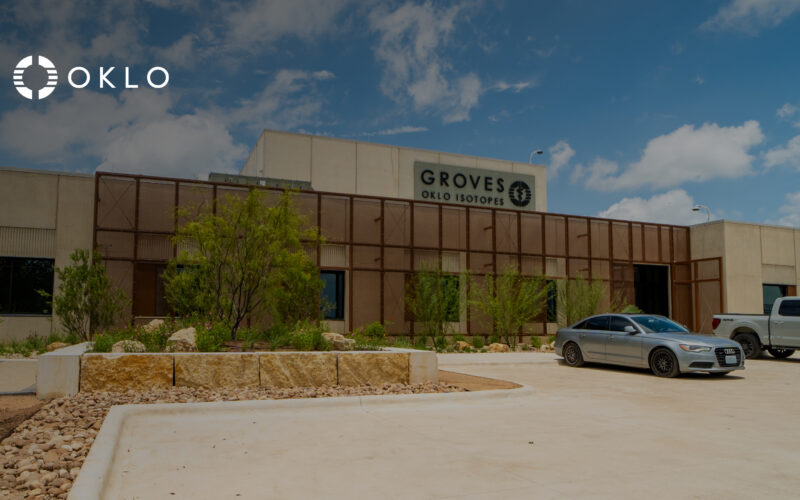
Oklo’s Groves Isotope Test Reactor reached first criticality in Texas on August 6 after achieving a controlled, self-sustaining chain reaction at low power. The Department of Energy confirmed that Groves became the fifth Department of Energy-authorised advanced reactor to reach criticality during the summer and the first Reactor Pilot Program project to do so on private land. Oklo developed the project from a greenfield site and completed construction, procurement, operator preparation and safety work in less than a year.
The achievement is relevant to Aurora because it demonstrates organisational capabilities that extend beyond reactor physics. Oklo gained practical experience in nuclear safety analysis, procurement, construction, commissioning, training, radiation protection, emergency preparedness and startup under Department of Energy oversight. The company explicitly says this operating foundation can reduce uncertainty across future isotope, fuel-cycle and powerhouse deployments.
Groves should not, however, be treated as a miniature commercial Aurora powerhouse. Department of Energy documentation describes it as a zero-power critical assembly with a maximum power level of approximately 100 watts, intended primarily to demonstrate reactor-development capability and support future isotope production. Aurora is intended to generate electricity commercially at megawatt scale, meaning it requires a much larger thermal system, power conversion equipment, fuel inventory, operating organisation and economic infrastructure.
Groves therefore proves something narrower but still valuable. It shows that Oklo can move an authorised nuclear project from site development through criticality under an accelerated regulatory pathway. It does not establish Aurora’s construction cost, electricity price, capacity factor or commercial reliability, which remain the measures required to validate the power business.
How does Oklo’s build-own-operate model increase both the upside and the financial risk?
Oklo plans to design, build, own and operate its powerhouses and sell electricity and heat through long-term agreements rather than primarily selling reactor designs to utilities. This model allows the company to retain recurring revenue from operating assets and potentially capture improvements in efficiency and lifecycle costs. It also aligns the developer more directly with customers that want power rather than responsibility for constructing a nuclear plant.
The model transfers more financial risk to Oklo than the traditional reactor-vendor approach. Because the company expects to own the powerhouses, construction overruns, financing costs and operating underperformance can remain on its balance sheet rather than being absorbed mainly by a utility customer. Oklo explicitly acknowledges that its integrated model exposes it directly to the costs of building, owning and operating the facilities.
Customer prepayments and project financing could reduce the amount of corporate equity required. The January 2026 arrangement with Meta Platforms, Inc. for a planned 1.2GW power campus in Pike County, Ohio, includes a mechanism allowing Meta to prepay for power and provide funding that can help secure nuclear fuel. Such structures demonstrate how large data-centre customers may absorb part of the development burden when access to future electricity is strategically valuable.
The commercial challenge is converting preliminary customer interest into binding agreements with financing-grade economics. Oklo continues negotiating power purchase agreements and other definitive contracts with customers that previously signed non-binding documents. The company’s headline project pipeline should therefore not be valued as though every prospective megawatt has already become contracted revenue.
Why does nuclear fuel remain one of the biggest constraints on Oklo’s 2028 deployment strategy?
Aurora is designed to use high-assay low-enriched uranium and potentially other fuel sources, including recovered or recycled material. Oklo has already received a Department of Energy award of five metric tons of high-assay low-enriched uranium derived from material associated with the former Experimental Breeder Reactor II programme for its Idaho deployment. This gives Aurora-INL a more concrete initial fuel path than many advanced reactor projects that remain dependent entirely on future commercial HALEU production.
The company is simultaneously developing an Aurora Fuel Fabrication Facility at Idaho National Laboratory and advancing a broader fuel-recycling strategy. Several safety documents for the Idaho fabrication facility have already received Department of Energy approval, while Oklo continues engineering and regulatory work required before the material can become finished reactor fuel. Securing raw nuclear material therefore solves only one part of the problem.
For later deployments, the supply chain remains less certain. Oklo signed a letter of intent with Centrus Energy Corp. in June covering enough domestically produced HALEU to support several years of requirements for up to five Aurora powerhouses, with deliveries expected to begin in 2029. The timing, price, volume and prepayment terms remain subject to negotiation and a definitive agreement, meaning the arrangement should not yet be treated as guaranteed fuel supply.
Fuel therefore represents both a competitive advantage and a scaling constraint. Oklo has multiple pathways involving government material, domestic enrichment, recycling and potential alternative fuels, but each carries separate regulatory, manufacturing and economic requirements. Demonstrating reliable fuel fabrication for Aurora-INL will be almost as important as completing the reactor structure itself.
What does OKLO stock performance reveal about how much execution investors already expect?
OKLO closed Friday, August 7 at $48.42, rising 14.8% during the session on volume of approximately 22.1 million shares. The company’s market capitalisation stood at roughly $8.53 billion, while the stock had risen about 17% from its August 3 close near $41.29. The strong Friday move followed the second-quarter update and the Groves criticality announcement, so the reaction appears to reflect a combination of financial runway, regulatory progress and renewed confidence in execution rather than one isolated catalyst.
The longer-term chart remains much more demanding. The shares were about 1.7% below their July 9 close of $49.27, while available historical market data places the 52-week range between approximately $36.61 and $193.84. At the August 7 close, OKLO was about 32% above the 52-week low but roughly 75% below the 52-week high, demonstrating how dramatically expectations around advanced nuclear deployment have moved during the past year.
The $8.5 billion market value is difficult to assess through conventional near-term multiples because current revenue does not represent the intended commercial power business. Investors are effectively valuing intellectual property, regulatory progress, cash, customer relationships, potential fuel-cycle assets and the possibility that Oklo can build a fleet of recurring-revenue nuclear powerhouses. That produces much greater sensitivity to execution milestones than would exist for an established utility whose valuation is anchored by current EBITDA and free cash flow.
The positive interpretation is that Oklo has enough financial runway to pursue first deployment without repeatedly returning to shareholders for small amounts of emergency capital. The cautious interpretation is that an $8.5 billion valuation still requires several assumptions about licensing, construction costs, fuel, power prices and repeat deployment to work before operating earnings can grow into the present market value.
What are the key takeaways from Oklo’s second-quarter 2026 results and Aurora-INL progress?
- Oklo ended June 2026 with approximately $3.01 billion of cash, cash equivalents and marketable debt securities.
- Second-quarter revenue was only $1.21 million and primarily came from engineering, consulting, manufacturing and fabrication activities rather than commercial electricity sales.
- Oklo recorded a second-quarter net loss of approximately $48.5 million and a first-half net loss of $81.6 million.
- The company raised approximately $1.85 billion of net equity proceeds through at-the-market programmes during the first half of 2026.
- Oklo now describes 2028 as the target for deploying its first Aurora powerhouse, replacing the older late-2027-to-early-2028 timetable.
- The Department of Energy approved Aurora-INL’s Preliminary Documented Safety Analysis in June, allowing final design and construction work to continue.
- Kiewit Nuclear Solutions remains the lead constructor, while Oklo is advancing procurement of reactor modules, refuelling systems, steam turbines and structural steel.
- The Groves Isotope Test Reactor reached first criticality on August 6, demonstrating accelerated nuclear project execution but not commercial Aurora power generation.
- OKLO closed August 7 at $48.42, up 14.8% for the session, with a market capitalisation of approximately $8.53 billion.
- Aurora-INL’s 2028 deployment, fuel fabrication, final safety authorisations and eventual electricity economics remain the clearest tests of whether Oklo can convert its valuation into operating value.
Can Aurora-INL justify Oklo’s $8.5 billion valuation before cash-rich optimism turns into an execution test?
Oklo has materially improved its position compared with an advanced nuclear developer dependent primarily on concepts and future fundraising. It possesses more than $3 billion of liquidity, has begun physical work at Idaho National Laboratory, has a major construction partner, has progressed through important Department of Energy safety reviews and now has direct experience taking a separate nuclear project through first criticality. Those achievements reduce several categories of development risk, particularly financing and organisational execution, even though none independently establishes the economics of commercial Aurora electricity.
What remains unresolved is more consequential. Oklo must fabricate fuel, complete the first-of-a-kind plant, secure the remaining authorisations, commission a megawatt-scale reactor and operate it reliably enough to prove that its build-own-operate model can produce competitive recurring revenue. Management also acknowledges that the first Aurora will contain unique costs that later units are expected to avoid, meaning investors may need to evaluate success through both technical completion and evidence that a repeatable lower-cost design can follow.
The next major proof point is therefore not another non-binding customer announcement or an increase in the theoretical project pipeline. It is visible progress toward a completed Aurora-INL powerhouse capable of reaching operation during 2028, accompanied by credible cost, fuel and operating data. If Oklo meets that timetable while retaining a substantial liquidity cushion, the $8.5 billion valuation will increasingly rest on physical infrastructure and potential future cash flow rather than expectation alone. A meaningful delay, unexpected first-of-a-kind cost escalation or inability to turn prospective customers into bankable power agreements would make the current gap between revenue and valuation considerably harder to defend.
Discover more from Business-News-Today.com
Subscribe to get the latest posts sent to your email.
