

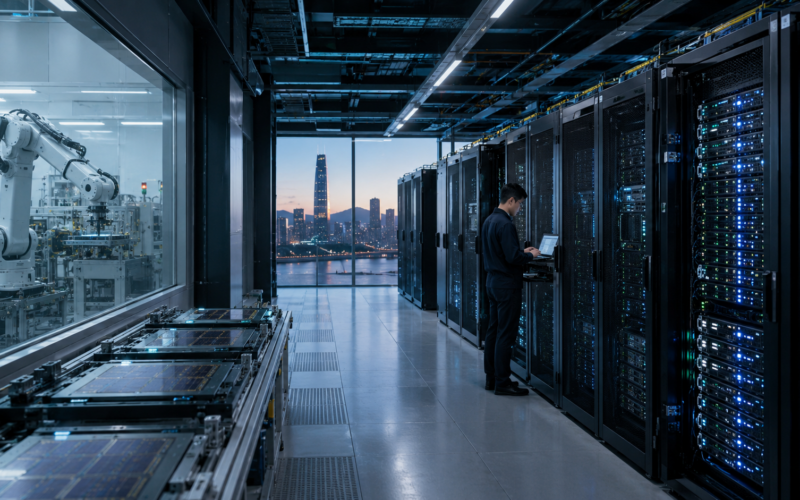
NVIDIA Corporation (NASDAQ: NVDA) has widened its South Korea AI infrastructure push through deeper partnerships with SK Hynix, SK Telecom, Naver Corporation, Hyundai Motor Group, LG Group and Doosan Group, turning a national compute rollout into a broader industrial AI platform. The latest agreements build on a Korea programme of more than 260,000 Nvidia graphics processing units across sovereign clouds, semiconductor factories, automotive systems, robotics and enterprise AI. For NVIDIA Corporation, the immediate strategic value is not only the sale of accelerators but tighter control over the memory, data centre and physical AI ecosystems that will determine whether demand can keep scaling. Nvidia shares recently traded around $208, below their 52-week high of $236.54 but well above the 52-week low near $140.86, reflecting a market that still rewards AI infrastructure leadership while scrutinising supply constraints and valuation risk.
Why does NVIDIA Corporation’s South Korea AI buildout matter beyond another GPU supply deal?
NVIDIA Corporation’s South Korea strategy matters because it shifts the artificial intelligence conversation from chip shipments to national industrial architecture. The company is not merely supplying graphics processing units to a set of high-profile customers. It is embedding Nvidia hardware, software, simulation tools, networking concepts and partner roadmaps into one of the world’s most sophisticated manufacturing economies.
That distinction is important for investors because South Korea is not just another end-market for artificial intelligence demand. It is a memory-chip powerhouse, an automotive production base, a robotics development hub, a shipbuilding and electronics centre, and a government-backed sovereign AI market. By placing Nvidia Blackwell infrastructure across those layers, NVIDIA Corporation is attempting to make its accelerated computing platform part of Korea’s industrial operating system.
The timing also matters. Artificial intelligence infrastructure is moving from hyperscale cloud training into physical AI, agentic AI, industrial digital twins, robotics, autonomous mobility and sovereign language models. These are not lightweight workloads. They require high-performance accelerators, advanced memory, power-dense data centres, cooling systems, software orchestration and domain-specific deployment partners. That makes South Korea an unusually valuable test bed because the country has the industrial base to use AI inside factories, fabs, cars, telecom networks and public-sector compute infrastructure.
The risk is that national-scale AI infrastructure can look easier on a slide than it feels on the ground. GPU supply is only one constraint. Power availability, grid connection, data centre cooling, memory packaging, software integration, model governance and return on invested capital will all determine whether these Korea AI factories become productive assets or expensive monuments to the AI cycle. In plain English, even Blackwell chips still need electricity, floor space and a business case. Silicon cannot magically pay the utility bill.

How does the SK Hynix partnership change Nvidia’s control over the AI memory supply chain?
The SK Hynix partnership is the most strategically sensitive part of the Korea expansion because memory has become one of the main pressure points in the artificial intelligence supply chain. NVIDIA Corporation designs the accelerators and platforms that define much of the AI infrastructure market, but high-bandwidth memory remains essential to system performance. The more AI workloads move into frontier training, inference, robotics and simulation, the more Nvidia needs memory roadmaps to move in lockstep with its own architecture plans.
SK Hynix already occupies a central position in advanced memory for AI platforms, and the multiyear partnership gives both companies a stronger basis for co-development. That matters because memory is no longer behaving like a purely commodity component in the AI era. Customisation, bandwidth, packaging compatibility, energy efficiency and roadmap timing increasingly determine whether a system can deliver the performance customers expect.
For NVIDIA Corporation, the benefit is supply visibility and technology alignment. If SK Hynix can align memory development with Nvidia platforms such as Vera Rubin, Vera central processing units, RTX Spark-powered personal AI systems and Jetson Thor robotics computers, Nvidia can reduce one of the biggest risks facing its hardware roadmap. For SK Hynix, the opportunity is deeper participation in Nvidia’s expanding ecosystem, but the risk is also clear. A tighter relationship with Nvidia may increase visibility, yet it also concentrates strategic exposure to one of the world’s most powerful platform companies.
The broader competitive implication is uncomfortable for Samsung Electronics and Micron Technology. If Nvidia and SK Hynix keep moving earlier into joint memory planning, rivals may need to compete not only on capacity and pricing but on roadmap intimacy. In AI infrastructure, being a qualified supplier may no longer be enough. The real prize is becoming part of the platform design conversation before the next wave of systems is locked in.
Why are SK Telecom, Naver Corporation and Hyundai Motor Group central to Nvidia’s physical AI ambitions?
The Korea expansion is not just about chips inside data centres. SK Telecom, Naver Corporation and Hyundai Motor Group give NVIDIA Corporation access to three different execution layers that could define the next phase of AI infrastructure: telecom-grade sovereign cloud, internet-scale AI services, and industrial physical AI deployment.
SK Telecom’s planned gigawatt-scale AI cloud points to a model in which telecom operators become national AI infrastructure providers. That is strategically important because telecom networks already sit close to enterprise customers, government clients, edge workloads and future 6G architectures. If SK Telecom can convert Nvidia-based infrastructure into reliable sovereign AI services, the deal could strengthen Nvidia’s case that AI factories will not be limited to U.S. hyperscalers.
Naver Corporation gives the strategy a different flavour. Naver is a domestic internet and cloud player with AI model ambitions, search and content assets, and enterprise cloud relationships. Its plan to scale Nvidia-based AI factories from the GAK Sejong footprint toward gigawatt scale suggests a bid to serve Korean industries and international AI customers with production-grade infrastructure. For Nvidia, that expands the market from hardware demand into a recurring ecosystem of models, services, developer tools and enterprise AI workloads.
Hyundai Motor Group adds the physical AI dimension. Automotive manufacturing, autonomous driving, robotics, smart factories and on-device semiconductors are all workloads where simulation, training and real-world deployment must connect. Nvidia has long argued that the next AI wave will move from chatbots into machines, factories and mobility systems. Hyundai Motor Group’s role makes that argument more tangible, because a carmaker with global manufacturing scale can test whether physical AI can improve design cycles, robotics productivity, factory automation and vehicle intelligence.
The challenge is that each partner has different success metrics. SK Telecom needs infrastructure utilisation and enterprise demand. Naver Corporation needs differentiated sovereign AI services and token economics that compete with global cloud giants. Hyundai Motor Group needs productivity, safety and autonomy outcomes that justify capital spending. NVIDIA Corporation benefits if all three succeed, but the Korea strategy will be judged partner by partner rather than by a single headline GPU number.
How could South Korea’s sovereign AI strategy reshape Nvidia’s position in Asia?
South Korea’s sovereign AI agenda gives NVIDIA Corporation a policy tailwind at a time when countries are increasingly treating compute capacity as strategic infrastructure. The Korean government’s plan to support national AI computing capacity, Korean-language foundation models and industry-specific applications creates a demand base that goes beyond commercial cloud adoption. This is where the Nvidia story intersects with industrial policy.
For South Korea, the logic is clear. A country with global champions in memory, electronics, automobiles, telecoms and shipbuilding does not want to depend entirely on foreign cloud infrastructure or imported AI models. Building domestic AI factories gives policymakers a route to local model development, public-sector AI capacity and industrial competitiveness. It also allows Korean companies to train and deploy models closer to local data, language, regulatory requirements and sector use cases.
For NVIDIA Corporation, sovereign AI is a powerful growth narrative because it expands the customer base from technology companies to governments, national cloud operators and industrial ministries. If Korea can demonstrate that sovereign compute produces commercially useful models and industrial productivity gains, other countries may use it as a reference point. That would support Nvidia’s argument that AI infrastructure demand has a long runway outside the United States and outside a narrow group of hyperscale cloud buyers.
There are geopolitical complications. Export controls, U.S.-China technology restrictions, regional security considerations and domestic procurement politics can all influence how sovereign AI programmes are financed and scaled. South Korea is closely aligned with the United States, yet its companies operate in a region shaped by China exposure, semiconductor competition and sensitive technology flows. Nvidia’s Korea deals therefore sit at the intersection of commercial growth and strategic dependency, which is exactly where AI infrastructure is heading globally.
What does the Nvidia stock reaction say about investor sentiment toward AI infrastructure spending?
NVIDIA Corporation’s market context is more nuanced than the strategic headlines suggest. The stock recently traded around $208.19, with a market capitalisation of roughly $5.08 trillion. Market data showed the shares down about 3.05 percent over five days and about 7.81 percent over one month, while the 52-week range stood near $140.86 to $236.54. That is still an extraordinary valuation backdrop, but it also shows investors are no longer treating every AI infrastructure announcement as automatic upside.
The muted recent performance does not necessarily undermine the Korea strategy. Instead, it shows that the market is separating long-term demand signals from near-term valuation and supply-chain questions. Nvidia can announce deeper partnerships in Korea and still face pressure if investors worry about chip-cycle volatility, memory constraints, capital expenditure digestion, U.S. rate expectations or broader semiconductor profit-taking.
Institutional sentiment appears to remain structurally constructive on Nvidia’s AI infrastructure leadership, but the burden of proof is rising. Investors now want evidence that AI factories can move from buildout to monetisation, that customers can earn returns on large compute investments, and that Nvidia can defend margins as the ecosystem scales. In other words, the market still likes the AI story. It is simply asking the grown-up question now: who gets paid after the servers are installed?
That question is especially relevant in South Korea. The country’s semiconductor stocks have seen sharp volatility even as AI demand supports long-term optimism. If memory suppliers, data centre operators and industrial partners absorb heavy capital spending while Nvidia captures the highest-margin layer of the stack, local investors may reassess who benefits most from the AI boom. That does not weaken Nvidia’s position. It may actually highlight the company’s strategic advantage.
What are the main execution risks in turning Korea’s AI factories into profitable infrastructure?
The first risk is infrastructure intensity. AI factories at large scale require power procurement, cooling design, land, interconnects, physical security, data governance and operational reliability. These are not app launches. They are industrial assets with long planning cycles and high fixed costs. Korea’s manufacturing depth helps, but even advanced economies face grid and energy constraints when compute demand expands quickly.
The second risk is utilisation. A national AI factory is only valuable if enough workloads flow through it at attractive economics. Training foundation models can consume vast capacity, but long-term returns depend on enterprise adoption, inference demand, industrial deployment and software monetisation. If Korean companies use the infrastructure mainly for experimentation, the capital efficiency story weakens. If they use it to run factories, robots, vehicles, telecom networks and sovereign AI services at scale, the investment case becomes much stronger.
The third risk is ecosystem complexity. NVIDIA Corporation is coordinating with memory suppliers, cloud providers, telecom operators, automakers, government agencies, data centre builders and software developers. Each party has its own investment timetable, regulatory exposure and margin expectations. The more ambitious the platform, the more execution risk moves from chip delivery into systems integration.
A final risk is competitive response. Advanced Micro Devices, Broadcom, custom silicon developers, cloud in-house chips, Samsung Electronics, Micron Technology and regional AI infrastructure players will all look for openings. Nvidia’s advantage is strongest when hardware, software, memory alignment and developer adoption reinforce one another. If customers become uneasy about dependency on one platform, alternatives will gain attention even if they trail Nvidia on ecosystem maturity.
What does Nvidia’s Korea strategy signal for the next phase of the global AI infrastructure race?
NVIDIA Corporation’s Korea strategy signals that the AI infrastructure race is entering a more national, industrial and supply-chain-driven phase. The first wave of the AI boom was dominated by model training and hyperscale cloud capacity. The next wave is likely to be shaped by countries and industrial groups that want AI infrastructure embedded into manufacturing, mobility, telecoms, public services and sovereign model development.
That shift favours companies that can operate across the full stack. Nvidia’s advantage is not only the graphics processing unit. It is the combination of accelerators, networking, software libraries, model tools, simulation environments, robotics platforms, partner certification and ecosystem gravity. The Korea deals show how that stack can be sold as a national industrial platform rather than a component catalogue.
The strategic bet is bold because it assumes AI demand will keep spreading into physical industries. If that happens, Korea could become a reference market for AI factories that serve fabs, car plants, telecom networks, robots, shipyards and cloud customers. If demand disappoints or power and cost constraints bite harder than expected, the same programme could become a warning that the AI buildout has outrun monetisation.
For now, the balance of evidence favours Nvidia’s strategic positioning, even if the stock is no longer floating upward on every AI headline. South Korea gives NVIDIA Corporation what every platform company wants: deep customers, national policy support, manufacturing use cases, memory partners and a showcase economy. The hard part begins after the announcement. Chips must become capacity, capacity must become workloads, and workloads must become measurable productivity. That is where the Korea story will either validate the AI factory thesis or expose its weakest link.
What are the key takeaways from NVIDIA Corporation’s Korea AI infrastructure expansion for investors and competitors?
- NVIDIA Corporation’s Korea push is best understood as a platform strategy, not a simple hardware sales cycle, because the company is embedding accelerators, software, memory planning and industrial AI tools into a national technology roadmap.
- The SK Hynix partnership strengthens Nvidia’s visibility into advanced memory supply, which is increasingly important as AI infrastructure performance depends on bandwidth, packaging, capacity planning and roadmap alignment.
- South Korea gives Nvidia a rare combination of sovereign AI demand and industrial deployment potential, with use cases across semiconductors, telecoms, internet services, robotics, autonomous mobility and smart manufacturing.
- Naver Corporation and SK Telecom expand the addressable market for Nvidia-based AI factories by connecting the platform to cloud services, enterprise workloads, sovereign AI models and future telecom infrastructure.
- Hyundai Motor Group turns Nvidia’s physical AI narrative into a more practical industrial test, because automotive manufacturing and autonomous systems require simulation, training, robotics and deployment at scale.
- The current Nvidia stock setup shows confidence but not euphoria, with shares below their 52-week high despite the company’s continued strategic momentum in AI infrastructure.
- Execution risk remains substantial because AI factories require power, cooling, utilisation, data governance, software integration and return on capital, not just access to the newest graphics processing units.
- Samsung Electronics and Micron Technology face a more complex competitive environment if SK Hynix uses its Nvidia partnership to deepen its role in next-generation memory design for AI systems.
- For governments, the Korea model may become a template for sovereign AI infrastructure, but it also raises questions about dependence on U.S. technology platforms and long-term compute economics.
- For investors, the central issue is whether Nvidia’s AI factory ecosystem can convert massive infrastructure spending into durable revenue, high-margin software pull-through and defensible platform control.
Discover more from Business-News-Today.com
Subscribe to get the latest posts sent to your email.