



Lockheed Martin Corporation, listed on the New York Stock Exchange as LMT, has agreed to acquire Ultra Maritime from Advent International for $3.45 billion, expanding its position in anti-submarine warfare, sonar, sonobuoys, torpedo defence and autonomous maritime sensing. Ultra Maritime will become part of Lockheed Martin’s Rotary and Mission Systems business after the transaction closes. The acquisition gives Lockheed Martin a workforce of approximately 2,000 employees across Five Eyes countries and a portfolio already used by the United States and allied navies. The deal also provides greater exposure to exportable naval subsystems at a time when governments are increasing investment in submarine detection, fleet survivability and uncrewed maritime operations. However, Lockheed Martin has not disclosed the financing structure, expected closing date, regulatory conditions or anticipated earnings contribution, leaving investors to assess whether the strategic fit justifies a price equal to roughly 4.4 times Ultra Maritime’s estimated 2026 revenue.
Ultra Maritime develops sonar systems, sonobuoys, towed arrays, hull-mounted sonar products, torpedo countermeasures, naval radar and autonomous sensing technologies. The business has expanded under Advent International, with revenue reportedly expected to reach approximately $784 million in 2026, compared with about $494 million in 2023.
The transaction represents a sizeable acquisition for Lockheed Martin, but not one that threatens to overwhelm a company generating approximately $75 billion in annual sales. The more important questions concern strategic control of the undersea warfare supply chain, regulatory approval and whether Ultra Maritime can grow faster inside a large defence prime without losing the partnerships and customer neutrality that helped build its position.
Why is Lockheed Martin paying $3.45 billion to acquire Ultra Maritime now?
The timing reflects a wider change in naval procurement. Submarines are becoming quieter, autonomous underwater vehicles are becoming more capable and long-range maritime operations are increasing demand for persistent sensing across enormous areas.
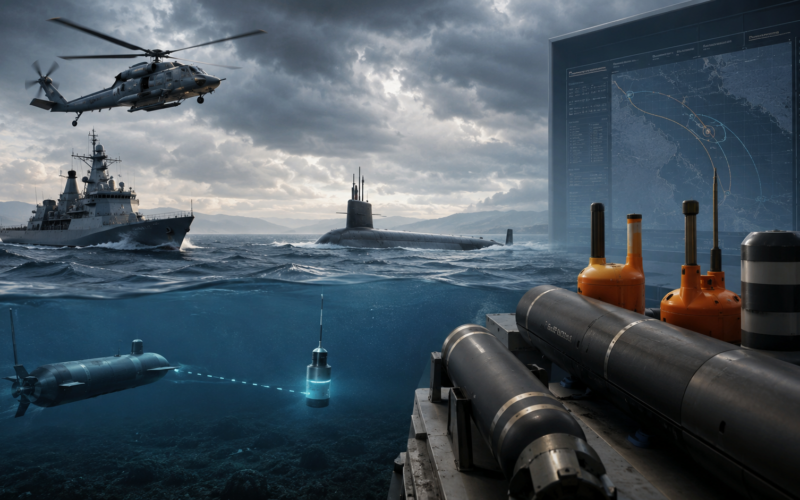
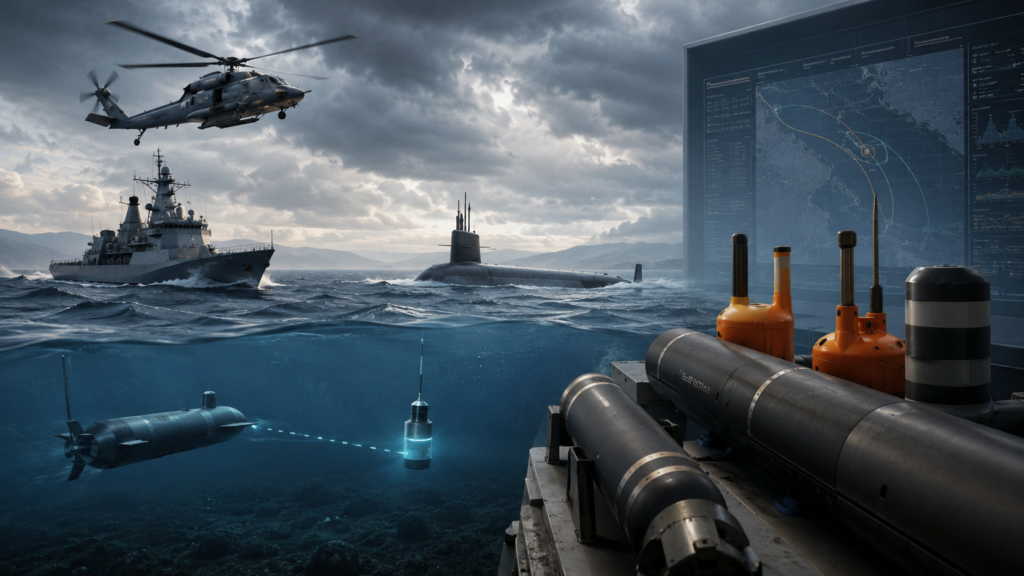
Detecting an adversary submarine is no longer a task performed by one ship carrying one sonar system. Modern anti-submarine warfare increasingly connects aircraft, helicopters, ships, submarines, expendable sonobuoys, seabed sensors and uncrewed vehicles into a distributed network.
Ultra Maritime occupies several important points within that network. Its sonobuoys can be deployed from crewed or uncrewed aircraft, its sonar systems support surface and undersea platforms, and its countermeasure products are intended to protect vessels against increasingly intelligent torpedoes.
Lockheed Martin already supplies maritime combat systems, sensors, helicopters, command-and-control equipment and undersea technologies. Ultra Maritime adds specialised acoustic products and an international customer base that can be connected to those larger platform relationships.
The strategic logic is therefore less about buying a single product and more about controlling a larger share of the detect, track, classify and defeat chain. Lockheed Martin can potentially combine Ultra Maritime sensors with Sikorsky helicopters, mission software, ship combat systems, autonomous platforms and data-processing capabilities.
Building that portfolio internally would require time, technical investment and customer qualification. Acquiring Ultra Maritime gives Lockheed Martin mature products, specialist employees and existing naval relationships immediately, subject to regulatory approval.
The purchase also prevents a competing defence company from acquiring the asset. Ultra Maritime reportedly attracted interest from several strategic bidders, reflecting the scarcity of established companies with meaningful intellectual property in undersea sensing and torpedo defence.
Does the reported Ultra Maritime revenue justify Lockheed Martin’s $3.45 billion valuation?
Ultra Maritime is expected to generate approximately $784 million of revenue in 2026. On that basis, Lockheed Martin is paying roughly 4.4 times annual sales.
That is a substantial multiple for a traditional defence hardware supplier, particularly when Lockheed Martin itself trades at a much lower sales multiple. The premium suggests that Lockheed Martin is paying for growth, intellectual property, customer access and strategic scarcity rather than current revenue alone.
Ultra Maritime’s reported revenue growth has been strong. An increase from about $494 million in 2023 to approximately $784 million in 2026 would represent growth of nearly 59% across three years.
That trajectory helps explain the price, but revenue alone does not reveal transaction quality. Lockheed Martin has not disclosed Ultra Maritime’s earnings before interest, tax, depreciation and amortisation, operating margin, cash conversion, backlog or required capital expenditure.
The absence of those figures makes it impossible to calculate a reliable earnings multiple or determine how quickly the acquisition could improve Lockheed Martin’s earnings per share.
Private equity ownership also matters. Advent International invested in product development, manufacturing capacity and operational improvement before selling the business. Lockheed Martin is therefore buying an asset after a period of substantial value creation rather than acquiring an underperforming company at a distressed price.
The acquisition will be attractive if Ultra Maritime sustains double-digit growth, wins larger allied programmes and improves margins through Lockheed Martin’s scale. The price will look less comfortable if growth slows after the current procurement cycle or if integration disrupts customer relationships.
The valuation also implies limited tolerance for execution problems. At 4.4 times estimated revenue, Lockheed Martin needs more than a collection of technically impressive products. It needs reliable production, profitable growth and strong order conversion.
How will Ultra Maritime strengthen Lockheed Martin’s anti-submarine warfare portfolio?
Ultra Maritime brings products covering airborne, surface and undersea applications. This allows Lockheed Martin to participate across several stages of an anti-submarine warfare mission rather than relying on one platform or sensor category.
Sonobuoys are a particularly important capability. These expendable sensors are deployed into the ocean to detect, classify and track underwater acoustic activity. Demand can scale with training, patrol activity and operational use because sonobuoys are consumed rather than installed permanently on one platform.
Ultra Maritime also produces receivers that process acoustic information from sonobuoys. Combining expendable sensors with receiving and processing equipment creates a broader system opportunity and strengthens the company’s position in customer procurement programmes.
Towed sonar arrays provide another revenue stream. These systems are deployed behind surface ships or submarines to detect underwater threats while reducing interference from the host platform.
Hull-mounted sonar systems provide close and medium-range detection capability from naval vessels. Their integration with ship combat-management systems creates a natural connection with Lockheed Martin’s existing maritime electronics portfolio.
Torpedo defence adds an effector and survivability layer. Ultra Maritime develops systems that detect incoming torpedoes and deploy acoustic or other countermeasures intended to confuse, divert or defeat them.
The acquisition therefore connects sensing with platform protection. Lockheed Martin can potentially offer navies a more integrated package involving detection, data processing, command systems and defensive responses.
That integration may create commercial advantages, but it also creates responsibility. Customers will expect the combined system to work across platforms, suppliers and national security architectures rather than merely performing well in separate product demonstrations.
Why are autonomous maritime platforms central to the Ultra Maritime acquisition strategy?
Ultra Maritime has been moving beyond conventional sonar products into uncrewed and distributed anti-submarine warfare. Its partnerships with Anduril Industries and General Atomics Aeronautical Systems illustrate that strategic direction.
The General Atomics partnership is focused on using unmanned aircraft to deploy and support anti-submarine sensing. This could extend the reach of maritime patrol forces while reducing reliance on expensive crewed aircraft for every surveillance mission.
Ultra Maritime’s work with Anduril Industries combines acoustic sensing with autonomous underwater platforms. Such systems could remain at sea for extended periods, collect information across dispersed areas and reduce the number of crewed ships required for continuous surveillance.
Lockheed Martin can contribute mission integration, secure communications, artificial intelligence and command software to those partnerships. It can also connect undersea data to aircraft, ships, satellites and joint-force networks.
The acquisition creates an opportunity to move Ultra Maritime from being primarily a subsystem provider towards becoming part of a larger autonomous maritime architecture.
However, Lockheed Martin must manage existing partnerships carefully. Anduril Industries and General Atomics Aeronautical Systems are independent defence companies that may compete with Lockheed Martin in other markets.
Those partners may become less comfortable sharing sensitive technology or long-term product plans after Ultra Maritime joins one of the world’s largest defence primes. Lockheed Martin will need to preserve commercial neutrality where collaboration creates more value than exclusivity.
The company must also avoid forcing every Ultra Maritime product into a proprietary Lockheed Martin ecosystem. Open interfaces are increasingly important to defence customers that want to combine platforms and software from multiple suppliers.
How could Lockheed Martin use Ultra Maritime’s international footprint to expand exports?
Ultra Maritime operates across the United States, United Kingdom, Canada, Australia and New Zealand, giving it a substantial presence within the Five Eyes intelligence and defence partnership.
This geographic footprint provides local customer relationships, cleared employees and experience with national procurement systems. Such capabilities can be difficult to establish quickly through exports from a single domestic manufacturing site.
Ultra Maritime’s sonobuoys, sonar systems and torpedo defence products are also more exportable than some of Lockheed Martin’s most sensitive platforms. A country may be unable or unwilling to acquire an advanced combat aircraft, but it may still require maritime sensors, countermeasures or radar.
The acquisition can therefore broaden Lockheed Martin’s international revenue base through subsystem sales and upgrades. These products can be fitted to locally built ships, aircraft and uncrewed platforms without requiring the customer to purchase an entire Lockheed Martin platform.
India could become an important example. Ultra Maritime has already entered a production-planning agreement with Bharat Dynamics Limited for sonobuoy co-production, creating a potential pathway for local manufacturing and technology transfer.
Australia is another significant market because of its investment in anti-submarine warfare, Hunter-class frigates, nuclear-powered submarines and maritime surveillance. Ultra Maritime has existing Australian operations and programme relationships that Lockheed Martin can expand.
The United Kingdom offers opportunities through surface-ship sonar, submarine programmes, torpedo defence and maritime-patrol operations. Canada and New Zealand also require surveillance and fleet-support capabilities across large ocean areas.
Export expansion will still depend on U.S. approvals, national-security reviews and customer preferences. Some governments may be cautious about consolidating too much undersea warfare technology under one American prime contractor.
What does the deal mean for Lockheed Martin’s Rotary and Mission Systems business?
Ultra Maritime will join Rotary and Mission Systems, the Lockheed Martin segment containing Sikorsky helicopters, maritime systems, radar, sensors, combat systems, training, cyber and command-and-control technologies.
Rotary and Mission Systems generated approximately $17.3 billion of revenue in 2025. Ultra Maritime’s estimated 2026 sales would equal roughly 4.5% of that annual segment revenue.
The acquisition is therefore large enough to influence the segment’s growth profile without fundamentally changing Lockheed Martin’s overall business mix.
Rotary and Mission Systems entered 2026 with operational pressure. First-quarter revenue declined 8% to $3.99 billion, while operating profit fell 19% to $423 million and operating margin declined from 12% to 10.6%.
Lockheed Martin attributed part of the comparison to programme timing and portfolio effects, but the figures show why an externally acquired growth platform could be attractive.
Ultra Maritime may increase exposure to product categories with recurring demand, particularly sonobuoys, countermeasures, upgrades and support. Those characteristics could complement large platform programmes that produce more uneven revenue.
The segment had approximately $45.84 billion of backlog at the end of the first quarter. The $3.45 billion purchase price equals about 7.5% of that backlog, although acquisition value and backlog are not directly comparable.
The main financial question is whether Ultra Maritime can improve segment growth without diluting margins. Lockheed Martin has not disclosed the target’s profitability, making this one of the most important missing pieces for investors.
How could Lockheed Martin finance the $3.45 billion Ultra Maritime acquisition?
Lockheed Martin has not disclosed whether it will use cash, new debt, commercial paper or a combination of funding sources.
The company reported approximately $1.89 billion of cash and cash equivalents at the end of the first quarter of 2026. The acquisition price exceeds that balance by around $1.56 billion.
Lockheed Martin also carried approximately $20.53 billion of long-term debt. Adding acquisition financing would therefore increase leverage unless the company rebuilds cash before closing or reduces other capital returns.
The balance sheet remains supported by substantial annual cash generation. Lockheed Martin produced $6.9 billion of free cash flow in 2025 and expects approximately $6.5 billion to $6.8 billion in 2026.
The acquisition price equals roughly half of one year’s expected free cash flow. That makes the deal financially manageable, but not irrelevant to capital allocation.
Lockheed Martin regularly returns cash through dividends and share repurchases while investing in manufacturing capacity. Funding the acquisition could temporarily reduce the pace of repurchases or increase borrowing.
The timing of the closing will influence the financing decision. A later completion would allow Lockheed Martin to accumulate additional cash from operations before payment.
Investors should also watch the treatment of Ultra Maritime debt, pensions, transaction expenses and intangible assets. The headline price may not equal the final impact on Lockheed Martin’s enterprise value or future amortisation expense.
A large allocation to acquired intangible assets could create additional non-cash amortisation that reduces reported earnings even if cash performance remains strong.
Could regulators challenge Lockheed Martin’s acquisition of Ultra Maritime?
Regulatory risk cannot be dismissed because Lockheed Martin already supplies sonar, maritime combat systems and undersea warfare technologies. Acquiring another important subsystem provider could raise questions about competition and access for rival prime contractors.
Lockheed Martin’s previous attempt to acquire Aerojet Rocketdyne demonstrates that defence transactions receive close scrutiny. The Federal Trade Commission challenged that $4.4 billion deal because Aerojet Rocketdyne supplied critical missile propulsion products to Lockheed Martin and competing prime contractors.
Ultra Maritime is not identical to Aerojet Rocketdyne. The undersea warfare market contains other sonar and maritime defence suppliers, including RTX Corporation, Thales, L3Harris Technologies, Leonardo, Saab and several specialist companies.
However, regulators may examine specific product categories rather than the broad maritime market. Sonobuoys, particular sonar technologies or torpedo countermeasures may have fewer qualified suppliers than the wider market suggests.
Authorities will likely assess whether Lockheed Martin could disadvantage competitors that currently depend on Ultra Maritime products. They may also consider whether combining platform integration and key acoustic subsystems could reduce future competition.
The transaction could require reviews in the United States, United Kingdom, Canada, Australia and other jurisdictions because Ultra Maritime operates across multiple allied countries and handles sensitive defence technology.
Governments may seek commitments covering supply continuity, protection of sovereign capabilities, local employment, security arrangements or access for third-party customers.
The absence of a disclosed closing date may reflect the complexity of those reviews. Lockheed Martin should avoid assuming that strategic alignment among allied governments automatically produces rapid regulatory approval.
How does the acquisition change competition across the global naval defence market?
The transaction strengthens Lockheed Martin against defence companies with established naval sensor and sonar portfolios. Thales, RTX Corporation, L3Harris Technologies, Saab, Leonardo and General Dynamics Corporation will all monitor how Lockheed Martin integrates Ultra Maritime.
The deal also reflects accelerating consolidation in maritime autonomy and undersea warfare. Defence contractors increasingly view underwater sensing, robotics and data processing as the next major competitive domain after rapid growth in aerial drones.
Thales moved separately to acquire Exail Technologies, a maritime robotics and navigation specialist, highlighting the strategic premium being attached to undersea technologies.
Large defence companies are seeking combinations of sensors, autonomous vehicles, command software and effectors. The commercial objective is to provide an integrated architecture rather than one piece of equipment.
This may create pressure on remaining independent maritime technology companies. Scarce assets with proven naval customers could attract further acquisition interest from defence primes and private equity funds.
Consolidation can accelerate investment and global distribution, but it can also reduce supplier diversity. Naval customers may become concerned if a small number of companies control critical sensors and software.
Defence ministries could respond by supporting open architectures, retaining multiple suppliers or funding smaller companies to preserve competition.
Lockheed Martin’s success will therefore depend partly on whether customers view the acquisition as expanding capability or narrowing choice.
Why did Lockheed Martin stock fall after the Ultra Maritime deal announcement?
Lockheed Martin shares traded around $538 during late-morning trading on July 6, down approximately 1.5% from the previous close of $545.91.
The decline does not indicate that investors reject the strategic logic. Acquisition announcements often pressure the buyer’s shares because investors immediately recognise the purchase price while future synergies remain uncertain.
Lockheed Martin is paying a premium sales multiple without disclosing Ultra Maritime’s earnings, margins or expected accretion. The market is therefore being asked to accept strategic logic before receiving the financial bridge.
The stock had also risen strongly before the announcement. Lockheed Martin gained approximately 8% during the seven days ending July 2 and remained about 2.6% higher over one month despite the acquisition-day decline.
The 52-week range stood at $410.11 to $692. At around $538, the shares were approximately 22% below the annual high and 31% above the low.
Market sentiment towards Lockheed Martin remains supported by rising defence budgets, strong missile demand and a backlog exceeding $186 billion. However, investors remain attentive to programme losses, margin pressure and capital-allocation discipline.
The acquisition represents less than 3% of Lockheed Martin’s market capitalisation, so it is not large enough to dominate the investment case. Its importance lies in whether it improves the quality and growth of the Rotary and Mission Systems portfolio.
A sustained negative reaction would suggest concern about price, financing or regulation. A limited decline followed by stabilisation would imply that investors view the deal as manageable but want additional financial disclosure.
What must Lockheed Martin prove after the Ultra Maritime transaction closes?
The first requirement is regulatory clearance without remedies that weaken the commercial logic. Lockheed Martin must preserve access to key products, customers and intellectual property while satisfying competition and national-security authorities.
The second requirement is employee retention. Ultra Maritime’s value rests heavily on acoustic specialists, engineers and programme teams with security clearances and customer relationships.
The third requirement is operating continuity. Navies cannot tolerate disruptions in sonobuoy deliveries, sonar support or torpedo countermeasure programmes while corporate systems are being integrated.
The fourth requirement is partnership preservation. Lockheed Martin must decide how Ultra Maritime’s relationships with Anduril Industries, General Atomics Aeronautical Systems and other platform companies will operate after closing.
The fifth requirement is financial transparency. Investors will need information on acquired revenue, backlog, margins, amortisation, integration costs and earnings contribution.
Lockheed Martin should also identify where the combination creates measurable cross-selling. General statements about connected battlespaces will not be enough. Investors will look for contracts linking Ultra Maritime sensors with Lockheed Martin platforms and mission systems.
Manufacturing investment will be another test. Undersea defence demand is increasing, but customers require dependable delivery rather than a portfolio diagram showing every possible connection.
The acquisition can strengthen Lockheed Martin’s maritime franchise if Ultra Maritime retains its speed and technical focus while gaining access to greater capital and international reach. It could disappoint if bureaucracy slows product development or customers become concerned about supplier concentration.
What are the key takeaways from Lockheed Martin’s Ultra Maritime acquisition?
- Lockheed Martin has agreed to acquire Ultra Maritime from Advent International for $3.45 billion.
- Ultra Maritime will join Lockheed Martin’s Rotary and Mission Systems business after the transaction closes.
- The acquisition adds sonobuoys, sonar arrays, hull-mounted sonar, torpedo defence, naval radar and autonomous maritime sensing.
- The purchase price equals roughly 4.4 times Ultra Maritime’s reported 2026 revenue estimate of approximately $784 million.
- Lockheed Martin has not disclosed Ultra Maritime’s earnings, margins, backlog, financing structure or expected earnings accretion.
- Ultra Maritime’s approximately 2,000 employees and Five Eyes footprint strengthen Lockheed Martin’s allied export and local-support capabilities.
- Partnerships with Anduril Industries and General Atomics Aeronautical Systems provide pathways into autonomous underwater and airborne anti-submarine warfare.
- Regulatory scrutiny could focus on whether Lockheed Martin gains excessive control over specialised sonar, sonobuoy or torpedo-defence supply chains.
- Lockheed Martin has sufficient cash-generation capacity to fund the transaction, but the deal may affect leverage, share repurchases or other capital priorities.
- Investors should watch regulatory approvals, financing disclosure, employee retention, partnership continuity and the effect on Rotary and Mission Systems margins.
Discover more from Business-News-Today.com
Subscribe to get the latest posts sent to your email.