

British AI infrastructure company Nscale has filed for an initial public offering (IPO) in the United States, planning to list on the New York Stock Exchange under the symbol NSCL after one of the fastest infrastructure expansions of the artificial-intelligence boom. The company has not yet determined the number of shares to be sold or the IPO price range, meaning there is currently no confirmed offer size or valuation. Goldman Sachs, JPMorgan and Morgan Stanley are acting as lead bookrunners.
The financial profile revealed in the filing is extreme even by AI infrastructure standards. Revenue increased 1,252% year over year to $140.6 million during the first half of 2026, while the net loss widened to approximately $1.02 billion from $368.9 million. Nscale says it has scaled total contracted value to more than $103 billion and built an owned and controlled power pipeline exceeding 10 gigawatts in only about two and a half years.
What exactly is Nscale selling to artificial-intelligence customers?
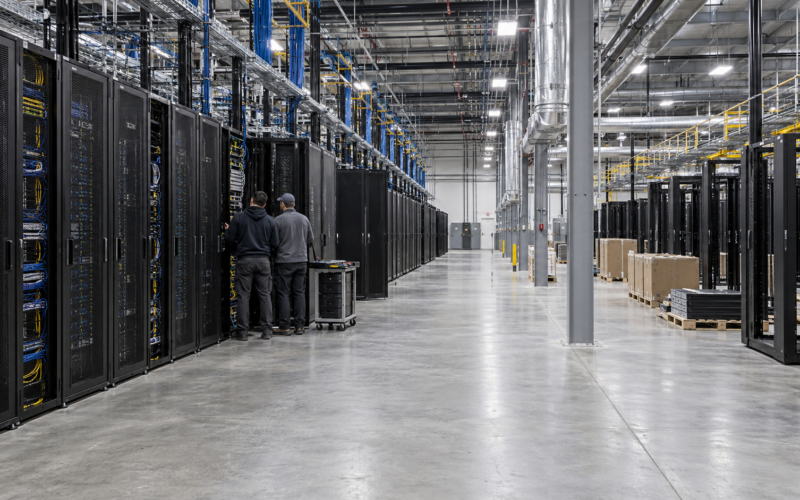
Nscale describes itself as a full-stack AI hyperscaler whose infrastructure stretches from electricity and data-centre development through high-performance computing and cloud software. Its Nscale Infrastructure operation develops power, data centres and AI clusters, while Nscale Cloud provides computing services for model training, fine-tuning and inference.
The model reflects a fundamental change in the AI market. Customers developing large models increasingly need thousands of specialised accelerators operating together, but acquiring chips is only part of the problem. Those systems also require land, electricity, liquid cooling, networking, buildings and software capable of orchestrating enormous computing clusters.
Nscale argues that access to large contiguous blocks of reliable power has become the primary constraint on new AI infrastructure. The company has consequently built its strategy around securing powered sites before demand arrives, including the 2026 acquisition of American Intelligence & Power Corporation and its Monarch Compute Campus in West Virginia. Nscale says that campus has a pathway toward more than 6.5GW of IT load and over 8GW of gross power generation.
That infrastructure-first strategy can provide an advantage if AI compute demand continues increasing rapidly. It can also produce enormous upfront financial requirements because power and data-centre assets must be secured years before customers generate the full contracted revenue.
How can Nscale have $103 billion of contracted value but only $140.6 million of first-half revenue?
The figures measure very different things. Revenue represents services delivered during a specific accounting period, while total contracted value includes payments expected over future years under customer agreements. Nscale said it had approximately $103.4 billion of active and contracted TCV as of August 31, up from about $38 billion at the end of 2025.
Those contracts cover roughly 461,000 GPUs that were active or contracted at the same date, according to the prospectus. The sheer scale helps explain investor interest, but contracted value should not be treated as money already earned or cash already received. Infrastructure still needs to be completed, customers need to consume contracted capacity and numerous operational conditions can affect the timing of revenue recognition.
The gap between current revenue and contracted value is therefore both the central attraction and one of the biggest risks in the IPO. If Nscale delivers the infrastructure successfully, revenue can potentially increase at an extraordinary rate as contracted projects come online. If projects are delayed by power, construction, financing or equipment shortages, expected revenue may arrive much later than investors initially model.
That makes execution visibility more important than the headline contract number alone.
Why is customer concentration one of the biggest risks in the Nscale IPO?
Nscale’s largest customer accounted for approximately 52% of first-half revenue, according to Reuters’ review of the filing. Future customers are expected to include major technology groups such as Microsoft and Anthropic, with Anthropic recently committing to an enormous multiyear cloud arrangement.
Large anchor customers can be extremely valuable because their contracts make financing infrastructure easier. Banks and investors are more willing to fund data centres when highly creditworthy technology companies have committed to using the capacity.
The drawback is bargaining power. If one or several customers account for a large proportion of revenue, they can materially influence pricing, contract terms and expansion decisions. Losing an anchor customer or experiencing a deployment delay can also affect utilisation across infrastructure developed specifically around that demand.
Nscale expects the customer base to broaden as its cloud business expands, but IPO investors will need to determine how quickly that diversification can occur relative to the pace at which infrastructure commitments increase.
Why has Nscale lost more than $1 billion despite enormous demand?
Rapid infrastructure development creates costs well before mature utilisation. Nscale is buying or contracting computing hardware, acquiring data-centre and energy assets, hiring staff and developing software while many customer deployments remain in early stages.
The company has also grown through acquisitions and financing transactions. Reuters reported that Nscale agreed to sell approximately $3.1 billion of convertible bonds, including $1 billion to Nvidia, underscoring how much external capital is required before large contracted deployments generate cash.
That makes the business structurally different from a conventional software company. Software businesses can often add customers with relatively low incremental physical investment, while every large Nscale contract can require new servers, power capacity and data-centre infrastructure.
An IPO can strengthen the balance sheet and create another source of equity capital, but public investors will expect a clearer path from rapid revenue growth toward positive cash generation.
Why does Nvidia backing matter for Nscale?
Nvidia sits at the centre of the current AI infrastructure ecosystem because its GPUs remain widely used for training and inference. A $1 billion Nvidia commitment through convertible bonds provides financial support while also strengthening Nscale’s relationship with an important technology supplier.
The relationship does not eliminate hardware risk. AI accelerator technology changes quickly, and infrastructure built around one generation of processors can lose economic value as newer chips provide more performance per watt.
That creates a tension between long-lived infrastructure and rapidly changing computing equipment. Power connections and data-centre shells can remain valuable for decades, but the servers inside them may need repeated replacement.
Nscale’s ability to keep sites technologically current while financing those upgrade cycles will therefore become one of the most important long-term determinants of returns.
What should investors scrutinise before the Nscale IPO is priced?
The first number is the eventual IPO valuation, which the company has not yet announced. Reports have discussed potential valuations, but until Nscale files a price range those figures remain market expectations rather than company terms.
The second issue is capital intensity. Investors need to understand how much additional debt and equity are required to convert the 10GW-plus power pipeline and contracted GPU commitments into operational capacity.
Customer concentration, contract duration, take-or-pay provisions and deployment schedules are equally important because they determine how dependable the $103 billion headline contract figure really is.
Nscale has already proved that AI infrastructure demand can create astonishing top-line growth. The IPO will test something more demanding: whether public investors believe a company can finance one of the world’s largest AI infrastructure build-outs and still leave enough economic value for ordinary shareholders.
Discover more from Business-News-Today.com
Subscribe to get the latest posts sent to your email.