





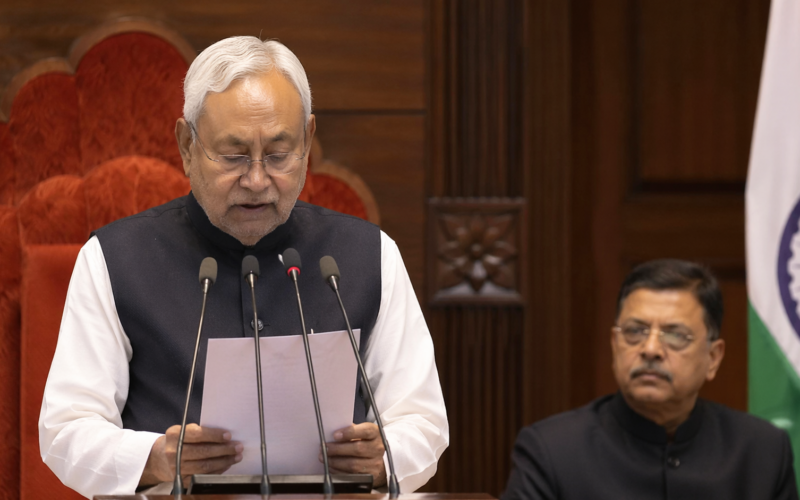
Nitish Kumar took oath as a member of the Rajya Sabha on Friday, marking the clearest formal step yet in Bihar’s unfolding leadership transition and shifting immediate attention to who the National Democratic Alliance will choose to lead the state next. Current reporting indicates that Nitish Kumar’s move to Parliament has created space for a change in Bihar’s top office, but no final public announcement on his successor had been made at the time of writing.
The significance of the moment lies in what has and has not happened at the same time. Nitish Kumar has completed the oath-taking process for the Upper House and has already resigned as a member of the Bihar Legislative Council after being elected to the Rajya Sabha. Yet Bihar has not formally seen the installation of a new chief minister, leaving a short but politically important transition window in which the National Democratic Alliance leadership is expected to settle both timing and succession.
Why does Nitish Kumar’s Rajya Sabha oath matter so much for Bihar politics in April 2026?
Nitish Kumar’s oath matters because it transforms a period of speculation into an institutional fact. For weeks, Bihar politics had been operating around reports that he would move to the Rajya Sabha, but the oath-taking confirms that the transition is no longer theoretical. That is why the conversation in Patna has shifted from whether Nitish Kumar would leave for Parliament to when Bihar’s executive transition will be completed and by whom.
The move is especially consequential because Nitish Kumar has been the central axis of Bihar politics for most of the past two decades. Times of India reported that he first became chief minister in March 2000 for an eight-day stint and then returned in November 2005, holding the office for most of the period since, apart from the interval between May 2014 and February 2015. That long tenure means that any transition away from a Nitish Kumar-led Bihar government is not just a routine personnel change. It is a structural reset in the state’s coalition era.
Prime Minister Narendra Modi publicly congratulated Nitish Kumar after the oath, describing him as one of the country’s most experienced leaders and saying it would be a pleasure to see him in Parliament once again. That reaction underlined that the move is being framed inside the alliance not as a rupture but as a managed transfer from state leadership to a national parliamentary role.
What does the Constitution of India allow after a chief minister moves to the Rajya Sabha?
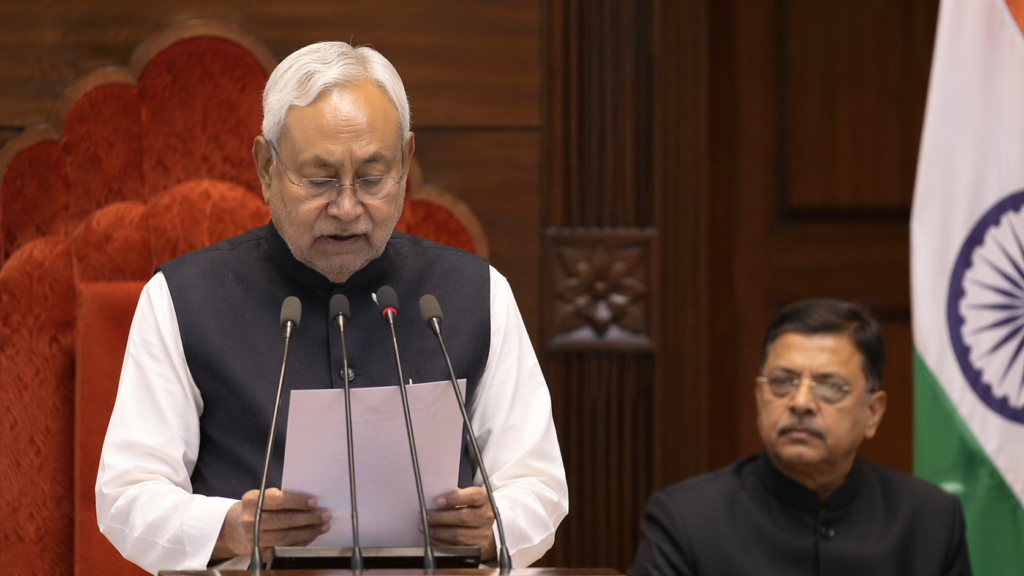
A key reason the transition has not had to happen on the same day as the oath is the constitutional position governing ministers in a state. Article 164(4) of the Constitution of India states that a minister who is not a member of the state legislature for six consecutive months ceases to be a minister at the end of that period. In practical terms, that creates a limited window in which a chief minister may continue in office even after ceasing to be a member of the state legislature.
That provision has featured prominently in current reporting on Bihar. Times of India cited senior Janata Dal (United) leader Shravan Kumar as saying constitutional provisions allow Nitish Kumar to continue as chief minister for up to six months despite election to the Rajya Sabha. Indian Express likewise reported that the Constitution permits an individual to hold the chief minister’s office for six months without being a member of either House of the state legislature. The constitutional point is therefore central to understanding why the oath itself does not automatically mean an immediate same-day swearing-in of a successor.
That legal cushion, however, should not be mistaken for political indecision without direction. The reporting from both Patna and Delhi suggests the alliance is using the interval to stage-manage the optics and internal arithmetic of succession. Times of India reported that alliance leaders do not want the transition to appear as a celebration of Nitish Kumar’s exit, which is one reason the expected swearing-in of a new chief minister is being approached cautiously.
Who is emerging in the race to succeed Nitish Kumar as Bihar chief minister?
Current reporting points most consistently to Deputy Chief Minister Samrat Choudhary as the leading contender, though no official public decision has yet been announced. Indian Express reported on March 31 that, as the Bihar unit of the Bharatiya Janata Party awaited the final word, one name remained the favourite: Deputy Chief Minister Samrat Choudhary. It also reported that sources within the Janata Dal (United) indicated support for him and that his candidacy was seen as compatible with continuity inside the ruling arrangement.
Economic Times reporting carried the same broad signal on Friday, saying Samrat Choudhary had emerged as the frontrunner in the race to succeed Nitish Kumar. At the same time, Indian Express said other names discussed in political circles included Union Minister Nityanand Rai, Deputy Chief Minister Vijay Kumar Sinha and Sanjeev Chourasia, showing that the field has not been publicly narrowed to a single individual by the alliance leadership.
What matters here is not only the identity of the successor but the mechanism of choice. Times of India reported that BJP state president Sanjay Saraogi said the top National Democratic Alliance leadership, along with Nitish Kumar, would decide the successor in Bihar. That wording is politically important because it signals a coalition-managed handover rather than a unilateral assertion by the Bharatiya Janata Party, even though current reporting also says the move to the Rajya Sabha opens the way for the Bharatiya Janata Party to have its first chief minister in Bihar.
Why does the Bihar Assembly result make this succession decision especially significant now?
The 2025 Bihar Assembly result changed the internal balance inside the ruling alliance even though Nitish Kumar returned as chief minister. Election Commission of India results show the Bharatiya Janata Party won 89 seats and Janata Dal (United) won 85 in the 243-member Assembly, while the National Democratic Alliance won a total of 202 seats. That made the Bharatiya Janata Party the single largest party in the House, even as the alliance continued under Nitish Kumar’s leadership after the election.
That arithmetic explains why Nitish Kumar’s move to the Rajya Sabha is being read as more than a career shift. It opens a path for the alliance’s internal hierarchy in Bihar to align more closely with the legislative numbers produced by the 2025 election. Times of India explicitly reported that his move paves the way for the Bharatiya Janata Party, a Janata Dal (United) ally, to have its first chief minister in Bihar.
At the same time, the transition is not being framed as a break between partners. BJP leaders quoted in current reporting have emphasized that everything is proceeding under Nitish Kumar’s leadership and that senior National Democratic Alliance leaders, in consultation with him, will settle the successor question. That messaging suggests the alliance is trying to preserve both continuity and respect for Nitish Kumar’s standing even while preparing for a post-Nitish executive arrangement in Patna.
How does Nitish Kumar’s Rajya Sabha move reshape the next phase of National Democratic Alliance politics in Bihar?
Nitish Kumar’s move does two things at once. First, it relocates him from day-to-day state administration to the national parliamentary arena after more than two decades away from Parliament. Second, it forces the National Democratic Alliance to answer a question it has been able to postpone for years: what Bihar’s ruling coalition looks like when Nitish Kumar is no longer the operative chief ministerial center of gravity.
This is why the succession debate has extended beyond names to political sequencing. Indian Express reported that Nitish Kumar was likely to step down after the end of Kharmas on April 15, while Times of India reported there was still no clarity on when he would resign as chief minister. Those reports show that the alliance is dealing not just with who comes next, but with when the moment should be formalized in a way that minimizes friction inside the coalition and avoids an appearance of haste.
The broader meaning is that Bihar appears to be moving from a Nitish Kumar-defined coalition model to a Bharatiya Janata Party-led coalition model that still seeks Nitish Kumar’s consent and symbolic continuity. In that sense, Friday’s oath was not the end of the story. It was the procedural act that made the political transition unavoidable.
Key takeaways on what Nitish Kumar’s Rajya Sabha oath means for Bihar, the National Democratic Alliance, and Parliament
- Nitish Kumar has formally taken oath as a Rajya Sabha member, confirming his move from Bihar state politics to the Upper House of Parliament.
- Bihar’s next chief minister had not been publicly announced at the time of writing, with current reporting saying the National Democratic Alliance leadership and Nitish Kumar will decide the successor.
- Deputy Chief Minister Samrat Choudhary has emerged in current reporting as the leading contender, though no final official declaration has yet been made.
- The constitutional framework allows a minister in a state to remain in office for up to six months without being a member of the state legislature, which explains the brief transition window after Nitish Kumar’s Rajya Sabha move.
- The Bihar Assembly numbers make the succession decision unusually important because the Bharatiya Janata Party is now the single largest party in the House, even though Nitish Kumar remained chief minister after the 2025 election.
Discover more from Business-News-Today.com
Subscribe to get the latest posts sent to your email.


