



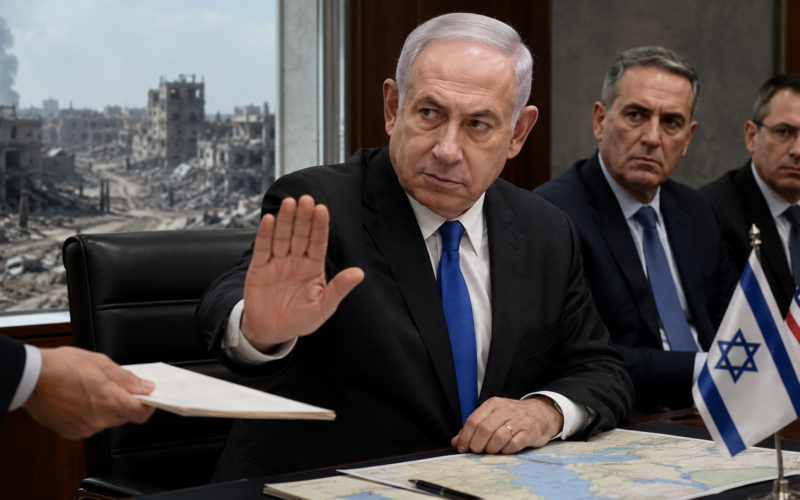
Israeli Prime Minister Benjamin Netanyahu has publicly rejected President Donald Trump’s latest 15-point Gaza roadmap, declaring that Israeli forces will not withdraw from the territory until Hamas has been fully disarmed. The position creates a potentially decisive confrontation with Washington over how the next phase of the Gaza ceasefire should proceed and whether the current reduction in fighting can be converted into a durable political settlement.
Netanyahu told his cabinet on August 9 that Israel did not accept the roadmap in its present form and wanted Hamas to surrender its military capabilities before the Israeli military begins withdrawing from areas it controls. That stance conflicts with the sequencing envisioned by the United States-backed framework, which ties gradual Hamas demilitarisation to corresponding Israeli withdrawals under international monitoring.
The disagreement comes at an unusually sensitive moment. Israel has substantially reduced military activity in Gaza following pressure from the Trump administration, while Hamas says it remains committed to the roadmap negotiated with mediators. The ceasefire is therefore still functioning at an operational level, but the political mechanism intended to turn that temporary calm into a permanent settlement is already encountering one of its most difficult tests.
At the centre of the dispute is a question that has repeatedly undermined previous attempts to stabilise Gaza: whether Hamas must surrender its weapons before Israeli troops leave, or whether disarmament and withdrawal should advance together through reciprocal steps. Neither side wants to surrender its principal source of leverage without firm guarantees that the other will follow through.
Why has Benjamin Netanyahu rejected Donald Trump’s 15-point Gaza roadmap despite reduced fighting?
Netanyahu’s objection centres on what Israel considers an unacceptable security risk in withdrawing while Hamas retains any meaningful armed capability. The Israeli leader has argued that demilitarisation must be genuine rather than symbolic and should cover heavy weapons, small arms, military production facilities, tunnels, storage sites and the broader infrastructure supporting Hamas and other armed factions.
The United States-backed roadmap takes a more gradual approach. Heavy weapons, military production facilities, weapons depots and tunnels would be decommissioned in stages while Israeli forces withdraw from corresponding areas. An international verification mechanism would assess whether each party had fulfilled its obligations before the process advanced to the next phase.
From Netanyahu’s perspective, that framework could allow Hamas to retain enough capability to reorganise if Israel relinquishes strategically important positions too quickly. Washington and the roadmap’s supporters face the opposite problem: if Hamas is required to surrender its entire military structure before Israel moves, the organisation would lose its primary bargaining leverage without certainty that Israeli forces would subsequently withdraw.
This sequencing dispute is therefore not a minor technical disagreement. It determines whether either side believes the settlement protects its essential interests sufficiently to begin implementing irreversible steps.

What does Donald Trump’s 15-point Gaza roadmap require from Hamas and Israel?
The roadmap is intended to move Gaza from a ceasefire into a structured political transition built around Palestinian administrative reform, demilitarisation, Israeli withdrawal and reconstruction. Hamas and other armed factions would relinquish civilian and security authority to a Palestinian technocratic administration operating under the principle that only one recognised authority should control weapons and policing in Gaza.
Police personnel would undergo vetting, while security structures would be reorganised under the new administration. Heavy weapons, tunnels, military production facilities and ammunition depots would be dismantled or placed beyond the control of independent armed factions. Militia weapons would be transferred into a Palestinian-controlled mechanism rather than handed directly to Israel, an arrangement designed to reduce the symbolism of unconditional surrender.
Israel would simultaneously withdraw in stages, with an international stabilisation force positioned between Israeli troops and areas transferred to Palestinian administrative control. Progress would depend on verification that each side had completed the obligations attached to a particular phase before the next movement occurred.
Reconstruction would run alongside the political transition rather than wait indefinitely for every security question to be settled. That element is important because millions of Palestinians require housing, infrastructure, healthcare and basic services after years of fighting and widespread destruction.
Why does Netanyahu want Hamas fully disarmed before Israeli troops leave Gaza?
Israel’s position reflects longstanding concerns that withdrawals conducted before complete demilitarisation could allow Hamas to rebuild underground infrastructure, reorganise command structures and re-establish military control once Israeli troops move away.
Netanyahu’s political allies on the Israeli right have reinforced that argument. Finance Minister Bezalel Smotrich and other hard-line figures oppose a withdrawal that occurs while Hamas retains weapons or command networks, and they have also argued against beginning large-scale reconstruction before demilitarisation is complete.
Domestic politics make compromise particularly difficult. Netanyahu is heading towards an Israeli election scheduled for October 27, and any withdrawal perceived as premature could expose him to attacks from parties arguing that Israel abandoned the military objectives established after the October 7, 2023 Hamas attacks.
A phased withdrawal may therefore be strategically negotiable but politically hazardous. Netanyahu must persuade Israeli voters that any reduction of military control is being exchanged for measurable and irreversible changes inside Gaza rather than relying simply on international promises.
Why is Hamas unwilling to surrender its weapons before Israel begins withdrawing?
Hamas approaches the sequence from the opposite direction. The organisation says it remains committed to the roadmap negotiated with mediators but expects Washington to ensure that Israel follows the agreed withdrawal process rather than adding new conditions after the ceasefire has already begun.
For Hamas, surrendering weapons while Israeli forces continue occupying large parts of Gaza would amount to giving up its strongest remaining leverage without a guarantee that Israel will leave. The organisation has therefore preferred language describing weapons as being transferred or placed under Palestinian administrative authority rather than handed directly to Israel.
That distinction is politically important inside the Palestinian movement. A direct weapons surrender could be portrayed by opponents as capitulation, while transferring military authority to a Palestinian governing structure can be presented as part of a broader national political transition.
The roadmap attempts to bridge these positions by making demilitarisation and withdrawal reciprocal. Netanyahu’s rejection of that sequencing, however, shows that Israel does not yet believe the proposed monitoring and verification arrangements provide enough security.
How much territory does Israel still control in Gaza under the current ceasefire?
Israeli forces continue to control a large portion of Gaza despite the substantial reduction in major combat. The territorial situation remains one of the most difficult practical obstacles to establishing the Palestinian administration envisioned under the roadmap because civilian governance cannot become fully effective while Israeli military units retain control over large areas.
Israel sees those positions as leverage and as a security buffer until Hamas has been demilitarised. Hamas and Palestinian officials view the same military presence as evidence that Israel could prolong occupation even after armed factions begin surrendering weapons.
This creates a circular trust problem. Israel argues that withdrawal cannot precede disarmament because Hamas could rebuild its capabilities, while Hamas argues that disarmament cannot precede withdrawal because Israel could simply remain once Palestinian leverage disappears.
International monitoring is supposed to solve precisely that problem by certifying reciprocal compliance. The political question now is whether Netanyahu can be persuaded that outside verification is strong enough to replace direct Israeli territorial control.
Why has Israel already reduced attacks if Netanyahu opposes the roadmap?
Israel’s rejection of the current roadmap does not mean the broader ceasefire has collapsed. Israeli military activity has already been reduced following discussions with the United States, and operations have increasingly been limited to situations Israel describes as immediate security threats.
That restraint is significant because it suggests Netanyahu is still bargaining over the terms of the next phase rather than abandoning diplomacy altogether. Israel continues engaging with Washington, and Hamas has not declared the framework dead despite the dispute over sequencing.
The danger is that a prolonged stalemate could gradually undermine the operational ceasefire. Israeli officials may conclude that Hamas is using the pause to reorganise, while Hamas could decide that continuing to observe the agreement offers little value if Israel shows no intention of withdrawing.
The coming negotiations therefore need to translate the current reduction in violence into specific, measurable obligations before mutual suspicion begins pushing both sides back towards military escalation.
Could Donald Trump pressure Netanyahu to accept a compromise on Gaza?
The United States possesses substantial leverage over Israel through military assistance, diplomatic backing and broader strategic cooperation, but using that leverage aggressively would be politically sensitive, particularly during an Israeli election campaign.
Trump has invested considerable political capital in presenting the Gaza roadmap as part of a wider Middle East settlement. A complete Israeli rejection would therefore weaken not only the ceasefire but also the administration’s broader claim that Washington has created a workable post-war framework.
Netanyahu nevertheless has strong incentives to show Israeli voters that decisions involving national security are not being dictated from Washington. His public language has consequently left some room for negotiation by suggesting that Israel accepts parts of the American approach while rejecting others.
That makes a compromise possible. Washington could seek stronger verification provisions, accelerated weapons inspections or additional security guarantees in exchange for Israeli acceptance of phased withdrawals. The challenge will be designing guarantees strong enough for Netanyahu to defend domestically without changing the roadmap so radically that Hamas refuses to participate.
Could Gaza reconstruction begin before Hamas is completely disarmed?
Reconstruction represents another area where the political and security arguments intersect. The United States-backed framework envisages rebuilding beginning as the Palestinian administrative transition develops rather than waiting until every weapon has disappeared from Gaza.
Netanyahu’s right-wing partners want reconstruction tied much more tightly to complete demilitarisation. Their concern is that construction materials, infrastructure and newly available resources could eventually be redirected towards rebuilding tunnels or military capabilities if Hamas retains influence.
Supporters of earlier reconstruction argue the opposite. They believe visible improvements in housing, electricity, water, healthcare and employment could strengthen the Palestinian technocratic administration by giving civilians a direct incentive to support stability rather than armed rule.
Delaying reconstruction indefinitely also carries humanitarian and political costs. Large numbers of Palestinians remain displaced or dependent on temporary accommodation, and continued devastation could make it harder for any new governing authority to establish legitimacy.
The reconstruction argument therefore mirrors the broader sequencing dispute. Israel wants irreversible security changes before releasing leverage, while the roadmap attempts to use reconstruction itself as part of the mechanism encouraging political transition.
What would the international stabilisation force actually do inside Gaza?
The proposed international stabilisation force is intended to reduce direct contact between Israeli forces and Palestinian-administered areas while providing an external security layer during the transition.
Its responsibilities would likely include monitoring ceasefire lines, supporting the movement of humanitarian aid, assisting with Palestinian police training and helping verify whether armed factions are surrendering weapons and infrastructure according to the agreed timetable.
The force would also be politically important because it could allow Israel to withdraw without relying solely on promises from Hamas. Instead, Israeli troops would be replaced by a multinational presence capable of reporting violations and supporting Palestinian security institutions.
Yet much depends on which countries provide personnel and what rules govern their deployment. Governments may hesitate to send troops into Gaza unless they receive clear authority, strong protections and confidence that they will not become trapped between Israeli forces and Palestinian armed groups.
An international force can therefore support the peace architecture, but it cannot compensate indefinitely for the absence of political agreement between the principal parties.
What are the key takeaways from Netanyahu’s rejection of Trump’s Gaza roadmap?
- Benjamin Netanyahu rejected the current United States-backed 15-point Gaza roadmap on August 9 and said Israeli forces should not withdraw before Hamas has undergone comprehensive demilitarisation.
- The roadmap instead proposes that Hamas disarmament and Israeli withdrawal proceed through linked, reciprocal stages, with international verification determining when each side has met the conditions required to move forward.
- Hamas says it remains committed to the roadmap but opposes surrendering its military leverage before Israel begins implementing withdrawal commitments.
- The framework would transfer civilian and security authority away from Hamas towards a Palestinian technocratic administration intended eventually to become the only recognised authority controlling weapons and policing in Gaza.
- An international stabilisation force would deploy between Israeli-controlled and Palestinian-administered areas while supporting ceasefire monitoring, humanitarian access and the development of Palestinian security institutions.
- Israel has already reduced military activity under United States pressure, meaning Netanyahu’s rejection has not yet caused a complete collapse of the broader ceasefire.
- Israeli domestic politics are becoming increasingly important because Netanyahu faces an October 27 election and could encounter strong opposition from right-wing allies if he withdraws while Hamas retains significant weapons.
- The central unresolved issue is now sequencing rather than the stated end goals: Israel wants demilitarisation to precede withdrawal, while Hamas and the United States-backed framework favour reciprocal implementation.
Why the sequencing dispute could decide whether Gaza returns to war or finally moves towards reconstruction
The disagreement between Netanyahu, Washington and Hamas may sound procedural, but it reaches the central trust problem that has undermined almost every attempt to design a post-war framework for Gaza. Israel’s principal leverage is territorial control, while Hamas’s principal leverage remains its weapons and organisational structure. Any settlement requiring one side to surrender that leverage completely before the other moves creates a powerful incentive to delay.
Trump’s roadmap attempts to overcome that problem through synchronised steps, outside verification and an international stabilisation force. Netanyahu is now signalling that he does not yet consider those protections sufficient to justify withdrawing Israeli troops while Hamas retains any meaningful military capability. Hamas, meanwhile, is unlikely to dismantle its armed structure if it believes Israel can simply remain after that leverage disappears.
The current ceasefire nevertheless provides diplomatic space that did not exist during periods of intense combat. Israeli attacks have declined, Hamas continues publicly supporting the framework, and Washington remains engaged with both the implementation process and Netanyahu’s objections. That gives negotiators an opportunity to strengthen verification provisions rather than redesign the entire settlement from the beginning.
The danger is that this opportunity will not remain open indefinitely. If negotiations stall while Israeli troops continue controlling large areas and Hamas retains weapons, both sides may increasingly accuse the other of exploiting the pause. Renewed Israeli strikes or Palestinian attacks could then transform a sequencing dispute into another military confrontation.
August 9 has therefore exposed the weakest point in the Gaza peace architecture: the roadmap contains institutions, monitoring arrangements, withdrawal provisions and a reconstruction framework, but none can work unless Israel and Hamas accept that surrendering leverage must occur through coordinated rather than unilateral steps. Whether Washington can bridge that gap will determine whether the current ceasefire becomes the beginning of Gaza’s political reconstruction or another temporary interruption in a conflict that remains fundamentally unresolved.
Discover more from Business-News-Today.com
Subscribe to get the latest posts sent to your email.