


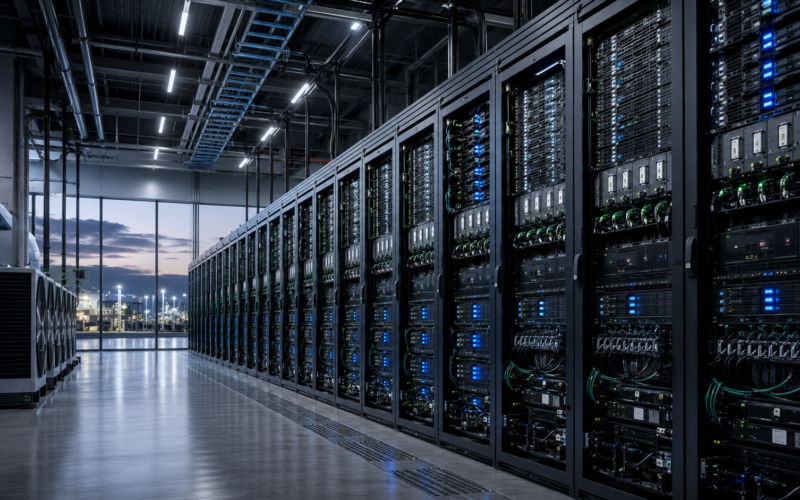
Nebius Group N.V. (NASDAQ: NBIS) has become one of the most closely watched companies in the global artificial intelligence infrastructure market, combining large-scale graphics processing unit clusters, proprietary cloud software, data-centre development and model-serving tools in an attempt to compete with both specialist neocloud providers and established hyperscalers. The Amsterdam-headquartered company generated $399 million in consolidated revenue during the first quarter of 2026, up 684% from the comparable period, while its core Nebius AI cloud operation accounted for approximately 98% of group revenue. It has also secured more than $40 billion of additional contracted revenue commitments involving Microsoft Corporation and Meta Platforms, Inc., while NVIDIA Corporation has invested $2 billion and disclosed beneficial ownership of approximately 9.3% of Nebius Class A shares.
Those figures explain why the Nebius Group company profile has attracted growing investor attention, but they do not remove the central uncertainty surrounding the business. Nebius is spending billions of dollars on GPUs, data centres and power capacity before much of its contracted revenue is recognised, while its first-quarter net income was heavily influenced by a non-cash revaluation of its ClickHouse investment. Investors must therefore distinguish between rapid operating growth, customer prepayments, contract values, annualised run-rate revenue and sustainable free cash flow.
What does Nebius Group do and how does its AI cloud business model operate?
Nebius Group builds and operates computing infrastructure designed specifically for artificial intelligence workloads. Its core platform provides customers with GPU computing, storage, networking, managed services, training infrastructure, inference capabilities and developer tools needed to build, fine-tune and deploy AI models. The company serves AI-native developers, model builders, enterprises, robotics companies, healthcare researchers and other organisations that require large amounts of accelerated computing capacity.
Nebius earns revenue by selling access to GPU capacity and related cloud services. Some customers purchase on-demand computing, while others reserve capacity through longer-term agreements. Large infrastructure contracts can include dedicated GPU clusters, storage and connectivity delivered over several years, allowing Nebius to use contracted cash flows and customer advances to help finance the infrastructure required to provide the service.
The business model is more capital intensive than conventional enterprise software. Nebius must secure power and land, construct or lease data-centre capacity, purchase advanced NVIDIA GPUs, build networking systems and maintain its cloud software before it can recognise revenue. The company is attempting to offset that burden through customer prepayments, convertible debt, equity funding, secured asset financing and a newer partnership model under which external infrastructure partners finance and own data centres while Nebius supplies its architecture, software stack, hardware design and customer relationships.
That partnership structure may become strategically important. It gives Nebius a way to expand computing capacity without funding every data centre and GPU deployment directly from its own balance sheet. The model could also create a higher-margin revenue stream if Nebius can monetise its software, engineering and customer-acquisition capabilities while infrastructure partners absorb more of the underlying capital cost.

How did Nebius Group emerge from Yandex and become a standalone AI infrastructure company?
Nebius Group is the corporate successor to the Dutch parent company formerly known as Yandex N.V. Yandex had built one of the largest technology ecosystems associated with Russia, encompassing search, advertising, mobility, e-commerce and other digital services. Following Russia’s invasion of Ukraine and the resulting geopolitical, regulatory and market disruption, trading in the company’s Nasdaq-listed shares was suspended in February 2022.
Yandex N.V. subsequently agreed to divest its Russia-based operations and certain international businesses. The transaction valued the sold businesses at approximately $5.4 billion and was completed in July 2024. The Dutch parent received about $2.8 billion in total cash proceeds and 162.5 million of its own Class A shares as consideration, while retaining a portfolio of international businesses that became Nebius Group.
The retained portfolio included the emerging Nebius AI infrastructure business, autonomous-driving company Avride, technology education platform TripleTen and interests connected with artificial intelligence data company Toloka and database software company ClickHouse. Yandex N.V. changed its name to Nebius Group N.V., appointed Yandex founder Arkady Volozh as chief executive officer and resumed Nasdaq trading under the ticker NBIS in October 2024.
This history makes Nebius unusual among AI infrastructure companies. It did not begin as a newly financed data-centre start-up. It inherited technical expertise, engineering teams, intellectual property, cash and strategic investments from a much older technology organisation. At the same time, its current financial history is short because the company’s former Russian operations were divested and are no longer representative of the present business.
Which operating businesses and investments make up Nebius Group today?
The core Nebius AI cloud business now overwhelmingly determines group revenue and strategic direction. It combines owned data centres, leased colocation facilities, GPU clusters and proprietary software supporting the AI development lifecycle. The company is expanding across the United States and Europe, with locations and projects in Finland, New Jersey, Missouri, Pennsylvania, France, the United Kingdom, Iceland, Israel and other markets.
Nebius announced in May 2026 that it had secured land and up to 1.2 gigawatts of power for a new owned AI factory in Pennsylvania. The addition helped lift contracted power capacity above 3.5 gigawatts, prompting the company to raise its year-end 2026 contracted-power target to more than 4 gigawatts. Management reported that owned capacity represented more than 75% of contracted power, although contracted power is not the same as connected or revenue-generating capacity.
Avride develops autonomous vehicles and delivery robots. The business has a multiyear partnership with Uber Technologies, Inc. and has been expanding its delivery operations, vehicle fleet and geographic footprint. It remains a loss-making investment-stage operation and made only a limited contribution to group revenue during the first quarter of 2026.
TripleTen is an education technology platform that provides training programmes for careers in software development, quality assurance, data analysis and related technology fields. TripleTen generated $11.6 million of first-quarter 2026 revenue, up 10% year over year, but remained adjusted EBITDA negative as it continued investing in customer acquisition.
Nebius also holds a significant minority interest in ClickHouse, an open-source database technology company, and an equity-method investment in Toloka. ClickHouse raised $400 million at a reported valuation of approximately $15 billion in January 2026, leading Nebius to record a $780.6 million non-cash revaluation gain during the first quarter. That gain materially increased reported net income but did not represent operating profit or cash generated by the AI cloud business.
How does Nebius generate revenue and what did its 2025 financial performance reveal?
Nebius Group generated $529.8 million in consolidated revenue during the year ended December 31, 2025, an increase of 479% from $91.5 million in 2024 on the restated continuing-operations basis used in its latest results. The core Nebius AI cloud business generated $480.3 million, up 603% from $68.3 million a year earlier.
Full-year adjusted EBITDA remained negative at $64.9 million, although this represented a substantial improvement from the $226.3 million adjusted EBITDA loss reported for 2024. Nebius reported $29 million in net income from continuing operations, but adjusted net loss widened to $446.7 million after removing items that management considered unrelated to underlying operating performance.
The divergence between GAAP net income and adjusted loss demonstrates why surface-level earnings measures can be misleading for Nebius. Financial results have been affected by investment revaluations, share-based compensation, depreciation, debt-accounting charges, restructuring costs and changes in the consolidation of businesses such as Toloka.
The company ended 2025 with annualised run-rate revenue of approximately $1.25 billion. Nebius calculates this metric by taking AI cloud revenue from the final month of the period and multiplying it by 12. ARR therefore reflects the revenue pace at the end of the period rather than revenue recognised over the full year. It is useful for measuring a rapidly scaling cloud business, but it should not be treated as equivalent to audited annual revenue.
What do Nebius Group’s first-quarter 2026 results say about current momentum?
Nebius Group’s first-quarter 2026 results showed that the company had moved beyond merely promising future AI cloud growth. Consolidated revenue increased to $399 million from $50.9 million a year earlier, while Nebius AI cloud revenue rose to $389.7 million from $41.4 million. The core business’s revenue therefore expanded by more than nine times and represented about 98% of group revenue.
Cost of revenue increased to $103.8 million from $24.7 million, but fell to 26% of revenue from 49%. This improvement suggested meaningful operating leverage as additional computing capacity generated revenue. Product-development and selling, general and administrative expenses also increased, but both declined sharply as percentages of revenue.
The core Nebius AI cloud operation generated adjusted EBITDA of $174 million and an adjusted EBITDA margin of approximately 45% during the quarter. Group adjusted EBITDA reached $129.5 million, compared with a $53.7 million loss a year earlier. These non-GAAP figures exclude depreciation, share-based compensation and other items, but they indicate that operating economics improved as capacity utilisation and pricing strengthened.
GAAP operating performance remained less flattering. Nebius recorded an operating loss of $128 million after $212 million of depreciation and amortisation, compared with an operating loss of $120.3 million in the prior-year quarter. Depreciation rose as the company placed more GPUs and infrastructure into service, demonstrating that the accounting cost of its hardware base remains substantial.
Nebius reported net income from continuing operations of $621.2 million, but the result included the $780.6 million ClickHouse revaluation gain. Adjusted net loss was $100.3 million. The more relevant operating indicators were therefore revenue, cost of revenue, adjusted EBITDA, depreciation, capital expenditure and the pace at which annualised run-rate revenue increased.
ARR reached $1.92 billion at March 31, 2026, up 54% from the end of 2025. Management retained its target of $3 billion to $3.4 billion of 2026 revenue and $7 billion to $9 billion of ARR by year-end. Reaching that target will require the company to bring substantial new capacity online during the remainder of the year.
How strong is Nebius Group’s balance sheet after billions of dollars of fundraising?
Nebius reported $9.3 billion in cash and cash equivalents at March 31, 2026, compared with approximately $2.45 billion at the end of 2024. The balance-sheet expansion followed multiple financing transactions, including convertible notes, public equity funding, customer advances and NVIDIA’s $2 billion investment.
The cash balance should not be interpreted as excess capital sitting untouched. Nebius spent approximately $2.47 billion on property, equipment and intangible assets during the first quarter alone, primarily on GPUs, related hardware and data-centre expansion. Net investing cash outflow reached $2.64 billion, while financing activities generated $6.3 billion.
Operating cash flow was positive at $2.26 billion, but this was primarily driven by $3.2 billion of advances received under customer agreements. Those prepayments are economically valuable because they help finance construction, but they also create obligations to deliver services in future periods. They should not be confused with recurring free cash flow generated after the infrastructure is operating.
Non-current debt increased to approximately $8.43 billion at March 31, while non-current deferred revenue rose to $4.09 billion. Total liabilities reached about $15.06 billion, compared with shareholders’ equity of $7.24 billion. Nebius still held a substantial liquidity position, but its business is becoming increasingly leveraged to successful capacity delivery and customer utilisation.
The company added its first senior secured financing in July 2026, raising approximately $775 million through a facility backed by deployed GPUs and contracted cash flows. The debt matures in October 2030 and carries pricing of the Secured Overnight Financing Rate plus 2.50%. Nebius said the financing and associated customer cash flows covered more than 100% of the capital expenditure required for the underlying infrastructure.
This transaction may represent a significant shift in Nebius’s funding model. If commissioned GPU clusters supported by investment-grade customer contracts can be financed at the asset level, the company may rely less heavily on corporate equity issuance. However, the model works only if Nebius delivers infrastructure on schedule and the contracted cash flows remain dependable.
How important are Microsoft, Meta and NVIDIA to Nebius Group’s growth strategy?
Microsoft Corporation became a foundational customer through an AI infrastructure agreement with a base contract value of approximately $17.4 billion through 2031, potentially rising to about $19.4 billion if additional services and capacity are purchased. The infrastructure is being deployed in tranches, and Nebius reported in July 2026 that it had delivered the latest planned capacity tranche and remained on schedule for the remaining deployments.
Meta Platforms, Inc. initially signed an agreement worth approximately $2.9 billion for dedicated GPU infrastructure delivered over five years. Nebius subsequently announced a much larger agreement in March 2026 with a potential value of up to $27 billion. The arrangement includes $12 billion of dedicated capacity scheduled to begin in early 2027 and as much as $15 billion linked to additional capacity that Nebius can first attempt to sell to third-party cloud customers, with Meta purchasing qualifying unsold capacity under agreed terms.
The Meta structure offers both downside protection and potential upside, but the full $27 billion should not be viewed as guaranteed recognised revenue. The additional $15 billion portion depends on future capacity, customer allocation and contract conditions. Delivery delays can also lead to discounted fees or termination rights.
NVIDIA Corporation is simultaneously a strategic supplier, technology partner and shareholder. NVIDIA invested $2 billion in Nebius through pre-funded warrants covering approximately 21.07 million shares. Along with shares already held, NVIDIA reported beneficial ownership of roughly 22.26 million Class A shares, equivalent to about 9.3% of the class under United States securities rules.
NVIDIA’s support strengthens Nebius’s credibility and potentially improves access to new GPU platforms. It also creates a circular relationship that investors must evaluate carefully: NVIDIA benefits when cloud companies purchase more of its hardware, while Nebius depends heavily on NVIDIA products to generate revenue. The investment validates the relationship, but does not eliminate the commercial risk associated with GPU prices, technology changes or supplier concentration.
How are Tavily and Eigen AI expanding Nebius beyond basic GPU rental?
Nebius is attempting to differentiate itself from infrastructure providers that compete mainly on access to GPUs. Its acquisitions of Tavily and Eigen AI are designed to add search, inference, model optimisation and agentic capabilities to the core cloud platform.
Tavily provides search infrastructure built for large language models and AI agents. Nebius acquired the company in February 2026, with the first-quarter cash-flow statement showing approximately $170.2 million of consideration paid, net of cash acquired. Tavily’s technology can help AI applications retrieve current information and interact with external data sources, moving Nebius closer to the application and agent infrastructure layer.
Nebius completed the acquisition of Eigen AI in June 2026. The agreed consideration included up to approximately $98 million in cash and about 3.8 million Nebius Class A shares. Eigen AI specialises in inference optimisation, compression and fine-tuning, areas that can reduce the GPU capacity required to run models and improve the economics of Nebius’s Token Factory inference platform.
These acquisitions indicate that Nebius wants to become a full-stack AI cloud rather than a wholesale computing landlord. The strategic opportunity is to earn higher-value software and service revenue while making its infrastructure more attractive to customers. The risk is that Nebius is integrating acquired technology while simultaneously undertaking one of the industry’s largest physical infrastructure expansions.
How does Nebius compete with CoreWeave, IREN and the major cloud platforms?
Nebius competes most directly with specialist AI infrastructure providers such as CoreWeave, Inc. and IREN Limited, as well as smaller neocloud operators. These companies seek to offer faster access to new GPU systems, more specialised support and greater flexibility than broad hyperscale cloud platforms.
Amazon Web Services, Microsoft Azure and Google Cloud remain formidable competitors because they possess global data-centre footprints, extensive software ecosystems, enterprise relationships and enormous capital budgets. Nebius does not need to displace these companies across the entire cloud market. Its opportunity lies in serving AI-intensive customers that value specialised infrastructure, rapid GPU availability, transparent performance and hands-on engineering support.
Nebius’s technical heritage may be a genuine differentiator. The company retained engineers with experience building search, cloud and large-scale computing systems, while its owned infrastructure gives it greater control over design and operating performance. Its expanding software stack, including Token Factory, Tavily and Eigen AI, may also reduce direct comparability with providers whose primary value lies in leasing hardware.
The disadvantage is scale and concentration. Nebius is much smaller than the hyperscalers and is committing billions of dollars to infrastructure that may depreciate quickly. Its most valuable contracts are concentrated among a small number of very large technology companies, while the economic life and residual value of AI hardware remain uncertain.
How has the Nebius Group share price performed in 2026 and what is driving sentiment?
Nebius shares closed at $187.77 on July 24, 2026, after falling 15.02% during the session. The stock was nevertheless up approximately 108.7% from its January 2 closing price of $89.95 and gained about 5.7% over the five trading days beginning July 17. It was down approximately 27.7% from its June 24 close of $259.66, illustrating the unusually high volatility surrounding AI infrastructure companies.
The shares traded within a 52-week range of approximately $50 to $299.86. At the July 24 closing price and based on 253.9 million shares outstanding at March 31, Nebius had an indicative market capitalisation of roughly $47.7 billion. The calculation does not fully capture potential dilution from convertible securities, employee awards or NVIDIA’s pre-funded warrants.
Investor sentiment received a major boost when NVIDIA’s 9.3% beneficial stake became public, sending Nebius shares sharply higher. However, the stock subsequently surrendered much of that gain as investors reassessed capital expenditure, debt, customer concentration and the wider valuation of AI infrastructure businesses.
Valuation based on reported earnings is particularly misleading. First-quarter net income was inflated by the ClickHouse revaluation gain, while depreciation and interest expense will continue rising as Nebius expands its infrastructure. A price-to-sales multiple based on historical revenue also appears extreme because investors are valuing future capacity, contract commitments and management’s growth targets rather than the 2025 revenue base.
Current analyst sentiment remains broadly positive, but expectations vary considerably. Citi reportedly maintained a target of $287, while broader published consensus estimates were near $276 following NVIDIA’s investment disclosure. The distance between these targets, the July closing price and the stock’s recent $299.86 high reflects uncertainty over how much future revenue, margin expansion and execution success are already priced into the shares.
What does Nebius Group’s ownership and governance structure reveal?
Arkady Volozh serves as founder, chief executive officer and executive director, while John Boynton has served as chairman. Ophir Nave is chief operating officer and an executive director. The board also includes non-executive directors with backgrounds in technology, investment, law and artificial intelligence.
Nebius has a dual-class share structure. Class A shares carry one vote each, while Class B shares carry ten votes each. The family trust established by Volozh historically held Class B shares representing a much larger proportion of voting power than economic ownership, giving the founder substantial influence over director elections and other corporate matters.
Founder control can support long-term investment during a period of rapid expansion, especially when quarterly financial results may be volatile. Minority shareholders must nevertheless recognise that their ability to influence strategy, compensation, capital allocation or major transactions is limited.
The company also has multiple potential sources of dilution. These include employee equity awards, convertible notes, acquisition shares, an at-the-market programme covering up to 25 million Class A shares and NVIDIA’s pre-funded warrants. Nebius had not used the at-the-market programme as of March 31, but management said it was evaluating available financing options regularly.
What are the biggest operational, financial and strategic risks facing Nebius Group?
The most important risk is execution. Nebius must bring several gigawatts of contracted power and data-centre capacity online, acquire GPUs, connect networking systems and satisfy service-level obligations under multibillion-dollar customer contracts. Delayed delivery could postpone revenue, trigger fee reductions or allow customers to terminate parts of their agreements.
Capital intensity is the second major risk. Nebius spent nearly $2.5 billion on property, equipment and intangible assets in the first quarter, exceeding the company’s entire 2025 revenue several times over. The expansion is supported by cash, debt, customer advances and strategic investment, but the company may need additional capital if construction costs rise or capacity is delivered more slowly than expected.
Customer concentration is another concern. Microsoft and Meta account for a large proportion of the contracted revenue supporting Nebius’s expansion. Investment-grade counterparties improve financing quality, but the loss, delay or renegotiation of a major contract could have a material effect on revenue expectations and asset utilisation.
Technology obsolescence could affect returns. GPUs and networking hardware can lose economic value as newer architectures improve performance and efficiency. Nebius changed the estimated useful life of server and network equipment from four years to five years at the beginning of 2026, reducing near-term depreciation compared with the previous estimate. Actual economic life will depend on customer demand and the competitiveness of older hardware.
Power supply, regulation and community opposition may also slow data-centre construction. Gigawatt-scale AI factories require grid connections, land, water or cooling systems and substantial local infrastructure. Government policy toward data centres is becoming more sensitive as utilities assess electricity demand, consumer prices and environmental effects.
Valuation risk remains unusually high. Nebius shares more than doubled during 2026 even after the July pullback. The market is therefore assuming substantial revenue growth, timely execution and durable margins. A missed capacity milestone or weaker demand signal could produce a disproportionate share-price response.
What is the growth outlook for Nebius Group through 2027?
Nebius has established a credible position in the AI cloud market faster than most emerging infrastructure companies. Revenue has accelerated, cost-of-revenue ratios have improved, core adjusted EBITDA has turned positive, NVIDIA has become a major investor and multiyear contracts with Microsoft and Meta provide demand visibility. The company also controls a growing portfolio of power and data-centre development opportunities that could support expansion beyond its current revenue base.
The central question is no longer whether Nebius can attract customers. Its contract book suggests that it can. The harder test is whether the company can deliver capacity on schedule, convert customer advances into productive infrastructure and generate returns that exceed the cost of debt, equity dilution and hardware depreciation.
The $7 billion to $9 billion year-end ARR target provides a useful marker, but recognised revenue and cash flow will matter more. Investors should examine connected and active power rather than contracted power alone, along with quarterly AI cloud revenue, gross economics, depreciation, interest costs and capital expenditure. ARR can rise rapidly when new capacity is commissioned late in a period, even though the associated revenue has not yet appeared across a full year.
Nebius’s asset-light infrastructure partnership model may improve the long-term economics by shifting part of the capital burden to external owners. Tavily and Eigen AI could also expand margins if software and inference services become a larger part of the revenue mix. Neither outcome is yet sufficiently mature to remove the risks associated with the company’s physical buildout.
Nebius Group has evolved from a complicated post-Yandex carve-out into one of the most strategically relevant independent AI cloud companies. Its engineering heritage, NVIDIA relationship, expanding software stack and investment-grade customer contracts give it a stronger foundation than many speculative AI infrastructure stories. However, a market capitalisation approaching $48 billion means that investors are already paying for a large portion of the anticipated transformation. Through 2027, markets are likely to judge Nebius less by new contract headlines and more by whether commissioned capacity, reported revenue and cash generation begin to validate the scale of its valuation.
Discover more from Business-News-Today.com
Subscribe to get the latest posts sent to your email.