

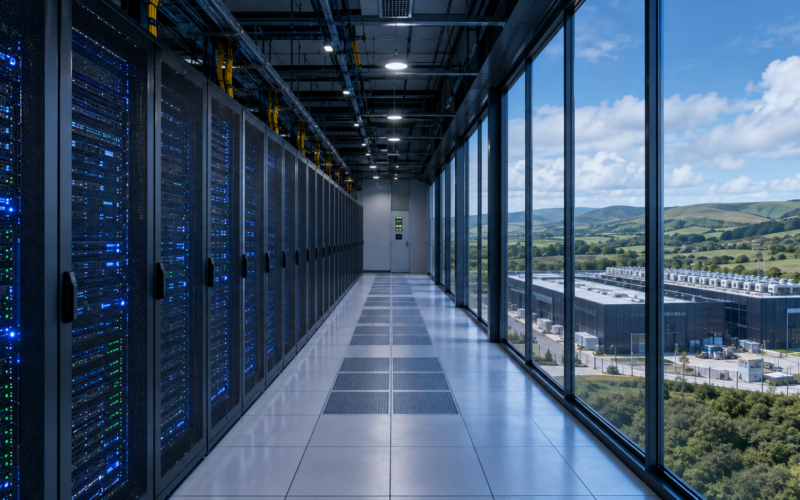
Nebius Group N.V. (NASDAQ: NBIS) has agreed to lease high-density capacity at Vantage Data Centers’ CWL1 campus in Newport, creating the first announced commercial capacity commitment inside the South Wales AI Growth Zone. The deployment will support artificial intelligence training, inference, agentic AI and enterprise workloads and forms part of approximately £1.7 billion of committed Nebius Group capacity expansion across four United Kingdom locations. The August 13 announcement arrives one day after Nebius Group reported second-quarter revenue of $582.3 million, up 454% year over year, while its core AI cloud business reached a $3 billion annualized revenue run rate and an adjusted EBITDA margin close to 50%. The commercial opportunity is substantial, but Nebius Group spent approximately $5.7 billion on capital expenditure during the quarter, nearly 9.8 times quarterly revenue, underscoring the enormous financing requirement behind the growth. Nebius Group shares traded near $263.23 during the August 13 session, approximately 38.6% above their August 6 close and 23.8% higher than one month earlier.
Why does the Newport agreement matter for Nebius Group’s £1.7 billion United Kingdom AI infrastructure strategy?
The Newport deployment turns part of Nebius Group’s United Kingdom infrastructure programme from an investment commitment into identifiable commercial capacity. Nebius Group disclosed approximately £1.7 billion of committed buildout across four United Kingdom locations in June, but the Vantage Data Centers agreement now connects that strategy to an established hyperscale campus capable of supporting high-density artificial intelligence equipment.
The distinction matters because artificial intelligence infrastructure announcements increasingly contain large capital figures without corresponding evidence that power, facilities or customers can be secured on commercially useful schedules. Vantage Data Centers’ CWL1 campus has operated in Newport since 2010 and already has power, connectivity and data centre infrastructure. Leasing capacity there gives Nebius Group a faster route to market than waiting exclusively for newly constructed facilities.
The specific capacity being leased by Nebius Group has not been disclosed. That missing figure prevents investors from calculating the expected capital requirement, potential revenue contribution or utilisation economics of the Newport deployment. It is therefore strategically meaningful but not yet individually measurable from a financial perspective.
Vantage Data Centers expects to deliver more than 1 GW of AI-ready capacity across Newport, Bridgend and Bro Tathan as part of its wider South Wales investment strategy. Nebius Group can potentially expand within that ecosystem if customer demand continues to exceed its available supply.
For the United Kingdom, the agreement also gives the South Wales AI Growth Zone its first announced commercial capacity commitment. The policy designation is intended to accelerate artificial intelligence infrastructure by improving access to power and planning support. Commercial deployment is the point at which that policy begins producing physical computing capacity rather than simply another map with an optimistic shaded area.

How does Nebius Group’s 454% revenue growth change the economics of expanding AI infrastructure in Britain?
Nebius Group entered the Newport agreement from a dramatically stronger operating position than it occupied a year earlier. Second-quarter group revenue reached $582.3 million, increasing 454%, while revenue from the Nebius AI cloud business rose 514% to approximately $574.9 million.
The AI cloud operation accounted for roughly 98% of total group revenue, making infrastructure deployment the dominant economic driver rather than one activity inside a diversified technology conglomerate. Annualized run-rate revenue increased to $3 billion from $1.9 billion at the end of March.
Profitability at the operating infrastructure level also improved sharply. Nebius AI cloud generated approximately $285.7 million of adjusted EBITDA during the quarter, producing a margin of 49.7%. Group adjusted EBITDA reached $236.2 million compared with a $21 million loss in the same quarter a year earlier.
Those figures matter because artificial intelligence infrastructure businesses can grow rapidly while destroying substantial amounts of capital. Nebius Group is showing that already deployed capacity can produce attractive adjusted operating economics when utilisation and pricing remain strong.
The challenge is timing. The profitable capacity producing second-quarter revenue is only part of the infrastructure Nebius Group is currently funding. The company spent approximately $5.7 billion on capital expenditure during the quarter, primarily on graphics processing units, related hardware and data centre expansion.
That means quarterly capital expenditure was roughly 9.8 times quarterly group revenue. The comparison is not a conventional margin calculation because the assets purchased will support revenue for several years, but it illustrates the size of the funding gap between current operations and the infrastructure required for future growth.
Newport becomes important within that context because leased or partner-supported capacity may allow Nebius Group to expand faster without owning every building and power asset itself. The company is increasingly combining owned sites, colocation and asset-light partner models rather than relying on one development structure.
Why is Nebius Group raising its contracted power target to 5 GW when much of that capacity is not yet producing revenue?
Nebius Group has increased its expected year-end contracted power position to 5 GW, up from more than 4 GW indicated in the previous quarter and dramatically above the ambitions it outlined a year ago. The company also plans to deploy more than 1 GW of capacity annually beginning in 2027.
Contracted power and operating capacity are not interchangeable. Securing land and electricity provides the right to develop future computing infrastructure, but revenue requires data centres, electrical equipment, cooling, networking systems and graphics processors to be installed and accepted by customers.
The 5 GW figure therefore represents strategic inventory rather than current computing output. Nebius Group is acquiring power availability ahead of demand because utility connections have become one of the hardest constraints in artificial intelligence infrastructure.
The company believes demand is strong enough to justify this approach. Four major AI cloud agreements signed during the second quarter carried average total contract values above $1 billion, while annual contract value across those deals averaged approximately $20 million to $25 million per megawatt.
Nebius Group also indicated that it could sell all of its planned 2027 capacity under current commercial terms but is deliberately retaining some availability for shorter-duration customers willing to pay more for immediate access. Its first short-term capacity agreement in the third quarter points toward potential pricing in the $40 million to $50 million per megawatt range.
That pricing environment explains the aggressive power strategy. Capacity that takes years to secure can become significantly more valuable when customers need computing within months.
The risk is that power commitments are being made during a period of unusually tight supply. Accelerator availability, cloud pricing and customer urgency could look different by 2028 or 2029. Nebius Group must therefore convert contracted electricity into revenue before industry capacity catches up with demand.
Can customer prepayments finance Nebius Group’s AI expansion without excessive debt or shareholder dilution?
Nebius Group expects more than $9 billion of customer prepayments during 2026, making customers an important source of infrastructure financing. Approximately 70% of the major deals signed during the second quarter included prepayments, with those payments expected to cover roughly 50% to 60% of the associated capital expenditure.
This is one of the most important features of the company’s business model. A customer that pays part of the infrastructure cost upfront reduces Nebius Group’s need to borrow money or issue shares before capacity begins producing revenue.
The arrangement also validates demand more strongly than a non-binding expression of interest. Customers willing to commit billions of dollars and provide advance cash are accepting some risk that the computing capacity will arrive as promised.
Nebius Group still needs substantial external capital. The company completed its first secured debt financing in July, raising approximately $775 million at a spread of SOFR plus 2.50%. The financing is backed by deployed graphics processing unit infrastructure and contracted cash flows from an investment-grade customer.
The company ended the second quarter with approximately $8 billion of cash after generating about $2.3 billion of positive operating cash flow. It also raised approximately $2.8 billion through its at-the-market equity programme during the quarter by selling 12.7 million Class A shares at a weighted-average price of about $223.60.
That equity issuance illustrates the other side of the expansion. Customer prepayments and asset-backed borrowing reduce funding pressure, but shareholders are still being diluted to support growth. Another 12.3 million shares remained available under the programme at June 30.
The financing question therefore becomes one of return rather than availability. Nebius Group currently appears capable of raising capital through customers, debt and equity. Investors must determine whether the returns produced by newly deployed capacity exceed the cost of those funding sources after depreciation and future hardware replacement are considered.
Why could the Vantage Data Centers model become important as Nebius Group tries to deploy more than 1 GW annually?
Nebius Group’s infrastructure model is evolving as the scale of its ambitions increases. Owning every facility gives the company greater control over design, power systems and long-term economics, but it also requires substantial capital and can slow expansion.
Colocation agreements such as Newport allow Nebius Group to place its computing platform inside facilities where much of the physical infrastructure already exists. This can reduce development lead times and shift part of the real estate and facility investment burden to specialist data centre operators.
Nebius Group has also introduced a more explicitly asset-light partnership model in which partners finance and own physical artificial intelligence infrastructure built to Nebius standards. Nebius Group supplies its software platform, systems architecture and commercial relationships.
That model could become critical if management genuinely intends to deploy more than 1 GW of new capacity annually beginning in 2027. Even with strong customer prepayments, building every megawatt directly would require enormous amounts of capital.
Vantage Data Centers provides an example of the type of infrastructure partner capable of absorbing part of that requirement. Its South Wales portfolio is already designed for hyperscale deployments, while newer facilities use closed-loop cooling systems intended to limit operational water consumption.
The trade-off is economic ownership. Partner-supported capacity can reduce capital requirements but also means another party expects a return from the underlying land, building and power infrastructure.
Nebius Group must therefore determine where ownership produces enough long-term value to justify heavy upfront expenditure and where leasing or partnership structures offer better risk-adjusted returns.
The best outcome may be a mixed portfolio. High-value strategic sites can remain owned, while capacity required quickly in constrained markets such as the United Kingdom can be added through colocation and asset-light partnerships.
How does domestic AI infrastructure in South Wales fit Britain’s push for greater computing sovereignty?
The South Wales AI Growth Zone is part of a wider United Kingdom effort to increase domestic access to advanced computing. Artificial intelligence models may be accessed through software from anywhere, but the physical infrastructure performing the work remains tied to land, electricity, networking and national regulation.
Domestic computing capacity matters to enterprises and public-sector organisations handling sensitive data, regulated workloads or applications where latency and data-residency requirements limit the use of overseas infrastructure.
Nebius Group’s Newport deployment therefore competes on more than raw accelerator availability. It can offer United Kingdom customers access to NVIDIA-powered systems located within the country and subject to local infrastructure and regulatory arrangements.
That could become increasingly important for government, healthcare, financial services and research workloads. Organisations may want the flexibility of commercial artificial intelligence cloud infrastructure without moving sensitive datasets across international borders.
The approach also creates competition with Amazon Web Services, Microsoft Azure, Google Cloud and other specialist artificial intelligence infrastructure providers expanding United Kingdom capacity. Nebius Group must show that a specialised AI cloud can offer better availability, pricing or performance than larger hyperscalers.
South Wales provides several strategic advantages, including established industrial infrastructure, connectivity and a growing semiconductor ecosystem. However, the region still faces the same fundamental challenge as every large data centre market, securing enough electricity at acceptable cost.
Government designation can accelerate planning and infrastructure coordination, but it cannot repeal electrical engineering. The long-term success of the zone will depend on actual power delivery, grid upgrades and commercial tenants rather than policy branding.
Why is Nebius Group stock rising so rapidly after Q2 earnings, and what could reverse investor sentiment?
Nebius Group shares traded around $263.23 during the August 13 United States session, up approximately 1.6% from the August 12 close of $259.20. The stock had risen about 38.6% from its August 6 close near $189.88 and approximately 23.8% from its July 13 level near $212.69.
The 52-week range stood at approximately $62.01 to $299.86. The August 13 price was therefore only about 12.2% below the 52-week high while remaining more than four times the 52-week low.
The immediate sentiment shift followed the second-quarter results. Revenue materially exceeded year-earlier levels, AI cloud adjusted EBITDA margins strengthened and management reported more than $40 billion of customer commitments. The Q2 report also reduced concerns that specialist artificial intelligence cloud providers can grow only by selling heavily subsidised computing.
The commercial metrics are particularly supportive. New deals averaged more than $20 million in annual contract value per megawatt, total contract value signed during the quarter increased nearly fourfold sequentially, and new-customer contract value rose more than ninefold.
The valuation now embeds significant execution success. At an August 13 market value above $60 billion, investors are paying for a business expected to become substantially larger than its current revenue base.
Capital intensity is the largest counterweight. Depreciation and amortisation reached approximately $259.7 million during the second quarter and will continue rising as billions of dollars of newly purchased equipment enter service.
Equity dilution is another consideration. Nebius Group’s $2.8 billion at-the-market issuance provided useful capital at elevated share prices, but repeated issuance transfers part of future growth to newly created shares.
Investor sentiment therefore appears strongly constructive but increasingly execution-sensitive. A company priced for scarcity benefits when capacity arrives on schedule and customers continue paying premium rates. Delayed data centres, weaker GPU pricing or slower demand could alter that calculation quickly.
What are the key takeaways from Nebius Group’s Newport AI deployment and rapid capacity expansion?
- Nebius Group has secured high-density capacity at Vantage Data Centers’ Newport campus, creating the first announced commercial deployment in the South Wales AI Growth Zone.
- The deployment forms part of approximately £1.7 billion of committed Nebius Group artificial intelligence infrastructure expansion across four United Kingdom locations.
- The specific number of megawatts leased by Nebius Group at Newport has not been disclosed, limiting immediate financial analysis of the individual deployment.
- Nebius Group reported second-quarter revenue of $582.3 million, up 454%, while its core AI cloud business generated approximately $574.9 million.
- Nebius AI cloud reached a $3 billion annualized revenue run rate and produced an adjusted EBITDA margin of approximately 49.7%.
- Second-quarter capital expenditure of about $5.7 billion was approximately 9.8 times quarterly revenue, highlighting the financing intensity behind the growth strategy.
- Nebius Group raised its expected year-end contracted power position to 5 GW and plans to deploy more than 1 GW of capacity annually starting in 2027.
- Customer prepayments are expected to exceed $9 billion during 2026 and covered approximately 50% to 60% of capital expenditure associated with major Q2 deals.
- Nebius Group shares were up approximately 38.6% over five trading sessions and 23.8% over one month during the August 13 session.
- Newport strengthens Nebius Group’s UK footprint, but future shareholder returns depend on converting contracted power and billions of dollars of infrastructure spending into operating capacity before industry scarcity eases.
Can Nebius Group convert today’s AI infrastructure shortage into a durable cloud business before supply catches up?
The Newport agreement matters because it demonstrates how Nebius Group intends to convert extraordinary artificial intelligence demand into physical capacity across multiple markets. The company is no longer proving merely that customers want graphics processors. Its challenge is assembling land, electricity, data centre infrastructure, financing and software quickly enough to serve customers before their demand moves elsewhere.
The second-quarter numbers show that the operating model can produce strong economics once capacity is online. A 49.7% adjusted EBITDA margin in the AI cloud business, customer prepayments covering a significant portion of project capital and average Q2 deal payback estimates of roughly one year and ten months support an aggressive expansion strategy. The financial risk sits between signing the contract and reaching that operating stage.
South Wales is therefore a useful test. Vantage Data Centers provides existing infrastructure, the United Kingdom provides a policy framework encouraging domestic artificial intelligence capacity, and Nebius Group brings the computing platform and customer demand. If that combination brings capacity online quickly without requiring disproportionate Nebius Group capital, the model could be replicated across other constrained markets.
The opportunity is large enough to justify ambition, but the stock now reflects much of that ambition. Nebius Group has moved from proving that an alternative AI cloud can attract customers to proving that it can deploy gigawatts while controlling capital intensity, dilution and hardware obsolescence. Newport is another capacity win, but the increasingly important metric is no longer how many sites Nebius Group announces. It is how efficiently those sites turn electricity into durable cash flow.
Discover more from Business-News-Today.com
Subscribe to get the latest posts sent to your email.