


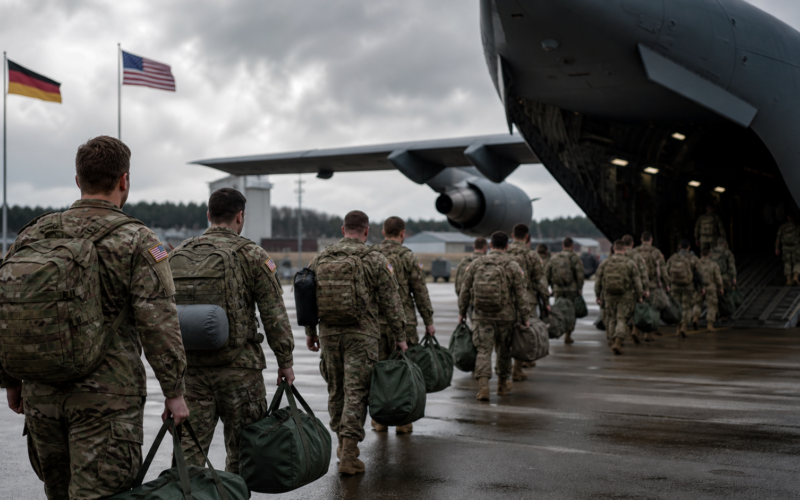
The United States has ordered the withdrawal of approximately 5,000 active-duty service members from Germany, with the drawdown to be completed within six to twelve months, the Pentagon confirmed on Friday. The decision, communicated by Defense Secretary Pete Hegseth and announced by Chief Pentagon Spokesman Sean Parnell, comes amid an escalating personal and policy dispute between United States President Donald Trump and German Chancellor Friedrich Merz over Washington’s ongoing war with Iran.
In a brief statement, Sean Parnell said the decision followed a thorough review of the Department of Defense’s force posture in Europe and reflected current theater requirements and conditions on the ground. The Pentagon said the redeployment would touch one brigade combat team currently stationed in Germany and would also cancel the planned forward deployment of a long-range fires battalion that the Joe Biden administration had earmarked for Germany later this year. Some withdrawn personnel are expected to return to the continental United States before being reassigned, with several reportedly to be redirected toward the Indo-Pacific theater and homeland defense priorities.
Germany currently hosts approximately 36,400 active-duty United States military personnel, more than any other country in Europe and second worldwide only to Japan. The 5,000 figure represents about fourteen percent of the in-country force. According to United States Defense Manpower Data Center figures cited by news organisations, Germany also hosts roughly 1,500 reservists and around 11,500 civilian Department of Defense employees. The withdrawal will return the United States footprint in Germany to roughly pre-2022 levels, before the post-invasion reinforcement triggered by the Russian war in Ukraine.
How does Friedrich Merz’s “humiliated” remark on Iran connect to the United States troop drawdown decision in Germany?
The trigger for the decision is a series of public exchanges between Donald Trump and Friedrich Merz this week. Speaking to students in the German town of Marsberg on Monday, Friedrich Merz said the United States was being humiliated by Iranian leadership, particularly the Islamic Revolutionary Guard Corps, in negotiations to end the two-month-old war that began with United States and Israeli strikes on Iran on February 28. Friedrich Merz argued that Iranian negotiators had outmanoeuvred the White House team, that Washington lacked a convincing exit strategy, and that the conflict was inflicting direct damage on European economic output through energy disruption.
Donald Trump responded on Truth Social on Tuesday and Wednesday, accusing Friedrich Merz of misjudging the threat posed by Iran, suggesting the German chancellor focus instead on ending the Russia-Ukraine war and on what Donald Trump described as Germany’s broken economy. On Wednesday, Donald Trump indicated publicly that the United States was reviewing troop levels in Germany, with a determination to come within a short window. The Friday announcement converted that warning into policy. A senior Pentagon official, briefing reporters on condition of anonymity, said recent German rhetoric had been inappropriate and unhelpful and that the president was responding to counterproductive remarks from Berlin.
What does the United States troop withdrawal mean for NATO posture and Article 5 deterrence in Eastern Europe?
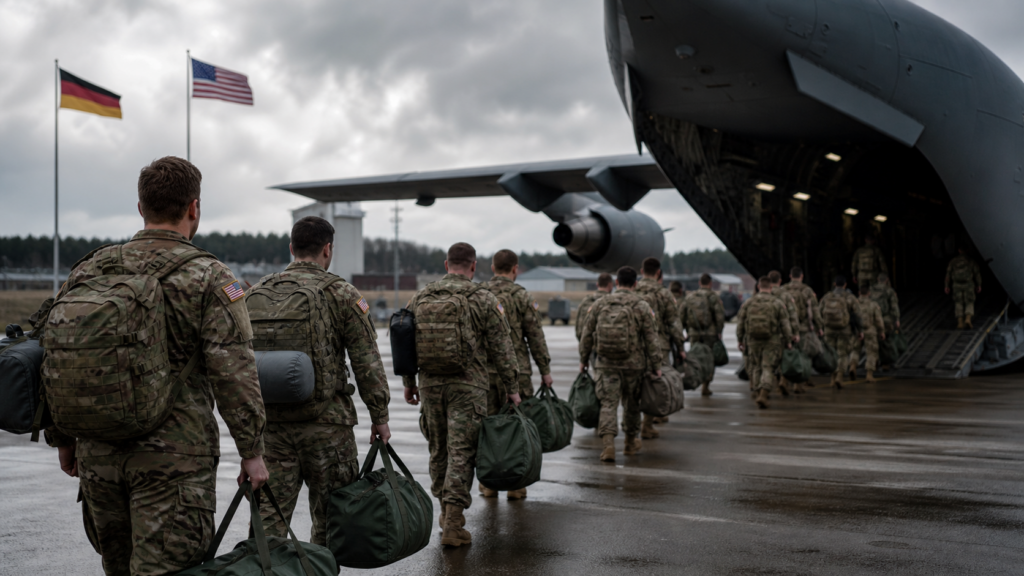
The drawdown lands at a sensitive moment for the North Atlantic Treaty Organisation. Around 80,000 to 100,000 United States personnel are typically present in Europe at any given time, depending on rotations and exercises. Allied governments have braced for an American pullback since Donald Trump returned to the White House, with Washington signalling that Europe must take greater responsibility for its own defence and for support to Ukraine. The 5,000-troop reduction in Germany is the most concrete step yet in that direction.
Germany hosts the headquarters of United States European Command and United States Africa Command, both based in Stuttgart, as well as Ramstein Air Base, the headquarters of United States Air Forces in Europe and a critical hub for airlift, airdrop and aeromedical evacuation operations across Europe, Africa and the Middle East. The Grafenwoehr Training Area is the United States Army’s largest training facility in Europe. Landstuhl Regional Medical Center, the largest American hospital outside the United States, sits alongside Ramstein and has treated personnel injured in the Iran war, including a United States airman wounded when his aircraft was shot down over Iranian territory. The Pentagon confirmed that medical evacuation operations and the Landstuhl mission would not be affected by the withdrawal.
The Senate Armed Services Committee’s ranking Democrat, Senator Jack Reed of Rhode Island, said the move suggested American commitments to allies were now contingent on the president’s mood and called on Donald Trump to halt what he described as a reckless action with potentially irreversible consequences for alliances and long-term national security. Bradley Bowman, a scholar at the Foundation for Defense of Democracies, said the United States military presence in Germany not only strengthened deterrence against further Kremlin aggression but also enabled the projection of American power into the Mediterranean, the Middle East and Africa.
How is Friedrich Merz’s response shaping Germany’s diplomatic posture toward the Donald Trump administration?
Friedrich Merz has so far avoided a direct public confrontation. Visiting Bundeswehr personnel at the Munster training area on Thursday, the German chancellor did not address the troop drawdown threat by name, instead emphasising the endurance of the transatlantic relationship. Friedrich Merz said Germany maintained close and trusting contact with partners in Washington on every major international issue, framing that engagement around mutual respect and a fair sharing of the burden. The remarks were widely read in Berlin as a deliberate attempt to lower the temperature without retreating from his earlier criticism of the Iran war.
German military officials, speaking to news organisations after the Wednesday signal from Donald Trump, expressed surprise at the announcement, citing what they described as constructive meetings with the Pentagon earlier the same day. They argued that Germany has done more than other European allies to support the United States campaign against Iran, including granting use of bases, permitting overflights and announcing the deployment of a Bundeswehr naval minesweeper to the Mediterranean Sea in preparation for any eventual operation to reopen the Strait of Hormuz once hostilities end. Friedrich Merz has also pledged further German participation in any post-war international stabilisation mission. Berlin’s official position remains that the United States troop presence serves both German and American interests by anchoring NATO security and providing a logistics platform for American forces operating across three continents.
Why does the 2026 National Defense Authorization Act limit how far Donald Trump can reduce United States forces in Europe?
The legal architecture around United States troop levels in Europe constrains the scope of any further drawdown. The 2026 National Defense Authorization Act, passed by the United States Senate last year, includes a provision that bars permanent reductions of United States forces in Europe below a floor of 75,000 personnel. With roughly 80,000 to 100,000 United States personnel typically in theatre, the 5,000-troop reduction in Germany sits within the legal envelope, but it narrows the cushion against the statutory minimum and complicates any additional cuts the Donald Trump administration may pursue elsewhere in Europe.
Donald Trump has already publicly floated reducing United States troop levels in Italy and Spain, citing what he described as their insufficient support for the Iran war. Italy hosted 12,662 active-duty personnel at the end of 2025, primarily across Vicenza, Aviano, Naples and Sicily, while Spain hosted 3,814 personnel. Earlier reporting indicated that a leaked Pentagon email had floated the idea of punitive force-posture changes against Spain and the United Kingdom over their leaders’ criticism of the Iran campaign. In October last year, the United States confirmed a reduction of 1,500 to 3,000 troops on NATO’s borders with Ukraine, a move that unsettled Romania, where the alliance operates an air base. A 2023 statute also prevents any United States president from withdrawing the country from NATO without the approval of the United States Congress, a guardrail that Donald Trump has tested rhetorically but not legally.
What does the United States troop drawdown signal about the future of transatlantic burden-sharing and European strategic autonomy?
The Friday decision reopens a debate that has shadowed the alliance for nearly a decade. Donald Trump first proposed a Germany drawdown during his first term, when he announced plans to remove around 9,500 of the then-34,500 United States troops in the country, citing low German defence spending and Berlin’s backing of the Nord Stream 2 gas pipeline. That plan was halted by Joe Biden shortly after his 2021 inauguration. Friday’s order revives the policy in a sharper geopolitical setting, with an active war in the Middle East, an unresolved Russian war on Ukraine that has now passed the four-year mark, and a European Union actively recalibrating its defence industrial base.
Former NATO Policy Director Fabrice Pothier told Euronews this week that the time had come for European leaders to think seriously about a Europe without the United States, citing what he described as a tiredness among European capitals with the negotiating tactics of the Donald Trump administration. Ed Arnold, a European security specialist at the Royal United Services Institute in London, said European governments were arguably more concerned about a separate United States redeployment of Patriot missile systems and ammunition stocks from Germany to the Middle East than about the headline troop figure. The Donald Trump administration has revoked sanctions on Russian oil in recent months, threatened to annex Greenland from Denmark, and publicly described NATO as a paper tiger for its refusal to enter the Iran war. Each move has compounded European doubts about the durability of the American security guarantee and accelerated quiet planning in Berlin, Paris and Brussels for a more autonomous European defence posture.
What are the key takeaways from the United States decision to withdraw 5,000 troops from Germany in 2026?
- The Pentagon, on instructions from Defense Secretary Pete Hegseth, has ordered the withdrawal of approximately 5,000 United States service members from Germany over the next six to twelve months, returning the in-country force to roughly pre-2022 levels.
- The drawdown affects one brigade combat team in Germany and cancels the planned deployment of a long-range fires battalion previously scheduled by the Joe Biden administration.
- Germany hosts approximately 36,400 active-duty United States personnel, the largest American military presence in Europe and second only to Japan globally.
- The decision follows public criticism from Chancellor Friedrich Merz, who said the United States was being humiliated by Iranian leadership and lacked an exit strategy in the two-month-old war that began on February 28.
- The 2026 National Defense Authorization Act prohibits permanent reductions of United States forces in Europe below 75,000 personnel, leaving limited statutory room for further drawdowns in Italy, Spain or other host nations.
Share this:
Discover more from Business-News-Today.com
Subscribe to get the latest posts sent to your email.