


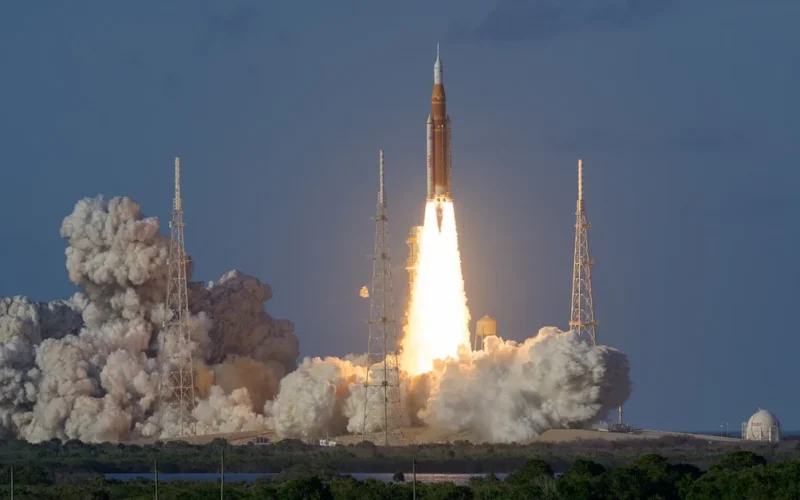
NASA’s Artemis II mission was more than halfway to the moon on Saturday, April 5, 2026, as the four-person crew aboard the Orion spacecraft completed final preparations for a historic lunar flyby scheduled for Monday, April 6. Launched from Kennedy Space Center in Florida on April 1, 2026, the mission is on course to break the human spaceflight distance record that has stood since April 1970, when the Apollo 13 crew set the mark under emergency conditions following a catastrophic onboard failure.
The Artemis II crew consists of NASA astronauts Reid Wiseman, serving as mission commander, Victor Glover, serving as pilot, and Christina Koch, serving as mission specialist, along with Jeremy Hansen of the Canadian Space Agency, serving as mission specialist. The four astronauts are the first humans to travel toward the moon since the Apollo 17 crew departed from the lunar surface in December 1972. No human being has traveled beyond low Earth orbit in the 53 years since the conclusion of the Apollo program.
How did the Artemis II Orion spacecraft begin its journey to the moon from Kennedy Space Center?
The Space Launch System rocket carrying the Artemis II Orion spacecraft lifted off from Launch Complex 39B at Kennedy Space Center at 6:35 p.m. EDT on April 1, 2026. The Space Launch System flew for only the second time in its operational history on this mission, following an uncrewed test flight under the Artemis I designation in November 2022. After completing two orbits of Earth during which the crew verified spacecraft systems, the astronauts executed a translunar injection burn on the evening of April 2, committing Orion to its lunar trajectory. The spacecraft entered what NASA describes as a free-return trajectory, a flight path shaped by orbital mechanics and lunar gravity that will bring the capsule around the moon and direct it back toward Earth without requiring significant additional propulsion.
How far will the Artemis II crew travel from Earth and what Apollo 13 record are they breaking?
Artemis II is expected to reach a maximum distance of approximately 252,757 miles from Earth at 7:05 p.m. EDT on Monday, April 6. That figure surpasses the standing human spaceflight distance record of 248,655 miles set by the Apollo 13 mission in 1970. The Artemis II crew is projected to exceed the Apollo 13 record by approximately 4,100 miles.
The circumstances of Apollo 13’s record give the milestone added historical resonance. The Apollo 13 mission launched in April 1970 with the intention of placing astronauts on the lunar surface. An oxygen tank rupture in the service module forced the crew to abandon the planned landing, use the lunar module as a lifeboat, and complete an emergency return to Earth. The record distance the Apollo 13 crew reached was an artifact of that aborted trajectory, not an intended achievement. That unplanned record has remained unbroken for 56 years. The Artemis II crew will surpass it under planned mission parameters.
What will the Artemis II crew do during the six-hour lunar flyby on April 6, 2026?
The lunar flyby window is set to open at 2:45 p.m. EDT on April 6 and will last approximately six hours. As the Orion capsule swings around the moon, the crew is expected to travel farther from Earth than any humans have before. During the flyby, the crew’s main cabin windows will be positioned toward the moon, giving the astronauts the opportunity to make scientific observations and photograph lunar surface features.
The crew is scheduled to apply geological observation skills to photograph and describe impact craters, ancient lava flows, and surface cracks and ridges formed as the moon changed over time. The astronauts will note differences in colour, brightness, and texture that can help scientists understand what the lunar surface is made of and how it formed.
Why is the lunar far side scientifically significant and what will Artemis II astronauts observe there?
The far side of the moon is markedly different from its near side. The far side has far fewer of the vast lava flows that characterise the near side’s surface, but it has a thicker crust and many more impact craters. Even the Apollo program’s crews were unable to observe much of the lunar far side directly, because the orbital geometry of those missions confined observation windows to near-side and limb terrain. The Artemis II crew memorised 15 distinctive features on the moon before launch to help them stay oriented throughout the flight. Among the scientifically significant targets is the Orientale basin, which Apollo crews never saw and which the Artemis II astronauts will be the first humans to observe directly.
Toward the end of the flyby window, the crew will experience a solar eclipse from space. The sun will move behind the moon at 8:35 p.m. EDT, blocking its light from the perspective of the Orion capsule, with the eclipse lasting almost an hour. During that time, the moon will appear mostly dark, giving the astronauts a chance to observe the sun’s corona and look for flashes of light from rocky objects striking the moon. The crew will lose communication with mission control in Houston during their passage around the far side of the moon, with the blackout expected to last anywhere from 30 to 50 minutes.
Who are the Artemis II astronauts and what historic firsts does this crew represent?
Jeremy Hansen of the Canadian Space Agency is the first non-American astronaut to travel to the moon. The Canadian Space Agency held a live televised linkup with Hansen on Saturday, April 4, with agency president Lisa Campbell telling reporters that Hansen was making history for Canada. Hansen said in the linkup that he had already witnessed views from the Orion capsule that he described as extraordinary.
Christina Koch is the first woman to travel to the moon. Victor Glover is the first Black astronaut to travel beyond low Earth orbit toward the moon. Reid Wiseman is the oldest person to travel beyond low Earth orbit in the Artemis context. Wiseman, Glover, and Koch are International Space Station veterans. Hansen is on his first spaceflight.
How does the Artemis program’s multinational framework compare to the Apollo program and China’s lunar ambitions?
The multinational character of the Artemis program distinguishes it structurally from the Apollo program, which was an entirely American enterprise. The Artemis program flies under the flag of 60 countries, signatories to the Artemis Accords, an international pact whose members have committed to supporting the peaceful exploration of space and contributing funding, modules, and astronauts to the program. China has announced its intention to place astronauts on the moon by 2030. China and Russia agreed in 2021 to collaborate on a competing project designated the International Lunar Research Station, aimed at operational status by 2035. NASA and the United States government have framed the Artemis program in part as a response to China’s stated lunar ambitions, with the Artemis timeline targeting a crewed lunar landing before China reaches that milestone.
What happens after the Artemis II lunar flyby and when does the mission return to Earth?
Artemis II is specifically a test mission. The crew is not landing on the moon and will not enter lunar orbit. The flyby is a shakedown mission, test-flying the Orion spacecraft as essential preparatory work for achieving NASA’s broader lunar objectives. Following the flyby, the crew will make a four-day journey back to Earth using the moon’s gravity to redirect the Orion capsule homeward, negating the need for significant propulsion. The mission is scheduled to conclude with a parachute-assisted splashdown in the Pacific Ocean near San Diego, California, on April 10, 2026, after which the crew will be recovered by a United States Navy vessel.
NASA has stated its objective of landing two astronauts near the lunar south pole as early as 2028. The lunar south pole has been identified as a scientifically and strategically significant landing zone because orbital reconnaissance has confirmed the presence of water ice in permanently shadowed craters. That ice is considered a potential source of drinking water, oxygen, and rocket propellant capable of supporting a long-term human presence on the moon.
Key takeaways on what the Artemis II mission means for NASA, international space cooperation, and the future of human spaceflight
- Artemis II is the first crewed mission beyond low Earth orbit since Apollo 17 in December 1972 and the first crewed flight of the Orion spacecraft.
- The crew is expected to break the Apollo 13 human distance record of 248,655 miles, reaching a maximum of 252,757 miles from Earth on April 6, 2026, surpassing the 56-year-old mark by approximately 4,100 miles.
- The mission establishes several historic firsts: Jeremy Hansen is the first non-American to travel to the moon, Christina Koch is the first woman, and Victor Glover is the first Black astronaut to travel beyond low Earth orbit toward the moon.
- Artemis II is a test mission, not a landing attempt, designed to validate the Orion spacecraft under crewed deep-space conditions before a landing attempt planned as early as 2028.
- The Artemis program operates under the Artemis Accords with 60 signatory nations, positioning it as a multinational effort in direct strategic competition with China, which has announced ambitions to land astronauts on the moon by 2030.
Discover more from Business-News-Today.com
Subscribe to get the latest posts sent to your email.