
Cuba’s electricity crisis deepened after the country’s national grid suffered a partial collapse on Thursday, cutting power across large parts of eastern Cuba and intensifying public frustration after days of rolling blackouts in Havana and other areas.
The latest grid failure affected eastern provinces including areas from Guantánamo to Ciego de Ávila, leaving Santiago de Cuba and other communities without electricity. The disruption came as Cuba’s power system was already operating under severe strain because of fuel shortages, ageing power plants, weak grid resilience, and a broader economic crisis that has steadily eroded the island’s ability to maintain reliable electricity supply.
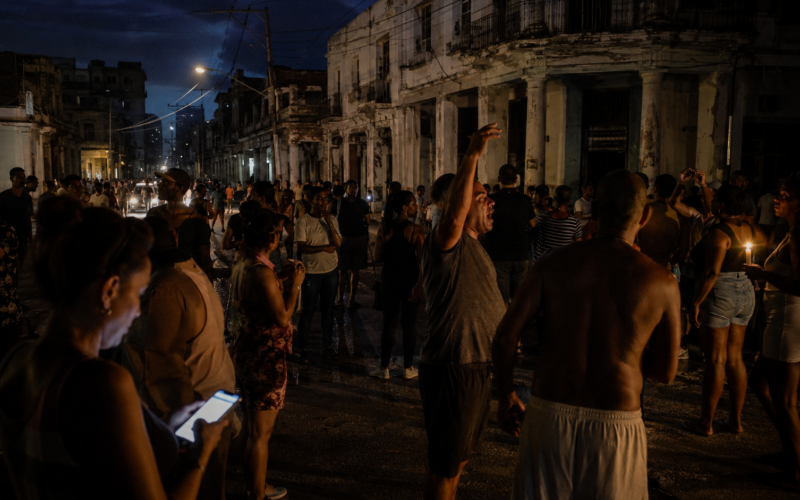
The blackout also came amid rare public protests in Havana, where residents in several neighbourhoods took to the streets after enduring long power cuts during hot weather. Demonstrators banged pots, blocked roads, and voiced anger over the collapse of basic services, while police were present in affected areas. The protests reflected a widening social pressure point for the Cuban government, which has been struggling to contain public frustration over electricity shortages, fuel scarcity, food spoilage, water disruption, and transport cuts.
Cuba’s Energy and Mines Minister Vicente de la O Levy said the country had run out of fuel oil and diesel reserves, leaving the national electric system in a critical condition. Cuban officials have blamed the worsening energy situation on restrictions affecting fuel imports, while the United States has maintained pressure on Havana over political and human rights issues. For ordinary Cubans, however, the immediate issue is simpler and harsher: refrigerators are failing, water pumps are stopping, homes are overheating, and daily life is being reorganised around an unreliable power grid.
Why did Cuba’s electrical grid suffer a partial collapse during the latest blackout crisis?
The partial collapse of Cuba’s electrical grid was not an isolated technical fault. It was the latest visible failure in an electricity system that has been weakened by years of underinvestment, fuel dependency, ageing generation units, and limited financial capacity to modernise infrastructure.
Cuba’s electricity system relies heavily on thermal power plants that need fuel oil and diesel for generation and backup operations. When fuel supplies tighten, the system loses the flexibility needed to balance demand, protect transmission stability, and respond to sudden generation losses. That makes grid failures more likely, especially during periods of high demand.
The latest disruption hit eastern Cuba at a moment when the national electric system was already forecast to face a large generation deficit during peak demand. Cuban officials had warned that the situation was particularly tense, with available generation falling short of what households, hospitals, businesses, and public services required.
A grid in that condition becomes vulnerable to cascading failures. If one generating unit goes offline, or if demand exceeds available supply, operators may be forced to cut electricity to protect the wider system. When those controls fail or capacity drops too sharply, entire regions can lose power. That appears to be the broader context behind Thursday’s partial collapse.
The failure also underlines why Cuba’s electricity crisis is no longer only an energy-sector problem. A partial grid collapse affects communications, refrigeration, water supply, healthcare, education, transport, and public order. In a country already facing economic pressure, every prolonged blackout multiplies the strain on households and institutions.

How are Havana protests changing the political pressure around Cuba’s power shortages?
The protests in Havana are significant because public demonstrations remain rare in Cuba, and energy shortages have become one of the most direct triggers of visible public anger. The latest protests were not framed around an abstract policy dispute. They were rooted in the daily realities of power cuts, heat, spoiled food, water shortages, and the exhaustion of families trying to work and sleep without electricity.
Residents in some areas of Havana reportedly faced outages lasting around a day, while other parts of the country have endured rolling blackouts for far longer. In practical terms, that means people are losing access to refrigeration, fans, internet connectivity, cooking routines, and pumped water in apartment buildings. When electricity disappears for extended periods, the blackout becomes a full civic disruption.
The protests also show how infrastructure failure can quickly become a governance test. Cuban authorities have long presented external pressure, especially United States sanctions and fuel restrictions, as a central reason for the country’s economic hardship. That argument remains central to the government’s position. But public anger tends to build around lived conditions, not diplomatic explanations.
The government now faces a difficult balancing act. It must preserve public order without appearing indifferent to hardship. It must restore electricity without adequate fuel reserves. It must explain the crisis while also managing the risk that more neighbourhoods may protest if blackouts continue through hotter months.
For Havana, the political sensitivity is especially high. Protests in the capital receive greater domestic and international attention than smaller local demonstrations. If electricity shortages persist, the blackout crisis could remain one of the most visible tests of state capacity in Cuba.
What role are fuel shortages playing in Cuba’s worsening electricity emergency?
Fuel shortages sit at the centre of Cuba’s power crisis because the island’s electricity system cannot operate reliably without imported fuel, backup fuel, and stable logistics. Cuba produces some domestic crude and uses natural gas, but domestic output is not enough to support the full economy or protect the national grid during periods of stress.
The government’s admission that fuel oil and diesel reserves had been exhausted marked a critical escalation. Fuel oil is essential for thermal power generation, while diesel supports backup generation, transport, logistics, and emergency systems. When both are scarce, the state has fewer tools to stabilise electricity supply or cushion the effect on public services.
The shortages have also exposed the limits of alternative energy deployment. Cuba has added some solar capacity, but solar generation cannot fully offset fuel shortages without sufficient storage, grid integration, and backup capacity. Solar power can reduce daytime demand pressure, but it cannot automatically solve evening peaks or prolonged shortages without battery systems and broader infrastructure investment.
Cuba’s energy crisis is therefore both immediate and structural. The immediate issue is the lack of fuel. The structural issue is an electricity system with limited redundancy, old generation assets, and high exposure to external fuel supply disruptions. That combination makes each new fuel shock more dangerous than the last.
The result is a crisis that cannot be fixed only by restoring one power line or restarting one plant. Cuba needs fuel, grid stability, generation capacity, and operational flexibility at the same time. That is a much harder problem than a normal blackout.
Why is Cuba blaming external pressure while the power grid faces internal weaknesses?
Cuban officials have blamed United States restrictions and the broader pressure campaign against Havana for the worsening energy situation. From the Cuban government’s perspective, limits on fuel shipments, financing constraints, and sanctions pressure have reduced the country’s ability to secure the energy imports needed to keep the grid functioning.
That argument is important because Cuba’s energy security has long depended on external suppliers. When fuel flows from allied or friendly countries weaken, the island has limited room to manoeuvre. If suppliers face pressure, shipping complications, financial risks, or diplomatic constraints, Cuba’s fuel position can deteriorate quickly.
At the same time, the crisis also reflects internal weaknesses. Cuba’s power plants are old, maintenance has been difficult, investment capacity is limited, and the national grid lacks the resilience needed to absorb repeated shocks. Even without external pressure, an ageing system with insufficient fuel and limited financing would be vulnerable to blackouts.
The most accurate reading is that Cuba’s crisis is not caused by a single factor. External pressure has tightened fuel access. Domestic infrastructure weaknesses have magnified the impact. Economic hardship has reduced the state’s ability to respond. Public frustration has risen because the consequences are now landing directly inside homes.
This is why the electricity emergency carries broader significance. It is not only about whether lights return after the latest blackout. It is about whether Cuba can rebuild enough energy stability to prevent recurring grid failures from becoming a permanent feature of national life.
How could the Cuba blackout crisis affect public services and everyday life?
The blackout crisis is already disrupting essential services across Cuba. Electricity cuts affect hospitals, clinics, schools, transport systems, food storage, water pumping, communications, and small businesses. In a fragile economy, even temporary outages can create lasting damage.
For households, the biggest immediate risks are food spoilage, heat stress, lack of water, and interrupted communication. For small businesses, blackouts can mean lost inventory, fewer operating hours, and weaker income. For hospitals and clinics, fuel shortages can strain backup systems and complicate non-emergency procedures. For schools and public transport, unreliable power and fuel shortages can force closures or service reductions.
The social impact is also cumulative. A single blackout is disruptive. Repeated blackouts lasting many hours become a psychological and economic burden. Families change sleeping patterns, workers lose productivity, and communities become more anxious about whether the next outage will last hours or days.
The protests in Havana show that the line between inconvenience and public anger has already been crossed in some neighbourhoods. If fuel shortages continue and grid stability worsens, the government may face repeated local flare-ups, especially in dense urban areas where heat, water supply, and food storage problems are more immediate.
Cuba’s blackout crisis therefore has a humanitarian dimension as well as a political one. Electricity is not only a utility. In a modern economy, it is the foundation of public health, food security, mobility, and social stability.
What happens next if Cuba cannot stabilise its national electric system?
The next phase of the crisis depends on whether Cuba can secure enough fuel and restore enough generation capacity to reduce the length and frequency of blackouts. If fuel deliveries resume and grid operators can stabilise supply, the immediate pressure may ease. But if fuel shortages continue, Cuba could face deeper service disruptions and more public protests.
The government’s first priority will be restoring electricity to affected regions and managing demand through controlled outages. That may prevent a wider collapse, but it will not resolve the underlying problem if available generation remains far below demand.
The second priority will be securing fuel. Without fuel oil and diesel, the grid will remain exposed to repeated failures. Cuba may seek additional support from allies, emergency shipments, or alternative financing arrangements, but those efforts will be shaped by sanctions pressure, shipping risks, and Cuba’s own financial constraints.
The third priority will be controlling the political fallout. The Havana protests suggest that public patience is thinning. The government will need to show that it can restore power, protect essential services, and prevent blackouts from becoming a daily crisis through the summer.
For the wider region, Cuba’s power crisis is a reminder that energy security remains a geopolitical issue in the Caribbean. Fuel access, sanctions policy, infrastructure resilience, and domestic stability are now tightly linked. When one fails, the consequences do not stay inside the electricity sector.
What are the key takeaways from Cuba’s partial grid collapse and blackout protests?
- Cuba’s national electric grid suffered a partial collapse on Thursday, cutting power across large parts of eastern Cuba.
- The outage affected eastern provinces including areas from Guantánamo to Ciego de Ávila, with Santiago de Cuba among the places hit by darkness.
- Havana saw protests after residents endured long power cuts, with demonstrators expressing anger over electricity shortages and worsening living conditions.
- Cuba’s Energy and Mines Minister Vicente de la O Levy said the country had exhausted fuel oil and diesel reserves.
- The crisis reflects both external pressure on Cuba’s fuel access and internal weaknesses in the country’s ageing power generation system.
Discover more from Business-News-Today.com
Subscribe to get the latest posts sent to your email.