
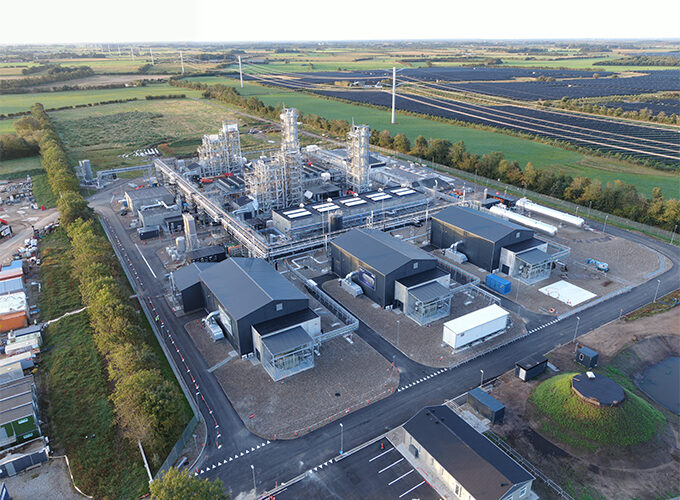
Mitsui & Co., Ltd. (Tokyo: 8031) and Danish renewables developer European Energy A/S said on 20 August 2026 that they had extended the customer base of the Kassø e-methanol facility in southern Denmark, adding Austrian integrated energy group OMV as the fourth named commercial buyer. OMV will take Kassø e-methanol classified as a Renewable Fuel of Non-Biological Origin under the European Union’s Renewable Energy Directive, for use as a land-based transportation fuel. The plant, operated by joint venture vehicle Solar Park Kassø ApS, in which European Energy holds 51 per cent and Mitsui 49 per cent, has an installed capacity of up to 42,000 tonnes a year and shipped its first commercial e-methanol to A.P. Moller-Maersk in May 2025. In the spring of 2026 the same plant began supplying LEGO Group for use in toy production and Novo Nordisk for use in pharmaceutical-related chemical products, and the OMV agreement now stretches the same 42,000-tonne asset across marine fuel, plastics feedstock, healthcare-related chemicals and RFNBO-compliant road fuel. The commercial tension for Mitsui shareholders is straightforward: Kassø is arithmetically small against a global methanol market of more than 100 million tonnes a year, so what matters is whether the four-vertical offtake mix, RFNBO certification and Nordea-SMBC bridge finance combine to prove a replicable Power-to-X template that Mitsui can scale rather than a one-off flagship.
What did Mitsui and European Energy actually announce about the Kassø e-methanol customer base?
The 20 August 2026 announcement was not a new tonnage expansion of the Kassø plant itself, but a widening of the commercial offtake profile around the existing 42,000-tonne-per-year facility. The plant is owned by Solar Park Kassø ApS, a subsidiary of Kassø MidCo ApS, the joint venture in which European Energy A/S holds 51 per cent and Mitsui & Co., Ltd. holds 49 per cent, an interest Mitsui acquired in mid-2023 and consolidated through 2024 and 2025 as the plant moved from construction to commercial operation. The facility, located in Kassø in Aabenraa Municipality in southern Denmark, produces low-carbon methanol by combining green hydrogen from an on-site electrolyser with biogenic carbon dioxide captured from biomass sources. The first commercial shipment left the plant in May 2025 bound for A.P. Moller-Maersk to be blended into marine bunker fuel. In the spring of 2026 the operating partners added the LEGO Group and Novo Nordisk as long-term buyers for chemical rather than fuel applications, and the OMV agreement disclosed on 20 August 2026 introduces the fourth named commercial destination in the form of land-based transport fuel. Mitsui said the OMV contract designates the delivered volumes as a Renewable Fuel of Non-Biological Origin under the European Union’s Renewable Energy Directive, a compliance category that OMV can use inside its European road-fuel obligations.

Why does the OMV RFNBO designation matter more than the added tonnage from Kassø’s fourth offtaker?
The tonnage story is the least interesting part of the OMV agreement, because the Kassø plant has a fixed 42,000-tonne annual capacity, and adding a fourth named buyer does not change the volume produced or shipped. The commercially important element is the RFNBO classification itself. Under the EU’s Renewable Energy Directive as revised for the 2021 to 2030 period, road-fuel suppliers in member states such as Germany face a rising quota for renewable fuels of non-biological origin, a category defined narrowly enough to exclude most bio-based and mass-balanced alternatives. RFNBO-certified molecules therefore command a compliance premium that structurally exceeds the price of merchant grey methanol produced from natural gas or coal, which is itself the pricing anchor for the roughly 100-million-tonne global methanol market. By moving Kassø volumes into a certified road-fuel channel, Mitsui and European Energy have shown that the plant’s output can access the highest-value pricing pool for e-methanol in Europe rather than being confined to voluntary decarbonisation contracts where price discovery is opaque and often driven by counter-party sustainability commitments. That is a meaningful validation for the next tranche of Power-to-X projects the two partners are considering, because it demonstrates that certified regulatory demand exists at a defined premium, not merely that voluntary buyers can be found.
How does the four-vertical customer mix change the risk profile of the world’s first commercial e-methanol plant?
The Maersk shipment in May 2025 established Kassø as the world’s first commercial-scale e-methanol supplier for marine fuel, a use case that had until then been demonstrated only at pilot scale. Adding LEGO Group in the spring of 2026 shifted a share of production into chemical and polymer feedstock, allowing the toy manufacturer to substitute a bio-based methanol input for fossil-derived precursors in its plastic supply chain. The Novo Nordisk contract, added in the same window, extended the plant into healthcare-related chemical applications where the customer’s own scope-three emission targets create a durable willingness to pay above grey methanol prices. The OMV agreement now anchors the fourth vertical of RFNBO-compliant land transport fuel. From a risk perspective this composition matters more than the cumulative tonnage. Four end markets with different regulatory and commercial drivers reduce the merchant-tail risk that would arise if the plant depended on a single buyer or a single application. Marine fuel demand tracks International Maritime Organization decarbonisation timelines, chemical demand tracks corporate scope-three commitments, and RFNBO road fuel demand tracks the EU Renewable Energy Directive quota schedule. Correlation across those three regimes is low, which is exactly the property lenders and equity partners look for in a Power-to-X project seeking long-term financing.
What does Kassø tell investors about Mitsui’s Global Energy Transformation 2.0 pillar in Medium-term Management Plan 2029?
Mitsui explicitly framed the Kassø development around what it now calls Global Energy Transformation 2.0, a designated key strategic initiative under Medium-term Management Plan 2029. The phrasing marks an evolution from the earlier Global Energy Transition banner used under Medium-term Management Plan 2026, when Mitsui first invested in Kassø in July 2023. The 2.0 formulation, per the company’s own description, is intended to signal that Mitsui is now building an integrated low-carbon energy portfolio in which e-methanol sits alongside its United States bio-methanol business, clean ammonia investments and its long-standing liquefied natural gas positions rather than being treated as a single-project experiment. For public equity investors, Global Energy Transformation 2.0 is the disclosure lens through which future Kassø-style commitments will be presented in earnings calls and integrated reports, and Kassø is now the reference asset that management can point to when explaining that the strategy has moved from investment thesis to commercial cash-flow generation, however small the initial volumes. The next practical test is how much of the Medium-term Management Plan 2029 capital allocation the Basic Materials Business Unit and the Integrated Energy Solutions Business Unit will direct into further RFNBO-eligible projects and whether Mitsui will disclose an aggregate Power-to-X pipeline figure in future results.
Where does the Nordea and SMBC bridge financing fit in the Kassø economic case for Mitsui and European Energy?
On 20 January 2026 European Energy A/S and Mitsui & Co., Ltd. said that they had secured a green-financing bridge facility from Nordea and SMBC for the joint venture behind the Kassø solar park and e-methanol plant, with a partial guarantee from EIFO, Denmark’s export and investment fund. The stated purpose was to optimise short-term liquidity while an active process to raise long-term project financing continued. That bridge is the disclosed capital layer that carried the plant through its ramp-up and through the addition of the LEGO Group, Novo Nordisk and OMV offtake contracts, all of which materially strengthen the bankability case that long-term lenders will underwrite. The next financial milestone for Kassø, and by extension for the Mitsui and European Energy joint venture, is therefore the conversion of the Nordea-SMBC bridge into a long-term project-financing structure. That conversion has not yet been disclosed, and its terms, tenor and pricing will be a more meaningful test of whether the four-vertical offtake profile plus RFNBO certification has re-rated the cost of capital available to commercial-scale e-methanol projects in Europe than any single new customer name. Kenichi Hori, president and chief executive officer of Mitsui & Co., Ltd., has continued to identify low-carbon methanol as a core building block of the group’s energy transition strategy, and Knud Erik Andersen, the co-founder and chief executive of European Energy A/S, has consistently described Kassø as the reference plant against which subsequent Power-to-X projects will be benchmarked.
How does the RED III compliance and German demand outlook shape pricing power for RFNBO-certified e-methanol?
Mitsui specifically flagged that demand for e-methanol is expected to expand across Europe, especially in Germany, driven by policy frameworks such as the Renewable Energy Directive in its RED III form. Germany’s national transposition of the directive establishes rising sub-quotas for RFNBO in road transport, which fuel suppliers can only fulfil with certified molecules produced from renewable electricity and non-biogenic pathways that meet strict additionality and greenhouse gas savings thresholds. The pool of European projects able to deliver RFNBO-certified e-methanol at commercial scale is currently very narrow, which is why the OMV contract carries strategic significance disproportionate to the volume. For OMV, securing supply from an operating commercial plant with a validated certification pathway is preferable to relying on projects still under construction or subject to final investment decision, given the near-term compliance timetable. For Mitsui and European Energy, that same scarcity translates into pricing power for the incremental Kassø tonne that had until now been sold into voluntary decarbonisation contracts where the premium was negotiated rather than regulator-anchored. The forward question is how quickly competing European e-methanol projects, including those being developed by ENGIE and European Energy under a separate large-scale renewable hydrogen cooperation announced for Denmark, come online and compress that scarcity premium.
What does Kassø signal about Mitsui’s broader positioning across bio-methanol, clean ammonia and LNG value chains?
Mitsui’s positioning in Kassø sits inside a broader low-carbon fuels portfolio that already includes a United States bio-methanol business, a series of clean ammonia investments across Asia and the Middle East and long-established LNG interests. The strategic logic Mitsui has articulated is that different decarbonisation pathways will win in different applications, with clean ammonia favoured for co-firing and specific marine segments, bio-methanol suited to applications where waste-derived feedstock economics are favourable, and e-methanol positioned where existing methanol infrastructure and regulatory compliance drive demand. Kassø’s commercial validation reinforces the e-methanol leg of that framework without displacing the others. For Mitsui shareholders this matters because the general trading house model depends on optionality across value chains, and demonstrating that any one low-carbon fuel leg can move from investment to commercial cash flow with a diversified customer base increases the credibility of the whole portfolio. It also positions Mitsui as one of the small number of trading and investment groups globally that has taken direct equity in an operating commercial-scale Power-to-X asset, alongside Japanese peers Sumitomo Corporation, Mitsubishi Corporation and Marubeni Corporation, each of which is pursuing its own configuration of hydrogen, ammonia and synthetic-fuel investments.
Where does Mitsui’s share price and buyback stand as it builds its low-carbon methanol supply base?
Mitsui & Co., Ltd. shares closed at 4,845.00 Japanese yen on the Tokyo Stock Exchange on 20 August 2026, up 1.49 per cent on the session, with the stock 0.48 per cent higher over five trading days and 4.42 per cent higher year to date. The mean consensus rating from 13 analysts covering the stock is Outperform, with an average 12-month target price of 6,162.31 yen, implying a published spread of 29.08 per cent to the reference close. On 4 August 2026 Mitsui reported fiscal first-quarter attributable profit up 53 per cent for the three months ended 30 June 2026 and provided consolidated earnings guidance for the full year ending 31 March 2027. On the same day Mitsui authorised a buyback plan of up to 60 million shares, representing about 2.11 per cent of shares outstanding, for a maximum consideration of 200 billion yen. An interim dividend of 70 yen per share is scheduled with an ex-dividend date of 29 September 2026. Mitsui carries an MSCI ESG rating of AA. Kassø does not by itself move the earnings picture at group level, given that Mitsui reported group attributable profit measured in hundreds of billions of yen for the quarter and Solar Park Kassø ApS accounts for a very small share of consolidated income. Its relevance for the market layer is instead as an execution proof point that supports the multiple applied to Mitsui’s Basic Materials and Integrated Energy Solutions segments, both of which are among the most direct beneficiaries of a demonstrated commercial pathway for low-carbon methanol.
What should investors track next as Mitsui and European Energy scale the Kassø e-methanol template beyond Denmark?
- Mitsui & Co., Ltd. and European Energy A/S expanded the commercial customer base of the Kassø e-methanol plant on 20 August 2026, adding OMV as the fourth named offtaker after A.P. Moller-Maersk, the LEGO Group and Novo Nordisk.
- The OMV agreement designates the volumes as a Renewable Fuel of Non-Biological Origin under the EU Renewable Energy Directive, which opens the higher-priced European road-fuel compliance market rather than adding tonnage.
- Solar Park Kassø ApS, owned 51 per cent by European Energy and 49 per cent by Mitsui, operates a plant with capacity of up to 42,000 tonnes a year, small against a global methanol market above 100 million tonnes.
- The four-vertical offtake mix across marine fuel, plastics feedstock, healthcare-related chemicals and RFNBO road fuel materially de-risks the merchant tail on the world’s first commercial-scale e-methanol plant.
- Kassø is now the reference asset for Mitsui’s Global Energy Transformation 2.0 initiative under Medium-term Management Plan 2029, evolving from the Global Energy Transition banner of the earlier Medium-term Management Plan 2026.
- The next financial catalyst is the conversion of the January 2026 Nordea and SMBC green-financing bridge, guaranteed in part by EIFO, into a long-term project-financing structure whose pricing will test how the offtake mix has re-rated the cost of capital.
- The RED III framework and German road-fuel sub-quotas provide the regulatory demand backbone, but the scarcity premium for RFNBO-certified e-methanol will compress as competing European projects reach commercial operation.
- Mitsui’s Basic Materials and Integrated Energy Solutions segments are the most direct earnings beneficiaries of a proven e-methanol template, complementing existing United States bio-methanol, clean ammonia and LNG portfolios.
- Mitsui shares closed at 4,845 yen on 20 August 2026 with a 13-analyst Outperform consensus and an average target of 6,162.31 yen; the company authorised a 200-billion-yen buyback covering 60 million shares on 4 August 2026 alongside a 53 per cent jump in fiscal first-quarter attributable profit.
- The thesis strengthens if Mitsui discloses additional RFNBO-eligible Power-to-X commitments and secures term financing at competitive spreads, and weakens if new European e-methanol capacity compresses the compliance premium faster than the joint venture can lock in long-dated offtake pricing.
Discover more from Business-News-Today.com
Subscribe to get the latest posts sent to your email.