


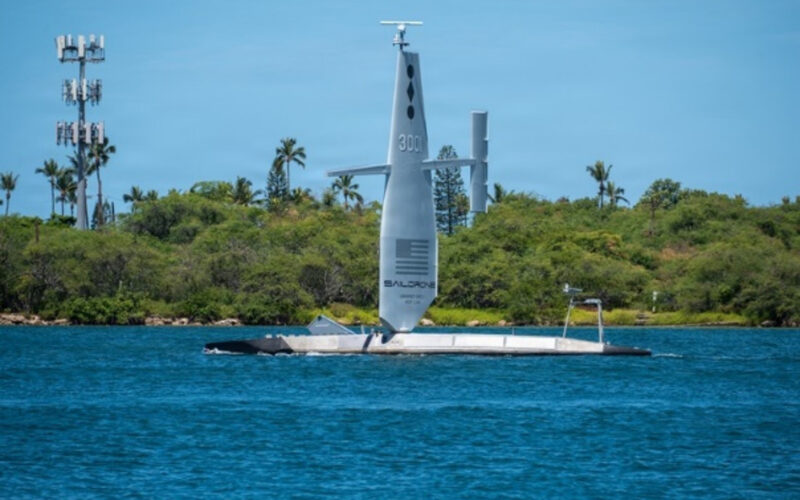
Lockheed Martin Corporation (NYSE: LMT) and privately held Saildrone, Inc. have completed the first live missile launches from a Saildrone unmanned surface vessel, firing two AGM-179 Joint Air-to-Ground Missiles from a 65-foot Saildrone Surveyor during the United States Navy’s Rim of the Pacific 2026 exercise off Hawaii. The Surveyor operated under the Navy’s Fleet Experimentation Program in coordination with the USS Theodore Roosevelt (CVN-71) Carrier Strike Group-9, engaging a surrogate high-speed surface craft using the Navy’s Adjunct Remote Engagement System, known as ARES. Lockheed Martin said the demonstration moved from concept to live fire in six months, drawing on the strategic partnership the two companies signed in October 2025 alongside a $50 million Lockheed Martin investment in Saildrone. For Lockheed Martin’s Missiles and Fire Control segment, the shot doubles as proof that its containerised weapons doctrine can be bolted onto a commercial autonomous hull inside a compressed defence procurement window. The tension for investors is not the two missiles fired, but whether that six-month timeline, and the roadmap to the larger Saildrone Spectre carrying the Mk70 vertical launcher, converts into a durable programme-of-record revenue stream rather than a one-off experimentation win.
What did Lockheed Martin and Saildrone actually demonstrate at RIMPAC 2026 and why does it matter now?
The event, disclosed on 20 August 2026, was the first time a Saildrone platform has launched a live weapon. The 20-metre Surveyor, hull number SD-3001, carried a custom JAGM Quad Launcher designed by Lockheed Martin, capable of holding four AGM-179 missiles, and departed Joint Base Pearl Harbor-Hickam earlier in the RIMPAC 2026 at-sea phase. During the demonstration, the Surveyor was integrated with ARES, a remotely operated combat system, and acted on targeting data associated with a surrogate high-speed surface craft while a manned Carrier Strike Group provided command-and-control context. The vessel also carried a passive electronic warfare sensor and, working with an MH-60 helicopter, detected, classified and identified a surrogate threat radar during the same multi-domain window.
The significance lies less in the two rounds themselves and more in the operating architecture around them. A commercial-derived autonomous hull, until now used for intelligence, surveillance, reconnaissance and ocean-mapping missions, was slotted into a live carrier strike group engagement pattern using an existing Navy fire-control system and an existing tactical missile. That combination is exactly what the Navy has told industry it wants under its hybrid fleet vision, and Lockheed Martin is now the first prime contractor able to show that combination working end to end.

How does the JAGM Quad Launcher change the Saildrone Surveyor’s mission profile?
The AGM-179 is the successor to the AGM-114 Hellfire, with a modernised seeker and a track record on Apache and other rotary-wing platforms. Lockheed Martin has proposed the same missile for counter-unmanned aerial system roles aboard American guided-missile destroyers and littoral combat ships, particularly against Houthi one-way attack drones seen in the Red Sea. The Saildrone Surveyor gives that missile a persistent, low-cost, minimally staffed surface node from which to engage, without tying up a destroyer or a Zumwalt-class hull.
Saildrone founder and chief executive Richard Jenkins described the demonstration as pairing one of the most tried and trusted munitions with the most operationally deployed class of unmanned surface vessel. Saildrone’s own operating log supports the operational claim: the fleet has clocked more than 130,000 nautical miles over 2,700 cumulative mission days, with 116,000 unique contacts detected in one recent deployment window alone. First deployed with the Navy in 2021, Saildrone platforms are already operating alongside Navy sailors in multiple combat theatres. What was missing until RIMPAC 2026 was a kinetic layer. That layer now exists, in a form that can be replicated across additional Surveyor hulls without redesigning the underlying vessel.
Why is the six-month concept-to-fire timeline the most important number in this story?
The Navy’s traditional acquisition cycle for a new weapon-platform pairing runs on multi-year timelines shaped by requirements documents, milestone reviews and full-and-open competition. Lockheed Martin has framed the RIMPAC integration as taking six months from partnership signature to live fire, which is a material compression against that norm. Paul Lemmo, vice president and general manager for sensors, effectors and mission systems at Lockheed Martin, said the two companies would continue to invest in new capabilities ahead of need to accelerate and de-risk deployment of urgently needed defence technologies.
Investors should read that carefully. The phrase ahead of need is a signal that Lockheed Martin is now willing to underwrite pre-production integration work using its own balance sheet, in exchange for first-mover position when the Navy converts experimentation dollars into programme-of-record dollars. The company’s $50 million equity investment in Saildrone in October 2025 was the down payment on that model. The six-month execution against that investment is the first evidence that the operating model works in practice, not only in press releases. If the Navy rewards that speed with sole-source or limited-competition procurement decisions on subsequent unmanned surface vessel weapons integrations, the return calculus on the Saildrone stake improves meaningfully. If instead the Navy runs full-and-open competitions in which Lockheed Martin’s early work becomes a shared industry baseline, the return calculus is thinner.
What does Lockheed Martin’s $50 million Saildrone investment look like after the first live-fire dividend?
Lockheed Martin’s October 2025 investment in Saildrone was announced as a strategic partnership rather than a minority equity investment in the way private-market participants would frame it, but the effect is comparable. The investment locked in an integration pathway across Saildrone’s Surveyor platform for the JAGM Quad Launcher, and set out the roadmap for larger integrations on the Spectre, the company’s largest unmanned surface vessel at 52 metres, which is designed to carry containerised mission payloads.
For Lockheed Martin, the investment is small in absolute terms against a group with 2025 revenue of $75.05 billion and full-year earnings of about $5.02 billion. It is, however, structurally significant as the template for how Lockheed Martin plans to insert itself into commercial-defence unmanned platform partnerships across sea, air and ground. Saildrone, for its part, gains a defence prime whose contracting relationships, integration engineering base and combat-system integration capability would take years to replicate internally. The two companies’ shared statement that the RIMPAC demonstration is the first in a planned series of integrations ahead of Spectre suggests the partnership is intended to be a multi-year deployment rather than a one-off experiment.
How much does the Saildrone Spectre and the Mk70 VLS matter to Lockheed Martin’s real financial upside?
The Surveyor firing a JAGM is the headline. The Spectre carrying a Mk70 vertical launching system is the money. The Mk70 is a containerised four-cell version of the Mk 41 VLS and can, in principle, fire the same family of standard missiles carried by American cruisers and destroyers, including Tomahawk Block V land-attack cruise missiles and SM-6 dual-purpose missiles. Placing those weapons on an unmanned 170-foot autonomous hull that can persist at sea for extended windows changes the economics of distributed maritime fires. Fleet-defence and long-range strike capability begin to detach from crewed hull availability.
Lockheed Martin has already positioned the Spectre in the Navy’s Medium Unmanned Surface Vessel competition alongside Fincantieri. Construction of the first Spectre is expected to begin shortly, with sea trials for the first vessel scheduled for early next year according to earlier company statements. The RIMPAC live fire de-risks the smaller-scale integration case for the Surveyor, which in turn de-risks the more ambitious integration case for the Spectre. Investors weighing Lockheed Martin’s unmanned maritime narrative should track the Medium USV downselect timing, the pace of Spectre construction and any confirmed integration testing of the Mk70 on Spectre. Those milestones, not the two JAGM rounds, will drive whether the segment generates a durable revenue stream.
Where does this fit inside the Missiles and Fire Control segment growth story alongside PAC-3, Patriot and THAAD?
Lockheed Martin’s Missiles and Fire Control segment is already the group’s fastest-growing division on the back of a stack of large contracts. On 29 July 2026, the United States government awarded Lockheed Martin a seven-year undefinitized contract action modification for up to $53.86 billion for PAC-3 missiles. The Army followed with a Patriot interceptor production contract worth up to $58.62 billion, described as a record award for the programme. On 17 August 2026, Lockheed Martin secured a $211.44 million Missile Defense Agency contract modification. The Department of War has separately signalled plans to sharply increase production of Patriot and THAAD interceptors in response to global demand and recent combat use.
Against that backlog, a demonstration involving two JAGM missiles is arithmetically immaterial. Strategically, however, it extends the segment’s optionality. Every additional operational platform that can carry a Lockheed Martin missile enlarges the addressable market for that missile without new development spending. The RIMPAC event demonstrates that the Saildrone Surveyor is now, at least in principle, a JAGM firing platform. If Navy operational testing continues to validate the pairing, incremental JAGM orders can be sized against a broader launch-platform base than before. That is a growth multiplier for the segment, layered on top of the existing air-launch demand from Apache and future rotary-wing programmes.
How is the market currently valuing Lockheed Martin and what could shift the read?
Lockheed Martin shares closed at $607.17 on 18 August 2026, having risen 2.26 per cent in the session, according to StockInvest.us. That leaves the stock up about 3 per cent across the prior fortnight and gives Lockheed Martin a market capitalisation of roughly $140 billion on 230.79 million shares outstanding at the mid-August share price cited by WallStreetZen. The 12-month analyst average price target sits at $632.95, implying an upside of about 7.4 per cent, with the consensus recommendation classified as Hold across 21 analysts covering the stock. Citi raised its price target to $691 from $641 on 15 August 2026, keeping a Buy rating in place ahead of the RIMPAC disclosure.
Next scheduled earnings are on 20 October 2026. The RIMPAC live fire, together with the recent PAC-3 and Patriot awards and the Missile Defense Agency modification, all land within the same reporting quarter. Investors should watch whether management uses the third-quarter print to formally tie the Saildrone partnership into forward Missiles and Fire Control revenue guidance, or whether it remains labelled as an experimentation initiative. The rerating case for Lockheed Martin will lean on how tightly management links Missiles and Fire Control growth to specific new launch-platform integrations, including unmanned surface vessels. The de-rating case would emerge if Medium USV competition timelines slip, if the Spectre construction schedule drifts, or if the Navy elects to run a full-and-open competition rather than sole-source subsequent JAGM Quad Launcher integrations.
What are the specific proof points and risks investors and analysts should track from here?
The RIMPAC live fire strengthens Lockheed Martin’s unmanned maritime pitch in several ways. It converts an announced partnership into an operational proof. It shows that a commercial-derived autonomous hull can be integrated with a Navy combat system and a carrier strike group inside a compressed window. It validates the $50 million Saildrone investment as an execution vehicle, not just a strategic option. It positions Lockheed Martin as the incumbent integrator for future JAGM Quad Launcher work across additional Saildrone hulls and for the higher-value Mk70 integration on Spectre. It also gives Missiles and Fire Control an additional narrative for its already elevated backlog, at a moment when investors are trying to distinguish between defence primes with durable growth stories and those benefiting from a cyclical rearmament wave alone.
The weaknesses run in the other direction. The two JAGM rounds fired at RIMPAC do not by themselves constitute a programme of record. Saildrone remains private, so scale and pace of production remain outside Lockheed Martin’s direct control. The Spectre has not yet begun sea trials, and construction schedules for novel hulls slip more often than they hold. The Mk70 integration on the Spectre remains a stated intent rather than a demonstrated capability. The Medium USV competition outcome is not yet decided, and Lockheed Martin faces credible competitors. Any future Navy decision to compete follow-on JAGM Quad Launcher integrations openly would compress margins on what Lockheed Martin might otherwise treat as sole-source work. The upside case therefore rests on Spectre construction milestones, Medium USV downselect, further live-fire demonstrations, formal programme-of-record decisions on the Surveyor JAGM configuration, and the tone of Missiles and Fire Control commentary from Lockheed Martin management on the 20 October 2026 earnings call.
What should investors track next as Lockheed Martin converts the RIMPAC live fire into Spectre and Mk70 milestones?
- Two AGM-179 Joint Air-to-Ground Missiles fired from a 65-foot Saildrone Surveyor at RIMPAC 2026 marked the first live missile launches from any Saildrone platform, coordinated with the USS Theodore Roosevelt Carrier Strike Group-9 under the Navy’s Fleet Experimentation Program.
- The Surveyor was integrated with the Navy’s Adjunct Remote Engagement System, ARES, and acted on targeting data associated with a surrogate high-speed surface craft, giving Lockheed Martin its first operational proof of a commercial-derived unmanned surface vessel firing a live weapon inside a carrier strike group construct.
- Lockheed Martin said the demonstration moved from concept to live fire in six months, a material compression against traditional Navy acquisition cycles and the strongest single argument in the company’s ahead-of-need investment doctrine.
- The demonstration follows a strategic partnership signed in October 2025 that included a $50 million Lockheed Martin investment in Saildrone, giving Lockheed Martin the integration pathway for the JAGM Quad Launcher on the Surveyor and a roadmap toward the larger Saildrone Spectre with containerised Lockheed Martin payloads.
- The real financial upside sits with the Spectre, a 52-metre unmanned surface vessel designed to carry the Mk70 vertical launching system, which can in principle fire Tomahawk and SM-6 class missiles from an unmanned hull.
- Lockheed Martin has positioned the Spectre in the Navy’s Medium Unmanned Surface Vessel competition alongside Fincantieri, with construction of the first Spectre expected to begin shortly and first sea trials scheduled for early next year according to earlier company statements.
- The Missiles and Fire Control segment is already carrying a record backlog after the $53.86 billion PAC-3 undefinitized contract action modification on 29 July 2026, the $58.62 billion Patriot production award and the $211.44 million Missile Defense Agency modification on 17 August 2026, alongside signalled increases in THAAD production.
- Lockheed Martin closed at $607.17 on 18 August 2026 with a market capitalisation of roughly $140 billion, a Hold consensus across 21 analysts, an average 12-month price target of $632.95 implying upside of about 7.4 per cent, and a Citi price target lifted to $691 with a Buy rating on 15 August 2026.
- The next scheduled earnings release on 20 October 2026 is the first formal opportunity for Lockheed Martin management to link the Saildrone partnership into forward Missiles and Fire Control revenue guidance rather than leaving it framed as experimentation.
- The bull thesis strengthens on a Medium USV downselect that includes Spectre, on-schedule Spectre construction, a successful Mk70 live-fire demonstration and formal programme-of-record decisions on the Surveyor JAGM configuration; the thesis weakens on Medium USV slippage, Spectre construction delays, open competitions for follow-on JAGM Quad Launcher integrations, or muted Missiles and Fire Control commentary on 20 October.
Discover more from Business-News-Today.com
Subscribe to get the latest posts sent to your email.
