


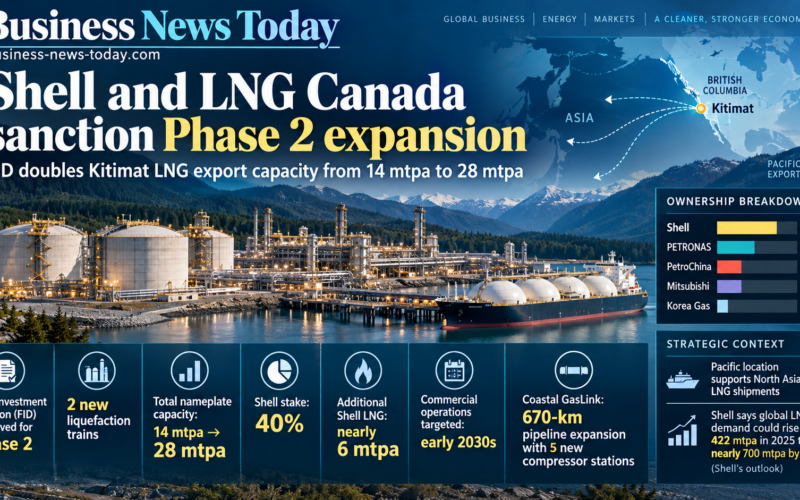
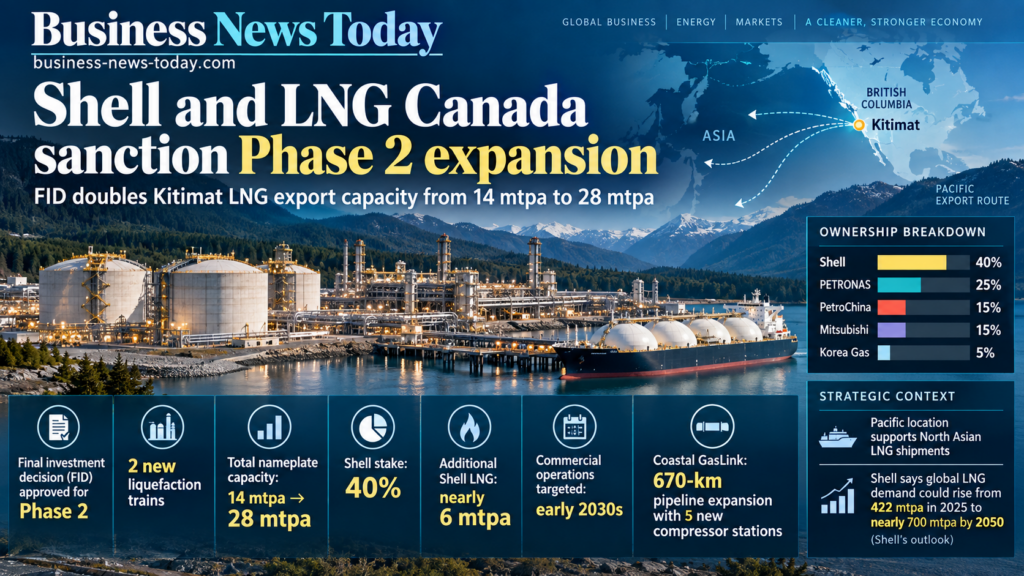
Shell plc (LSE: SHEL; NYSE: SHEL) and its LNG Canada partners have taken final investment decision on Phase 2 of the Kitimat export facility in British Columbia, committing to add two liquefaction trains and double total nameplate production capacity from 14 million tonnes per annum to 28 mtpa. Shell owns 40% of LNG Canada and expects to receive nearly 6 mtpa of additional LNG from the expansion, with commercial operations targeted for the early 2030s.
The ownership structure remains Shell at 40%, PETRONAS at 25%, PetroChina Company Limited at 15%, Mitsubishi Corporation at 15% and Korea Gas Corporation at 5%. LNG Canada operates through an equity-lifting model, meaning each partner is responsible for bringing its share of natural gas to the plant and taking away its proportionate LNG production rather than selling all output through one central marketing company.
Why is FID materially different from the earlier LNG Canada Phase 2 planning work?
Final investment decision is the point at which project partners move from evaluating an expansion to formally committing capital under an approved development framework. That distinction is critical in LNG because proposed projects often spend years in permitting, engineering and commercial discussions without ultimately reaching construction.
Phase 2 has now crossed that threshold. Shell’s September 29 announcement says two additional trains will be added at the existing Kitimat site together with another LNG storage tank, condensate tank, loading berth and expanded utility and process systems. Coastal GasLink will also expand the capacity of its existing 670-kilometre pipeline through five additional compressor stations.
The project is therefore not simply adding liquefaction equipment. The entire gas-delivery, storage and marine-export chain has to accommodate twice the LNG capacity, which is why expansion economics extend well beyond two new trains.
How much additional LNG will Shell actually control from Phase 2?
The expansion adds approximately 14 mtpa of project capacity. Applying Shell’s 40% ownership to that incremental capacity gives 5.6 mtpa, consistent with Shell’s description that it will receive nearly 6 mtpa of additional LNG.
That volume becomes strategically important because Shell markets one of the world’s largest LNG portfolios and can optimise cargoes across customers, geography and seasonal demand rather than treating its equity production as tied to one destination.
LNG Canada’s Pacific location is particularly useful for Asian markets. Cargoes from British Columbia can reach North Asian buyers without transiting the Panama Canal or sailing from the US Gulf Coast, giving the project a different shipping position from many competing North American LNG developments.
The commercial opportunity still depends on future LNG prices and demand. Shell says it expects Phase 2 to generate double-digit returns and exceed the hurdle rate for its Integrated Gas business, but those are management expectations rather than guaranteed realised returns.
Why does Shell see Asian demand as strong enough to justify another 14 mtpa?
Shell’s 2026 LNG Outlook projects global LNG demand increasing substantially through 2040 and 2050, driven by rising energy consumption and the role the company expects gas to play in power generation and energy security. Shell’s Phase 2 announcement cites global LNG demand increasing from 422 mtpa in 2025 to nearly 700 mtpa by 2050.
That forecast should be treated as Shell’s market outlook rather than a consensus certainty. LNG developers are simultaneously sanctioning new capacity in the United States, Qatar, Canada and other producing regions, meaning future supply growth could place pressure on prices if demand develops more slowly than expected.
LNG Canada’s competitive argument rests partly on geography, upstream resources and already-developed site infrastructure. Phase 2 can reuse an established export location rather than creating an entirely new greenfield LNG complex, potentially reducing execution risk relative to a first-generation project even though the expansion remains a major undertaking.
How does Shell’s completed ARC Resources acquisition fit into LNG Canada?
Shell completed its acquisition of ARC Resources during the third quarter of 2026, expanding its Canadian upstream position in British Columbia and Alberta shortly before taking LNG Canada Phase 2 FID. Shell’s Phase 2 announcement notes that acquisition as part of its wider Canadian business context.
The important analytical boundary is that Shell has not stated in the Phase 2 announcement that every molecule from the acquired ARC portfolio is contractually dedicated to LNG Canada. What the acquisition clearly does is enlarge Shell’s western Canadian gas resource exposure at the same time its LNG lifting requirement is set to increase substantially.
That integration can create optionality across upstream production, pipeline capacity, liquefaction and global marketing. It also increases capital exposure to Canadian gas at a point when Shell is effectively betting that Asian LNG demand remains attractive well into the 2030s and 2040s.
Why does Coastal GasLink need five new compressor stations if the pipeline already exists?
Pipeline throughput depends not only on pipe diameter but also on pressure. Adding compressor stations allows more gas to move through the existing Coastal GasLink system toward Kitimat without constructing an entirely separate parallel pipeline for Phase 2.
Shell says the 670-kilometre Coastal GasLink system will therefore be expanded using five additional compressor stations.
This infrastructure reuse is central to the expansion economics. The pipeline, port location and LNG site already exist, meaning Phase 2 can build around infrastructure created for the first 14 mtpa rather than repeating the full greenfield development process.
That does not eliminate execution risk. Compressor expansion, new tanks, additional marine infrastructure and two trains must all be completed and integrated while the existing facility continues operating.
Why should investors avoid treating the Phase 2 FID as immediate earnings growth?
Commercial operations are expected only in the early 2030s. Until then, Shell and its partners will fund engineering, construction and commissioning before the additional 14 mtpa begins generating operating cash flow.
That creates the classic LNG investment profile: large upfront capital expenditure followed by decades of potential cash generation if the plant operates reliably and global demand remains strong.
Shell has not disclosed the complete Phase 2 project cost in its primary FID announcement, making it inappropriate to calculate a definitive return on invested capital from public figures alone. Management has stated that it expects double-digit returns and returns above the Integrated Gas hurdle rate, but actual economics will depend on construction performance, gas costs, utilisation and LNG-market conditions.
The significance of September 29 is therefore strategic rather than near-term earnings accretion. LNG Canada has moved from one 14 mtpa operating platform toward a sanctioned 28 mtpa system, and Shell has committed to making Canada an even larger component of its long-duration LNG portfolio.
Discover more from Business-News-Today.com
Subscribe to get the latest posts sent to your email.