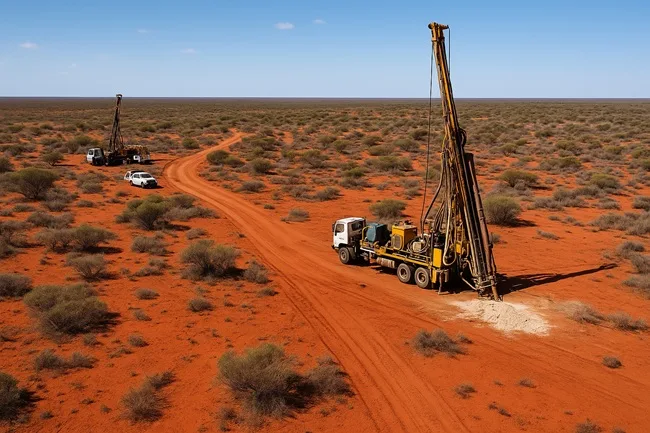




Liontown Limited (ASX: LTR), the Australian lithium producer developing the Kathleen Valley operation in Western Australia, has approved a A$389 million expansion designed to lift spodumene concentrate production substantially by the end of the decade. The September 30, 2026 final investment decision follows a financial recovery that delivered A$639 million in FY2026 revenue, A$147 million in underlying EBITDA and A$182 million in operating cash flow. However, the expansion introduces a new capital commitment at a time when lithium prices remain volatile, raising an important question about whether higher production volumes will translate into proportionately stronger cash generation.
The expansion will increase Kathleen Valley’s designed ore-processing capacity from 2.8 million tonnes to 4.2 million tonnes annually, with the company targeting average spodumene concentrate production of approximately 780,000 dry metric tonnes a year over the five financial years beginning FY2030. Liontown expects initial incremental production during FY2028, while the expanded operation is anticipated to reach its highest annual output of more than 800,000 tonnes in FY2034. These figures represent development targets rather than existing operating capacity or guaranteed future production.
The financial significance becomes clearer when compared with Kathleen Valley’s current performance. Liontown produced 391,992 dry metric tonnes of spodumene concentrate during FY2026, meaning its longer-term production target is almost twice the volume achieved in the latest financial year. That comparison illustrates the scale of the company’s ambition, although it also incorporates production growth expected from the existing underground ramp-up rather than representing the incremental contribution of the A$389 million expansion alone.
The board’s decision therefore marks a transition from establishing Kathleen Valley as a commercial lithium producer towards attempting to extract greater value from its installed infrastructure and mineral resources. The project benefits from an operating mine, existing processing facilities and established customer relationships, but its financial outcome will depend on mine development, plant efficiency, capital discipline and lithium market conditions over several years.
How much additional lithium production will Liontown’s Kathleen Valley expansion deliver?
The Kathleen Valley expansion is structured around increasing the productivity of an existing lithium operation rather than constructing an entirely new mine and processing complex. The company’s approved plan lifts ore-processing design capacity from 2.8 million tonnes to 4.2 million tonnes annually, representing a 50% increase in nominal throughput capability. This distinction is important because an increase in processing capacity does not translate automatically into an equivalent increase in saleable lithium concentrate.
Actual concentrate production depends on the amount of ore mined and processed, its lithium grade, mineral recovery rates and the availability of the processing plant. Liontown’s expansion assumes a combination of increased underground ore supply and improvements to the facilities that convert that material into spodumene concentrate. The company is targeting approximately 780,000 dry metric tonnes of annual concentrate production averaging 5.4% lithium oxide over FY2030 to FY2034.
FY2026 concentrate production of 391,992 tonnes provides a useful historical benchmark. The targeted 780,000 tonnes would represent approximately 99% more output than the most recently completed financial year. However, that does not mean the expansion independently doubles production, because the existing mining operation is still progressing towards its planned underground production rate.
Liontown completed open-pit mining in December 2025 and has transitioned Kathleen Valley to an entirely underground operation. Its immediate operational objective is to achieve an underground mining run rate of 2.8 million tonnes annually by the end of FY2027. Achieving that milestone would provide the production foundation upon which the subsequent expansion is intended to build.
The development schedule creates several separate milestones. Initial incremental ore is targeted for the first quarter of FY2028, construction completion is planned by the end of the second quarter of FY2029, and the expanded production profile is expected from FY2030. Each stage will require evidence that mine development, equipment installation and processing improvements are progressing according to plan.
The company’s longer-term production plan also contains geological uncertainty. Approximately 21.5% of the expansion production target is supported by inferred mineral resources, which carry a lower level of geological confidence than indicated or measured resources. Additional drilling and technical work may improve confidence, but there is no certainty that the entire targeted production profile will ultimately be achieved.

What does Liontown’s A$389 million expansion budget actually include?
Liontown’s A$389 million approved investment covers the Kathleen Valley expansion programme, including contingency and approximately A$60 million to A$70 million of previously announced FY2027 pre-investment-decision expenditure. The expenditure is scheduled across FY2027 to FY2029, aligning the capital programme with underground development, processing upgrades and the phased introduction of additional production capacity. The approved figure represents the identified expansion investment rather than the company’s entire capital expenditure requirement over those financial years.
That distinction is central to understanding the funding commitment. The expansion budget excludes certain expenditure associated with the existing 2.8-million-tonne underground ramp-up, ongoing sustaining capital, other mine infrastructure, optimisation programmes and inflation. Consequently, the total cash required to operate, maintain and develop Kathleen Valley will be greater than the A$389 million project figure alone.
The expansion takes advantage of a processing plant designed with future scalability in mind. Key work includes additional milling capacity, improvements to magnetic separation and tailings handling, and infrastructure required to support higher ore throughput. Liontown had already advanced early works and procurement before approving the full programme, including a 5.5-megawatt ball mill intended to improve throughput and grind-size control.
The company disclosed in April that the ball mill represented approximately A$12 million of committed expenditure. Early procurement was designed to address long equipment lead times and reduce the possibility that critical components would delay the broader expansion. However, placing equipment orders ahead of a final investment decision also demonstrates that project schedules depend on a sequence of commitments made before additional production becomes available.
Mining infrastructure forms another substantial component of the development strategy. Expansion work will accelerate access to the Kathleen’s Corner underground orebody, previously described as Northwest Flats, alongside continued development at Mount Mann. Ventilation, power, water infrastructure, mine services and additional equipment will be needed to support the higher production rate.
The capital intensity of the programme needs to be understood in relation to both its increased processing capability and the additional mine development required to supply that capability. A relatively modest processing-plant expansion can still require substantial investment in underground access, materials handling and supporting infrastructure. The economic benefit will depend on whether those investments deliver reliable throughput without creating disproportionate ongoing operating costs.
Liontown has also revised its broader FY2027 capital expenditure guidance to approximately A$435 million to A$495 million, compared with the earlier range of A$320 million to A$370 million. The revised guidance includes approximately A$175 million to A$195 million of Kathleen Valley expansion expenditure during FY2027. This illustrates why the A$389 million headline should not be interpreted as the company’s total spending requirement for the upcoming development period.
Can Liontown fund the Kathleen Valley expansion from existing cash and operating cash flow?
Liontown enters the expansion phase with a substantially improved liquidity position compared with the weaker periods of the lithium market cycle. At June 30, 2026, the company reported approximately A$561 million in cash, following a June quarter that generated A$137 million in net cash flow. The closing cash balance provides an important financial buffer as Liontown begins committing larger amounts to underground development and processing infrastructure.
The A$389 million approved expansion budget is equivalent to approximately 69% of the June 30 cash balance. This comparison is useful for illustrating the project’s scale, but it should not be interpreted as meaning that 69% of available cash will necessarily be spent on the expansion. The investment is scheduled across multiple financial years, and the business will continue generating revenue, incurring operating expenses, investing in existing facilities and servicing financial obligations throughout that period.
Liontown has indicated that it intends to fund the expansion through existing liquidity and internally generated cash flow under its assumed lithium-price conditions. The feasibility of that approach depends on the operating business maintaining sufficient cash generation while the investment programme proceeds. A stronger lithium market could support that strategy, while weaker realised prices or higher operating costs would reduce the amount of cash available to fund growth.
The company’s FY2026 operating cash flow of A$182 million represents an encouraging starting point, particularly because Kathleen Valley had not yet reached its targeted underground mining rate. Nevertheless, operating cash flow is not the same as free cash flow. Capital expenditure, financing costs and other investing activities must also be considered before concluding how much internally generated cash can be allocated towards expansion.
A simple comparison shows that A$389 million is approximately 2.1 times the company’s FY2026 operating cash flow. That ratio is not a project payback calculation and does not suggest that the expansion will require 2.1 years to finance. Rather, it illustrates the relative size of the planned investment against cash generated during the most recent operating year.
The financing position has also been affected by changes to Liontown’s capital structure. Earlier in 2026, the conversion of convertible debt into equity materially reduced reported borrowings and improved the balance-sheet profile. That development lowered certain debt-related pressures, although it also changed the equity capital base and should not be confused with cash generated through mining operations.
The more useful financing question is whether the company can preserve adequate liquidity throughout the period of peak spending without depending heavily on additional capital or unusually favourable lithium prices. Future quarterly cash-flow reports will be important in determining whether operating receipts, capital commitments and cash balances remain aligned with the development schedule.
Why does Liontown’s FY2026 operating performance matter for the expansion economics?
Liontown’s FY2026 results provide evidence that Kathleen Valley can generate substantial revenue and positive operating cash flow under more favourable market conditions. Revenue reached A$639 million, compared with approximately A$298 million in FY2025, reflecting higher production, sales volumes and improved lithium prices. Underlying EBITDA increased to A$147 million from approximately A$20 million, demonstrating a significant improvement in operating earnings as the mine progressed through its ramp-up.
The company also reported a statutory net profit after tax of A$93 million, including one-off items, while underlying net profit after tax was approximately A$14 million. This difference matters because the statutory result includes accounting effects that should not be assumed to recur in future periods. The underlying profit provides a more conservative measure of normalised earnings, although it remains sensitive to the company’s chosen adjustments and prevailing commodity prices.
Using reported FY2026 figures, Liontown generated an underlying EBITDA margin of approximately 23%. That is a meaningful improvement from its earlier operating performance, but it does not establish the margin that the enlarged mine will achieve. Future profitability will depend on product prices, mining costs, recovery rates, shipping and royalty expenses, as well as the efficiency of the expanded operation.
The company’s average realised spodumene concentrate price was approximately A$1,379 per tonne in FY2026. Management attributed much of the year’s financial recovery to stronger prices during the second half, following a considerably weaker first half. This demonstrates the direct influence of market conditions on reported financial performance and highlights why expansion economics should not be assessed using production volumes alone.
Kathleen Valley’s underground transition introduces another variable. Underground mining requires sustained development expenditure, reliable ore access, ventilation, equipment availability and effective coordination between mining and processing operations. As throughput increases, fixed operating costs may be spread across greater production volumes, potentially improving unit economics if production targets are achieved.
However, underground operations can also encounter geological variability, scheduling challenges and equipment constraints that affect costs and output. The economic benefit of a larger processing plant depends on reliable ore supply, particularly where mine development must advance sufficiently ahead of production. Consequently, the operating performance of Kathleen Valley during FY2027 will provide an important indication of how effectively the company can support its subsequent expansion.
How sensitive could Liontown’s larger lithium operation be to spodumene prices?
Lithium-price volatility is arguably the most consequential external uncertainty surrounding Liontown’s expansion decision. Spodumene concentrate is an upstream material used in lithium chemical production, and its market value is influenced by demand for rechargeable batteries, electric vehicles, energy storage systems and the availability of competing lithium supply. Higher production volumes can increase revenue opportunities, but the financial benefit depends on the realised price and cost of delivering each tonne.
A simple sensitivity exercise illustrates the scale of this exposure. At a hypothetical production level of 780,000 tonnes annually, a A$100-per-tonne movement in realised concentrate pricing would correspond to approximately A$78 million in annual gross sales value, assuming every tonne was sold and all other factors remained unchanged. This is an arithmetic illustration rather than a Liontown revenue forecast, because actual sales prices, product grades, production levels, contractual pricing and exchange rates may differ.
The sensitivity works in both directions. A stronger spodumene market could allow additional tonnes to generate substantial incremental revenue, while a prolonged downturn could compress margins even if production targets were met. A larger operation may also benefit from lower unit costs, but those savings would need to be demonstrated through actual operating performance.
This creates an important distinction between production efficiency and commodity-price exposure. Improvements in mining productivity, recovery rates and processing costs can strengthen resilience across the market cycle. They cannot eliminate the effect of sustained declines in lithium prices, particularly where expansion expenditure has already been committed.
Liontown’s decision to proceed reflects confidence in the longer-term market and in the financial benefits of increasing production. Nevertheless, the investment decision does not remove the uncertainty surrounding future lithium demand, industry supply additions or concentrate pricing. The strongest financial outcome would combine reliable higher output with competitive costs and sufficient realised prices to produce attractive cash returns.
Does Liontown’s expansion payback estimate establish that the project will be profitable?
Liontown’s expansion has an estimated undiscounted payback period of approximately 2.5 years from the end of construction, based on incremental project cash flows. This measure suggests that, under the assumptions used in the company’s economic assessment, the additional investment could be recovered relatively quickly after construction is completed. However, the calculation should not be interpreted as a guaranteed cash recovery schedule.
An undiscounted payback calculation measures how long cumulative projected cash flows take to recover an investment without adjusting those future cash flows for the time value of money. It therefore differs from net present value and internal rate of return, which incorporate more detailed considerations about cash-flow timing and investment returns. A relatively short estimated payback period can be attractive, but its reliability depends on the underlying operational and commercial assumptions.
The company has not disclosed updated net present value or internal rate of return figures for the September 2026 expansion in the information reviewed. Historical financial metrics associated with the original Kathleen Valley feasibility study should not be substituted for current expansion economics. The project scope, development status, capital requirements and commodity-market assumptions have changed materially since the earlier study.
The payback estimate also needs to be assessed alongside the expenditure excluded from the A$389 million expansion budget. Sustaining capital, other mine development and inflation can influence the cash ultimately generated by the overall operation. A project-level incremental cash-flow assessment is not equivalent to forecasting total company free cash flow over the same period.
An additional consideration is the composition of the production target. The reliance on inferred resources for part of the planned output introduces geological uncertainty, while higher processing throughput requires successful equipment installation and operational integration. These factors may affect realised production volumes, timing and costs relative to the development case.
The most defensible interpretation is therefore that Liontown’s economic assessment supports proceeding under its selected assumptions, rather than establishing that the expansion will necessarily deliver the projected returns. Confirmation will emerge progressively as construction expenditure, operating costs, production volumes and cash generation become observable.
Could Kathleen Valley’s higher output change Liontown’s lithium sales strategy?
The expansion could provide Liontown with greater commercial flexibility because additional production is not necessarily committed to existing customers under long-term supply arrangements. Uncommitted concentrate creates opportunities to negotiate new offtake agreements, pursue spot-market sales or consider prepayment arrangements where commercially attractive. The value of that flexibility depends on market conditions, customer demand and the contractual terms eventually agreed.
Long-term offtake contracts can provide sales visibility and strengthen relationships with customers in the battery supply chain. However, pricing formulas, delivery obligations and other contractual provisions determine how effectively those arrangements capture favourable market conditions. Spot-market exposure may provide flexibility when prices are strong but can increase revenue volatility during downturns.
The expansion also changes the company’s exposure to production execution. Larger annual output targets require stable processing performance and reliable logistics, particularly when concentrate production and shipments increase. The financial benefits of higher throughput can be reduced if inventory accumulates, customer deliveries are delayed or working-capital requirements rise disproportionately.
Liontown’s FY2026 shipments of 381,997 tonnes provide a useful baseline for evaluating this future commercial transition. As the mine expands, growth in shipped volumes and realised sales prices will be more financially meaningful than growth in nominal processing capacity alone. The relationship between production, shipments, inventories and customer receipts will therefore remain an important indicator of commercial efficiency.
The broader opportunity is to establish Kathleen Valley as a higher-volume supplier with improved operating economics and a more diversified commercial position. That outcome remains conditional on execution, lithium market conditions and the company’s ability to secure attractive sales arrangements for additional production.
What must Liontown demonstrate before the Kathleen Valley expansion delivers stronger cash returns?
The first major test will be the existing underground operation’s ability to reach its targeted 2.8-million-tonne annual mining run rate by the end of FY2027. This milestone matters because the expansion assumes continued progress in underground development and the availability of sufficient ore to support higher processing capacity. Reliable operational performance would reduce uncertainty around the production foundation of the larger project.
The second test concerns capital discipline. Liontown must manage an increasingly substantial expenditure programme while maintaining adequate liquidity and continuing to fund its existing operations. Quarterly cash-flow reports will reveal whether operating receipts are sufficient to support the spending schedule or whether changing market conditions place additional pressure on the balance sheet.
The third test is the conversion of higher concentrate output into improved cash margins. Production volumes alone cannot establish economic success, particularly in a cyclical commodity market. Unit operating costs, sustaining expenditure, realised prices and working-capital movements will provide stronger evidence of whether the mine is generating incremental financial value.
The fourth test is execution against the announced development timetable. First incremental production is targeted during FY2028, followed by completion of the main construction programme and the anticipated expansion in steady-state output from FY2030. Delays or cost escalation could weaken investment returns, while disciplined execution would support the company’s stated development strategy.
Liontown’s next scheduled September-quarter results, due on October 30, 2026, will provide an early opportunity to assess operating performance and cash generation following the expansion decision. The update may also clarify progress with underground development, procurement and capital commitments. More substantial evidence of expansion economics will emerge as construction advances and additional production becomes available.
Liontown has moved beyond the uncertainty of whether Kathleen Valley can produce and sell lithium concentrate at commercial scale. Its FY2026 revenue, operating cash flow and underlying earnings demonstrate that the mine can generate meaningful financial returns under supportive conditions. The next challenge is whether the company can use those cash flows and its existing financial resources to fund a larger operation without allowing capital spending and commodity-price exposure to undermine the benefits of additional production.
The A$389 million expansion creates a pathway towards considerably higher output, but it is not itself evidence of stronger future profitability. The decisive measure will be the cash generated from additional tonnes after accounting for operating expenditure, sustaining investment and the capital required to achieve the production targets. Kathleen Valley’s next phase will therefore be judged less by the scale of its planned expansion than by the financial returns it ultimately delivers.
Discover more from Business-News-Today.com
Subscribe to get the latest posts sent to your email.