


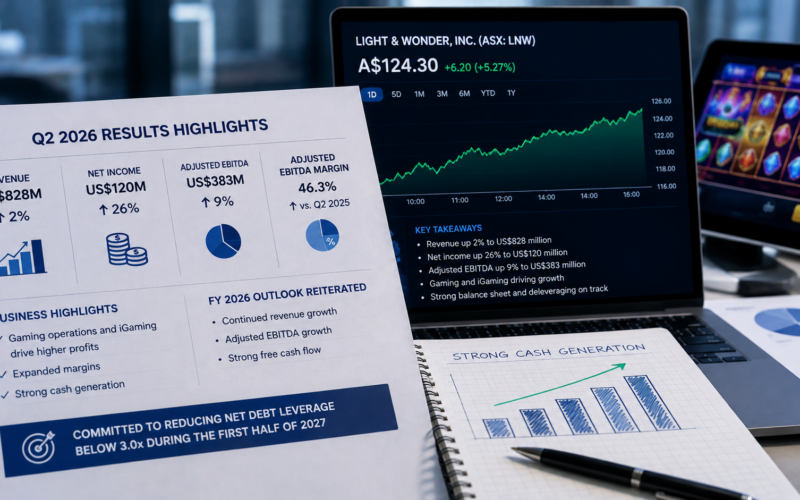
Light & Wonder, Inc. (ASX: LNW) shares climbed 5.27% to A$124.30 on August 7 as investors continued to digest a second-quarter result that combined modest revenue growth with substantially stronger earnings, expanding margins and accelerating cash generation. Consolidated revenue increased 2% to US$828 million, but net income rose 26% to US$120 million and adjusted EBITDA increased 9% to US$383 million as Gaming operations and iGaming became larger contributors to the group. Light & Wonder also reiterated its fiscal 2026 outlook and remains committed to reducing net debt leverage below 3.0 times during the first half of 2027.
The August 7 rally took LNW approximately 8.8% above its July 31 close and lifted its market capitalisation to about A$9.58 billion. The shares remain roughly 36% below their 52-week high of A$193, however, reflecting the substantial valuation reset that preceded the latest rebound. The investment question is increasingly whether growth in recurring gaming operations and digital content can offset weakness in SciPlay while management diverts more cash from buybacks towards reducing more than US$5 billion of debt.
What does Light & Wonder currently do across casino gaming, SciPlay and iGaming?
Light & Wonder operates as a global games company across three principal businesses: Gaming, SciPlay and iGaming. Gaming develops casino machines, game content, table products, systems and recurring participation products for casino operators, while SciPlay develops social casino and mobile games. The iGaming division distributes online casino content and technology to regulated digital gaming operators.
The model has gradually shifted towards recurring revenue rather than relying predominantly on one-off machine sales. Light & Wonder defines recurring revenue as including gaming operations, Grover charitable gaming, gaming systems maintenance, table-service and rental arrangements, SciPlay and iGaming. Approximately 71% of first-half 2026 revenue was recurring, equivalent to roughly US$1.2 billion.
That revenue mix matters because casino machine sales can move considerably between quarters depending on customer capital expenditure and shipment schedules. Installed machines, online gaming content and digital player spending can provide a more repeatable earnings stream.
Light & Wonder has also become much more directly relevant to Australian investors. The company ended its Nasdaq listing in November 2025 and moved to a sole primary listing on the Australian Securities Exchange, placing its entire quoted equity value within the ASX market rather than maintaining separate primary markets.

Why did earnings grow much faster than Light & Wonder’s 2% revenue increase?
Second-quarter consolidated revenue increased from US$809 million to US$828 million, but consolidated adjusted EBITDA rose from US$352 million to US$383 million. The adjusted EBITDA margin expanded by approximately 200 basis points to 46%.
Net income increased 26% to US$120 million, while diluted net income per share rose 38% to US$1.53. The faster per-share growth reflects both stronger profitability and the reduction in shares produced by Light & Wonder’s continuing buyback programme.
Gaming generated US$554 million of revenue, up 5%, while adjusted EBITDA increased 10% to US$307 million. Gaming operations revenue rose 18%, supported by expansion in the North American premium installed base and the contribution from Grover charitable gaming.
The North American premium installed base added more than 650 units sequentially during Q2 and more than 2,500 units year on year. Management has targeted more than 500 additional premium units per quarter, making continued expansion of this installed base one of the clearest operating measures investors can track.
The improvement highlights why revenue quality matters. A dollar of recurring gaming-operations revenue can have different profitability characteristics from a dollar generated through hardware sales. Light & Wonder’s current strategy is deliberately pushing the portfolio towards higher recurring content and participation economics.
Can iGaming become a much larger earnings engine for ASX: LNW?
iGaming delivered one of the strongest performances in the quarter. Revenue increased 14% to US$92 million, while adjusted EBITDA rose 18% to US$33 million and the segment margin expanded to approximately 36%. Wagers processed through the platform reached a quarterly record of US$31.3 billion.
Growth was driven primarily by North America, where Light & Wonder continues expanding distribution of its first-party casino content through a broader network of regulated online operators.
The economics are attractive because digital content does not require Light & Wonder to manufacture and ship a physical casino cabinet each time additional players use a game. Successful titles can be distributed across multiple platforms and markets, creating considerable operating leverage once development costs have been incurred.
The company wants its first-party iGaming content to achieve more than 10% global market share by 2028, representing an increase of approximately 300 basis points from its 2024 position.
Regulation remains the principal constraint. Online gaming rules differ substantially between jurisdictions, and governments can increase taxes even where gambling remains legal. Light & Wonder said its Q2 iGaming growth was achieved despite higher United Kingdom gaming duties that took effect on April 1.
The long-term opportunity therefore depends on two things happening simultaneously: additional markets permitting regulated online casino gaming and Light & Wonder gaining content share within markets where digital gambling is already established.
Why is SciPlay the weak point in an otherwise improving result?
SciPlay revenue declined 9% to US$182 million during the quarter as the free-to-play social casino market remained soft. Adjusted EBITDA fell 3% to US$72 million, although its margin improved to 40% from 37%.
The divergence between lower revenue and higher margin is important. Light & Wonder has increasingly encouraged players to purchase virtual currency directly rather than through mobile app stores, which typically collect a portion of player spending.
Direct-to-consumer revenue reached US$53 million during Q2 and represented 29% of SciPlay revenue, compared with 18% one year earlier. That already places the business close to Light & Wonder’s 2028 objective of generating 30% of SciPlay revenue through direct channels.
However, improved distribution economics cannot indefinitely compensate for a shrinking player base. SciPlay still needs to stabilise engagement and attract spending across its game portfolio if the segment is to return to meaningful top-line growth.
For investors, SciPlay is therefore a useful counterweight to the more bullish digital narrative. Light & Wonder is successfully increasing digital exposure through iGaming, but not every digital product is currently expanding.
How important is Grover to Light & Wonder’s gaming growth?
Light & Wonder acquired Grover Gaming’s charitable gaming business in 2025, paying US$850 million upfront with the possibility of an additional revenue-based earn-out of up to US$200 million.
Grover gives the company exposure to distributed gaming markets where machines operate outside traditional large casinos, expanding Light & Wonder’s recurring installed base and allowing existing game-development capabilities to be deployed through another distribution channel.
The business added 277 units sequentially during Q2 and more than 1,540 year on year. Management’s longer-term target had contemplated approximately 100 to 150 new units per quarter excluding Indiana, meaning the latest growth substantially exceeded that benchmark.
This acceleration contributed to Gaming operations revenue growth but also increased capital expenditure because Light & Wonder must purchase and deploy machines before generating continuing participation revenue from them.
The economic case therefore depends on lifetime cash generated by the installed machines rather than simply the number deployed. Strong revenue per unit and long operating lives can make recurring participation equipment attractive, while weaker utilisation could leave the company with capital tied up in underperforming assets.
Why is debt reduction becoming more important than another large buyback?
Light & Wonder returned US$134 million to shareholders through share repurchases during Q2 and US$156 million across the first half. Since buybacks began in 2022, the company has repurchased approximately 26.2 million shares or CDIs for more than US$2.1 billion, equivalent to roughly 27% of the shares outstanding before the programmes began.
Only around US$180 million remained under the current authorised programme at June 30. Management has now indicated that it intends to reduce the pace of repurchases and prioritise deleveraging.
Principal debt outstanding stood at approximately US$5.2 billion, while reported total debt was US$5.13 billion and cash was US$148 million. Net debt leverage stood at 3.4 times, with management targeting less than 3.0 times during the first half of 2027 and eventually seeking an investment-grade-style leverage profile.
The company has approximately US$928 million of available liquidity and an effective interest cost around 6.3%. Roughly 53% of debt is fixed-rate and 47% floating-rate, making both debt reduction and interest-rate movements relevant to future earnings.
Reducing leverage could create value even without producing immediate revenue growth. Lower debt reduces financial risk and eventually lowers interest expense, allowing a larger portion of operating earnings to reach shareholders.
The trade-off is that fewer buybacks mean less near-term support for earnings per share from a shrinking share count. Future EPS growth will need to rely increasingly on underlying earnings rather than financial engineering.
Does stronger cash generation make the debt target achievable?
Light & Wonder generated US$241 million of operating cash flow during Q2, up 127% year on year. Adjusted free cash flow increased 50% to US$156 million.
Across the first six months, adjusted free cash flow reached US$363 million compared with US$216 million one year earlier. Conventional free cash flow was US$211 million after capital expenditure and other required investments.
Capital expenditure is significant because the company continually develops new gaming cabinets, adds recurring participation units and expands the Grover installed base. Research and development plus capital expenditure have historically consumed approximately 16% to 19% of quarterly revenue.
This reinvestment is essential to maintaining the content pipeline. Casino operators regularly replace machines and demand new game themes, hardware and technology, meaning Light & Wonder cannot maximise near-term free cash flow simply by stopping investment.
The current cash profile nevertheless provides a credible path towards lower leverage if operating momentum continues and buybacks are reduced as planned.
Is the Light & Wonder share price still cheap after the August rebound?
Light & Wonder closed at A$124.30 on August 7, up 5.27% for the session after trading as high as A$126.87. The shares were approximately 8.8% above the July 31 close and about 14.6% higher over the latest four-week period.
The stock remains far below its A$193 52-week high. At the August 7 close, LNW was approximately 35.6% below that peak while standing about 28.4% above its A$96.79 52-week low.
The market capitalisation was approximately A$9.58 billion, with the securities trading around 26 times displayed trailing earnings.
That valuation is not obviously distressed, particularly for a company producing only 2% consolidated revenue growth during the latest quarter. The stronger argument rests on the earnings mix: adjusted EBITDA grew 9%, margins expanded and free cash flow increased considerably faster than sales.
Investors are effectively being asked to decide whether improving recurring revenue deserves a higher valuation than the headline revenue growth rate implies.
The large decline from the 52-week high provides room for a recovery, but a historic peak is not evidence that the shares must return there. A sustainable re-rating requires stronger machine sales in the second half, continued premium installed-base growth, digital expansion and credible deleveraging.
What are the next measurable catalysts for Light & Wonder investors?
Light & Wonder reiterated its fiscal 2026 expectation for mid-to-high-single-digit consolidated adjusted EBITDA growth. Management also expects earnings to remain second-half weighted, partly because gaming machine sales and customer capital spending tend to be stronger later in the year.
Gaming machine sales fell 4% during Q2 as some shipments moved into the second half. Successful conversion of those deferred deliveries is therefore one of the clearest near-term proof points.
The company has not yet announced the date for its third-quarter results. That update, following the September quarter, should provide evidence on Gaming machine shipments, premium installed-base additions, Grover deployment, SciPlay stabilisation and the pace of debt reduction.
Light & Wonder’s longer-term objectives provide a further benchmark. Management is targeting consolidated adjusted EBITDA of US$2 billion in 2028 and adjusted NPATA earnings per share above US$10.55.
Reaching those targets requires continued margin growth and execution across all three businesses. Gaming and iGaming are currently moving in the right direction, while SciPlay remains the clearest operating weakness.
The investment case would strengthen if second-half machine sales recover, premium installed units continue increasing by more than 500 per quarter and leverage begins moving decisively towards 3.0 times.
It would weaken if SciPlay declines accelerate, casino customers postpone capital expenditure, digital regulatory costs increase or debt remains elevated despite stronger cash flow.
Light & Wonder’s August rebound reflects growing confidence that the company can expand earnings faster than revenue. The next stage is proving that those improved economics can simultaneously fund product investment, reduce leverage and deliver the 2028 earnings targets.
Key takeaways for investors watching Light & Wonder after the August rally
Light & Wonder, Inc. (ASX: LNW) closed 5.27% higher at A$124.30 on August 7 as investors continued responding to its second-quarter earnings and margin improvement.
Second-quarter revenue increased only 2% to US$828 million, but net income rose 26% to US$120 million and consolidated adjusted EBITDA increased 9% to US$383 million.
Gaming operations and iGaming were the principal growth engines, while SciPlay revenue declined 9% amid weakness in the social casino market.
Adjusted free cash flow increased 50% to US$156 million during Q2, supporting management’s plan to shift capital allocation from aggressive buybacks towards debt reduction.
Light & Wonder had approximately US$5.2 billion of principal debt outstanding and a 3.4-times net debt leverage ratio, with a target of moving below 3.0 times during the first half of 2027.
LNW remains about 36% below its 52-week high despite the recent rebound, although the approximately A$9.58 billion market capitalisation already assumes continued earnings growth.
The next major proof points are second-half gaming machine deliveries, premium installed-base growth, SciPlay performance and evidence that stronger cash generation is translating into lower leverage.
Discover more from Business-News-Today.com
Subscribe to get the latest posts sent to your email.