


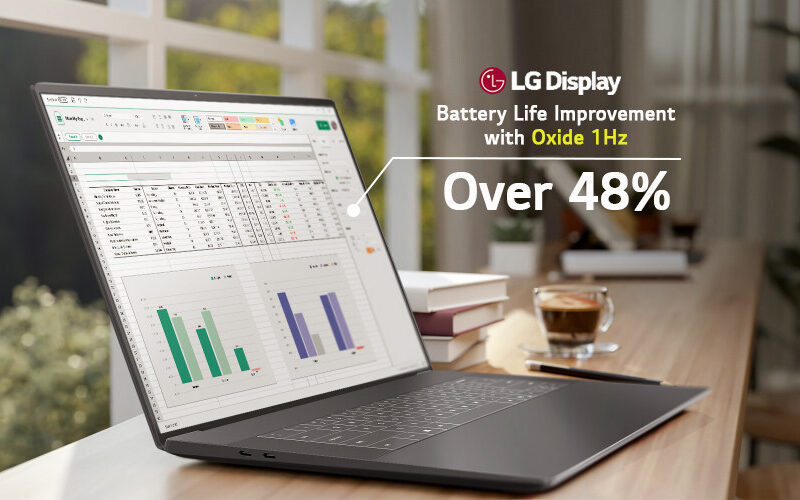
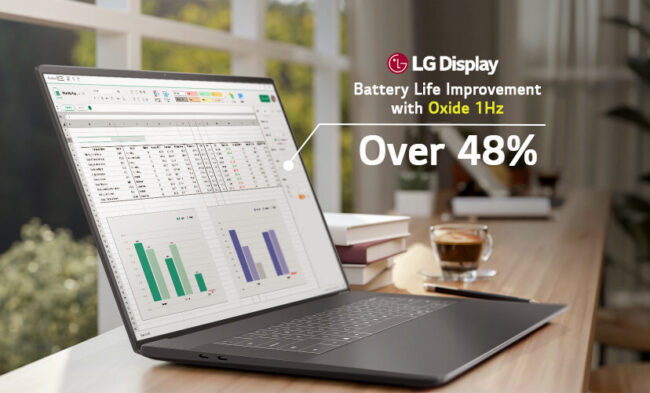
LG Display Co., Ltd. (NYSE: LPL, KRX: 034220) has announced the commencement of mass production on the world’s first LCD laptop panel incorporating its Oxide 1Hz variable refresh rate technology, marking a significant engineering milestone for the global display industry. The panel dynamically adjusts its refresh rate between 1Hz during static screen activity and 120Hz during video and gaming workloads, delivering what the company claims is a 48 percent improvement in battery life on a single charge compared with existing panel solutions. The announcement carries direct commercial weight: LG Display has secured Dell Technologies as its launch customer, with the panel already specified for the premium Dell XPS lineup unveiled at CES 2026 in January. For LG Display, a company navigating years of losses and a fundamental pivot away from LCD toward OLED, this development is a meaningful demonstration that its LCD engineering capability still has commercial relevance even as the industry transitions.
How does LG Display’s Oxide 1Hz technology extend laptop battery life compared with standard LCD panels
The fundamental constraint that Oxide 1Hz addresses is straightforward: conventional laptop panels maintain their full refresh rate regardless of whether the screen content is changing. A display running at 60Hz or 120Hz redraws the image sixty or one hundred and twenty times every second, and the underlying circuitry consumes power continuously whether the user is watching a fast-moving video or staring at a static spreadsheet. That continuous power draw has been an accepted inefficiency for years, largely because the engineering challenge of varying the refresh rate across a wide range, from a near-static 1Hz to a fluid 120Hz, without introducing flicker or image degradation, proved difficult to solve at panel level.
LG Display’s solution involved developing proprietary circuit algorithms and panel design techniques specific to low-refresh-rate performance. The company identified and applied oxide materials with the lowest measurable power leakage during 1Hz operation to the display’s thin-film transistor layer, which governs how the individual pixels respond to electrical signals. At 1Hz, the TFT needs to hold the pixel state reliably for a full second between refreshes, a requirement that places stringent demands on leakage current. The resulting 48 percent battery life improvement on a single charge is the commercial payload of that engineering work, translating directly into longer unplugged usage time, which consistently ranks among the top purchase criteria for laptop buyers.
Why the timing of this launch aligns with rising AI PC power consumption trends in 2026
The commercial case for Oxide 1Hz has become more compelling as AI-integrated laptops enter mainstream volume. On-device AI inference, whether running large language model workloads locally, accelerating image processing, or supporting real-time transcription, draws substantially more power from the processor and neural processing unit than conventional computing tasks. PC manufacturers and chip suppliers have been vocal about the power budget challenge this creates: when AI tasks consume a greater share of the system’s power envelope, every other subsystem including the display needs to become more efficient to preserve battery life at an acceptable level.
LG Display is positioning Oxide 1Hz as a direct response to this dynamic. The panel’s ability to drop to 1Hz during email reading, document review, or any task dominated by static content offsets a portion of the incremental power cost introduced by AI workloads running elsewhere in the system. While a display panel’s contribution to total laptop power consumption varies by use case, it typically accounts for a meaningful percentage of the overall budget, making panel-level efficiency gains relevant to system designers and OEM product planning teams as they work through the power architecture of next-generation AI PC platforms.
What does the Dell XPS design win signal about LG Display’s competitive position in premium laptop panels
Securing Dell’s XPS franchise as the launch platform for Oxide 1Hz is a material endorsement for LG Display. The XPS lineup sits at the premium end of Dell’s consumer and prosumer portfolio, a segment where battery life claims carry real marketing weight and where display quality is a primary product differentiator. Design wins at this tier involve rigorous qualification processes, including power performance validation, image quality assessments at multiple refresh rates, and thermal and reliability testing. The fact that Dell committed to XPS rather than a mid-range product line suggests a level of confidence in Oxide 1Hz performance that goes beyond prototype validation.
For LG Display’s medium display business unit, which encompasses laptop and monitor panels, the XPS win provides a reference design that can be presented to other OEM customers. Samsung Display, BOE Technology Group, and AUO remain strong competitors in the laptop panel segment, and LG Display’s ability to point to a production-verified, flagship-tier deployment with a major global PC brand strengthens its negotiating position in subsequent design win conversations. The competitive question now is how quickly rivals can develop equivalent variable refresh rate LCD technology and whether LG Display can expand its customer base before that capability gap narrows.
How does the Oxide 1Hz LCD launch fit into LG Display’s broader OLED transition strategy through 2027
LG Display’s strategic narrative for the past several years has been built around its transition from LCD to OLED as the primary growth driver, particularly in large-format television panels and automotive displays. The company has invested heavily in OLED manufacturing capacity in South Korea, and its OLED panels for Apple’s iPhone and MacBook product lines represent some of its highest-value revenue. Against that backdrop, continuing to invest engineering resources in LCD technology for laptops might appear to cut against the grain of the company’s own strategic direction.
The rationale becomes clearer when viewed through a revenue bridge lens. LCD panels for notebook computers remain a volume business with a multi-year demand runway, particularly in the mid-range and premium commercial segments where OLED has not yet achieved price parity. Oxide 1Hz allows LG Display to defend and potentially expand its LCD notebook panel revenue while OLED unit economics continue to improve. The company has also confirmed it is developing a 1Hz OLED panel incorporating the same underlying variable refresh rate technology, with mass production targeted for 2027. This suggests LG Display views Oxide 1Hz not as an LCD-only feature but as a platform-level capability that will carry forward into its OLED product roadmap, providing a degree of technology continuity as the mix shifts.
What does LG Display’s stock performance and market valuation tell investors about the company’s recovery trajectory
LG Display’s American Depositary Shares were trading around USD 4.07 to 4.17 at the time of this announcement, off a 52-week low of USD 2.43 but well below the 52-week high of USD 5.67. The stock has been under meaningful short-term selling pressure, having declined approximately 28 percent over the prior ten trading sessions according to available market data, though it remains significantly above its cycle lows reached in the past twelve months. The market capitalisation sits in the vicinity of USD 3.99 billion to 4.09 billion, reflecting a price-to-sales ratio of roughly 0.23 based on current revenue, which indicates that investors are pricing in ongoing margin pressure rather than a near-term earnings recovery.
Morningstar’s assessment carries an interesting divergence from market sentiment: the firm’s fair value estimate of USD 6.99 per share implies the stock is trading at a material discount to intrinsic value, though the uncertainty rating is flagged as high. The consensus analyst price target of approximately USD 5.36 similarly sits well above current trading levels. The Oxide 1Hz mass production announcement is unlikely to move the stock in isolation, as a single panel technology launch does not directly address the structural questions around LG Display’s profitability timeline, capital intensity, or OLED yield rates that dominate investor concerns. What it does contribute to is the narrative that LG Display’s medium display division retains engineering credibility and revenue-generating capability, a point relevant to any through-cycle recovery thesis for the stock.
What execution risks should investors and OEM partners consider as LG Display scales Oxide 1Hz panel production
The transition from engineering milestone to sustained commercial volume carries its own risks. Variable refresh rate technology at the low end of the range, specifically at 1Hz, requires the panel to maintain pixel fidelity under conditions that conventional LCD manufacturing processes were not designed to optimise. Yield rates during the early phases of mass production for new TFT material compositions and circuit architectures can underperform initial projections, particularly as production volumes ramp and process variations emerge at scale. LG Display has not disclosed yield data or capacity allocation figures for Oxide 1Hz, and the commercial impact of any yield shortfall would be absorbed primarily within the medium display division.
A second execution consideration involves the pace at which competitors respond. BOE Technology Group and Samsung Display both have deep LCD engineering resources and have demonstrated the ability to close technology gaps within relatively short development cycles when commercial incentives are sufficient. If Oxide 1Hz generates meaningful design win traction across the laptop OEM landscape, the competitive response will be proportional. LG Display’s window of exclusivity as the world’s first mass producer of this panel type is valuable but finite, and its ability to build a durable customer base before that window narrows will determine how much of the long-term value from this technology investment flows to its bottom line.
How does the Oxide 1Hz panel advance LG Display’s carbon emission reduction targets for product usage efficiency
LG Display has framed the Oxide 1Hz technology as a contribution to what it calls its Carbon Emission Reduction Project, which targets a reduction in carbon emissions during the product usage phase of up to 10 percent. The logic is reasonably direct: a panel that consumes substantially less power under real-world usage conditions reduces the lifetime energy draw of every laptop unit it is installed in, which translates into lower carbon emissions at the electricity generation level over the product’s operational life. For a company manufacturing tens of millions of panels annually, even modest per-unit power reductions compound into material aggregate effects.
The ESG framing also has commercial relevance beyond headline reporting. Laptop OEMs increasingly face regulatory and customer pressure to demonstrate energy efficiency improvements in their products, particularly in European markets where ecodesign regulations continue to tighten requirements on consumer electronics. A display panel that independently contributes to lower system power consumption gives OEM product teams a quantifiable efficiency improvement they can communicate to enterprise buyers and retail customers. This creates a secondary commercial pull for Oxide 1Hz panels beyond raw performance specifications, and it positions LG Display favorably in conversations with OEM sustainability officers who are now embedded in product planning processes at major PC manufacturers.
Key takeaways: What LG Display’s Oxide 1Hz launch means for the laptop display market, PC OEMs, and display sector investors
- LG Display has commenced mass production of the world’s first LCD laptop panel with a 1Hz to 120Hz variable refresh rate, achieving a 48 percent battery life improvement over existing panel solutions and establishing a first-mover position in a commercially relevant new product category.
- The technology was enabled by proprietary oxide material selection and circuit algorithm development targeting minimal power leakage at 1Hz, representing a genuine engineering advance rather than an incremental specification improvement.
- Dell Technologies has been secured as the launch OEM, with the Oxide 1Hz panel specified for the premium XPS lineup. This flagship-tier design win provides LG Display with a reference deployment that strengthens its positioning in subsequent OEM negotiations.
- The launch timing is strategically well-aligned with the AI PC cycle, as on-device AI workloads increase system-level power consumption and create additional commercial pressure on OEMs to recover efficiency through component-level improvements including the display.
- LG Display’s OLED transition strategy is complemented, not contradicted, by this LCD advance. The company has confirmed a 1Hz OLED panel incorporating the same technology is in development for mass production in 2027, suggesting Oxide 1Hz is a platform capability with cross-substrate applicability.
- Competitive exposure is real. BOE Technology Group and Samsung Display possess the engineering resources to develop competing variable refresh rate LCD panels. LG Display’s commercial advantage depends on how effectively it converts first-mover status into a durable OEM customer base before the competitive gap narrows.
- LPL shares trade around USD 4.07 to 4.17, in the lower half of a USD 2.43 to 5.67 52-week range. The Oxide 1Hz announcement does not resolve the broader profitability and yield concerns that suppress the stock, but it incrementally supports the case that the medium display division retains earnings potential.
- The ESG angle is commercially meaningful. Panel-level energy efficiency improvements give OEM partners a quantifiable sustainability credential, which is increasingly relevant in enterprise sales cycles and in compliance with European ecodesign regulations.
- Execution risk during production ramp centres on yield rates for the novel oxide TFT composition and on whether early-stage volume targets for XPS supply can be met without quality compromises that could affect the Dell relationship.
- If Oxide 1Hz achieves broad OEM adoption, it reinforces the case that LCD engineering innovation can generate durable revenue alongside LG Display’s OLED growth narrative, providing investors with a more diversified basis for a recovery thesis than OLED volume alone.
Discover more from Business-News-Today.com
Subscribe to get the latest posts sent to your email.