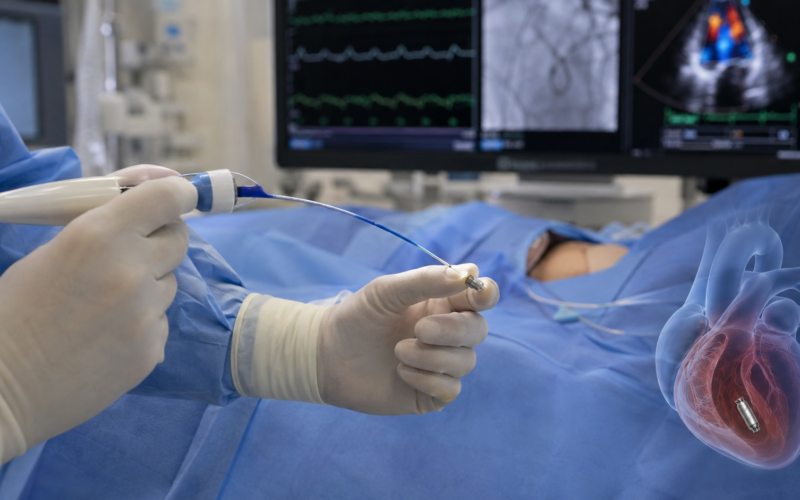
A conventional pacemaker usually asks the body to accommodate more hardware than its name suggests. A pulse generator is implanted beneath the skin, normally in the upper chest, while insulated electrical leads travel through the venous system and into the heart. Those leads deliver pacing therapy, but they also create possible long-term failure points involving infection, fracture, venous obstruction and the device pocket itself.
Leadless pacing attacks that architecture rather than merely shrinking it. The pacemaker is delivered through a catheter and implanted directly inside the heart, removing both the surgical chest pocket and the transvenous pacing lead. What initially looked like a solution mainly for patients needing ventricular-only pacing has now become a contest over whether increasingly sophisticated leadless devices can reproduce much more of what conventional cardiac rhythm systems do.
Abbott Laboratories crossed an important threshold when the U.S. Food and Drug Administration approved its AVEIR DR Leadless System in June 2023. Instead of one ventricular device attempting to infer activity elsewhere in the heart, AVEIR DR uses separate leadless pacemakers in the right atrium and right ventricle that communicate with each other to coordinate dual-chamber pacing. The pivotal study reported a 98.3% implant success rate and achieved its prespecified safety and performance endpoints.
The commercial significance is becoming visible as well. Abbott said in 2025 that accelerating AVEIR adoption had helped push its cardiac rhythm management business from historical single-digit growth into double-digit growth, while physician training and daily AVEIR DR implant volumes doubled between the second quarters of 2024 and 2025. In July 2026, Abbott also disclosed plans to begin trials of a leadless conduction-system pacing device based on the AVEIR platform, potentially extending the concept beyond eliminating wires toward reproducing more physiological activation of the heart.
What is a leadless pacemaker and how is it different from a traditional pacemaker?
The simplest leadless pacemaker contains the battery, electronics, sensing system and pacing electrodes inside a small capsule implanted directly in the heart. It is normally delivered through a catheter advanced through a large vein rather than through a chest incision and transvenous lead implantation. Abbott’s original AVEIR ventricular device, for example, is delivered through the venous system and fixed inside the right ventricle.
Medtronic’s Micra family follows the same broad architectural principle. Micra AV2 is only 25.9 millimetres long and weighs 1.75 grams, yet contains the electronics and battery needed for ventricular pacing. Its current projected median battery longevity is nearly 16 years, while the Micra VR2 ventricular model is projected at almost 17 years under specified conditions.
Removing the pocket and lead changes the complication profile. There is no pacing lead running through the vein and tricuspid valve, and there is no subcutaneous generator pocket that can become infected or create wound problems. The trade-off is that the entire pacing system now resides inside the heart, making fixation, retrieval, battery replacement and future therapy upgrades different engineering problems rather than eliminating them.

How did dual-chamber leadless pacemakers overcome one of the technology’s biggest limitations?
Early leadless pacing was dominated by ventricular systems. That left a substantial clinical gap because many patients need coordinated pacing involving both the atrium and ventricle rather than isolated stimulation of a single chamber.
AVEIR DR tackles the problem with two intracardiac devices. One is implanted in the right atrium and another in the right ventricle. Abbott’s implant-to-implant, or i2i, technology allows the devices to exchange information using high-frequency, low-energy electrical pulses conducted through blood and cardiac tissue, coordinating pacing on a beat-to-beat basis.
In the pivotal AVEIR DR study, the primary safety endpoint was met in 90.3% of patients at 90 days, exceeding the prespecified performance goal. The atrial electrical-performance endpoint was achieved in 90.2%, while at least 70% atrioventricular synchrony was achieved in 97.3% of evaluated patients. These results supported the first FDA-approved dual-chamber leadless pacing system.
The advance matters because it moves leadless pacing into a substantially larger clinical territory. Instead of asking whether a patient can accept the compromises of ventricular-only leadless pacing, physicians can increasingly ask whether the patient’s required pacing strategy can be delivered without transvenous leads at all.
Are leadless pacemakers actually reducing complications in real-world patients?
Post-approval evidence is beginning to provide a more useful answer than pivotal trials alone. The FDA-required AVEIR DR real-world study is following patients for five years using linked Abbott and Medicare data. In the latest FDA-posted interim results, the key acute complication rate through 30 days was 7.6% among 760 de novo dual-chamber implants, while freedom from key chronic complications was 98.3% at 13 months. The study had enrolled 1,334 patients across 226 sites when that report was posted.
A separate 2026 observational analysis compared 759 Medicare patients receiving AVEIR DR with more than 77,000 patients receiving conventional dual-chamber transvenous pacemakers. After adjustment, 30-day overall complication rates were not statistically different, but device-related complications were lower with the leadless system. At six months, adjusted overall complications were 4.1% for the leadless cohort versus 6.9% for the transvenous cohort, while device-related reinterventions were 2.1% versus 4.3%.
Those results are encouraging but need qualification. The comparison was observational rather than randomized, and several investigators reported relationships with Abbott, including company employees among the authors. It therefore strengthens the evidence that avoiding leads and pockets can reduce specific complications, but it should not be treated as definitive proof that leadless dual-chamber pacing is superior for every eligible patient.
How does Abbott AVEIR DR compare with Medtronic Micra AV2?
The two systems illustrate very different approaches to the same problem.
Abbott’s AVEIR DR is a true two-device dual-chamber system. The atrial device senses and paces the right atrium, the ventricular device performs the corresponding function in the right ventricle, and the two communicate to coordinate therapy. Abbott can also implant atrial or ventricular AVEIR devices separately depending on the clinical indication.
Medtronic’s Micra AV2 remains a single device implanted in the right ventricle. It does not contain a separate atrial pacemaker. Instead, an accelerometer detects mechanical signals associated with atrial contraction and uses those signals to promote atrioventricular synchrony in appropriate patients. Its U.S. indication specifically recognises that device-mediated synchrony can vary with patient condition and activity and may be limited at higher sinus rates.
That gives Medtronic an important simplicity advantage: only one intracardiac device is implanted. Abbott, however, can directly pace the atrium as well as the ventricle, expanding the range of rhythm disorders that can be treated without conventional leads.
The comparison demonstrates why the leadless market is unlikely to converge quickly around one design. Different architectures trade complexity, battery requirements, synchrony, retrieval and clinical flexibility against each other.
How long do leadless pacemakers last and what happens when the battery runs out?
Battery longevity is one of the most important economic and clinical constraints because replacing a leadless pacemaker is fundamentally different from changing a conventional pulse generator in a chest pocket.
Medtronic projects median longevity of about 15.6 years for Micra AV2 and 16.7 years for Micra VR2 under its specified modelling assumptions. The company estimates that more than 80% of patients receiving these devices could require only one Micra during their lifetime, although actual longevity depends on pacing burden and programming.
At end of service, a Micra can potentially be switched off and left inside the heart while another device is implanted. Retrieval may be possible, but Medtronic warns that removal can become difficult after the device is encapsulated by fibrotic tissue. The company therefore explicitly recognises both abandonment and retrieval as possible end-of-life strategies.
Abbott has made retrievability a more central design feature of AVEIR. Its devices use an active fixation helix intended to permit implantation and later retrieval, and Abbott has published long-term retrieval experience from predecessor technology. Even here, however, the crucial evidence will accumulate over years rather than months. A patient implanted at 50 could potentially face several decades of pacing therapy, making repeated retrieval, replacement and intracardiac device management far more consequential than the first successful implant.
Could atrial-only leadless pacing make pacemaker therapy more personalised?
Abbott is also testing the assumption that patients needing pacing should automatically receive ventricular hardware.
Its current AVEIR platform includes an atrial leadless option for selected patients with sinus node dysfunction and preserved atrioventricular conduction. The newer AVEIR AR2 is designed for atrial pacing and can later be paired with a ventricular AVEIR device if the patient’s conduction disease progresses, creating an upgrade path toward dual-chamber therapy.
That modular approach could change device selection. Rather than implanting a conventional dual-chamber system partly to protect against possible future conduction disease, a physician could theoretically implant only the hardware needed today and add another leadless device later if the disease evolves.
This strategy carries its own uncertainty. Predicting progression of conduction disease is imperfect, and adding another intracardiac device later still requires another invasive procedure. Yet the concept shows that leadless pacing is evolving from a replacement product into a configurable platform.
Can leadless pacemakers eventually stimulate the heart more naturally?
The next technical frontier may be conduction-system pacing.
Traditional right-ventricular pacing stimulates heart muscle from an artificial location. Conduction-system pacing instead attempts to recruit the heart’s native electrical pathways, such as the His bundle or left bundle branch area, with the aim of generating a more physiological activation pattern.
Abbott disclosed feasibility work on AVEIR-based leadless conduction-system pacing in 2025 and said in July 2026 that it plans to begin patient enrolment in the fourth quarter for clinical trials supporting a leadless conduction-system pacing device. The technology remains investigational and should not be confused with an approved AVEIR indication.
If successful, the development would address a deeper limitation than wires. It would ask whether a miniature intracardiac device can not only reproduce conventional pacing without leads but also deliver electrical activation closer to the heart’s natural physiology.
That could substantially raise the competitive stakes because the technology would be competing on the quality of cardiac activation rather than simply procedural convenience.
Could pacemakers and defibrillators become one wireless cardiac network?
Boston Scientific is pursuing another path through its investigational EMPOWER leadless pacemaker and modular cardiac rhythm management system.
The concept pairs the EMPOWER intracardiac pacemaker with Boston Scientific’s subcutaneous implantable cardioverter-defibrillator. The two devices are designed to communicate wirelessly so that the pacemaker can deliver antitachycardia pacing when requested by the defibrillator, while the defibrillator remains outside the vascular system.
In the pivotal MODULAR ATP study, Boston Scientific reported a 97.5% major-complication-free rate after EMPOWER implantation and a 98.8% communication success rate between the implanted devices. Despite those results, the EMPOWER pacemaker remains investigational in the United States and is not commercially available there, an important distinction between promising clinical performance and an approved product.
The strategic direction is nevertheless significant. Cardiac rhythm management could eventually move from large integrated devices connected by physical leads toward modular implants communicating wirelessly inside and around the heart. One device might pace, another might detect and terminate dangerous ventricular arrhythmias, and future components could conceivably be added as the patient’s disease changes.
Why have leadless pacemakers not replaced conventional pacemakers already?
The technology removes some hardware but introduces new constraints.
The catheter used for implantation must be advanced through relatively large venous access. Cardiac perforation, pericardial effusion, tamponade, vascular injury, device embolisation, loss of capture and other procedural or device complications remain possible. Abbott additionally identifies potential failure or interruption of the communication link between its paired AVEIR devices as a system-specific risk.
Long-term lifecycle management is another unresolved issue. Conventional generator replacement involves reopening a pocket while usually retaining working leads. A leadless device with depleted battery sits inside the heart. Whether it should be extracted or abandoned depends on device design, encapsulation, patient anatomy and clinical judgement.
Therapy breadth also matters. Patients requiring cardiac resynchronisation, defibrillation or more complex pacing configurations cannot simply be moved wholesale onto today’s commercial leadless pacemakers. Boston Scientific’s modular programme and Abbott’s conduction-system work show that manufacturers are trying to close those gaps, but their existence demonstrates that the gaps remain.
Cost and physician training add another barrier. Leadless implantation requires specialised catheter skills and expensive proprietary systems. Abbott’s own commercial data show rapidly expanding physician training, which is evidence of adoption but also evidence that diffusion depends on building an implantation ecosystem rather than merely gaining regulatory approval.
Will leadless pacemakers eventually replace traditional cardiac pacing systems?
The better question may be how much of conventional cardiac rhythm management can become leadless rather than whether every pacemaker will.
The first generation established that a tiny intracardiac device could deliver reliable ventricular pacing. Medtronic then extended that approach with algorithmic atrioventricular synchrony and projected battery lives approaching 16 to 17 years. Abbott crossed another boundary by putting communicating pacemakers in two chambers and subsequently adding atrial-only options. Boston Scientific is trying to connect pacing and defibrillation without running a lead through the heart, while Abbott is preparing to push leadless technology into conduction-system pacing.
Commercial adoption is also beginning to validate the technology as more than an engineering achievement. Abbott has directly linked AVEIR uptake with improved growth in its cardiac rhythm management franchise, while the FDA’s ongoing post-approval programme is now following more than 1,300 AVEIR DR recipients to establish longer-term real-world safety.
The bottleneck is shifting. Ten years ago, the difficult question was whether a pacemaker could work without a lead. That has been answered. The harder questions now concern how many chambers can be paced, how devices should communicate, what happens after 15 or 20 years, whether they can be safely retrieved and replaced repeatedly, and whether leadless platforms can eventually provide conduction-system pacing, antitachycardia pacing and other therapies now delivered through more complex implanted systems.
If manufacturers solve those lifecycle and therapy-expansion problems, the disruption will be larger than a smaller pacemaker. Cardiac rhythm management could gradually move from a generator connected to the heart by wires toward a network of miniature devices implanted only where therapy is actually required.
The pacemaker is not simply losing its leads. It is beginning to become modular.
Discover more from Business-News-Today.com
Subscribe to get the latest posts sent to your email.