Why is Kuniko’s stock still under pressure despite a strategic gold-silver push in Australia?
Shares of Kuniko Limited (ASX: KNI) continued their downward trajectory, falling by 1.33% to close at A$0.074 on September 12, 2025. With the stock now trading at its 52-week low and down more than 49% over the past year, the company’s latest announcements—including the closing of a partially underwritten rights issue and a new strategic gold-silver earn-in in New South Wales—have done little to revive investor sentiment.
Despite relatively stable trading volumes of over 100,000 shares on the day, the mineral exploration company’s market capitalisation has dwindled to A$6.47 million. For a company attempting to pivot into higher-value gold and silver resources while maintaining its battery metals positioning in Europe, the muted market reaction reflects deeper concerns around execution risk, funding efficiency, and near-term deliverables.
What does the Commonwealth Project earn-in mean for Kuniko’s long-term resource base?
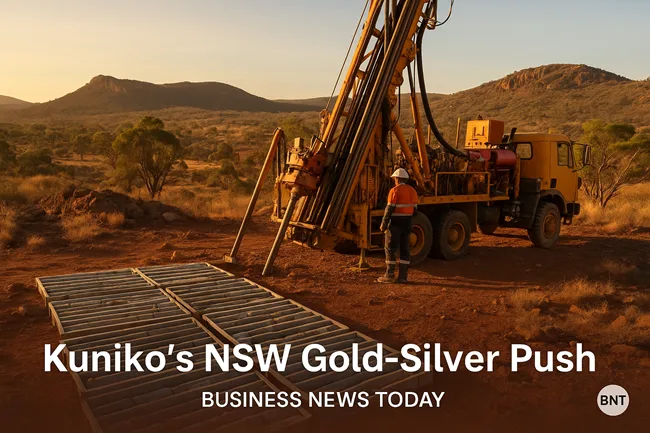
Kuniko’s latest move involves securing a staged earn-in agreement with Impact Minerals Limited (ASX: IPT), allowing it to earn up to 70% of the Commonwealth Gold–Silver Project, located in the world-class Lachlan Fold Belt of New South Wales. Under the terms of the agreement, Kuniko can acquire an initial 51% interest by spending A$1.5 million over two years, and increase this stake to 70% with an additional A$1.5 million over the subsequent two years.
The project comprises the Commonwealth and Silica Hill deposits, which collectively host JORC 2012-compliant Inferred Mineral Resource Estimates. At Commonwealth, the resource is estimated at 0.91 million tonnes grading 2.41 grams per tonne gold and 43.9 grams per tonne silver. At Silica Hill, the estimate includes 0.71 million tonnes grading 0.79 grams per tonne gold and 88 grams per tonne silver. Together, these deposits represent approximately 88,800 ounces of gold and 3.3 million ounces of silver, alongside notable zinc and lead credits.
These shallow, open-ended deposits are situated within a high-sulphidation volcanogenic massive sulphide and epithermal system, making them geologically significant in one of Australia’s most active metallogenic belts. Prior intercepts reported by Impact have included high-grade zones such as 5.7 metres at 3.8 g/t gold and 347 g/t silver at Commonwealth and 22.5 metres at 1.7 g/t gold and 276 g/t silver at Silica Hill, with localized zones recording up to 4,200 g/t silver over sub-metre intervals.
How is Kuniko financing this exploration push, and what is the market response to its capital strategy?
To support its new exploration commitments and maintain working capital, Kuniko launched a 1-for-3 non-renounceable rights issue priced at A$0.07 per share. The offer closed on September 12 and included free attaching unlisted options (1-for-3 basis) exercisable at A$0.14, expiring two years from issue. Despite being priced at a small discount to the last traded price, the stock failed to attract meaningful upward pressure from the announcement.
Kuniko appointed GBA Capital Pty Ltd as the lead manager and underwriter, with up to A$1.2 million of the offer underwritten. A supplementary prospectus is expected to be filed, and any shortfall in subscriptions may be placed within three months following closure of the offer, subject to market conditions and ASX compliance.
The proceeds from the capital raise are expected to fund Stage-1 technical work across the newly acquired tenements, pay for project-related expenses and transaction costs, and supplement general working capital. Notably, Kuniko plans to initiate drilling as an early-stage activity, supported by existing approvals and landholder agreements.
What is the geological significance of the Commonwealth and Silica Hill prospects?
Located approximately 100 kilometres north of Orange, the Commonwealth Project is situated within the Lachlan Fold Belt, a Tier-1 mineral province known for hosting world-class mines such as Cadia-Ridgeway, North Parkes, and Cowal. The region is highly accessible with existing infrastructure, easing logistical constraints for early exploration.
The Commonwealth and Silica Hill systems exhibit characteristics of both volcanogenic massive sulphide and high-sulphidation epithermal mineralisation. High-grade silver and gold mineralisation has been recorded within broader polymetallic envelopes, and the deposits remain open along strike and at depth.
Importantly, the project also holds regional upside beyond the defined JORC deposits. Historical geochemical data indicates a five-kilometre-long trend at Silica Hill East with strong soil anomalies and IP chargeability highs. Other satellite prospects like Greenobbys and Gladstone have returned rock chip assays of up to 9.9 g/t gold, 3.2% copper, and 4,550 g/t silver. The emerging thesis is that Commonwealth and Silica Hill may represent the upper levels of a deeper porphyry-style copper-gold system, akin to the Cadia-Ridgeway model, especially as drill data shows increasing copper content at depth.
How do Kuniko’s broader assets in Norway complement this Australian expansion?
Kuniko’s portfolio extends beyond Australia, with a notable presence in Europe through its nickel, cobalt, and copper projects in Norway. Kuniko’s portfolio in Norway includes several critical mineral projects that complement its Australian expansion strategy. The Ertelien Project hosts a JORC-compliant mineral resource of 40 million tonnes at 0.25% nickel equivalent (NiEq), with nickel, copper, and cobalt credits. This includes both Indicated and Inferred resources, and the company is targeting metallurgical recoveries ranging from 70% to 90%, based on test work conducted by SGS Canada.
The Skuterud Cobalt Project, once the world’s largest cobalt producer, has historically yielded over one million tonnes of cobalt ore and continues to return high-grade intercepts in Kuniko’s recent drilling programs. Meanwhile, the Ringerike and Vågå Projects are defined by extensive geophysical anomalies and mineralised trends, including a nine-kilometre volcanogenic massive sulphide-style copper corridor and additional platinum group element-bearing zones, adding further scale and diversification to Kuniko’s European asset base.
The company promotes its ethical sourcing credentials, particularly its use of 98% renewable energy in Norway and alignment with the UN Sustainable Development Goals. While this ESG positioning bolsters long-term relevance, the geographic and commodity diversification may also dilute investor focus in the near term.
What’s the investor sentiment and stock performance outlook after the rights issue?
As of September 12, 2025, Kuniko Limited is trading at the bottom of its 52-week range, with a market capitalisation of just over A$6.4 million. The stock has lost nearly half its value over the past year and is ranked 882 out of 1,068 companies in the basic materials sector, and 2,032 out of 2,298 overall on the ASX.
With a PE ratio of zero and no dividend yield, Kuniko remains a speculative exploration play, wholly dependent on the success of its drilling programs and ability to convert early-stage assets into defined resources. The updated JORC estimates, if upgraded following Stage-1 technical validation, could serve as a re-rating catalyst, but risks remain high.
There has been no clear indication of institutional inflows, and the entitlement offer response may provide a proxy for broader investor confidence. If shortfalls are significant, the company could face additional funding hurdles and downward pressure on share price due to dilution.
What happens next for Kuniko and the Commonwealth Project?
Kuniko is expected to begin technical work almost immediately following the completion of the rights issue. With permits in place and drill designs nearing finalisation, early drilling could begin within weeks, targeting depth conductors beneath the Main Shaft and step-out targets at Silica Hill.
In mid-November, a general meeting will be held to approve the issuance of underwriter and advisor options, and by late September, the company expects to complete the earn-in agreement with Impact Minerals. Looking ahead, Kuniko has engaged Snowden Optiro to validate the existing mineral resource estimates and intends to release revised JORC figures within two years as part of the Stage-1 program.
For now, the next big test is market response to drill results and progress on converting the Commonwealth and Silica Hill deposits from inferred to higher-confidence resource categories. Investors will also be watching for signs that Kuniko can translate its diversified portfolio into meaningful value creation—especially in a risk-averse small-cap mining environment.
Discover more from Business-News-Today.com
Subscribe to get the latest posts sent to your email.